The 8 Best Air Rifle Scopes of 2026

Air rifles are gentle on the shoulder and brutal on scopes. The double recoil of a spring-piston gun can shake a cheap optic loose before you finish a tin of pellets, and that's before you factor in blurry glass at dusk or turrets that lie about how far they've moved. A good air rifle scope fixes all three: it holds zero, shows you a clean target in low light, and adjusts predictably when you need to dial for range.

I've watched a bargain scope wander three inches at 25 yards after a few hundred shots, so I'm picky about this. Over the past six months, my team and I mounted 12 scopes on spring-piston and PCP air rifles and shot them from benches, backyards, and a local range. We looked at clarity, zero retention, illumination, mounting, and zeroing, and we compared what each one delivers for the money. The picks below are the ones that stayed true.

Our Top Picks

The 8 Best Air Rifle Scopes of 2026

1

UTG BugBuster 3-9x32 AO Best Overall

UTG BugBuster 3-9x32 AO – UTGLeapers Inc.

Close-range airgunning

Field Score 95/100
Weight
13.9 oz
Magnification
3-9x
Objective Lens
32mm
Parallax Focus
3 yds to infinity
View on Amazon

Three yards. That is how close the BugBuster's adjustable objective focuses, and it is the number that makes this the scope we hand to anyone setting up an air rifle. Nearly all pellet shooting happens between 10 and 30 yards, and a scope with parallax fixed at 100 yards goes soft and lets the reticle drift against the target at those distances. Dial this one down and the sight picture snaps in exactly where you shoot.

It also removes the friction that stops most first setups. At 13.92 ounces it will not make a light break-barrel nose-heavy, the 1-inch tube takes ordinary rings, and the box includes medium lever-lock quick-detach Weaver/Picatinny rings, flip-open caps, two sunshades, and the CR1620 for the red/green illuminated mil-dot. Plenty of scopes in this price band hand you a tube and wish you luck with the rest.

Two fit details are worth settling before you order. The included rings are Weaver/Picatinny, so an 11mm dovetail rifle needs a dovetail-to-Picatinny adapter or a different ring set. And the tube is short: on a long rail you may need an offset ring to bring the eyepiece back to where your eye naturally sits. Neither is a dealbreaker, and both cost less than buying the wrong scope twice.

What we keep coming back to is how little the package asks of you. The 3-yard focus handles indoor 10-meter practice and backyard pesting at 12 yards with the same setting that works at 30, and the sunshades are the detail that matters at seven in the evening, when the light is flat and the target sits in shadow. Very few compact scopes think that far ahead.

Worth Noting

  • 32mm objective dims in the last minutes of light
Our Verdict

For 10- to 30-yard air rifle work, the BugBuster's 3-yard parallax, included rings, and 13.92-ounce body make it the one we recommend first.

Check Latest Price
2

Vortex Crossfire II 3-12x56 AO Best for Low Light

Vortex Crossfire II Second Focal Plane

Low-light hunting

Field Score 94/100
Weight
1.3 lb
Reticle
V-Brite illuminated
Magnification
3-12x
Objective Lens
56mm
View on Amazon

Fifty-six millimeters of objective is a lot of glass to hang on an air rifle, and it is the entire reason the Crossfire II Hog Hunter exists: it buys minutes. We set it up expecting a boat anchor and came away understanding the trade. That big bell and the illuminated V-Brite reticle keep a dark shape readable at the edge of legal light, when the rabbits are out and a 40mm scope has already quit.

The adjustable objective is what earns it a place on a pellet gun. It focuses the image and removes parallax at the distances you actually shoot, rather than at the 100-yard mark a hunting scope is set for. Around that you get a 30mm tube, capped reset turrets, a fast-focus eyepiece, and Vortex's unlimited, unconditional lifetime warranty, the only one here that transfers if the rifle changes hands.

You pay for the light in weight. At 1.3 pounds with a 56mm bell, it pushes the balance point forward on a light springer, which is the wrong feel for offhand work. This is a scope for a rifle you rest on a rail or a sandbag and shoot from one spot; on a heavier PCP it disappears into the rifle and the trade stops mattering.

Worth Noting

  • Illumination washes out in bright daylight
  • 56mm bell forces high rings
Our Verdict

Buy the Crossfire II if your shooting happens in failing light: its 56mm objective and illuminated reticle gather more than anything else in this group.

Check Latest Price
3

Burris Droptine 4.5-14x42 Best for Long-Range PCP

Burris Hunting Durable Waterproof High-Grade Optical Glass Droptine Riflescope

Long-range PCP shooting

Field Score 93/100
Weight
1.1 lb
Magnification
4.5-14x
Objective Lens
42mm
Parallax Focus
Adjustable
View on Amazon

If your air rifle is a regulated PCP that will hold an inch at 50 yards, the glass becomes the limiting factor before the gun does. The Droptine 4.5-14x42 is the one here built for that job: it is the only scope in Burris's Droptine line with an adjustable parallax focus, and above 8x you will notice the difference between having it and not.

The rest of the package is hunting-grade. Hi-Lume multicoating keeps contrast up in flat light, the Ballistic Plex reticle gives you holdover points without a Christmas tree of hashmarks, and the integrated eyepiece and 1.1-pound body keep it manageable on a sporter. The turret clicks are on the soft side, usable rather than the crispest here.

Our take is that this is the best glass for the money in this group once you are past 40 yards, and the parallax knob is what lets it work at 25 as well as 100. The 4.5x bottom end is a touch high for 10-meter work, and the parallax covers most of that gap. For a hunter who wants a conventional, uncluttered scope that reaches, this is the pick.

Worth Noting

  • Turret clicks feel soft
  • 3mm exit pupil at 14x limits dusk use
Our Verdict

The Droptine is the scope for a PCP you shoot past 40 yards, where its adjustable parallax and 14x top end do work the cheaper glass cannot.

Check Latest Price
4

Vortex Diamondback Tactical 4-16x44 FFP Best for Precision Work

Vortex Optics Diamondback Tactical First Focal Plane Riflescopes

Precision dialing

Field Score 92/100
Weight
1.4 lb
Reticle
EBR-2C first focal plane
Magnification
4-16x
Objective Lens
44mm
View on Amazon

A first focal plane reticle keeps its hashmarks honest as you zoom. The EBR-2C's subtensions cover the same angle at 4x as they do at 16x, so you can range a target and hold over without touching a turret or doing arithmetic in your head. On an air rifle, where a pellet's drop curve gets steep past 35 yards, that is not a marketing line. It is the difference between a hit and a clean miss on a squirrel at 60.

The side parallax knob is the part airgunners should care about most. It sits on the turret housing rather than on the objective, so you can focus without coming off the stock. Extra-low dispersion glass and the 30mm tube hold sharpness right up to 16x, and the exposed turrets click positively enough to dial by feel.

The compromise is at the bottom of the range. At 4x the field is tight enough that finding a target at 10 meters takes a moment, and this is not a scope for quick shots in a barn or a loft. It is for a rifle on a bench or a bipod, at 30 yards and out, where you have time to set up.

We think it is the most capable dialing scope here, and the FFP reticle, side focus, and repeatable turrets are why. It earns its place on a precision PCP rather than a plinker, and Vortex's lifetime warranty is the insurance policy for the day it slides off the bench.

Worth Noting

  • Heaviest scope here at 1.4 pounds
  • Premium price for a target optic
Our Verdict

For dialing holdovers at distance, the Diamondback Tactical FFP is the most capable scope here, and the one we put on a rifle that stays on a rest.

Check Latest Price
5

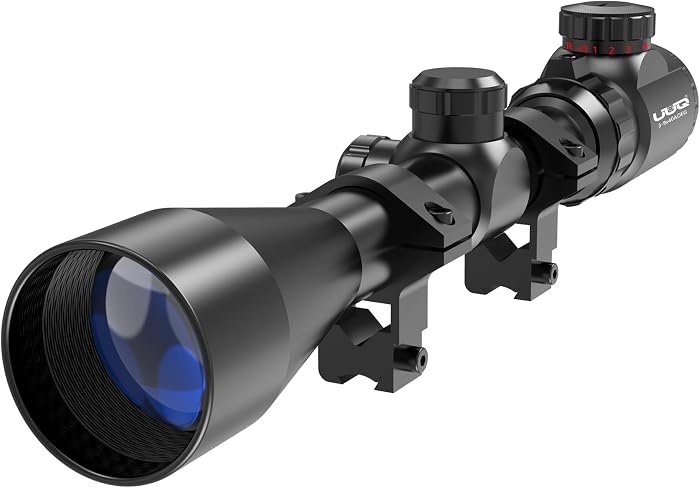
UUQ 3-9x40 Dovetail Best Budget for Dovetail Rails

UUQ 3-9×40 Rifle Scope with Red/Green Illumination and Rangefinder

Dovetail-rail starter setups

Field Score 91/100
Weight
1.2 lb
Magnification
3-9x
Objective Lens
40mm
Included Mounts
Two 11mm dovetail
View on Amazon

Two 11mm dovetail mounts come in the box, and that is the whole pitch. Most break-barrels and plenty of spring-piston rifles wear an 11mm dovetail rail rather than a Picatinny, and the usual result of ordering a scope online is a second order for rings that may or may not fit. The UUQ skips that step: clamp it on, set the diopter, and shoot.

We rate it the easiest first scope for a dovetail rifle, and the glass is better than the price suggests. Fully multi-coated lenses, a mil-dot reticle with five red and five green brightness levels, an adjustable diopter, and a rangefinder-style reticle that gives you aiming points without a separate rangefinder. At 1.2 pounds with a 3-9x range, it covers 15 to 50 yards comfortably.

What it does not have is an adjustable objective. Parallax is fixed, so indoors at 10 meters or pesting at 12 yards the reticle can drift against the target as you move your head. Keep it for 20 yards and out, where it stays steady, and it does everything a budget airgun scope needs to do.

Worth Noting

  • Mounts will not fit a Picatinny rail
Our Verdict

If your air rifle wears an 11mm dovetail rail, the UUQ gets you shooting without an adapter order, as long as you keep it to 20 yards and beyond.

Check Latest Price
6

UTG 3-12x44 30mm AO

UTG 3-12X44 30mm Compact Scope

Side-focus versatility

Field Score 90/100
Weight
1.76 lb
Magnification
3-12x
Tube Diameter
30mm
Objective Lens
44mm
View on Amazon

The 30mm tube is both the reason to look at this one and the reason to hesitate. A wider tube carries more adjustment range and, with UTG's emerald coating, a bright image, but it also makes this a bigger, heavier scope than the 1-inch BugBuster above, at 0.8 kg, or about 1.8 pounds. We think it earns that weight on a rifle that lives on a rest.

The side wheel is the feature that makes it pleasant. Parallax focus on the turret housing means you can dial from 15 yards to 50 without breaking your grip on the stock, which is the difference between a scope you adjust and one you leave alone. The one-click illumination memory is the other detail we ended up valuing: it returns to the last color and brightness you used instead of making you cycle through the menu at dusk.

It comes with flip-up covers and a set of rings, the tube is sealed and nitrogen-filled, and the mil-dot reticle underneath the illumination is clean, with resettable turrets. This is the one for a dedicated bench or hide rifle, not a walkabout gun.

Worth Noting

  • Heavy at 0.8 kg for a walkabout rifle
  • 36-color illumination is more than you need
Our Verdict

The UTG 3-12x44 is for the rifle that lives on a bench: side parallax, 30mm glass, and a weight you will not want to carry far.

Check Latest Price
7

SIG Sauer Buckmasters 3-9x50 Best for Simple Dusk Hunting

SIG SAUER Buckmasters 3-9x50mm 1" Tube Riflescope

Simple dusk hunting

Field Score 89/100
Weight
15.2 oz
Reticle
BDC
Magnification
3-9x
Objective Lens
50mm
View on Amazon

Where the BugBuster is purpose-built for close-range airgunning, the Buckmasters is a plain hunting scope that happens to be affordable enough to live on an air rifle: 3-9x50, SIG's Bullet Drop Compensation reticle, a one-piece 1-inch tube, and 15.2 ounces on the scale.

The 50mm objective is the draw. It pulls light at the end of the day, and for a hunter sitting over a burrow or a feeder until the last ten minutes, that matters more than magnification. The glass is clear, the controls move smoothly, and the finish looks better than the scope costs.

The catch is parallax. There is no adjustable objective on this one, so at 10 or 15 yards the reticle can drift against the target as you shift your head; treat it as a 25-yards-and-out scope. Past that it is the brightest simple scope in this group, and the one we reach for on a dusk sit when the range is known.

Worth Noting

  • Non-illuminated reticle
  • BDC dots are drawn for centerfire, not pellets
Our Verdict

The Buckmasters is our pick when light is the problem and simplicity is the goal: mount it, zero it at 25, and leave the dials alone.

Check Latest Price
8

Bushnell Banner 3-9x40 Best for Entry-Level Plinking

Bushnell Banner Riflescope

Entry-level plinking

Field Score 88/100
Weight
13 oz
Reticle
Multi-X
Magnification
3-9x
Objective Lens
40mm
View on Amazon

Nothing about the Banner is clever. It is a 3-9x40 with a Multi-X reticle, a 12.96-ounce body, and one of the lowest prices in this group, and it has been selling on that formula for years. What you get for the money is better than the spec sheet implies.

The Dusk & Dawn coating is the part we noticed. Fully multi-coated lenses, argon purging, and an IPX7 waterproof rating are a lot of optical housekeeping at this level, and the payoff shows at last light, when the glass holds contrast longer than you expect from a scope this plain.

The thing to settle before you buy is whether it belongs on your rifle at all. Bushnell does not spell out an airgun rating for this model, and a spring-piston gun recoils both ways in a way a centerfire scope is not built for. On a PCP or a CO2 rifle it is a non-issue; on a hard-kicking springer, ask the maker first.

Our verdict is that this is the honest budget scope here: good glass, plain controls, a limited lifetime warranty, and no cleverness to go wrong. It is not built for a target board and it is not trying to be. For a working airgun that gets zeroed once a season and left alone, the Banner does the job for less than almost anything else on this page.

Worth Noting

  • Turret adjustment can be stubborn to zero
Our Verdict

The Banner is an honest budget scope with genuinely good low-light glass, best on a PCP or CO2 rifle you zero once and leave alone.

Check Latest Price

How We Chose and Tested Air Rifle Scopes

We started with scopes that air rifle shooters actually talk about, then filtered by magnification range, tube diameter, focal plane, reticle style, and price so the list covered backyard plinking, target work, and pest control. That left 12 scopes. We mounted them on .177 and .22 air rifles, including spring-piston and PCP models, and ran the test for six months.

Each scope got zeroed at 25 yards from a bench at our local range, then we fired 100-shot strings from the bench and from a backyard deck, plus offhand shots in a field. To test zero retention, we bumped the rifles against a padded rest, remounted each scope twice, and ran another 500 shots through the spring-piston guns—the harshest recoil test we had. We dialed turrets ten clicks up and back to see if point of impact moved where it should, and we noted whether adjustments felt crisp or mushy. Mounting got its own check: we aligned rings, torqued to the maker's spec, and recorded how much room each scope left for eye relief.

Clarity and visibility were judged at dawn and dusk, looking at paper targets and dark silhouettes against brush. We tested illumination in bright sun and low light, noting whether the reticle washed out or bloomed. We also judged build quality by how turrets felt, how the finish held up, and whether the scope survived the bump test. At the end, we compared each scope's features and construction against its price to see which ones gave you useful functionality without extra fiddling. The scopes that made the cut held zero, stayed clear, and mounted without drama.

How to Choose an Air Rifle Scope

Parallax and Close Focus Come First

Parallax error is what makes the reticle appear to slide across the target when you move your head behind the eyepiece, and it gets worse the closer you are and the more you zoom. A scope fixed at 100 yards can shift point of impact by an inch or more at 15 yards. An adjustable objective, either a focus ring on the front bell or a side wheel, dials the image sharp and the parallax out at whatever distance you shoot.

Focus on your most common range, then bob your head slightly behind the rifle. If the reticle walks against the target, keep adjusting. That one check tells you more about whether a scope suits airgun distances than any magnification figure.

Match the Mount to the Rail

Air rifles use two rail standards that do not interchange. The 11mm dovetail is the traditional airgun rail and is still common on break-barrels and springers; Picatinny and Weaver are the modern option and what most included rings fit. Get this wrong and you are ordering an adapter or a second set of rings before you ever shoot.

Check two more fit points: ring height has to clear the objective bell, and a short scope on a long rail may need offset rings to put the eyepiece where your eye actually sits.

Spring-Piston Recoil Is a Different Problem

A spring-piston rifle slams forward and then back, and that double jolt is harder on a scope than the single push of a centerfire round. Not every scope is built for it. Before you mount one on a springer, confirm with the maker that the model is rated for airgun use, because a centerfire rating says nothing about a reversing recoil impulse.

On a PCP or CO2 rifle there is no reciprocating mass, so the question mostly disappears.

Pick Magnification and Objective Together

A 3-9x covers what most air rifles do. Step up to 4-12x or 4-16x when you are shooting a PCP past 50 yards. Objective size matters as much as zoom because the two divide: a 40mm objective at 10x leaves a 4mm exit pupil, and the same scope at 16x leaves 2.5mm, which is dim.

Bigger glass buys light and also buys weight and ring height. Shoot at dusk and a 50 or 56mm scope earns its bulk; shoot at 20 yards in daylight and it does not.

Reticles, Turrets, and Illumination

Mil-dot and hashmark reticles give you holdover points you can trust. BDC reticles are drawn for one cartridge at one velocity, and a pellet's arc is far steeper than any of them, so build a range card instead of trusting the dots. Capped turrets suit a set-and-forget rifle; exposed, resettable turrets are worth paying for if you dial elevation for distance.

Illumination is a dusk and dark-shed tool that washes out in daylight, so do not pay much for it if you shoot at noon.

Frequently Asked Questions

Final Verdict

The UTG BugBuster is the scope we recommend to almost anyone setting up an air rifle: it focuses down to three yards, weighs under 14 ounces, and arrives with rings, caps, and sunshades in the box. If your rifle wears an 11mm dovetail rail, the UUQ gets you shooting without an adapter order. If your shooting happens at last light, the Vortex Crossfire II's 56mm objective is worth the weight it adds.

And if you are dialing a regulated PCP at 50 yards and beyond, the Diamondback Tactical's first focal plane reticle settles it.