The 6 Best Backpack Sprayers of 2026

Anyone who has sprayed a fence line with a manual backpack sprayer knows the rhythm: squeeze the trigger, watch the mist fade, pump the handle another 30 times. Across a quarter acre of thistle, that rhythm eats an afternoon. A good sprayer breaks the cycle, holding steady pressure while both hands stay free for the wand.

I've walked plenty of fence rows, and the gaps between models show up fast on a slope. Over the past eight months, my team and I have tested 12 backpack sprayers — battery-powered units with adjustable pressure alongside classic manual pumps — on weeds, fence lines, and vegetable beds. The PSI on the box mattered less than whether pressure held through a full tank, whether a nozzle swap cured a spitting pattern, and whether anything leaked down my back. A full tank runs 30-plus pounds before you add concentrate, so strap padding earns its keep.

Below are picks for a half-acre suburban lot and for jobs that eat most of a day. Each is one we'd hand to a neighbor without a disclaimer.

Our Top Picks

The 6 Best Backpack Sprayers of 2026

1

PetraTools HD4000 Best Overall

PetraTools HD4000 Battery Powered Backpack Sprayer

No-pump all-around spraying

Field Score 92/100
Max Pressure
90 psi
Power Source
Battery, 12V 8Ah
Tank Capacity
4 gallons
Nozzles Included
6
View on Amazon

PetraTools quotes six to eight hours and more than 200 gallons per charge from the 12-volt, 8-amp-hour battery, which in practice means the tank runs dry long before the battery does. Four gallons is several passes over a normal suburban lot, so you charge it after a weekend of work and stop thinking about it. The pressure stays where you set it from the first gallon to the last, and you never stop walking to work a lever.

We were most impressed by the pressure knob. Adjusting between 40 and 90 PSI mid-job turns one sprayer into several: a soft mist for bedding plants, a hard stream for a gravel driveway, a fan pattern for a lawn that needs an even pass. The six nozzles in the box cover the rest, and the wand extends to 34.5 inches so you are not stooping under shrubs. The double-padded straps and back pad handle a full load better than the flat webbing on cheaper sprayers, which matters because four gallons of water is already more than thirty pounds before you add anything to it.

Two conditions come with it. A sprayer that sits all winter is slow to take a charge in spring, so put it on the charger every couple of months rather than the week before you need it. And the pump is the part that ages: when these fail, they tend to fail in the second season, past the point where a store return is easy. PetraTools' US support line sending out parts is the reason that is an inconvenience rather than a loss.

If you do not want another battery in your life, the Field King below carries the same four gallons with no charging at all. We still reach for this one first, because a fence line with a hand pump stops being yard work and starts being a workout.

Worth Noting

  • Pump failures tend to surface after the first season
Our Verdict

For a yard with real square footage to cover, this is the sprayer we hand people: push-button pressure, four gallons, and no pumping between the first row and the last.

Check Latest Price
2

Field King 190328 Best Manual

FIELD KING 190328 Backpack Sprayer

Chemical-safe manual spraying

Field Score 91/100
Pump Type
Internal piston
Item Weight
12.8 lb
Max Pressure
150 psi
Tank Capacity
4 gallons
View on Amazon

The Field King hides its piston pump inside the tank, and that is the detail that separates it from most manual sprayers. Everything on a backpack sprayer that eventually leaks, from the pump to the seals to the fittings, sits behind four gallons of solution instead of against your spine. It also builds up to 150 PSI, the kind of pressure that reaches the top of a fruit tree without dragging a ladder out to it.

We like the pressure and we like what comes with it: a 21-inch wand, a brass shut-off with a lock so you are not squeezing for an hour, Viton seals that stand up to wettable powders, and six nozzles including a foaming tip for waxy leaves. The pump comes apart without tools, which matters more than it sounds. Seals are the wear part on any manual sprayer, and a rebuild kit plus ten minutes gets you more seasons out of a unit that costs a fraction of the electric picks.

The trade is your arm. The lever falls under your hand while you walk, and on a quarter acre it is a rhythm; on two acres it is a workout, and the people who spray weekly are the ones who move to a battery unit. What you get in return is a pump sprayer with no battery to age out, no charger to lose, and a service life measured in seals rather than charge cycles.

Worth Noting

  • You pump continuously while you walk
  • 12.8 pounds empty, well over thirty full
Our Verdict

Buy this one if you want the chemical to stay in the tank: the piston pump sits inside it, so a worn seal wets the tank instead of your back.

Check Latest Price
3

PetraTools HD5000 Best for Large Properties

PetraTools Battery Powered Backpack Sprayer w/Cart & 100ft Commercial Hose

Large properties

Field Score 90/100
Hose Length
100 feet
Max Pressure
70 psi
Tank Capacity
6.5 gallons
Nozzles Included
7
View on Amazon

A hundred feet of hose is the specification that reorganizes a spraying day. Park the cart in the middle of a property and you can walk the hose to the far fence line, spray it, and come back without moving the tank or mixing a second batch. The 6.5-gallon tank is the largest here, and it lifts off the steel frame to become a backpack when the ground gets too soft or steep for wheels.

The conversion is the part we did not expect to like as much as we do. Flat-free tires roll over turf and gravel, the cart carries the weight between jobs, and the tank's straps are already attached, so a ditch in the middle of a job does not end it. Seven nozzles and a pressure knob up to 70 PSI handle the ordinary work: herbicide bands along a fence, fertilizer over a pasture, cleaner on a driveway. For acreage, this is the setup that saves the most walking by a wide margin.

It is also the least convenient to own. Six and a half gallons is a lot to hoist, which is exactly why the cart exists, and the whole rig needs a garage corner and a path wide enough to roll it out. Plan the storage before you plan the spraying.

Worth Noting

  • 70 PSI ceiling is the lowest of the battery picks
  • Lead-acid pack needs a full charge after each use
Our Verdict

For a property you measure in acres rather than beds, the HD5000 is the pick: park the cart, walk a hundred feet of hose, and never carry a full tank.

Check Latest Price
4

VAXMAY 4-Gallon Best Battery Value

VAXMAY 4-Gallon – Battery Powered Backpack Sprayer 4 Gallon

Budget battery spraying

Field Score 89/100
Battery
21V 2.6 Ah included
Hose Length
39.3 inches
Max Pressure
100 psi
Tank Capacity
4 gallons
View on Amazon

The VAXMAY's battery bay takes Makita 18-volt packs, and that changes who should buy it. If there are already two Makita batteries in your shop, they become sprayer batteries, the included 2.6-amp-hour pack becomes the spare, and the day the original dies is not the day the sprayer does. A voltage readout on the side tells you where the charge stands before you fill four gallons and walk off. We think the tool-battery compatibility is the most useful single feature on any of the budget electrics here.

Spraying itself is straightforward: 100 PSI, an adjustable knob, five nozzles, and a telescopic wand that gets under shrubs without kneeling. The claim of sixteen tanks per charge assumes perfect conditions, but a residential yard is comfortably a one-charge job, and pressure holds at the trigger instead of tapering as the tank empties. The padded straps and waist support do their part with a full load.

Where it slips is at the connections. The hose-to-wand and wand-to-nozzle joints are where these start to weep, and herbicide mix running down a forearm is something you notice in the first minute. Snug every fitting before the first fill, rinse the wand after each use, and do not leave it pressurized in the sun, because the hose is the part that pays for that.

Worth Noting

  • 39-inch hose is the shortest of these picks
Our Verdict

For anyone already carrying Makita 18V packs, this is the smart buy: honest 100 PSI spraying with no proprietary battery to replace in three years.

Check Latest Price
5

Chapin 61500 Best Budget Pick

CHAPIN 61500 4-Gallon Backpack Sprayer for Lawn

Light-duty yard work

Field Score 88/100
Hose Length
48 inches
Item Weight
10.1 lb
Max Pressure
60 psi
Tank Capacity
4 gallons
View on Amazon

Sixty PSI is the number that defines the Chapin 61500. That is plenty for a flat fan across a lawn, a stream along a sidewalk joint, or a shower over shrubs, and it is not enough for the top of a mature tree or a long throw across a ditch. The tank is translucent, which sounds like a small thing until you are mixing: you can read the level from the side instead of unstrapping the sprayer to check.

At 10.1 pounds empty this is the lightest four-gallon sprayer in the group, and that is why it is our pick for smaller jobs. It goes on and off without a production, and a two-gallon fill is a reasonable ask for someone who does not want thirty pounds on their shoulders. Two filters, one in the shut-off and one in the tank cap, catch debris before it reaches the nozzle, and the nitrile seals handle ordinary fertilizers and weed killers. The straps are thin, which is part of where the money went, so plan shorter sessions or wear a padded shirt.

Worth Noting

  • 60 PSI ceiling and one adjustable nozzle
  • Thin straps with little padding
Our Verdict

The lightest, least expensive way into four gallons, and enough sprayer for a suburban lot, though not enough pressure to reach treetops.

Check Latest Price
6

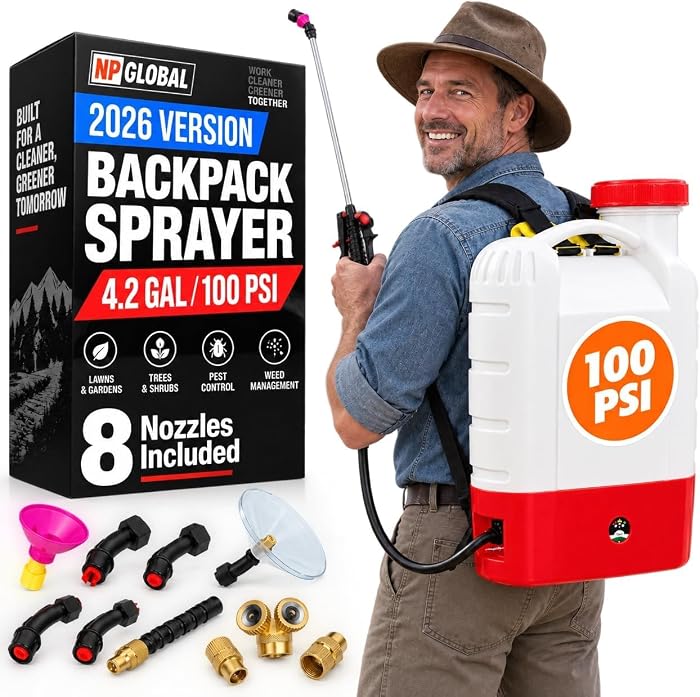
NPGLOBAL NPG-120

NPGLOBAL NPG-120 – 4.2 Gallon Battery Powered Backpack Sprayer Tank

Nozzle variety

Field Score 87/100
Hose Length
4.26 feet
Max Pressure
100 psi
Tank Capacity
4.2 gallons
Nozzles Included
8
View on Amazon

Eight nozzles and a 4.2-gallon tank is what the money buys here, and the tank is translucent with a wide lid and a strainer basket, so mixing is quick and you can see how much is left without taking it off. The pump runs to 100 PSI, adjusts with a knob, and holds pressure at the trigger rather than fading as the tank empties, which is the thing that makes an electric sprayer feel like an upgrade over a manual one.

The extra capacity is real, if modest: slightly more than the four-gallon tanks here, and it rides high enough on the back that a full load does not pull you backward. Eight tips mean a tight stream for driveway cracks, a fan for turf, and at least two nozzles you will not appreciate until you are spraying a slope.

Two things to know. The hose and wand connections are where this one weeps, a pinhole in the rod or a drip at the trigger, so snug every fitting before the first fill and rinse after each use. And the battery is where inexpensive electrics tend to end their lives, so put it on the charger monthly through the off-season. Set against the VAXMAY, this one gives you more tips and a bigger tank for similar money but gives up the tool-battery future; if Makita packs are already on your shelf, that trade is worth taking the other way.

Worth Noting

  • Wand and hose joints tend to weep
  • Battery can stop taking a charge
Our Verdict

Eight nozzles and a 4.2-gallon tank for less than most electrics here, as long as you are willing to check the hose fittings before every fill.

Check Latest Price

How We Chose and Tested These Backpack Sprayers

We started with about 40 sprayers and cut the list by what actually changes a job: a 4- to 6.5-gallon tank, adjustable pressure rather than one fixed setting, a few nozzle options, a harness with real padding, and a mouth wide enough to fill without a funnel. Battery and manual models both made the cut, since plenty of people spraying a small orchard don't want a charger in the mix.

Testing happened where the work happens: a gravel driveway with a marked 100-foot run, a weedy fence line on a slope, and garden beds that needed feeding all season. We weighed each sprayer empty and full on a luggage scale, then carried it on a 45-minute loop with a full tank to see where the straps bit in. On the fence line we timed how long a tank lasted and counted pumps per pass on the manual models. Every supplied nozzle got swapped in and sprayed at a sheet of cardboard to compare patterns, we ran the wands under a low deck to check reach, and we filled each tank from a hose and from a 5-gallon bucket to see how much landed on the ground.

Battery units ran to cutoff with a stopwatch, then again after a recharge, and we checked the meter against what was actually left. Leaks got their own test: each sprayer sat on a dry concrete pad for 20 minutes after use while we watched for puddles, then we tipped it on its side and inspected the fittings. Two got dropped off a tailgate, a couple spent afternoons in full sun, and we re-ran the fence line in month eight to see whether patterns had drifted or seals had started weeping. Value came down to what shipped in the box — charger, spare nozzles, wand length — weighed against the price tier, and the best ones are the sprayers we stopped thinking about.

How to Choose a Backpack Sprayer

Manual or Battery Comes First

Manual pump sprayers cost less, need no charging, and can be rebuilt with a seal kit; the price is a lever you work while you walk, which is fine for a quarter acre and miserable for two. Battery models hold steady pressure from a full tank to an empty one, which also makes them better for anything needing an even pass: herbicide bands, fertilizer, a fungicide application.

If you spray more than a handful of times a year, the electric premium pays itself back in comfort. If the sprayer lives in a shed and comes out twice a summer, a manual like the Field King is the smarter buy, and a worn seal is a ten-minute fix instead of a battery purchase.

Capacity and the Weight of a Full Tank

Four gallons of water weighs more than thirty pounds before you add anything to it, and six and a half is closer to fifty-five. Capacity is really a decision about refills versus your back: four gallons covers most suburban lots in one mix, and the six-gallon class wants wheels or a cart, because nobody hoists that twice.

Our rule is to buy four gallons and fill it to three for anything short of a full-lot pass. The tank level is what tires you out, not the sprayer, so a partial fill on a large tank beats a full fill on a small one.

Pressure, Nozzles, and Reach

Pressure decides whether you can hit a treetop from the ground. Sixty PSI, as on the Chapin 61500, is a lawn and shrub number; 90 to 150 PSI, as on the Field King, throws a stream far enough for fruit trees and fence lines.

Nozzles matter just as much: a fan tip covers turf evenly, a jet gets into cracks, and a foaming tip keeps droplets on waxy leaves instead of rolling off. If you spray wettable powders, look for filtration at the tank cap and again at the shut-off, because two stages catch grit before a nozzle does.

Seals, Leaks, and Where the Chemical Goes

Pump placement matters on a chemical sprayer. An internal pump, as on the Field King 190328, means a failed seal wets the inside of the tank rather than your spine; external designs are easier to service but put the seals where they can drip. Viton handles harsh herbicides and solvents, nitrile is fine for ordinary fertilizers and weed killers.

Set the lid on square every time, since a cross-threaded cap is the fastest route to a wet back, and rinse the tank, wand, and nozzle with clean water right after each use rather than the next morning.

Parts and Support Decide Year Three

Every sprayer here eventually needs a seal, a wand, or a battery, and the difference between a five-year tool and a one-season annoyance is whether those parts exist. Manual models with tool-free pump access and standard seals are the easiest to keep alive.

On electrics the battery is the wear item, and a pack that stops taking a charge ends the sprayer's life unless replacements are easy to find. That is why a model running on a tool battery you already own earns extra credit. Charge through the off-season and store the sprayer dry.

Frequently Asked Questions

Final Verdict

The PetraTools HD4000 is the one we recommend to most people with a real lawn to treat: four gallons, adjustable pressure, and hours of spraying without touching a lever.

If your spraying is a few beds and a fence line twice a season, the Chapin 61500 does that for the least money and the least weight on your back. And if the property is measured in acres, the HD5000's hundred-foot hose is the better tool by a wide margin.