The 8 Best Borescopes of 2026

A borescope is a camera on the end of a long, skinny cable, and it solves one specific kind of bad moment: the socket dropped into an engine bay, the wall cavity you're about to drill into, the vent that smells wrong. Seeing around a corner instead of guessing changes the whole job. What spec sheets miss is that two scopes with the same resolution can feel completely different in your hand.

We've spent six months putting 12 of them through real messes — cylinder walls, air ducts, sink traps, and wall cavities — and the gaps showed up fast. A .22-inch probe slips through a spark plug hole or a quarter-inch drilled hole that a thicker one can't, but it collects less light, so brightness and glare control matter more than the resolution number.

Where the picture lands counts too — a built-in screen means no pairing and no dead phone, while a Wi-Fi scope buys a bigger view and easy recording if the signal holds. The scopes below earned their place by surviving real jobs, not by winning on paper.

Our Top Picks

The 8 Best Borescopes of 2026

1

Teslong TD450S Best Overall

Teslong Articulating Borescope for Mechanic Automotive HVAC Wall Inspection

All-around inspections

Field Score 93/100
Probe
5 ft semi-rigid gooseneck
Screen
4.5 in IPS LCD
Battery
5 hours
Articulation
Two-way, 210 degrees
View on Amazon

A fixed lens only sees where the cable happens to point, and inside a cylinder head there is nothing to brace a cable against. The TD450S moves the aiming to your thumb: a joystick at the center of the body walks the camera head through 210 degrees and holds it there. On cylinder walls and piston tops, steering is the difference between a blurry guess and a picture you can read.

That is why this is the scope we hand to someone with one difficult inspection and no appetite for a phone app. The 4.5-inch IPS panel is bright enough to read in a working garage, the 2.0MP camera holds detail across its 0.6-to-4-inch focus window, and a 32GB card is already in the case. Teslong rates the battery at five hours, which covers a long Saturday.

The controls sit under one hand, joystick, shutter, and buttons together, so the tip stays steady while you shoot. Five feet of semi-rigid gooseneck pushes through a plug hole and stays where you leave it, and the whole kit lives in a hard case with the card and the charging cable.

One maintenance note from our own bench: the probe is IP67, but a head that goes back in the case wet can fog and stay fogged. Wipe the lens and let the head dry first. Beyond that, this is the scope the rest of the group gets measured against.

Worth Noting

  • 3.1 pounds is heavy for overhead work
  • Digital zoom stops at 1.5x
Our Verdict

If you need to see around a corner inside an engine, this is the scope we hand people: a steered tip, a bright screen, and everything in one case.

Check Latest Price
2

Teslong NTS300 Best for Long Reach

Teslong 5'' Dual Lens Borescope Camera for Wall & Engine Inspection

Long duct runs

Field Score 92/100
Probe
16.5 ft semi-rigid, 8mm
Screen
5 in IPS LCD
Battery
4.5 hours, 5000mAh
Cameras
Front and side lens
View on Amazon

Sixteen and a half feet of semi-rigid cable is the whole argument. Put a wall cavity, a duct run, or a chimney flue in front of us and this is the scope we take, because the cable pushes through insulation and around gentle bends while the 5-inch screen stays readable from a ladder. Think of it as the plumber's and HVAC scope rather than the mechanic's.

The second camera is the clever part. A side-facing lens with its own LED sits behind the front one, so you can look down a pipe and at its wall on the same pass instead of dragging the head back and rotating the cable. Both lenses light independently, and dimming the front LED is what kills the glare on a wet pipe.

There is no articulation, so the cable does the aiming. That is right for a straight run and wrong for a U-bend, and it is the trade for this much length. The 8mm head also keeps it out of small engine ports. Coil it in wide loops between jobs, since a semi-rigid cable trained into tight coils is harder to push straight the next time.

Worth Noting

  • 720p video and 1 MP stills limit fine detail
  • About five hours to recharge
Our Verdict

When the inspection is a long run rather than a tight corner, this is the scope we take: 16.5 feet of cable, front and side lenses, and a 5-inch screen.

Check Latest Price
3

FOXWELL Y400 Best for Tight Spaces

FOXWELL Y400 220° 2-Way Articulating Borescope

Tight engine ports

Field Score 91/100
Probe
0.24 in (6.2mm) slim
Screen
4.3 in IPS LCD
Battery
5 to 7 hours
Articulation
Two-way, 220 degrees
View on Amazon

The TD450S has the better screen; this one has the better nose. FOXWELL's probe measures 0.24 inch, about 6.2mm, which is the difference between looking at a glow plug hole and looking through one. We got it into openings that the 8mm scopes here will not enter, and that is most of the reason it earns a place.

Steering runs off a thumb wheel rather than a joystick, and it sweeps the head through 220 degrees without the lag cheaper linkages show. Add 4x zoom and small features, a valve seat or a nick in a bore, fill the 4.3-inch IPS screen. The panel is a half inch smaller than the top pick's, which you notice only when you are reading it in direct sun.

Small engines, motorcycles, and anything with a port you cannot get a camera into: that is the job this scope was built for. It ships with a 32GB card and a hard case, the IP67 body shrugs off oil and coolant, and an overheat cutout protects the head when you leave it in a hot spot.

Worth Noting

  • Menus take a little practice to learn
  • 5.3 ft probe is short for long runs
Our Verdict

The pick for ports a normal scope cannot enter: a 6.2mm probe steered through 220 degrees, with the zoom to make small parts readable.

Check Latest Price
4

Anykit AD430 Best Value Articulating

Anykit 210° Two-Way Articulating Borescope

Budget articulation

Field Score 90/100
Probe
0.22 in slim, 4 ft
Screen
4.3 in IPS LCD
Battery
3000mAh, 5 hours
Articulation
Two-way, 210 degrees
View on Amazon

Articulation is normally the feature that adds the most to the bill, and this is the exception in the group. The Anykit gives you a 0.22-inch probe on a 210-degree two-way head, a 4.3-inch IPS screen, and a thumb slider that works as well left-handed as right, for less than the other steerable scopes here. That is why it is our value pick.

The details are the kind we expect further up the range. The image flips 180 degrees for work upside down in a footwell, so you are not reading the picture inverted. A temperature sensor throws a red icon on screen when the head gets hot, which is a small thing that can save the camera.

The trade is light. A head that slim works a few inches from the surface, and the adjustable brightness is what keeps a picture from blowing out on polished metal. For glow plug holes, injector bores, and the inside of a frame rail, that is a fair exchange. This is a close-inspection tool, not a cavity floodlight.

Worth Noting

  • Four-foot probe is the shortest in this group
  • 8GB card is small if you shoot much video
Our Verdict

The least you can pay for a steered tip that works: a 0.22-inch probe, a bright screen, and articulation that holds position.

Check Latest Price
5

Daxiongmao C30 Best Budget

Daxiongmao Endoscope Camera with Light

No-app simplicity

Field Score 89/100
Probe
16.5 ft semi-rigid, 8mm
Screen
4.3 in LCD
Battery
3.5 hours
Lighting
8 adjustable LEDs
View on Amazon

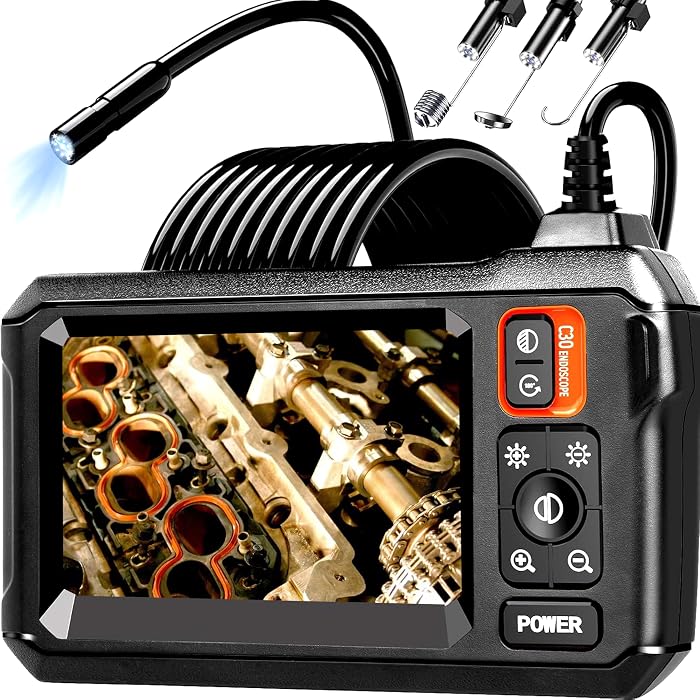
Some scopes here are diagnostic instruments. This is the one to buy before you know whether you need one. The C30 is self-contained, with a 4.3-inch screen, 16.5 feet of semi-rigid cable, an IP67 probe, and eight dimmable LEDs, and it switches on and works with no phone, no app, and no pairing. For a homeowner chasing a leak behind a wall, that simplicity is worth more than a sharper image.

We keep it for exactly that kind of job. The picture is serviceable rather than impressive: you can tell a crack from a joint, and a joint from a clog, but do not expect the high-definition image the badge suggests, and low light is where it struggles most. It weighs just over a pound, runs about 3.5 hours on a charge, and the hook, magnet, and mirror in the box cover grabbing and looking sideways.

Worth Noting

  • Cable is too soft to push around 90-degree bends
Our Verdict

For a first scope or a one-job buy, this is the sensible one: a real screen, 16.5 feet of cable, and no app to go wrong.

Check Latest Price
6

Klein Tools ET17 Best for In-Wall Work

Klein Tools ET17 Utility Borescope

In-wall work

Field Score 88/100
Probe
5.5mm, 9.8 ft gooseneck
Video
1080p
Screen
4.3 in LCD
Weight
8.64 oz
View on Amazon

The ET17 feels like a meter, not a gadget. Klein put the screen and the controls into one compact handheld body that weighs 8.64 ounces, then hung a 9.8-foot gooseneck off the front. On a ladder with one hand on a joist, that shape matters more than any line on a spec sheet.

Fish tape, conduit, and MC cable are where it earns its keep. The 5.5mm head slips past insulation and around a fire block, and the screen shows you the run before you cut. A mirror, a hook, and a magnet thread onto the tip for retrieval, so a dropped screw is a two-minute problem instead of a hole in the drywall.

The 4.3-inch LCD is bright, and 1080p capture is enough to document a run for a homeowner or a client. Focus is fixed, so you work at a set distance instead of hunting for it, and stills save with a button press rather than a menu dive.

The attachments matter more than we expected. The magnet gets used far more than the mirror, because seeing a dropped screw is only half the job and the other half is fishing it out. Klein also sells this as a tool rather than a kit: it arrives with a case, and nothing about the body needs babying.

Worth Noting

  • Fixed lens, with no steering inside a cavity
Our Verdict

The one to buy if you work inside walls and conduit: a light handheld body, a 9.8-foot gooseneck, and a screen you can read one-handed.

Check Latest Price
7

Kinpthy W400-B

Kinpthy W400-B – Endoscope Camera with Light

Phone-tethered value

Field Score 87/100
Probe
7.9mm, 16.4 ft
Lighting
8 adjustable LEDs
Connection
Lightning, USB-C, micro-USB
Resolution
1920 x 1440 stills
View on Amazon

There is no screen and no battery in this one; the phone in your pocket is both. The Kinpthy is a 7.9mm camera on 16.4 feet of semi-rigid cable, with Lightning, USB-C, and micro-USB adapters in the box, drawing its power from whatever it is plugged into. That is why it costs so little, and why it does so much for the money.

The images are the surprise. Stills save at 1920 by 1440 from a 2MP sensor, and in a dark cavity with the eight LEDs dimmed for the distance, a drain or a wall void reads clearly on the phone screen. The semi-rigid cable holds a bend, which is more than we can say for some scopes that cost several times as much.

The catch is the tether, and it is worth testing in the first week. Plug it in, open the app, and confirm the picture holds while you move the cable, because a thick phone case or a worn port is the usual reason a link drops. Do that before the return window closes and there are no surprises later.

We rate it as the honest entry point: buy it to find one leak behind one wall and it has paid for itself. If a scope is going to come out more than a few times a year, a built-in screen and a steered tip are worth the step up, to the Anykit for the steering or the Daxiongmao C30 for the screen.

Worth Noting

  • 7.9mm probe will not fit small engine ports
Our Verdict

A sensible first scope if you already own a recent phone: long cable, clear stills, and the lowest entry cost here.

Check Latest Price
8

Daxiongmao Z91 Best for Slim-Probe Work

Daxiongmao Articulating Borescope

Slim-probe work

Field Score 86/100
Probe
0.24 in slim, 5 ft
Screen
4.5 in IPS LCD
Storage
32GB card included
Articulation
Two-way, 210 degrees
View on Amazon

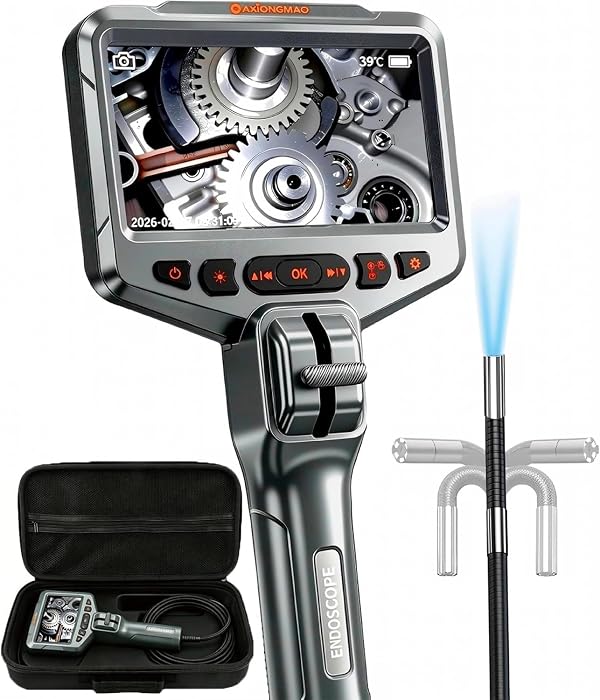
On paper this is our top pick for less money: 210 degrees of two-way articulation, a 4.5-inch IPS screen, five feet of semi-rigid probe, and a 32GB card in the box. The probe is slimmer than the Teslong's at 0.24 inch, so it slips into openings the bigger scope refuses.

The rest of the specification holds up. Zoom runs to 4x, the focus range is 2 to 10 centimeters, and the screen stays legible in a dim garage. Focus that close is the point: this is a scope for surfaces a couple of inches away, not for scanning a whole duct.

Where we hesitate is the track record. The layout is right and the price undercuts our top pick, but this is a newer design, and the articulating joint is the part that decides how long any of these scopes last. If you want the same tool for less and you are comfortable being early, it is a fair bet. We are just not ready to put it ahead of a scope with more miles on it.

Worth Noting

  • Two-way head only, though the images suggest four
Our Verdict

A near-copy of our top pick on paper, for less money, with a slimmer probe and the same 4.5-inch screen.

Check Latest Price

How We Tested Borescopes in Garages, Basements, and Wall Cavities

We started with research, not a shopping cart. I read spec sheets, mechanic forum threads, and a pile of customer reviews, then cut anything with a probe too fat for a spark plug hole, a cable too short for ductwork, or controls reviewers kept calling fiddly. That left 12 scopes — fixed and articulating, phone-tethered and screen-equipped — bought at retail or pulled from our own toolbags.

Testing ran six months, mostly in my garage and basement, plus a few afternoons at friends' houses where the projects were already waiting. We pulled spark plugs from a tired truck and studied the cylinder walls, fished cable behind drywall, chased a clogged sink trap, scoped a dryer vent, and retrieved a bolt from a mower deck. Every scope did every job.

We measured each probe with calipers and pushed it through holes drilled at 1/4, 3/8, and 1/2 inch. We bent each cable into an S to see whether it held the shape or sagged under its own weight, dunked the waterproof models in a bucket for ten minutes, and wiped the rest down with oil and coolant. Every unit got dropped from waist height onto concrete.

For picture and light, we aimed each camera at printed text and a tape measure from 1, 4, and 12 inches, then reviewed frames on a laptop to see where detail broke down and whether the LEDs washed out close surfaces. Controls were tested wearing nitrile gloves: how many presses to dim the light, how well the tip articulated with one thumb. Wireless scopes were paired to an iPhone and an Android phone, then carried 20 feet away with a metal door between them. At the end we tallied what came in the box — case, storage, attachments — against the price.

How to Choose a Borescope

Start With the Opening, Not the Camera

Crawl spaces are forgiving. Engine ports are not. An 8mm probe, the size on the Teslong NTS300 and the Daxiongmao C30, is right for drains, ducts, and wall cavities, and it will not pass a spark plug hole on most modern engines. Below about 6.5mm you are in injector-bore territory: the FOXWELL Y400 is 6.2mm, the Anykit is 0.22 inch, and the Klein ET17 is 5.5mm.

Check the opening with a drill bit before you order, and check the depth too. Four feet is plenty for an engine bay and nowhere near enough for a duct run, so the probe you buy should match the furthest thing you expect to reach.

Decide Whether You Need to Steer the Tip

A semi-rigid cable aims the whole camera: you bend it before you push, and it goes where the bend sends it. That is fine down a straight run and useless around a corner. Articulation moves the aiming to your thumb, which is the single biggest thing a borescope can do for engine diagnostics, and the reason our top pick has it.

Two traps. Two-way articulation is not four-way, so a head that sweeps left and right does not also look up and down, whatever the product images imply. And cable stiffness cuts both ways: too soft and it folds at a 90-degree bend instead of pushing through it.

A Built-In Screen or the Phone in Your Pocket

A phone-tethered endoscope camera costs less, puts the picture on a big display, and makes saving a photo trivial. It also depends on an app, a connector that stays seated, and a phone battery that is not already flat. A self-contained unit with its own screen always works and always has the same interface.

If you go the phone route, confirm the port, whether that is Lightning, USB-C, or micro-USB, and test the connection in the first week while returns are still easy.

Light, Glare, and How Close It Focuses

Every scope here lights its own way, and more light is not automatically better. At the distances these cameras actually work, a full-brightness LED blows out a wet pipe or a polished bore into a white smear. The Teslong TD450S focuses from 0.6 to 4 inches and the Daxiongmao C30 from 1.5 to 5 inches, which tells you how close you are meant to be.

Dimmable output is the feature to shop for, and the dimmer's low end matters more than its high end. Judge the picture at inches, not feet.

The Parts That Wear Out

The camera head and the joint behind it take the abuse; the screen rarely fails. Two habits keep a scope alive: dry the head before it goes in the case, because a lens that stays wet can fog and stay fogged, and coil the cable in wide loops rather than wrapping it tight around the body.

Check runtime and recharge time together. A scope rated for four hours that needs five to refill is a one-job-a-day tool, which is usually fine as long as you plan the job around a full battery.

Frequently Asked Questions

Final Verdict

The Teslong TD450S is the scope we point people to first. Steering the tip is the one feature that changes what an inspection can find, and this one pairs it with a screen bright enough to work from, a five-hour battery, and a case that holds the card and the cable.

The exceptions are specific. For a long run, whether that is a duct, a flue, or a wall cavity, the 16.5-foot Teslong NTS300 does what the TD450S cannot. For an opening smaller than an 8mm probe, the FOXWELL Y400 and its 6.2mm nose are the way in. And if this is a one-time look and the budget is tight, the Daxiongmao C30 finds the leak without asking you to install anything.