The 8 Best Camera Backpacks for Hiking of 2026

A camera bag that feels fine on a short walk can become a punishment by mile four, especially once you add a second lens, a tripod, and water. A good hiking camera backpack puts that load on your hips, keeps the camera reachable, and survives granite ledges, car trunks, and weather you didn't plan for.

Over eight months, my team and I hiked with 12 camera backpacks, from slim daypacks to larger haulers. We loaded each with a camera body, two lenses, a tripod, layers, lunch, and water, then walked and climbed while adjusting straps to see where each pack pinched or carried weight well. Strap quality showed up fast: thin padding and fussy adjusters announced themselves on steep miles. So did usable capacity, a laptop sleeve that didn't steal camera space, a rain cover that went on without a fight, and a tripod attachment that kept the load from swinging. Size and price can mislead; the best values weren't the biggest packs but the ones below that stayed comfortable and held up to repeated loading.

Our Top Picks

The 8 Best Camera Backpacks for Hiking of 2026

1

Lowepro Flipside Trek BP 250 AW Best Overall

Lowepro Flipside Trek BP 250 AW

All-day trail comfort

Field Score 94/100
Access
Back-panel
Weight
2.34 lb
Harness
ActiveZone suspension system
Camera Bay
20 x 12 x 23 cm
View on Amazon

Somewhere on a climb, a camera backpack stops being a bag and becomes a load, and the Flipside Trek is the pack here built for that moment. Lowepro's ActiveZone suspension holds the body of the bag off your spine with a tensioned panel, so air moves where a foam back pad would sit damp, and the waist belt settles onto your hips instead of floating around your ribs. Packed with a body, a 70-200, a wide zoom, water, and a shell, it carried like a hiking pack that happens to hold cameras.

That is why we hand it to the hiker with a full day ahead rather than a two-hour walk. The other half of the argument is access: the camera bay opens from the back panel, so you set the pack face-down in the dirt, the harness stays off the ground, and your gear sits sheltered while you swap a lens. Lowepro also splits the interior into a padded camera compartment and an open top space, and that split is what makes it a hiking pack rather than a camera box, because a shell, a sandwich, and a bottle ride above the dividers instead of fighting them.

The details we appreciated are small and specific. There are zippered pockets on the hip belt, so a spare battery and lip balm are within reach without stopping, and there are enough external attachment points to lash a tripod or a wet jacket outside the main body instead of cramming them in with the glass.

The limit is the camera compartment. At 20 x 12 x 23 cm it holds a body plus a couple of lenses happily, but a gripped camera with a long telephoto mounted crowds it, and that is the hiker we point at the TARION PB01. For a normal day kit on a full day out, this is the pack that makes the miles feel shorter than they are.

Worth Noting

  • Water-resistant shell, not waterproof
  • Highest price in this group
Our Verdict

We recommend the Flipside Trek BP 250 AW as the default for day hikes: the suspension and hip belt carry the weight, and the camera bay opens against your back.

Check Latest Price
2

Think Tank Backlight Sprint 15L Best Lightweight

Think Tank Backlight Sprint Lightweight Slim Camera Daypack Backpack for DSLR

Light, slim kits

Field Score 93/100
Access
Back-panel
Volume
15 liters
Weight
2.2 lb
Front Pocket
2 liters
View on Amazon

The move we kept repeating: swing the Sprint around on one shoulder, unzip the back panel, and lift out a body without setting the pack in the mud or unclipping the waist belt. Back-panel-only access is the whole idea here, and it is why this slim 15-liter pack is the one we reach for when the kit is one camera and two lenses and the plan is miles rather than hours.

At 2 lb 5 oz it barely registers on the way up, and the profile stays close enough that you stop thinking of it as a camera bag. There is room for a mirrorless body with a long zoom mounted, a second lens, batteries, filters, and a compact travel tripod strapped to either side using the pocket and the upper compression strap. The front pocket holds 2 liters of personal gear and opens vertically on the right, so a shell or a snack comes out without the pack coming off.

What sells it in use is how little there is to think about: one belt to click, one panel to open, and the whole bay visible at once because there is no top compartment to dig through. The nylon is water resistant rather than waterproof, so a passing shower beads off and a sustained downpour is a different problem, which is why a dry bag for the body rides in the front pocket on any trip with weather in the forecast.

Worth Noting

  • Back-panel opening is narrower than the camera bay
  • 15 liters leaves little room for food and layers
Our Verdict

Our pick for light, fast days: the Sprint carries one body and two lenses comfortably and lets you reach them without setting the pack down.

Check Latest Price
3

TARION PB01 27L Camera Backpack Best for Big Kits

TARION 2 Bags in 1 Professional Extra Large Camera Backpack 27L PB01

Two-camera loads

Field Score 92/100
Laptop
Up to 15.6 inches
Volume
27 liters
Weight
6.92 lb
Harness
Padded waist strap, ventilated back
View on Amazon

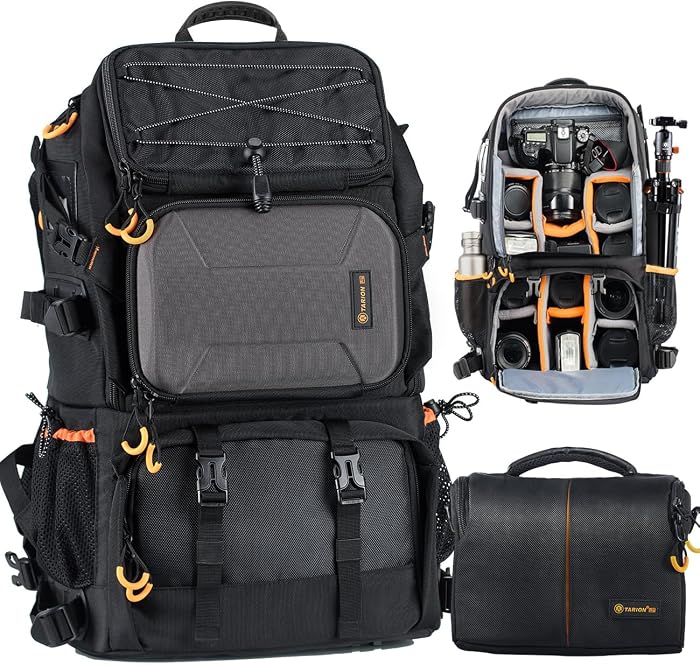
Two bodies, a 70-200, a couple of primes, a 15.6-inch laptop, and a jacket is not a day hike kit for most people, but it is exactly what the PB01 is shaped around. TARION splits it into a top compartment that takes a camera and five lenses and a lower one that handles another body and four more, with thick EPE dividers between everything and a rigid front panel over the sensitive gear. There is also a removable insert bag that converts the whole thing into two pieces of luggage for a workshop day.

The carrying hardware is more hiking pack than camera bag: padded shoulder straps, a waist strap, ventilated padding down the back, and strap anchors you can raise or lower to suit your torso. Side mesh pouches hold bottles, a tripod straps to either side, the laptop slides out through its own side zip, and a rain cover comes with it. Sixteen pockets means everything has a home, which sounds like a selling point until you are patting down four of them looking for a memory card.

The trade is weight, and it is not subtle. At 3.14 kg empty, this is the heaviest pack here by a wide margin, and it feels like luggage on a narrow, brushy trail. Where it earns that back is the carry to a single spot — a blind, a ridge, a workshop — where you want everything with you and the walk is a means to an end rather than the point of the day.

Worth Noting

  • 3.14 kg before you add any gear
  • Bulky on narrow, brushy trails
Our Verdict

Buy this one when the kit, not the trail, is the point: it swallows two bodies and a spread of lenses and still has a waist belt to help you haul it.

Check Latest Price
4

Besnfoto Rolltop Camera Backpack Best Weather Protection

Besnfoto Rolltop Camera Backpack – Camera Backpack Rolltop Photography Bag for DSLR Mirrorless Drone

Wet, changeable weather

Field Score 91/100
Shell
Waterproof tarpaulin
Laptop
Up to 15.6 inches
Volume
23 liters
Weight
2.87 lb
View on Amazon

When the forecast is wrong in the worst way, this is the pack we want on our backs. The body is high-density waterproof tarpaulin with YKK water-resistant zippers, and the rolltop closure means there is no seam at the top for rain to find. Nothing about it is delicate, and it is the only pack here we would keep wearing through a long, steady soak rather than calling the walk early.

That rolltop is also the practical trick: rolled down it is a 23-liter camera daypack, and rolled open it gains another 5 to 7 liters for a shell, snacks, or a gimbal. The camera bay opens from the side for a quick grab and from a full rear panel when you want to lay the whole kit out, there is a padded sleeve for a laptop up to 15.6 inches, a tripod holder on the side, and a luggage pass-through for travel days.

On the trail the air-mesh shoulder straps and the chest and waist belt distribute a loaded pack well, and at 1.3 kg the pack itself is not the problem. The hardware is where it gives ground: clips and elastic attachments are the parts that let the design down over time, and small items have a habit of disappearing into the rolltop because there is no mid-size pocket to catch them.

Worth Noting

  • Clips and elastic attachments are the weak hardware
  • No mid-size pocket for small items
Our Verdict

We trust the Rolltop in sustained rain, and its expandable top handles the shell and lunch that the smaller packs here cannot.

Check Latest Price
5

TARION TB04 15L Camera Backpack Best Value

TARION Small Camera Backpack for Photographers Side Access 15L

Everyday trail value

Field Score 90/100
Laptop
Up to 15 inches
Volume
15 liters
Weight
2.05 lb
Rain Cover
Included
View on Amazon

Set the TB04 next to our top pick and the list of features is embarrassingly similar: a side door into the camera bay, an included rain cover, a padded and ventilated back panel, a tripod holder, a 15-inch laptop sleeve. The difference is in the depth of the padding and the sophistication of the harness, not in what the pack can do on a three-hour trail.

At 0.93 kg it does not drag you down, and 15 liters holds a body with a lens mounted, two more lenses, batteries, and a tripod on the bottom straps. The dividers move to suit what you brought, the side door opens wide enough to pull the camera out one-handed, and the water-repellent nylon sends a passing shower running off before it reaches the padding.

The harness is the honest part of the deal: padded shoulder straps and a contoured back panel that stay comfortable for a few hours with a light load, which is the load this pack is built for. It does travel duty too, with a trolley sleeve that slides over a suitcase handle and a hidden anti-theft pocket for a passport or a spare card.

The judgment is straightforward. This is the pack we point at a hiker doing three-hour trails with one body and two lenses, because it covers access, weather, and padding that the cheapest packs here leave out and asks you to give up only volume. What we did not expect at this price is how little feels skimped: the zippers run clean, the padding holds its shape, and the rain cover is stowed where you can find it in a hurry.

Worth Noting

  • Only two exterior zip pockets
  • 15 liters fills fast with a jacket and lunch
Our Verdict

If you hike for hours rather than days, the TB04 gives you side access, a rain cover, and comfortable padding for far less than the top pick.

Check Latest Price
6

CADeN Camera Backpack 17L Best Budget

CADeN Camera Backpack Bag Professional for DSLR/SLR Mirrorless Camera Waterproof

Tight budgets

Field Score 89/100
Laptop
14 inches
Weight
1.7 lb
Capacity
17 liters
Camera Kit
2 cameras, 4 lenses
View on Amazon

The straps are what we noticed first. They are thickened, lengthened, and elastic enough that a 17-liter load sits close instead of bouncing, which on a camera pack matters more than a fancy back panel, and the handle and strap anchors are reinforced where cheap bags usually give out. At 1.7 pounds the CADeN all but disappears on a short trail, and the padded frame and dividers are thick enough that a body and four lenses arrive without knocking together.

For the money, we think it is the best first camera backpack here. Two cameras and four lenses fit in the bay, the partitions rearrange for a long lens, there is a 14-inch laptop sleeve, a front pocket sized for a tablet, a tripod holder with its own strap, and a mesh pocket for a bottle. CADeN backs it with a one-year replacement policy, which is unusual at this end of the range. On a light two-hour hike, nothing about it feels like a compromise.

What it is not is a pack for a long day. The suspension is a padded back panel rather than a vented frame, and 17 liters stops being enough the moment a jacket and a lunch come along. It is a first pack, a second pack, or the one that lives loaded in the car for short walks, and at this weight that is a role it fills well.

Worth Noting

  • Tripod holder only suits compact tripods
  • 14-inch laptop sleeve is the maximum
Our Verdict

We point budget buyers here: 17 liters, two bodies, four lenses, and 1.7 pounds of pack that disappears on a short trail.

Check Latest Price
7

RAINSMORE Camera Backpack 28L Best for Gear Plus Layers

RAINSMORE Camera Backpack 28L

Gear plus layers

Field Score 88/100
Laptop
15.6 inches
Volume
28 liters
Weight
3.64 lb
Rain Cover
Included
View on Amazon

Twenty-eight liters is a lot of camera bag, and RAINSMORE spends it the way a hiker wants: a padded camera bay with thick shock-absorbing dividers, then a top section that swallows a sweatshirt or a spare layer. A body with a 100-500 mounted fits in the main compartment and comes out through the zippered side opening without unpacking everything above it, which is the difference between grabbing a shot and missing one.

The weather story is better than the price suggests. Waterproof fabric plus a full-coverage rain cover means a wet forecast does not keep the camera in the bag, and the rest of the list is unusually complete: seven pockets and eight compartments, MOLLE webbing outside if you want to lash more on, a tripod holder, a sleeve for a 15.6-inch laptop, and a padded back panel and straps that stay comfortable on a couple of hours of walking.

Where it falls short of the hiking-first packs is the harness. A padded back panel and shoulder straps carry a camera kit well and a full 28 liters less so, and on a long climb you feel the difference against something like the suspended panel on the Flipside Trek. Load it for a photo walk, a basecamp wander, or a shore day and the volume is a gift; load it for eight miles of elevation and it is a chore.

Worth Noting

  • 1.65 kg empty, heavy for 28 liters
Our Verdict

Twenty-eight liters and a full rain cover make this the gear hauler of the group, and we like it for shorter carries where its weight matters less.

Check Latest Price
8

PGYTECH OneGo Lite 12L Best for Minimalist Day Hikes

PGYTECH OneGo Lite 12L Camera Backpack Minimalist Lightweight Camera Bag

Minimalist day hikes

Field Score 87/100
Access
Dual side
Volume
12 liters
Weight
1.7 lb
Camera Kit
1 camera, 2 lenses
View on Amazon

Under a kilo is the headline. At 0.77 kg without dividers, the OneGo Lite is the lightest pack here by a clear margin, and on a trail where every ounce gets argued about that is not a footnote, it is the reason to pick it. Shoulder straps and a chest strap hold a small load close, and the whole thing carries like a daypack that happens to have a padded camera bay rather than a camera bag you tolerate on a hike.

The 12-liter body is built around a light kit: one camera with a lens mounted plus two more, which in practice means a compact mirrorless with a superzoom attached, a couple of primes, batteries, and cards. Dual side openings let the camera come out on either hand, there is a tripod mount, a laptop sleeve with a velcro organizer pocket, and a water-repellent shell with splash-proof zippers over a reinforced base.

What surprised us is how organized 12 liters can be. The dividers hold a body with a superzoom mounted, a meshed pocket keeps batteries where you can see them, and the zipper path is routed so it takes a deliberate hand to open, which we appreciated at a crowded trailhead. Nothing rattles, nothing needs repacking mid-walk.

The one thing to check before you buy is how the depth sits on your back. The pack carries its volume away from the spine rather than close to it, and on a shorter torso that can feel like a box between the shoulder blades. Load it and walk a few minutes before you commit; if it sits right, this is the pack for the minimalist who wants the camera and nothing else.

Worth Noting

  • 12 liters leaves no room for a shell or lunch
Our Verdict

For a mirrorless body and two lenses on a quick, light hike, the OneGo Lite is the pack we reach for when weight is the whole argument.

Check Latest Price

How We Tested Hiking Camera Backpacks

I started by building a shortlist from camera packs marketed for hiking and travel, then filtered for real camera capacity, padded harnesses, rain protection, tripod attachment, and a laptop sleeve that didn't crowd the camera compartment. Price and size mattered, but I skipped anything that looked like a school backpack with foam dividers dropped in.

We tested 12 packs over eight months. Each carried a camera body, two lenses, a tripod, a rain shell, lunch, and a 1.5-liter water bottle on local day hikes, from after-work loops to wet, rocky weekend trails. I weighed every pack empty and loaded, then noted where the weight sat: on my hips, on my shoulders, or pulling me backward. I adjusted sternum and hip straps mid-climb, with and without gloves, and checked whether the padding stayed put or rolled.

At the trailhead and at home, I loaded and unloaded each bag repeatedly, set it down on granite and wet grass, and checked seams, zippers, and strap stitching for wear. I timed side access with the pack on one shoulder, stuffed the laptop sleeve to see if it stole camera space, and deployed each rain cover in a shower, then checked whether the contents stayed dry. I also wore each pack on narrow singletrack and slid it into a car trunk to judge bulk. Capacity was judged by what actually fit without fighting: a camera body, two or three lenses, a tripod, and layers.

For value, I compared build quality, capacity, and comfort across the field rather than trusting the spec sheet. The packs that scored best were not always the largest or lightest; they were the ones that still felt organized after a full day and did not leave me fidgeting with straps on the drive home.

How to Choose a Camera Backpack for Hiking

Put the Harness Before the Pockets

A camera bag can be beautifully organized and still ruin a hike. What carries the load is the harness: a waist belt that settles on the hip bones takes weight off your shoulders, and a tensioned or channeled back panel lets heat escape where a flat foam pad traps it. The Lowepro Flipside Trek is the clearest example here, with a suspended panel and a belt that lands on the hips rather than around the ribs.

Our rule is blunt: if the loaded pack goes much past about 15 pounds, or you are out longer than two hours, buy the harness first and the pockets second. For a ninety-minute walk with one body and one lens, padded shoulder straps are genuinely enough, and the light packs here prove it.

Size the Bag to Your Kit, Then Add Lunch

Liters tell you less than the camera does. A body with a 70-200 mounted eats space that a body with a 35mm leaves empty, a battery grip adds another inch of depth, and every divider you leave in steals volume from a jacket. Load your actual kit and measure the longest assembled lens before you shop.

As a rough map, 12 to 15 liters covers one camera and two lenses with little else, while 20 to 28 liters adds a layer, lunch, and a bottle, or a second body. The PGYTECH OneGo Lite's 12 liters is honest about its job: one camera and two lenses, no picnic.

Choose How You Want to Reach the Camera

Side access lets you swing the pack onto one hip and pull the camera out with the bag still on, which is why it suits anyone who shoots constantly. Back-panel access asks you to set the pack down, but the harness never touches the ground and your gear stays out of the weather while you work; the Think Tank Sprint and the Flipside Trek both open this way.

Decide by counting your stops. Few and deliberate, and the back panel is the better design. Every ten minutes, and you want a side door, even though it means the camera bay is open to the sky while you dig.

Plan for Rain, Zippers Included

Water-resistant fabric handles a shower; sustained rain needs a cover or a shell that is genuinely waterproof. A rain cover is only useful if it lives in the pack and comes out fast, so favor a pack that includes one, as the RAINSMORE and the TARION packs do, or a rolltop like the Besnfoto where the closure itself is the protection.

Either way, the zippers are where water gets in. A water-resistant zipper and a flap over the camera bay matter more on a trail than the fabric rating on the swing tag.

Weigh the Empty Pack, Then the Extras

A pack that weighs 3 kg before you put anything in it costs you on every climb; a 12-liter pack under a kilo costs you in what it cannot bring. Between those ends, the features worth their weight are the ones you touch on the trail: a tripod attachment that keeps the legs off your spine, a bottle pocket you can reach without unclipping the waist belt, and a hip belt with pockets in it.

Everything else is dead weight on a day hike. A laptop sleeve and a dozen organizer pouches are lovely in an airport and meaningless three miles up a switchback.

Frequently Asked Questions

Final Verdict

We recommend the Lowepro Flipside Trek BP 250 AW as the default because its harness, access, and layout all point the same way: the load rides on your hips, the camera comes out of the back panel while the pack stays clean, and the open compartment takes the layer and lunch a day hike actually requires.

Carry one body and two lenses and count the ounces? The Think Tank Sprint. Two bodies and a wall of glass? The TARION PB01.