The 8 Best Camping Axes of 2026

A campfire stops being relaxing when someone starts hacking at a soggy log with a dull hatchet. The right camping axe turns kindling into a quick job, splits small rounds cleanly, and stows safely in the truck or pack; the wrong one glances off wood, loosens at the handle, or arrives too heavy to carry. I want an axe that feels solid, holds an edge after a weekend of use, and comes with a sheath I trust around camp.

Over the past six months, my team and I tested 10 camping axes on firewood and kindling, and the differences came down to more than a sharp edge. Size drives almost every other tradeoff: a compact hatchet packs easily but lacks splitting leverage, while a longer axe gives you reach and swing speed at the cost of pack weight. For most campers, the right choice is a mid-size axe for car camping and a small hatchet for backpacking, so I weighed balance, grip, sharpness, and value too. The picks below cover that range.

Our Top Picks

The 8 Best Camping Axes of 2026

1

Fiskars X7 Hatchet Best Overall

Fiskars X7 Small Hatchet Axe 14"

All-around camp use

Field Score 97/100
Warranty
Lifetime limited
Item Weight
1.4 lb
Blade Length
5.12 in
Overall Length
14 in
View on Amazon

Fourteen inches and 1.4 pounds is the combination we keep coming back to: light enough that you forget it is strapped to a pack, heavy enough that the head still does the work on a piece of dry pine. Our verdict is that this is the best-balanced small axe in the group, and it makes kindling with less effort than anything else here of the same size.

What we appreciate most is how little drama there is in using it. The 5.12-inch blade arrives sharp, the low-friction coating keeps wet wood from grabbing the head, and the insert-molded head means there is no wedge to tighten and no handle to re-seat. A lifetime limited warranty backs that up, and the included cover has a belt loop and slips into a pack's side pocket without a second thought.

Balance is where it separates from the budget hatchets. A 1.4-pound tool can feel head-heavy and awkward; this one never does, and the weight sits where you want it through the swing, which is why branch wood splits far more easily than the size suggests. The edge does dull after a long kindling session, but it comes back in a few passes of a puck stone, so we never minded.

Nothing about it needs looking after. There is no wedge to tighten and no wood to oil, the coating has not worn through where it matters, and the cover holds the head snugly enough that you can grab the axe by the handle and walk to the fire ring. For a tool this inexpensive, that is a lot of nothing to worry about.

Worth Noting

  • 1.4-pound head is light for full rounds
Our Verdict

The X7 is the camp axe we hand people first: light enough to carry all day, balanced enough to split kindling cleanly, and sharp out of the box.

Check Latest Price
2

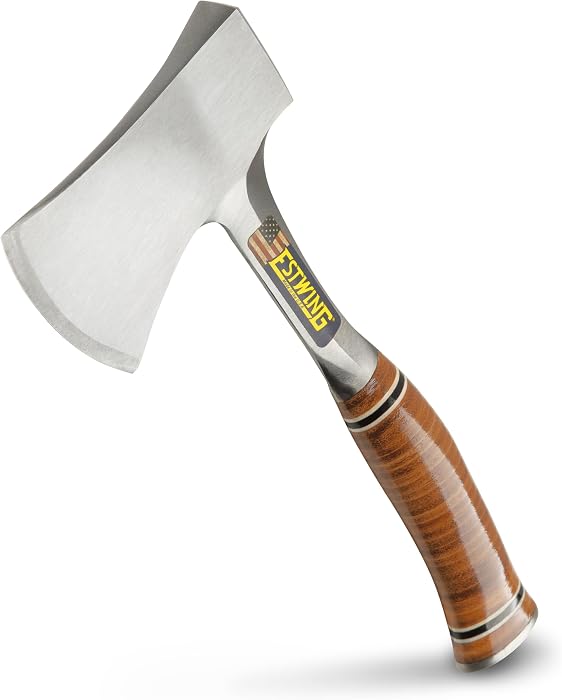
Estwing Sportsman's Axe E24A Best One-Piece Construction

Estwing Sportsman's Axe E24A

Buying once

Field Score 96/100
Handle
Leather
Item Weight
1.8 lb
Construction
One-piece forged steel
Overall Length
14 in
View on Amazon

The other 14-inch axe here is a different animal. Where the Fiskars is molded and light, the Estwing Sportsman's Axe is one piece of American steel from bit to butt, wrapped in leather, and it has the look of a tool your grandfather owned.

We like it for exactly that reason: there is no joint to work loose. One-piece forging means no wedge, no epoxy, and no head that starts to wobble after a season of hard overstrikes, and the hand-sanded leather grip stays comfortable through a long session in a way molded handles do not always manage. The poll is shaped to hook a tent stake, which quietly makes this the most useful axe in the group around an actual tent. It is also the best-looking tool we tested, and the only one with leather on it.

Two things to know. The edge is hand-sharpened and arrives working-sharp rather than razor, so give it a few minutes with a stone before the first trip. And the nylon sheath grips the head firmly enough that pulling the axe out takes a deliberate tug, which we liked in a pack and found mildly annoying at the woodpile.

Worth Noting

  • 1.8 pounds is a lot on a long hike
Our Verdict

If you want an axe you will never have to fix, the Sportsman's Axe is it: one forged piece of steel, a leather grip, and no head to re-seat.

Check Latest Price
3

Fiskars X11 Splitting Axe Best for Splitting Kindling

Fiskars X11 Splitting Axe 17"

Splitting rounds

Field Score 95/100
Head Type
Splitting wedge
Item Weight
2.2 lb
Blade Length
5.99 in
Overall Length
17 in
View on Amazon

The X11 looks like an axe that could not decide what it wanted to be: 17 inches of handle with a head that flares into a wedge instead of tapering to a thin bit. The flare is the entire point. This is a splitting axe scaled down to hatchet length.

A fist-size round of seasoned hardwood opens in one or two swings, and the head does not bury itself, because the flared cheeks push the split open behind the edge. That is also why it comes back out of the wood so easily, which matters more than it sounds when you are working through a crate of rounds.

At 2.2 pounds on a 17-inch handle it is still a one-handed tool at the fire ring, and the shock-absorbing handle takes most of the sting out of a miss. Our judgment: if your camp wood arrives as rounds, this is the axe to bring, and it is the one pick here that earns a place beside a woodstove at home as well.

It does want something flat to work against, whether that is a stump, a block, or the flat face of a big round. Wedge a round on soft ground and you will fight it all afternoon. Give it a block and it is the most satisfying tool in this group to use.

Worth Noting

  • Wedge head is poor for limbing and carving
Our Verdict

If your camp wood arrives in rounds, buy the X11: the flared wedge head pushes kindling apart where a thin hatchet just sticks.

Check Latest Price
4

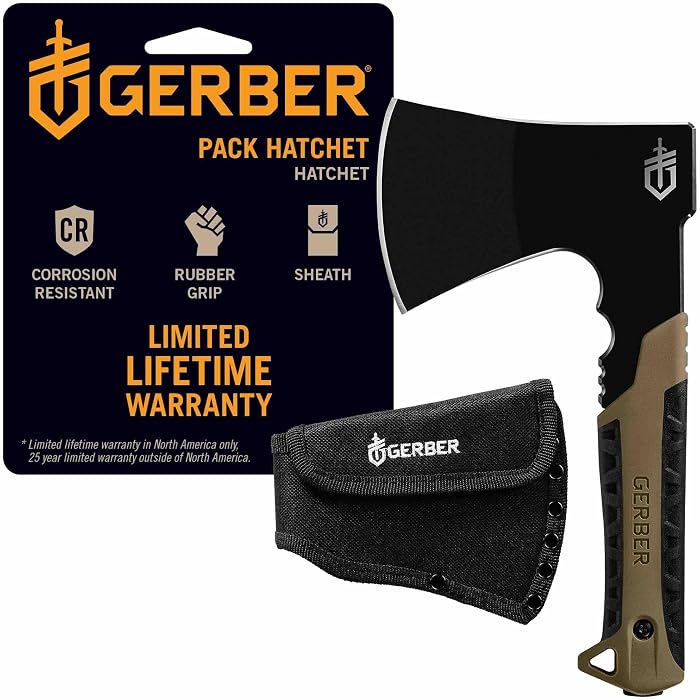
Gerber Pack Hatchet Best for Backpacking

Gerber Pack Hatchet & Sheath

Backpacking and hiking

Field Score 94/100
Sheath
Nylon, belt or pack mount
Item Weight
20.8 oz
Blade Length
3.5 in
Overall Length
9.46 in
View on Amazon

At 9.46 inches overall and 20.8 ounces, the Gerber Pack Hatchet is barely longer than a large fixed-blade knife, and it does not pretend otherwise. This is the axe that lives in a pack, not beside a woodpile.

We were pleasantly surprised by how much work that small package buys. The blade is full tang, steel running the length of the handle, so the head is not going anywhere, and the 3.5-inch blade with its tall grind bites deeper into dry branch wood than the length suggests. It is the only axe here that disappears into a daypack, and the sheath mounts to a belt or a pack's webbing instead of swinging loose.

Green wood is where it runs out of road. Limbs that bend instead of snap take several swings, and there is not enough handle to build real speed, so treat it as a dry-wood and split-it-down tool rather than a trail clearer. Where it does earn its place is at the end of a long walk, when a 20-ounce axe in the pack is the difference between a fire and no fire.

Worth Noting

  • Sheath is fiddly to re-seat with cold hands
Our Verdict

For backpackers counting ounces, the Pack Hatchet is the answer: 20.8 ounces, a full-tang 3.5-inch blade, and a sheath that rides on your pack.

Check Latest Price
5

Estwing Camper's Axe E45A Best for Base Camp

Estwing Camper's Axe E45A

Drive-up campsites

Field Score 93/100
Grip
Shock reduction
Head Weight
2.5 lb
Item Weight
3.5 lb
Blade Length
4 in
View on Amazon

If your camp has a truck parked next to it, the Estwing Camper's Axe is the one we point you to. Twenty-six inches of handle and a 2.5-pound head let you stand upright and let the axe fall, which is the difference between working through a pile of firewood and wrecking your shoulder with a hatchet.

The molded grip is why it does not punish you for it. One-piece steel axes have a reputation for stinging your hands, and this handle soaks up most of that shock. The flat poll will drive tent stakes, and the 4-inch edge takes branches off a fallen limb in a swing or two.

It is a two-handed tool and it behaves like one: the long arc wants clear space and a stump or a round to bite into, so a crowded site with people walking behind you is the wrong place for it. The nylon sheath has a belt loop, which is optimistic for a 3.5-pound axe. It lives better in a truck box or lashed to a pack frame.

Worth Noting

  • 3.5 pounds is more than you want on a hike
Our Verdict

This is the axe for a drive-up campsite: 26 inches of handle and a 2.5-pound head turn a pile of rounds into firewood without a chainsaw.

Check Latest Price
6

KSEIBI 274150 Hatchet Best Budget

KSEIBI 274150 Camping Hatchet Axe

Budget first axe

Field Score 92/100
Handle
Fiberglass
Item Weight
1.3 lb
Blade Length
4.13 in
Overall Length
15 in
View on Amazon

The KSEIBI is the least expensive axe here that we are comfortable recommending, and it does not feel like a compromise in the hand. Fifteen inches, 1.3 pounds, a fiberglass handle with a molded anti-slip grip, and enough head weight to keep the swing honest.

What it gets right is the boring part. The handle is stiff and does not flex on a miss, the grip stays put with wet hands, and the head is seated solidly enough that we never saw it shift. For splitting kindling and breaking down branch wood it does what the pricier hatchets do, and it does it without asking you to be careful with it.

Our judgment is that this is the right first axe: inexpensive enough to keep in a truck box, light enough for a beginner to learn a controlled swing, and solid enough that you will not be shopping again next season. The fiberglass handle also shrugs off being left out in the rain, which is more than we can say for a hickory one.

Worth Noting

  • Factory edge varies from sharp to dull
Our Verdict

If you want a capable camp axe without spending much, the KSEIBI is the one: light, stiff-handled, and solid where the head meets the handle.

Check Latest Price
7

Cold Steel Trail Boss

Cold Steel Trail Boss Axe

Traditional axe feel

Field Score 91/100
Handle
American hickory
Item Weight
2.6 lb
Blade Material
1055 carbon steel
Overall Length
27 in
View on Amazon

A 27-inch hickory handle is the reason to look at the Trail Boss. In a group of molded and forged handles, this is a traditional axe: straight-grained American hickory, a 1055 carbon steel head with a 4.5-inch cutting edge, and 2.6 pounds of tool that swings like something from a century ago.

The length is the useful part. Twenty-seven inches gives you real two-handed leverage without a full-size axe's mass, and the head takes a big bite, so it will clear a trail or break a pile of rounds down to kindling. The head is hung on two steel wedges rather than epoxy, which is the old way of doing it and, done right, still the strongest.

The edge arrives rough, which is normal for a carbon-steel axe, so budget an hour with a file and a stone before the first trip; after that it takes a keen edge and holds it. Hickory also wants a little care. Keep it off wet ground and wipe it with oil once a season so the grain does not dry and check.

What we like about it is the feel. Hickory flexes slightly on impact in a way fiberglass never does, and the longer handle lets you work at a relaxed pace instead of muscling every swing. If you want a traditional axe to learn on, or one to keep by the woodpile that is not trying to look tactical, this is the pick.

Worth Noting

  • Wood handle can split when a swing lands the shaft on a log
Our Verdict

The Trail Boss is the traditionalist's pick: 27 inches of hickory, a carbon-steel head, and a swing you can feel through the handle.

Check Latest Price
8

DESHIL 15-Inch Hatchet Best for Stakes and Kindling

DESHIL 15-Inch Hatchet – 15 inch Chopping Hatchet Axe for Camping Splitting & Kindling

Stakes and kindling

Field Score 90/100
Head
Hatchet with hammer poll
Cover
Locking blade cover
Item Weight
1.32 lb
Overall Length
15 in
View on Amazon

A hammer poll on a 15-inch hatchet is a small thing that turns out to matter. The DESHIL has a flat striking face opposite the blade, so the tool that splits your kindling is also the tool that drives your tent stakes, and that is one less thing to pack.

The rest of it is a sensible budget hatchet: 600 grams, about 1.3 pounds, on a fiberglass handle with an anti-slip grip, a forged carbon-steel head, and a locking blade cover for pack carry. It is balanced well enough to swing one-handed at the fire ring and heavy enough that it does not bounce off a piece of pine.

The poll is a stake driver, not a hammer. It is a small flat face, good for tent pegs and wooden stakes and not much else, so treat it as a bonus rather than a second tool. The cover is the other nice touch: it locks, which matters if the hatchet rides in a gear box with everything else.

Our judgment is that it is the right pick for a tight budget with a specific job in mind: car camping, scout trips, a hatchet that lives in the RV and drives as many stakes as it splits kindling. At 600 grams it is easy to hand to a teenager, and it does not need the care a wooden handle does.

Worth Noting

  • Factory edge is inconsistent; inspect it on arrival
Our Verdict

If you want one inexpensive hatchet that also drives stakes, the DESHIL is the practical choice for car camping and scout trips.

Check Latest Price

How We Tested Camping Axes

We built the shortlist by scanning reviews and spec sheets for camping axes sold at outdoor stores and major retailers, then filtered out anything with vague steel descriptions, no sheath, or a size that did not fit either a pack or a truck box. That left 10 axes, from compact hatchets to longer splitting tools. My team and I used them for six months at weekend car-camping trips, backyard fire pits, and a few trail-maintenance afternoons, rotating each axe through the same tasks so the comparisons stayed fair.

In camp, we used each axe to break down kindling, split small rounds of seasoned hardwood and softwood, and shave curls for fire starters. We counted strikes to split a log, noted whether the blade bit cleanly or glanced off, and checked the edge after each session for rolling or dulling. We also handled every axe bare-handed and with work gloves, gripped the handle while wet, checked the head-to-handle junction for wiggle, and noted whether the handle soaked up shock or stung my palm. Sheath retention got a simple test: turn each axe upside down and shake it.

We weighed each axe on a kitchen scale and carried it in a pack on a two-mile walk to see how size and weight played out on the trail. Durability got the least gentle treatment: axes rode in truck beds, got rained on, and were wiped down and inspected for rust, handle wear, and loose fittings. For value, we compared what came in the box, including the sheath and grip, against how each one cut and carried over the full test. We did not reward a low price if the axe bounced, loosened, or needed constant sharpening.

How to Choose a Camping Axe

Start With the Wood, Then Pick the Length

A 14- to 17-inch axe is a one-handed tool: it makes kindling, breaks down branch wood, and splits a too-long piece of firewood down to size, and it fits in or on a pack without a second thought. A 24- to 27-inch axe gives you two-handed leverage for whole rounds, which is real work and real weight.

The trap is assuming longer means more capable. A 26-inch axe weighs two to three times what a hatchet does and needs clear space plus a stump to bite into, so unless your camp wood arrives as rounds at a drive-up site, the short axe is the one you will still be carrying in September.

Chopping Head or Splitting Wedge

A thin, convex chopping bit bites across the grain, which is what you want for limbing a fallen branch or shaving kindling sticks. A splitting head flares into a wedge behind the edge, so the blade starts a crack and the flared cheeks push it open along the grain.

These are different jobs and rarely one tool. A splitting axe is mediocre at limbing, and a chopping hatchet will stick in a round without splitting it. Decide which pile of wood you actually have before you buy, then choose the head that matches it.

Weight and How You Carry It

Pack axes run around 1.3 to 1.8 pounds, midlength axes 2.2 to 2.6 pounds, and two-handed camp axes 3.5 pounds and up. Every few ounces changes how often the tool comes with you, and an axe left in the truck because it is heavy is worse than no axe.

Read the sheath as carefully as the head. A belt loop, a pack mount, and a locking blade cover are three different carry systems, and only one of them suits the way you travel. Compact in a listing means it fits a daypack, not that it chops like a bigger axe.

Handles, and How the Head Stays On

Wood absorbs vibration and looks better than anything else, but it dries, checks, and can split if a swing lands the shaft across a log. One-piece forged steel has no joint to loosen at all, while molded and fiberglass handles shrug off rain and need no oiling.

Whichever you choose, look at the head-to-handle junction. An insert-molded or one-piece head cannot work loose; a wedged wooden handle can, and it is worth checking the eye for a tight fit and two seated wedges before the season starts.

Frequently Asked Questions

Final Verdict

The Fiskars X7 is the camping axe we tell most people to buy. Fourteen inches and 1.4 pounds is enough tool for kindling, branch wood, and the split-once-more pieces you bring back from the camp store, and it arrives sharp with a head that cannot work loose.

If your wood comes as whole rounds, step up to the X11 and its flared splitting head. If the axe lives at a drive-up site next to a pile of firewood, the Estwing Camper's Axe earns its 3.5 pounds.