The 8 Best Chest Freezers of 2026

The moment usually arrives with a trunk full of chicken thighs, or a quarter of a cow split with a neighbor, and nowhere to put any of it — the icebox shelf in the fridge is already full. A chest freezer turns bulk buying from a gamble into a plan. What separates a good one from a frustrating one is rarely the price: it's how much usable space is inside, whether the thermostat holds steady in a hot garage, and whether the compressor hums at you all night.

My team and I lived with eight of these for eight months, from a 3.2-cubic-foot box that tucks into a bar corner to a 16-cubic-foot unit that swallowed a bulk-shop haul. Here's what first-time buyers miss: the cubic feet on the label is rarely the cubic feet of food you can fit, since baskets, the compressor hump, and tapered walls eat into it. We measured every interior with a tape and packed each one for real, so each pick below earns its place on usable capacity, quiet running, and steady cold.

Our Top Picks

The 8 Best Chest Freezers of 2026

1

Midea 7.0 Cu. Ft. Chest Freezer Best Overall

Midea 7.0 Cu. Ft. Chest Freezer

Family of four

Field Score 91/100
Capacity
7 cubic feet
Dimensions
22"D x 30.3"W x 33.5"H
Operating Range
38°F to 110°F in fridge mode, 0°F to 110°F in freezer mode
Power-Outage Hold
Up to 48 hours
View on Amazon

A chest freezer that can switch to refrigerator duty sounds like a brochure line until the week before Thanksgiving, when the turkey needs the kitchen fridge and the pies need somewhere cold. Midea rates this one for non-climate-controlled spaces — 38°F to 110°F in fridge mode, 0°F to 110°F in freezer mode — so an unheated garage in July or a furnace room in January isn't a disqualifier.

Seven cubic feet is the size most households land on: room for a half hog or a summer of berries, shallow enough that you can still see the bottom. The Midea is narrower than the Frigidaire and shallower than the Bangson, and it's the least expensive of the three 7-cubic-foot machines here. That combination is why we put it first.

The details are the ones you notice in year two. There's an LED inside the lid that lights the interior when you open it, which stops being a gimmick the first time you're hunting for the last bag of peas in a dark garage. The basket lifts out. The legs adjust, so a sloped garage floor doesn't leave the lid sitting crooked. And the 48-hour hold after the power goes is the number to think about during a February ice storm.

At 65.3 pounds it's a two-person delivery, and where it lands matters: leave room for the lid to swing and don't wedge it into a corner, because you'll be leaning in over the rim every time you use it.

Worth Noting

  • Lid and hinge damage the recurring weak point
Our Verdict

We recommend the Midea to most households: 7 cubic feet, a stated garage-ready range, and a fridge mode for the weeks when you need overflow cooling.

Check Latest Price
2

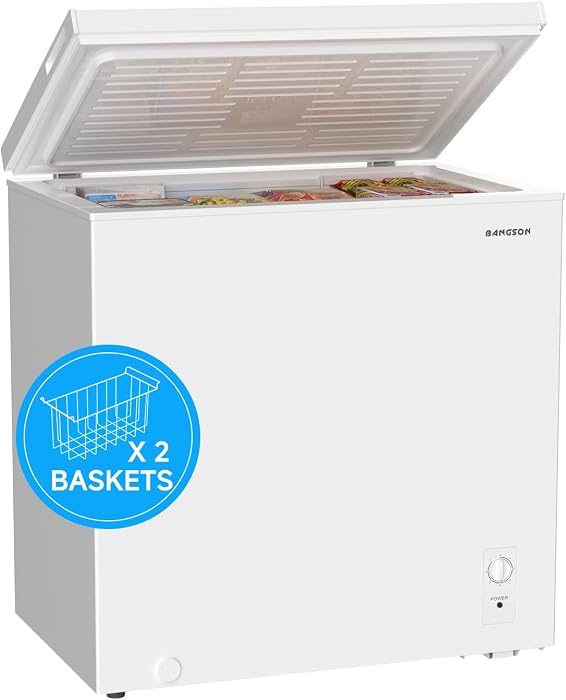
BANGSON 7.1 Cu. Ft. Chest Freezer Best for Narrow Spaces

BANGSON 7.1 Cu. Ft. Chest Freezer – 7.1 Cu.Ft Chest Freezer for Apartment

Narrow spaces

Field Score 90/100
Wattage
70 watts
Capacity
7.1 cubic feet
Dimensions
32.09"D x 21.46"W x 33.46"H
Temperature Control
7-level adjustable thermostat
View on Amazon

Twenty-one and a half inches is narrow for 7.1 cubic feet, and Bangson gets there by stretching the depth to 32.09 inches. That trade is the whole argument for this freezer: no other 7-cubic-foot box here fits a strip that tight, and you pay for it by having the cabinet stand further into the room. We think it's the right call for a galley kitchen or the slot between a basement wall and a workbench.

The rest is deliberately plain: a seven-level dial, a 70-watt draw, and basket storage hanging at the top for the things you reach for daily. It runs quietly enough for an open kitchen, the white cabinet is about as unobtrusive as an appliance gets, and 63.9 pounds means two people can walk it into place without a dolly.

Two things to check before you commit. The depth, because 32 inches in a narrow galley is a hip-height obstacle you'll walk around for years. And the lid clearance against whatever wall you've picked, since the door needs room to stand open. Measure those two and the Bangson is the easiest 7-cubic-foot freezer here to place.

Worth Noting

  • Deep 32-inch body eats floor space
Our Verdict

If your only free wall is a 22-inch strip, we point you to this one: 7.1 cubic feet in the narrowest body here, with a lid that stays where you put it.

Check Latest Price
3

Frigidaire 7.0 Cu. Ft. Chest Freezer Best for Easy Defrosting

FRIGIDAIRE EFRF7003-BLACK Chest Deep Freezer

Easy defrosting

Field Score 89/100
Capacity
7 cubic feet
Dimensions
26"D x 37"W x 33"H
Defrost Drain
Exterior, easy access
Temperature Control
7-setting adjustable thermostat
View on Amazon

Defrosting is the job nobody prices into a chest freezer: you empty it into coolers, wait for the ice to let go, and mop the floor. Frigidaire's answer is an exterior drain, so meltwater runs out into a pan or a floor drain instead of pooling under the box while you chip at it.

The rest is conventional in the ways that matter. Seven numbered settings on a dial, a vinyl-coated wire basket that hangs at the top and lifts out, and a power light on the front you can see from across a dark basement. The black cabinet is 37 inches wide and 26 inches deep, which makes it the widest of the three 7-cubic-foot machines here — measure the doorway, not just the wall.

We point at this one when the freezer is going to need cleaning more often than average: a garage box, a fishing-season box, anything that sees frost, spills, and a hose. You pay more than the Midea for it, and what you're buying is the drain and the tidier basket rather than capacity or a smarter thermostat. If neither of those matters to you, the money goes further elsewhere on this list.

Worth Noting

  • Widest 7-cubic-foot cabinet here
  • Priciest of the three 7-cubic-foot picks
Our Verdict

We reach for the Frigidaire when cleanup matters more than price: an exterior drain and a vinyl-coated basket make it the least fussy 7-cubic-foot box here.

Check Latest Price
4

BLACK+DECKER 16.2 Cu. Ft. Chest Freezer Best for Large Families

BLACK+DECKER 16.2 Cu. Ft. Chest Freezer

Large families

Field Score 88/100
Weight
141.1 lb
Capacity
16.2 cubic feet
Dimensions
29.5"D x 60.4"W x 33.5"H
Temperature Control
Mechanical dial with indicator lights
View on Amazon

Sixty and a half inches wide, 29.5 deep, 33.5 high, and 141.1 pounds before you put anything in it. This is not a box you tuck beside the refrigerator; it's a wall. Measure the doorway, the turn into the room, and the run of wall you're giving up, and have a second person and a dolly on hand for delivery day.

What that buys is 16.2 cubic feet, the largest here by a wide margin, on a 95-watt compressor with an ETL listing. Two removable baskets hang at the top, the mechanical dial and its indicator lights sit on the outside where you can read them without lifting the lid, and there's an easy-access drain for defrosting. For a family putting up a quarter of beef, or restocking after a good hunting season, this is the scale that makes sense — we think the extra cubic feet earn their floor space in a way a second small freezer never does.

Plan for two frictions. A manual-defrost box this size is a real afternoon once the frost sets in, so keep the drain path clear and pick a spot with room to work. And noise is the split on this one — some units hum, some make themselves known — so buy it for a garage, basement, or utility room rather than the wall behind a sofa.

Worth Noting

  • Needs 60 inches of wall and two movers
Our Verdict

Our pick for a family putting up a side of beef or a garden's worth of produce — provided you have 60 inches of wall and a second pair of hands.

Check Latest Price
5

Kismile 3.2 Cu. Ft. Chest Freezer Best Compact

Kismile 3.2 Cubic Feet Chest Freezer

Apartments

Field Score 87/100
Capacity
3.2 cubic feet
Dimensions
17.12"D x 20.67"W x 31.89"H
Energy Use
0.68 kWh per day
Temperature Control
7-grade adjustable thermostat
View on Amazon

Twenty-one inches wide, seventeen deep, thirty-two tall, and 3.2 cubic feet inside — the Kismile fits the kind of apartment where the only spare wall is behind the door. It's the one we point at for a first freezer, partly because the size means you can stand at it and reach the bottom without a step stool, and partly because the door parks anywhere between 45 and 90 degrees, which matters when you're holding a bag of frozen peas in one hand.

A seven-grade dial handles temperature, and the 0.68 kilowatt-hour daily figure is the one to multiply against your electricity rate before you decide a small freezer is the cheap option it looks like. Two baskets hang at the top, the black cabinet wipes down easily, and the compressor is quiet enough that a studio won't notice it from the couch.

Frost is the maintenance item, and on this box it collects along the top edge first — clear it before it gets thick enough to eat into the capacity you paid for. And 3.2 cubic feet is genuinely small: a couple can live out of it, while a family of four will fill it during one bulk shop and start stacking.

Worth Noting

  • Fills fast for a household of four
Our Verdict

For a first apartment or a garage corner, we like the Kismile: 3.2 cubic feet, two baskets, and a door that parks between 45 and 90 degrees.

Check Latest Price
6

Climate Choice 4.0 Cu. Ft. Chest Freezer Best Budget

Climate Choice 4.0 Cu. Ft. Chest Freezer – 4.0 Cu.Ft Chest Freezer

Tight budgets

Field Score 86/100
Capacity
4 cubic feet
Dimensions
16.34"D x 20.67"W x 32.52"H
Noise Level
Under 40 dB
Temperature Range
-7.6°F to 21.2°F
View on Amazon

Four cubic feet for less than the Kismile asks for 3.2 is the entire case for this one, and we think it's a good one when the freezer is a utility rather than a centerpiece. The gray box is 20.67 inches wide, 16.34 deep, and 32.52 tall, and at 40 pounds one person can walk it into a closet and set it down.

The specs don't read like a budget machine: seven settings, a stated range from -7.6°F to 21.2°F, an 85-watt compressor, operation under 40 dB, and a drain in the bottom for defrosting. The basket count is one rather than two, so the small stuff shares.

The catch is consistency. Freezing is the split point on this one — most units hold everything solid, some run warm or arrive dead — so plug it in, let it sit a day, and put a thermometer inside for a few hours before a month of groceries goes in. Do that and four cubic feet at the lowest price here is the best value in the small group; skip the check and the Kismile is the safer small box.

Worth Noting

  • Single basket leaves the bottom a dig
Our Verdict

We call this the budget pick: 4 cubic feet, a stated -7.6°F floor, and a price below the smaller Kismile.

Check Latest Price
7

DEMULLER 3.5 Cu. Ft. Chest Freezer Best Temperature Control

DEMULLER 3.5 Cu. Ft. Chest Freezer – Chest Freezer Small Deep Freeezer with 2 Removable Baskets

Precise freezing

Field Score 85/100
Capacity
3.5 cubic feet
Dimensions
20.7"D x 16.5"W x 29.5"H
Display Accuracy
Accurate to 1°F
Temperature Range
-15°F to 41°F
View on Amazon

Most chest freezers hand you a dial marked 1 through 7 and leave you to guess what number 4 means. The Demuller puts a digital panel on the front that reads the cabinet temperature and holds a target to within 1°F, anywhere from -15°F to 41°F. If you've ever opened a freezer to find freeze burn across the top layer of a good salmon fillet, that's the feature you're paying for.

The hardware is small-freezer standard done properly: two stainless steel baskets that hang along the top, a lid that stays put between 45 and 75 degrees, and 3.5 cubic feet in a body 20.7 inches wide and 16.5 deep. The listing is emphatic about standing it upright for 24 hours before plugging it in, which is good advice for any box that has spent a day on its side in a delivery truck.

Capacity is the limit. At 3.5 cubic feet this is a specialist's freezer, not a family's — it holds a two-person household's regular shopping with room to spare, and it stops there. It also costs about what the 4-cubic-foot Climate Choice does, so you're paying for control rather than volume.

Where it earns its keep is the job it was built for: anglers portioning fillets, hunters working through a deer, anyone who wants the number on the panel to mean something. For that buyer the precision is worth more than the extra half cubic foot, and two baskets make the daily portion easy to find without emptying the box.

Worth Noting

  • 3.5 cubic feet at a 4-cubic-foot price
Our Verdict

We choose the Demuller when the temperature has to be a number: a digital panel, 1°F accuracy, and a -15°F floor in a 3.5-cubic-foot box.

Check Latest Price
8

BODACIOUS 5.0 Cu. Ft. Deep Freezer Best for Garage or Rental

BODACIOUS 5.0 Cu. Ft. Deep Freezer – Ultra Quiet Deep Freezer

Garage or rental

Field Score 83/100
Capacity
5 cubic feet
Dimensions
16.14"D x 20.47"W x 31.69"H
Energy Use
0.36 kW·h per 24 hours
Noise Level
Under 40 dB
View on Amazon

Five cubic feet in a body 20.47 inches wide is the most capacity per inch of floor in this group, and the published energy number — 0.36 kW·h per 24 hours — is the lowest here. At 42 pounds and 58 watts with an ETL listing, it reads on paper like a well-sorted little machine.

The rest of the sheet is tidy too: a fast-freeze function for fresh meat, operation under 40 dB, and a cabinet only 16.14 inches deep. The warranty is the loose thread — the spec table says 15 months while the copy promises two years — so get whichever applies in writing before you order.

Consistency is where it gives ground. Freezing is the split point: plenty of units hold hard, some quit early, and dented lids are the other thing to inspect before you sign. It also feels smaller inside than 5 cubic feet suggests, so it rewards the buyer who wants a corner box rather than a pantry.

We keep it on the list for a specific buyer: a garage, a rental, a bar, or a workshop where a 5-cubic-foot box that costs little to run is worth more than a long pedigree. If this is going to be the only freezer feeding a family, the money is better spent on the Midea.

Worth Noting

  • Warranty listed as both 15 months and two years
  • Some units quit freezing early
Our Verdict

We keep this one on the list for 5 cubic feet in a 20-inch footprint and the lowest published energy draw here, with the caveat that its record is the shortest.

Check Latest Price

How We Tested (and Lived With) Chest Freezers

We started with every chest freezer we could find between roughly 3 and 16 cubic feet, then filtered on three things: whether interior dimensions matched the claimed capacity, whether the controls made sense without the manual, and whether a compact model would fit through a doorway into a kitchen, bar corner, or basement stairwell. That left eight units, bought at retail and set up ourselves, each running continuously for eight months in the places people actually keep them — a kitchen, a basement, an office break room, and a garage that touched 95 degrees in July.

Setup counted too: we timed how long each unit needed to settle before the compressor kicked on, checked whether leveling the feet changed how the lid sealed, and lifted the baskets out fully loaded to see if the handles cut into our hands. Capacity got measured twice — once with a tape along the interior walls, then again with a real load of grocery bags, a turkey, and stacked quart containers — because the labeled cubic feet rarely survives contact with actual food.

Freezing performance ran on thermometers and dinner. Probes sat among the food and were read morning and night; room-temperature water bottles went in so we could time how long they took to go solid; and ice cream lived in each freezer for a month, with grainy or soft scoops telling us the cold was swinging. We held each lid open for a full minute to watch recovery, ran a decibel meter three feet away overnight, and read a plug-in energy monitor monthly against the claimed draw. Defrost came at the end: we cut power, watched how fast ice released from the walls, and checked gaskets, hinges, and liners for cracking — the durability test that decides whether a low price is really a good value.

How to Choose a Chest Freezer

Start with capacity, then measure the path

Work from roughly 1.5 to 2.5 cubic feet per person. A couple can live out of 3 or 4 cubic feet, a family of four wants 7 or more, and anyone buying a quarter of beef or a season of garden produce should be looking at 14 and up.

Then measure twice: the gap itself and the route to it. A 60-inch freezer doesn't go through a 30-inch door, a 32-inch-deep box in a 22-inch alcove leaves you climbing over the rim, and the lid needs clearance to stand open.

Dial or digital thermostat

A dial numbered 1 through 7 is a relative setting, not a temperature: 4 on one freezer isn't 4 on another, and the only way to know what you've got is a thermometer inside. Digital panels show cabinet temperature and hold a target, sometimes to within a degree, which matters if you're freezing fish, game, or anything you plan to keep for months.

We think a dial is fine for a household box. The digital panel is worth paying for when the freezer is a tool.

Defrosting, drains, and what you can reach

Chest freezers are manual-defrost machines, so frost is maintenance rather than a fault. A drain at the bottom turns the job into a bucket and a towel instead of a scoop and a mop, and it's the feature to look for if the box lives somewhere you can't easily bail it out.

Organization matters as much: the basket holds what you use weekly, the deep well holds what you're keeping for months, and a lid that parks open leaves you a free hand.

Garage, basement, and unheated rooms

A freezer in a garage, shed, or unheated basement has to work in whatever the weather does. The Midea states a range of 38°F to 110°F in fridge mode and 0°F to 110°F in freezer mode; if the unit you're considering doesn't publish an ambient range, ask before you commit.

Below the rated range the compressor struggles to start, and above it the box runs constantly. In a damp space, stand it on a board rather than bare concrete.

Inspect it before you sign for it

Almost every chest freezer in this group can arrive dented, and the lid and hinge take the worst of it — a bent hinge is the difference between a lid that seals and one that doesn't. Open the carton before the driver leaves, run a hand along the lid edge and the hinge, and note any damage on the delivery paperwork.

Then let it stand upright for a day and run it empty overnight before the first load goes in.

Frequently Asked Questions

Final Verdict

The Midea is the freezer we point most people to: 7 cubic feet, a stated garage-ready range, a fridge mode for the weeks you need one, and the lowest price of the three 7-cubic-foot machines here. It asks the least of your space and gives the most back in a power cut.

If the only gap you have is 22 inches wide, the Bangson fits where the Midea can't. And if you're feeding a large family or putting up a whole animal, the 16.2-cubic-foot Black+Decker is the only box here built at that scale.