The 8 Best Chicken Nesting Boxes of 2026

A hen lays where she feels safe, and left to her own devices that's usually the darkest corner of the coop floor — which is how you end up with muddy, cracked eggs and a hen sitting in the doorway instead of the box you built her. A good nesting box gives her a dry, private spot off the ground and gives you a door you can open one-handed with a basket in the other. We've spent the past eight months assembling, mounting, and cleaning out 13 of them, and the differences are not subtle.

Two things I wish someone had told me sooner: hens want a dark box roughly a foot square and about 18 inches off the floor, and a small front lip keeps the bedding where it belongs instead of on your boots. Get the size wrong and they'll refuse the box entirely.

Assembly separates these boxes faster than anything else — some go up in ten minutes with a screwdriver, others arrive with vague instructions and screws that strip on the third turn. The ones below earned their spot on a real coop wall, from a single box for a small flock to a whole wall of holes for a much bigger one.

Our Top Picks

The 8 Best Chicken Nesting Boxes of 2026

1

Miller 4-Pack Nesting Boxes Best Overall

Miller 4-Pack Nesting Boxes – 4 PACK of LARGE WALL Mount EGG NESTING NEST BOXES with PERCH for CHICKEN COOP

Small backyard flocks

Field Score 92/100
Material
High-density polyethylene
Mounting
Wall, 16-inch stud spacing
Compartments
4
Box Dimensions
16.5 x 15.9 x 19.8 in.
View on Amazon

Four boxes is the number most backyard keepers end up wanting — one per four or five hens, plus a spare for the 9 a.m. queue — and buying them as a set is the cheapest way to get there. Each one is molded high-density polyethylene, roughly 16 inches deep, with a covered top and a low front lip that keeps shavings where they belong. We mounted the whole set along a coop wall on 16-inch centers and had all four hanging before the drill battery gave out.

Plastic is the material we keep choosing for a backyard coop. It doesn't take on the cold the way steel does in January, it hoses out in about a minute, and there are no seams for mites to move into. The detail we appreciated most is that each box lifts straight off its screws, so cleaning day means carrying four shells to the hose rather than scrubbing overhead with a brush at a bad angle.

Our hens moved in without an argument. The covered top gives them the dark pocket they look for, the front is open enough to reach into one-handed, and there's no latch to fumble while you're holding a warm egg. The one thing to sort out before the boxes arrive is the wall itself: these want framing, not sheathing. If your coop is skinned in metal or hardware cloth, cut and screw up a plywood backer first.

Worth Noting

  • ⚠️ Needs framing or a backer board to hang
Our Verdict

Four plastic boxes on one wall solve nesting for a typical backyard flock, and our hens took to them without a single protest. This is the pick we hand most people.

Check Latest Price
2

Duncan's 8-Hole Metal Nesting Box Best Metal

Duncan's 8-Hole Metal Nesting Box

Large, permanent flocks

Field Score 91/100
Material
Galvanized steel
Dimensions
52 x 20 x 36 in.
Egg Access
Lift-out steel bottoms
Compartments
8
View on Amazon

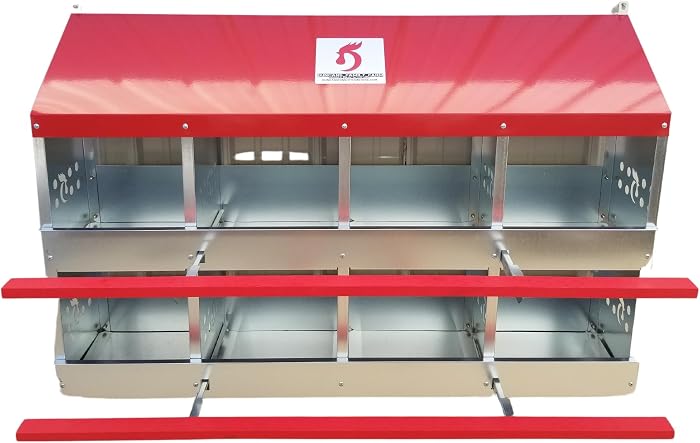
The parts are laser-cut galvanized steel with rolled edges, and the nuts come already attached to the frame, so assembly is a matter of driving screws rather than chasing washers around the coop floor. Eight nests sit in a single 52-inch run, 20 inches deep and 36 tall, with keyhole hangers that let one person lift the whole unit onto screws already set in the wall.

This is the box we argue for when someone is building a coop they mean to keep for fifteen years. Steel doesn't warp, it doesn't shelter mites the way raw pine does, and the red powder-coated roof looks deliberate rather than improvised. The bottoms lift out for cleaning, and the perches fold flat against the front — folded up, they double as a gate that keeps hens out of the nest overnight, which is how you stop a broody hen from claiming a box for the season.

Eight holes is roughly thirty hens at the usual ratio, so a twelve-bird flock is paying for capacity it won't fill. What the money buys instead is the most consistent quality in this group: thick sheet, machined fittings, and a unit that arrives square and stays square. If you keep a serious flock and you're tired of replacing things, this is where the budget goes.

Worth Noting

  • Costs more upfront than any plastic set
  • More nest than a small flock needs
Our Verdict

Thick galvanized steel, bottoms that lift out, and perches that fold up at night — we think it's the most solidly built box here, and the one to buy for a flock you plan to keep.

Check Latest Price
3

Little Giant Single Nesting Box Best Single Box

Little Giant Single Plastic Nesting Box Chicken Nest Box with Perch (Item No.

Adding one nest

Field Score 90/100
Material
High-density polyethylene
Mounting
Wall, 16-inch stud spacing
Dimensions
26.5 x 15.9 x 19.8 in.
Compartments
1
View on Amazon

If you need one more nest box and not four, this is the one we point to. It's a single molded polyethylene shell, about 26 inches deep, with an entrance perch across the front and ventilation holes above it — deep enough that a hen can land, step in, and turn around without her tail against the back wall. At three pounds it hangs on two screws.

The plastic earns its keep twice over. It doesn't take on the cold the way a metal box does in February, and it wipes down instead of absorbing anything, so there's nothing for mites to live in and no shavings to scrape out of corners. The mounting instructions are worth following too: stack three vertically and the first should sit about 24 inches off the ground, which keeps the bottom box clear of damp and out of a raccoon's reach.

Our hesitation is arithmetic. At one box per four or five hens, a twelve-hen flock needs three of these, and at that point a four-pack of the same kind of plastic shell is the better buy. Where the single really earns its place is the odd job: a broody corner, a hospital pen, a tractor that gets dragged to fresh grass every week, or a second nest for the hen everyone else bullies off the first.

Worth Noting

  • Sold singly, so a full coop costs more
Our Verdict

We like it as the odd-job box: one sturdy plastic nest for a small coop, a broody corner, or a movable tractor, cheap enough that adding a second is no big decision.

Check Latest Price
4

AugFir 2-Compartment Nesting Box Best Budget

AugFir 2-Compartment Nesting Box – Chicken Nesting Box

Small flocks, tight walls

Field Score 87/100
Material
Plastic
Dimensions
11 x 12 x 26 in.
Compartments
2
Egg Collection
Roll-away front tray
View on Amazon

The roll-away floor is the whole point of this one. The base tilts forward so a fresh egg rolls out of the nest and into a tray at the front, away from a hen who might decide to sit on it, step on it, or eat it. Two compartments stack in a 26-inch tower, each about 11 inches deep and 12 wide, with vents at the sides and drainage holes in the base so bedding doesn't sit in a puddle.

We were surprised by how much design is packed into the least expensive box here. Assembly is straightforward with the included hardware, the whole thing is light enough to hang from a coop ceiling without a frame behind it, and the front tray slides out so you're collecting eggs rather than reaching into the nest. For half a dozen hens and a short stretch of wall, it does the work of a much bigger unit.

The trade-off is size. Twelve inches of width is fine for a standard hen and tight for a big Orpington, and the collection tray is shallow, so a hen who insists on building a deep nest can dam the slope and stop the roll. Keep the bedding to a thin layer over the floor and it behaves; pile it up and you've built an ordinary nest box with an extra tray.

Worth Noting

  • Compartments are tight for heavy breeds
Our Verdict

For a handful of hens and a short stretch of wall, this two-box unit is the cheapest route to roll-away egg collection we found here.

Check Latest Price
5

PETSFIT 4-Hole Wooden Nesting Box Best Wooden

PETSFIT 4 Holes Chicken Nesting Box

Coops on display

Field Score 86/100
Material
Fir wood with PVC roof
Mounting
Wall or floor
Dimensions
46 x 12 x 18 in.
Compartments
4
View on Amazon

Natural fir, a PVC roof, and a black plastic back panel add up to something that looks like it belongs against a barn rather than bolted to one. Four nests share a 46-inch run, each semi-enclosed at the front to keep wind off a laying hen, and the unit either hangs on a wall or sits on the ground.

What you're not buying is heft. The fir is light, the back is a plastic panel rather than boards, and the roof is PVC — so this is a box for a covered run or a shed, not something to hang on an exposed fence line. At 12 inches deep it also suits standard and bantam hens better than a big dual-purpose breed, and the parts go together quickly with a screwdriver.

We like it most for the coop you can see from the kitchen window. Wood reads warmer than grey plastic, the roof sheds rain instead of pooling it, and the enclosed back makes a darker pocket than an open-front box — which is exactly the corner a hen hunting for privacy wants. Give it cover, keep it to standard-size birds, and it's the best-looking four-hole box here.

Worth Noting

  • Thin wood with a plastic back panel
  • Twelve-inch depth is snug for big hens
Our Verdict

Fir wood, a PVC roof, and an enclosed back make this the best-looking way to add four nests — we just want it under cover and stocked with standard-size hens.

Check Latest Price
6

Brower 2-Tier 10-Hole Nesting Box Best for Very Large Flocks

Brower 2-Tier 10-Hole Galvanized Steel Chicken Nesting Box

Very large flocks

Field Score 85/100
Weight
50 lb
Material
Galvanized steel
Dimensions
60 x 12 x 34 in.
Compartments
10
View on Amazon

Ten nests, fifty to sixty hens, one 60-inch wall: this is the unit for someone who has stopped counting the flock. The two tiers hold the footprint to 12 inches of depth, so it climbs the wall instead of eating floor space, and the sloped roof sends rain off the front rather than down into the boxes.

The details are aimed at a working coop. Side vents move air through and cut the damp that makes a nest smell, the perch rods are double-bolted and fold back when you want the front clear, and assembly is quoted at 30 to 45 minutes with a screwdriver and a wrench. At 50 pounds it wants two people and a solid wall, which is the honest cost of ten nests in one piece.

Where it slips is consistency. The instructions are the weakest part of the package — some builds run together in an hour, others stall on hardware that doesn't line up — and folding perches and wooden boards can arrive bent. Open the box and check the parts before you start, and plan to go around with a wrench after the first month. For a big flock and a long wall, ten nests for the money is still a strong trade; just go in ready to fettle.

Worth Noting

  • Instructions and hardware quality vary
  • Perches and boards can arrive bent
Our Verdict

Ten nests on one wall for a flock too big to count at a glance; our caveat is the hardware, so go in ready to tighten and straighten.

Check Latest Price
7

Rockever 3-Compartment Nesting Box Best for Large Hens, Small Coops

Rockever 3-Compartment Nesting Box – Nesting Boxes for Chickens

Large hens, small coops

Field Score 84/100
Cleaning
Removable roof panel
Material
Thickened HDPE
Dimensions
40.1 x 20.8 x 20.3 in.
Compartments
3
View on Amazon

Twenty inches of depth is what sets this one apart. Most wall boxes run 12 to 16 inches front to back; here each of the three compartments gets a floor that deep, so a large hen can turn around inside instead of backing out. The 40-inch unit splits into nests of roughly 13 inches of width each, which is roomy by any standard.

The shell is thick HDPE in a matte grey, and the roof lifts off in one piece rather than hinging. We like that for a deep clean: take the top off, hose the whole thing down, and there's no hinge or latch to work around. Every part is pre-drilled and the hardware is in the box, so no power tools are needed.

The trade-off is straightforward. It costs more than our top pick and gives you one fewer nest, so you're paying a premium for room rather than capacity. That's a fair swap only if your birds are actually large; for standard hens it's money spent on space they won't use.

Where we land: if your hens run heavy — Orpingtons, Brahmas, Jersey Giants — the room per nest is worth more than an extra hole, and this is the plastic box we reach for. If they're standard size, the four-pack is the better use of the same money and the same wall.

Worth Noting

  • Costs more than our top pick for fewer nests
Our Verdict

Three deep, roomy plastic nests for big hens — the plastic box we reach for when standard compartments look cramped.

Check Latest Price
8

Matutinus 2-Pack Wooden Nesting Box Best for Starter Coops

Matutinus 2-Pack Wooden Nesting Box – Chicken Nesting Boxes

Starter coops

Field Score 83/100
Material
Solid pine
Mounting
Wall or freestanding
Compartments
2
Box Dimensions
13.5 x 13 x 15.5 in.
View on Amazon

Two solid-pine boxes for less than a single plastic one costs here is the pitch, and it's a good one. Each box runs 13.5 by 13 by 15.5 inches — a proper square footprint rather than a narrow slot — with a semi-enclosed front and a removable tray in the bottom.

The pine is the part we like. It's sanded, jointed rather than stapled, and it holds warmth in a way sheet metal doesn't, which counts for something in a drafty shed in February. Solid wood also takes paint or a fresh coat of sealer, so it can be made to match a coop instead of standing out against it.

Both boxes hang on a wall or stand on a shelf, the parts are pre-drilled, and the tray slides out for cleaning. Bear in mind what wood asks of you: bare pine under a leaky roof soaks up moisture and goes soft, so give it cover and a yearly coat of something.

For a starter trio or a pair of bantams, these are the nicest small boxes here for the money, and they'll dress up a coop in a way grey plastic won't. Past six hens, buy multiples or step up to a four-hole unit — two nests is a small flock's worth and no more.

Worth Noting

  • Two boxes only, so bigger flocks need more
  • Bare pine needs cover or yearly re-sealing
Our Verdict

The nicest small wooden boxes here for the money, and the ones we point to for a starter trio, a pair of bantams, or a coop that wants to look like something.

Check Latest Price

How We Tested Chicken Nesting Boxes

We started by reading through the listings and the reviews behind them, then narrowed to boxes we could actually mount or set down in a backyard coop — plastic, fir wood, and galvanized steel, single units, two-holers, and full ten-hole walls, wall-mounted and floor-standing. Price mattered, but capacity, material, and mount style mattered more. Thirteen made the cut, and they've been living in coops for eight months.

Assembly was timed solo with a cordless drill and a screwdriver, no second pair of hands. The largest steel unit took two of us most of an afternoon; a single plastic box went up in under ten minutes. We read each set of instructions the way a nervous first-timer would and noted where steps were skipped, then counted the hardware and flagged screws that stripped or panels that arrived without pilot marks.

Then the hens took over. We watched the first few mornings of every box between about 7 and 10 a.m., when most laying happens, and noted which boxes got used and which got ignored. Egg collection was done one-handed with a basket in the other, to see whether a door swung wide enough or a slanted floor actually rolled a clean egg forward. Cleaning was a Saturday job: plastic and metal got hosed off in the driveway, wood got scraped and re-bedded, and we tracked where shavings caught in corners.

Over the eight months we checked stability by leaning on each mount and watching whether a hen landing on the perch rocked the whole unit, and durability by tracking rust at the welds, sagging wooden floors, and plastic roofs through sun and rain. Material explained most of the price gaps; value came down to whether a box still looked and worked like new after a wet spring.

How to Choose a Chicken Nesting Box

Count boxes first, then measure one compartment

One nest per four to five hens is the working rule, and it's a floor rather than a target. Hens queue, and a flock of six does better with three boxes than with one and a half — the lower-ranked hen needs somewhere to go when the top hen is settled in.

Compartment size is where listings get loose. Aim for at least 12 inches in every direction, and 15 inches wide if you keep heavy breeds, because a Brahma or a Jersey Giant physically cannot turn in a 10-inch slot. A 32-inch unit split six ways gives each hen less room than a single 15-inch box, so check the inside of one compartment rather than the length of the whole thing.

Plastic, steel, or wood

Plastic is what we steer most backyard keepers toward. High-density polyethylene doesn't rot, doesn't absorb moisture, hoses out in a minute, and feels warmer than sheet metal on a cold morning. Steel wins on longevity and on large-flock economics — a galvanized unit outlasts several plastic sets and gives you more nests per inch of wall — but it's cold in winter, heavier to hang, and rusts wherever the coating gets scratched. Wood looks best and insulates well, and it's also the material that holds damp, shelters mites in the joints, and needs re-sealing every year or two.

None of these is wrong. Match the material to the coop: an open, humid run calls for plastic or galvanized steel, while a covered shed with a coat of paint on it can take wood.

Mount it where the hens want it

Wall-mounted boxes want framing. Most hang on 16-inch on-center studs, and if your coop is skinned in metal, plastic sheeting, or hardware cloth, plan a plywood backer before the box arrives — screws into sheathing alone will pull out with a hen's weight on them. Height matters too: 18 to 24 inches off the floor is the usual guidance, and always below the roost. Put a nest above the perch and you'll be scraping it every week.

Floor-standing units need to sit off the ground on blocks or a shelf, both to stay dry and to keep rodents and snakes from treating the box as a doorway into the coop.

Roll-away floors and cleaning design

A roll-away floor tilts so the egg rolls to a tray at the front, out of reach of a hen who might step on it or eat it. It's genuinely useful in a flock with an egg-eater and it keeps eggs cleaner. The catch is bedding: hens like to build, and a deep pile of shavings will dam the slope and stop the roll. Keep the layer thin over a roll-away floor and save deep bedding for an open box.

On any box, the cleaning feature worth paying for is a bottom that lifts out or a shell that comes off the wall. That's the difference between a two-minute job and a twenty-minute one, and it's the feature you'll notice every single week.

Frequently Asked Questions

Final Verdict

The Miller four-pack is the one we send most people to: four plastic boxes on a single wall, inexpensive per nest, easy to hose out, and hens walk into them without a training program. It solves nesting for a normal backyard flock in one purchase, which is why it holds the top spot.

Spend the extra on the Duncan's steel unit if you're keeping twenty-plus birds and want a box that outlives the coop, and pick the Little Giant single if you need one nest rather than a set.