The 5 Best Circular Saw Blades of 2026

A circular saw can feel like it's fighting you—until you put a fresh, well-made blade on it. The blade is where the cut actually happens: it decides whether plywood splinters, whether a rip cut wanders, and how hard you have to push through a 2x4. I learned that after burning through a cheap blade mid-project, and I've been picky about what goes on the arbor ever since. Over the past four months, we ran 16 circular saw blades across the common sizes, from framing lumber to finish plywood.

Tooth count changes what a blade is good at: fewer, larger teeth clear waste fast for framing, while more teeth leave a smoother edge on trim and plywood. Carbide tips are the other dividing line—they usually hold an edge longer than steel, but the quality of the tip and how cleanly it's brazed matter more than the word "carbide" on the package. The picks below earned their spot by cutting cleanly, staying sharp, and making sense for the money.

Our Top Picks

The 5 Best Circular Saw Blades of 2026

1

Diablo Finish 7-1/4-Inch 40-Tooth Best Overall

Diablo Finish 7-1/4-Inch 40-Tooth

General woodworking

Field Score 97/100
Arbor
5/8 in
Diameter
7-1/4 in
Max Speed
8,000 RPM
Tooth Count
40 ATB
View on Amazon

Forty teeth on a 7-1/4-inch blade is the combination we recommend first because it covers the cuts most people actually make: crosscutting 2x stock, trimming plywood, and leaving an edge that does not need much sanding. The Diablo D0740A makes that role feel easy. Its ATB finish grind and thin laser-cut kerf leave a cleaner line than the 24-tooth framing blades here, especially at the exit edge of plywood and trim. We also liked that it does not make a modest sidewinder feel underpowered; the thin kerf asks less of the motor while the 40 teeth still produce a smooth cut.

TiCo carbide and tri-metal brazing are the durability details behind that performance, and the hardened steel body gives the plate a stiff, planted feel. The Perma-Shield coating is not just red dressing—it resists heat, gumming, and corrosion, which matters if you cut pine or pressure-treated stock that likes to leave pitch on a blade. The 5/8-inch arbor with diamond knockout is the common fit for 7-1/4-inch saws, though it is worth checking your spindle before ordering if you run a trim saw with a 10mm arbor.

Where we reach for it is the finish side of a project: trimming cabinet parts, crosscutting deck boards, or cleaning up a cut that will be seen. The red plate is also easy to spot in a crowded tool bag, which sounds small until you are digging for the right blade.

Worth Noting

  • Not the fastest choice for heavy ripping
Our Verdict

For the widest range of trim, plywood, and general crosscuts on a standard 7-1/4-inch saw, this is the blade we reach for first.

Check Latest Price
2

DeWalt 6-1/2-Inch 40-Tooth Best for Compact Cordless Saws

DeWalt 6-1/2-Inch 40-Tooth

Compact cordless saws

Field Score 96/100
Kerf
Thin kerf
Diameter
6-1/2 in
Tooth Count
40
Tooth Design
ToughTrack
View on Amazon

A 6-1/2-inch blade is the compact-saw counterpart to the 7-1/4-inch pick above. The DeWalt DWA161240 pairs a 40-tooth count with a thin kerf and the company's ToughTrack tooth profile, and it is rated for both corded and cordless saws. That combination is aimed at the saw most homeowners actually carry: a smaller, lighter circular saw that benefits from a blade that does not demand a lot of torque.

What we like most is how the blade handles the small-saw compromise. The 40-tooth count is high enough for clean crosscuts in plywood and trim, but the thin kerf and body slots keep it from feeling like the saw is working harder than it should. We used it for shelf parts and trim cuts and came away preferring it to the coarser framing blades in this group for anything that would be seen. The ToughTrack tooth design is the detail behind that steady feel; it is meant to keep the blade tracking straight as it wears, and that is the right priority for a cordless saw that gets dragged around a jobsite.

One practical detail: the blade is thin enough that it does not fight the saw's motor, so a long run of crosscuts does not leave the saw feeling heat-soaked. That is the difference between a blade you tolerate and one you leave on the saw.

Worth Noting

  • Less cut depth than 7-1/4-inch blades
Our Verdict

If your cordless saw takes a 6-1/2-inch blade, this 40-tooth DeWalt is the one we recommend for clean crosscuts and general trim work.

Check Latest Price
3

Diablo 5-3/8-Inch 36-Tooth Trim Best for Trim Saws

Diablo 5-3/8-Inch 36-Tooth Trim

Trim and finish cuts

Field Score 95/100
Kerf
.049 in
Arbor
10 mm
Diameter
5-3/8 in
Tooth Count
36 ATB
View on Amazon

The 10mm arbor tells you this is a trim-saw blade, and the 36-tooth ATB grind tells you it is meant for clean edges rather than fast framing. On a low-powered 5-3/8-inch saw, the thin .049-inch kerf is the real advantage: the blade asks less of the motor, so the saw keeps its speed through trim and plywood instead of bogging down. We liked it most for finish cuts where a standard framing blade leaves fuzz and tear-out.

The 36-tooth count is high for this diameter, and that is the point. It gives you a smoother cut in hardwood, plywood, and laminate, and the ATB teeth slice rather than tear, so the edge stays chip-free enough to skip a lot of sanding. We also noticed it runs quieter than the stamped blade that came on the saw, which is a welcome change on detail work. The Perma-Shield coating keeps pitch from building up, and the laser-cut stabilizer vents help the blade stay calm in the cut.

The blade is a specialist, and it earns its place when the cut will be seen. It is not the blade to grab for fast framing, but on a compact trim saw it turns clean cuts into the default.

Worth Noting

  • 10mm arbor does not fit every compact saw
Our Verdict

For a 5-3/8-inch trim saw, this 36-tooth Diablo is the clean-cutting choice for detail work and laminate.

Check Latest Price
4

DeWalt 6-1/2-Inch 18/24-Tooth Combo Best Two-Blade Value

DeWalt 6-1/2-Inch 18/24-Tooth Combo

Framing and ripping

Field Score 94/100
Kerf
Thin kerf
Diameter
6-1/2 in
Tooth Counts
18 and 24
Tooth Design
ToughTrack
View on Amazon

The two-blade pack is the appeal here: an 18-tooth blade for fast rips and rough framing, and a 24-tooth blade for general crosscuts and sheet goods. Both are 6-1/2-inch blades with a thin kerf, so they suit the compact cordless saws that use that size.

The shared ToughTrack tooth design and anti-vibration body slots are the same family features DeWalt uses on its single blades, and they matter more on a 6-1/2-inch saw than they might on a bigger one. A compact saw has less torque to spare, so a thin kerf and a stable plate help it keep moving through 2x material without bogging down. The pair covers both rough and general cuts instead of forcing one tooth count to do everything.

The value we see is not just two blades for one purchase; it is having the right tooth count on hand when a project switches from framing to trim. For a 6-1/2-inch saw owner who does both, this is the pack that keeps a rough blade from doing finish work. The 24-tooth is the better generalist for shelf parts and deck boards, while the 18-tooth handles the fast, dirty cuts.

The reinforced shoulder on the 18-tooth is the detail we appreciate most when cutting used lumber. It is built for nail-embedded wood, which is exactly the kind of material you meet on a tear-out or remodel, and it gives the tooth tips a little more protection when a hidden fastener shows up. That is a small feature with a real job.

Worth Noting

  • No 40-tooth finish blade included
Our Verdict

A smart buy if you want one blade for framing and one for general cuts without shopping twice.

Check Latest Price
5

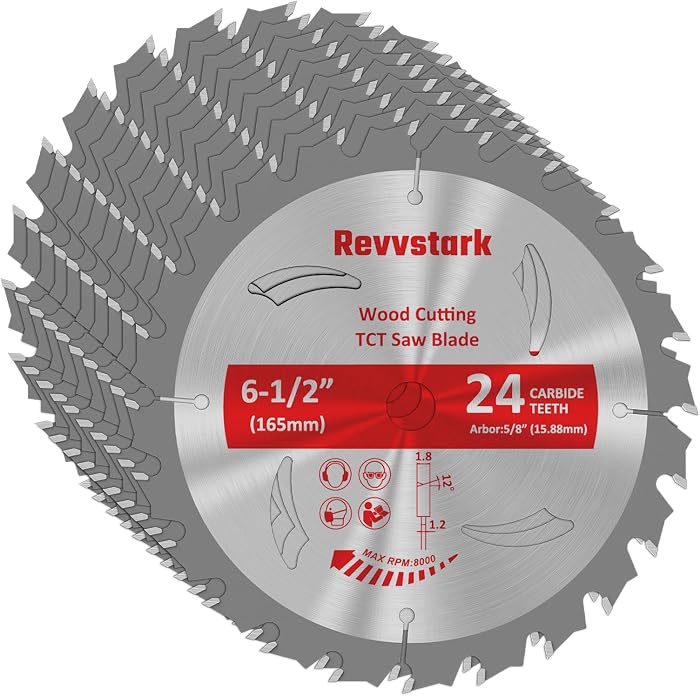
Revvstark 6-1/2-Inch 24-Tooth 10-Pack Best for Bulk Jobsite Use

Revvstark 6-1/2-Inch 24-Tooth 10-Pack – 10 PCS Circular Saw Blade 6-1/2" 24T for Cutting Wood

Bulk jobsite use

Field Score 93/100
Arbor
5/8 in
Diameter
6-1/2 in
Pack Size
10 blades
Tooth Count
24
View on Amazon

Ten 24-tooth blades in one pack is a different proposition from the singles here. The Revvstark set is aimed at work where a blade is a consumable: framing, decking, pallets, and the kind of jobsite cutting where you might hit a nail or a knot and not want to stop. The 6-1/2-inch diameter and 5/8-inch arbor fit common compact circular saws, and the 24-tooth count is coarse enough to move quickly through softwood.

We see this as a crew pack or a spare-blade stash rather than a finish blade. The thin kerf and noise-reducing perforations are useful on a compact saw, and the per-blade cost is where the pack earns its place: you can keep a fresh blade in each saw and swap out a dull one without treating it like a major purchase.

The 8,000 RPM rating and 5/8-inch arbor are the practical details to check against your saw before ordering, and the anti-kickback teeth give the blade a more controlled feel in rough stock. We keep one in the truck for the cuts that are more about getting through the board than showing off the edge. That is the job this pack is built for.

Worth Noting

  • Only 24-tooth blades in the pack
  • Rougher cut than finish blades
Our Verdict

A practical bulk pack for rough framing, decking, and jobsite spares when a clean finish is not the priority.

Check Latest Price

How We Tested Circular Saw Blades

We started by pulling together blades in the sizes most circular saws use, then narrowed the list by tooth count, carbide tip construction, arbor size, and price tier so it included framing blades, finish blades, and budget multi-packs. We tested 16 blades over four months. The work happened where these blades actually get used: my garage workbench, a driveway cut station, and a weekend deck repair. I crosscut 2x4s, ripped plywood, trimmed hardwood, and cut composite decking, using each blade long enough to get past the first impressive cuts.

Cut quality was judged by what came off the saw: tearout on plywood, burn marks on trim, and whether cuts stayed square. Sharpness showed up as effort—how much forward pressure the saw needed and whether the blade pulled itself through the wood or I had to muscle it. I also checked each blade for wobble on the saw and looked at the carbide tips for chipped or uneven edges before the first cut and again after repeated use.

To get at durability, I ran a set number of cuts in stacked plywood and pressure-treated lumber, then noted whether the blade slowed down, gummed up, or started leaving a rougher edge. Value came last: I compared how each blade cut and held up against what it cost, since a cheap blade that dies after a dozen cuts is not a bargain. The ones that rose to the top did not just cut fast on the first pass; they were still cutting clean after the work piled up.

How to Choose a Circular Saw Blade

Start With Diameter and Arbor

A 7-1/4-inch blade is the common full-size choice, while 6-1/2- and 5-3/8-inch blades serve compact and trim saws. Diameter is easy; arbor size is the detail that trips people up. Many full-size saws use a 5/8-inch arbor, but compact trim saws can use a 10mm spindle, and a blade that does not seat properly is not a bargain. Check the old blade or the saw's manual before ordering.

We treat arbor fit as a hard stop. If the product page does not state the arbor, look up the saw model before you buy; no tooth count makes up for a blade that will not mount.

Choose Tooth Count for the Cut

Tooth count is shorthand for the finish you can expect. A 24-tooth blade is a framing and ripping tool: it clears material fast and leaves a rougher edge. Forty teeth is the general-purpose sweet spot for crosscuts in plywood and trim. A 60-tooth blade is for cabinet work and delicate moldings where tear-out matters more than speed. We do not ask a 24-tooth framing blade to leave a finish-ready edge; that is a different job. If you do both framing and finish work, a two-blade pack makes more sense than a compromise blade.

Understand Thin Kerf

Thin kerf means the blade removes less wood, which asks less of the motor and helps a cordless saw keep its speed. That is why so many compact and trim blades use it. The trade-off is stability: a very thin plate can flex more in deep or wet cuts, so let the saw do the work and avoid forcing a deep rip. On a low-powered saw, we prioritize thin kerf; on a heavy full-size saw making repeated deep cuts, a standard kerf is the more forgiving choice.

Match the Blade to the Material

A wood-cutting carbide blade is not a universal blade. Fiber cement, metal, and masonry need their own tooth geometry and often a different blade body; using a wood blade on those materials can overheat the blade and increase kickback. For decking and siding work, a PCD-tipped fiber-cement blade is the specialist choice, and it produces a lot of fine dust, so eye protection and a controlled cutting area matter. For wood, match the tooth count to the finish you need and keep the blade clean.

Decide Between a Single Blade and a Pack

A single 40-tooth blade is the right first purchase for most homeowners because it covers crosscuts, trim, and sheet goods. A two-blade pack makes sense if your 6-1/2-inch saw switches between framing and general work. A bulk pack of 24-tooth blades is for rough material and crews that treat blades as consumables; it is not the pack to buy for finish carpentry. Buy for the work you do most, then add a specialist blade only when a project demands it.

Frequently Asked Questions

Final Verdict

For most 7-1/4-inch circular saws, the Diablo 40-tooth finish blade is the one we recommend first: it makes clean crosscuts in plywood and trim without making a standard saw feel underpowered. If you run a compact 6-1/2-inch cordless saw, the DeWalt 40-tooth is the better fit, and the DeWalt 18/24 combo covers framing and general work in one purchase. The Revvstark 10-pack is the value play for rough jobsite cuts, not finish work.