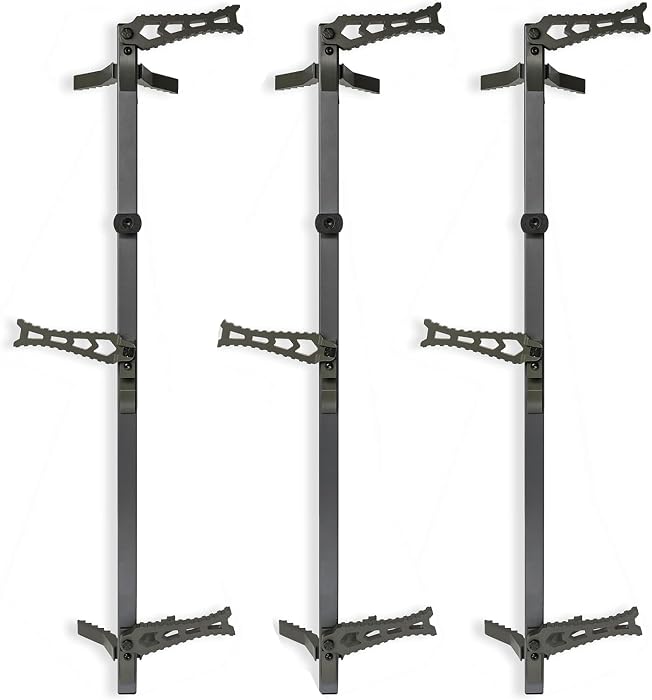
The 8 Best Climbing Sticks of 2026

Nobody gets excited about climbing sticks. They're the part of a treestand setup you buy once, fight with in the dark, and trust with your life at 5:40 in the morning — which is why the details behind a solid lockup matter more than the product photos show. A good set disappears under your boots: quiet, planted, repeatable.

My team and I spent eight months running 12 sets through spring scouting, archery season, and late-season sits, and the trade-offs are clearer than the spec sheets suggest. Longer sections mean fewer strap connections between you and the top, but they pack bulkier — and a stick that clatters against your stand on the walk in costs you more than a few extra ounces ever will. The closure matters just as much: a cam strap you can't work with gloves on turns a two-minute hang into a ten-minute argument with the trunk.

Below are the sets that earned a permanent place in the truck — the ones we'd hang on a leaning oak in the rain, and the ones we'd hand to a friend who's tired of borrowing.

Our Top Picks

The 8 Best Climbing Sticks of 2026

1

XOP X2 3-Pack Best Overall

XOP X2 3-Pack

Mobile saddle hunts

Field Score 90/100
Step Width
10 inches
Sticks Included
3
Length Per Stick
19.5 inches
Weight Per Stick
1.6 lb
View on Amazon

Three short sticks with 10-inch steps are the reason the X2 is our top pick. The 19.5-inch sections space steps 17 inches apart and hold the boot 5 inches off the trunk, so a muddy lace has room to clear bark. We noticed the step surface first: it is broad and rough enough that your foot lands in the same place instead of searching for an edge. For a mobile hunter who wants a small pack and a planted climb, this is the set we recommend.

The carry is the other half of the case. At 1.6 pounds per stick, the three-stick set goes onto a pack without the swing of a long ladder, and the side-stack clamps let the sticks nest into one bundle. We also like the deep standoff on uneven trunks; it keeps the stick from folding your ankle toward the tree. The cam straps are straightforward to set, and the sticks integrate with XOP hang-on stands for silent transport.

Grip comes from the DURAGRIP coating and the bark teeth, and it is the part we trusted most. The trade-off is noise: bare aluminum rings when the sticks knock together, so we keep the contact points separated or taped in the pack. That is a packing ritual, not a reason to pass.

The X2 is the set we reach for when the pack is already full and the tree is still a quarter mile in. It earns that place with the step, not the paint.

Worth Noting

  • Sharp step texture can catch skin and ropes
  • Three-stick set needs aiders for tall stands
Our Verdict

We recommend the X2 as the default mobile set: wide, grippy steps, a deep standoff, and three sticks that pack small enough to carry in without a second trip.

Check Latest Price
2

Muddy Pro 4-Pack Best Quiet Four-Stick Kit

Muddy Pro Aluminum Climbing Sticks Designed for Use on Crooked or Straight Trees

Quiet fixed setups

Field Score 89/100
Attachment
Rope cam
Set Weight
10 lb
Climb Height
12.5 feet
Sticks Included
4
View on Amazon

Four 20-inch sections, 12.5 feet of reach with 18 inches between steps, and a rope cam instead of a buckle: the Muddy Pro is built for a quieter, more deliberate setup. The sections nest in the Peg-Pack system, and the rope-and-cam attachment avoids the metal clang of a cam buckle swinging against the tree. That is a useful head start on a cold morning.

We like this set best for a fixed or semi-mobile stand where you are not carrying it miles. Once the rope cam is set, the stick pulls tight and stays put, and the four-section reach gets you into a normal hang-on without a ladder. The aluminum sections are stout enough for a firm step, and the black-and-orange rope is easy to find in the leaves.

The catch is the hardware. The cam cleats need a firm, clean bite, and the bolts benefit from a check before the season and again after a few climbs. A step mounted backward or a cam that is not seated is the kind of thing you want to catch on flat ground. Set one stick low, load it, and look at every connection before you go higher.

The rope cam is the part that keeps it in our rotation: it is quiet going on and quiet coming off, and that is worth more than a few saved ounces when the stand is set for the season.

Worth Noting

  • Ten-pound set is a load on long walks
Our Verdict

For a quiet four-stick climb to about 12.5 feet, the Muddy Pro is the set we trust, provided you check the cam hardware and accept the extra carry weight.

Check Latest Price
3

Tomaki 4-Pack Best Value

Tomaki 4-Pack – Climbing Sticks

Budget four-stick kit

Field Score 88/100
Attachment
Four straps
Set Weight
11.5 lb
Sticks Included
4
Weight Capacity
350 lb
View on Amazon

The Tomaki set is the value play: four aluminum sticks, four straps, a sliding lock clip, and a 350-pound rating for less money than the premium kits. We like that it does not strip the package down to three sticks to hit its price. The V-shaped gear bracket is the detail that makes it more than a budget copy; it wraps the trunk and gives the step a firmer bite than a flat back.

The steps have raised ends and a non-slip surface, which matters when you are climbing in wet boots. The sliding lock clip keeps the sticks together for transport, and the four-strap bundle is simple to hang on a pack. We found the V-bracket easiest to set on rough-barked trees, where the wings can find a shoulder instead of skating across the surface. A four-stick set also gives you fewer trips up and down while you learn your spacing.

The Tomaki is not a premium set, and it shows in small ways: the fit and finish are workmanlike, and the bundle does not nest as tightly as the XOP. But the four-stick count and the 350-pound rating are what matter on the tree, and they are here. Save the premium dollars for a platform or a better harness.

The four-stick count is the part that matters: it gives a newer hunter room to learn spacing without buying a second set.

Worth Noting

  • 11.5-pound set is not a featherweight
Our Verdict

We point budget-minded hunters to the Tomaki set for four sticks, a 350-pound rating, and a V-bracket bite that costs less than the premium kits.

Check Latest Price
4

Rivers Edge Grip Rail 4-Pack Best Wide-Step Set

Rivers Edge Grip Rail 4-Pack

Wide, stable steps

Field Score 87/100
Step Width
Fits two feet
Sections Included
4
Length Per Section
32 inches
Weight Per Section
5 lb
View on Amazon

The Grip Rail's steps are wide enough for two feet, and that changes how the climb feels. Instead of perching on a narrow rung, you can plant a boot flat and shift your weight without the step disappearing under your arch. Four 32-inch steel sections make a ladder-like set, and the noiseless strap attachment keeps metal from grinding on metal.

We choose this set when steady footing matters more than a light pack. The permanent Tractionite coating is the kind of non-slip surface that still works with mud on it, and the independent sections let you space the rails to the tree rather than fighting a fixed ladder. For a stand you set once and leave for the season, that combination is hard to beat.

The steel build is the reason it feels planted, and also the reason it is not a long-walk set. Each section is listed at 5 pounds, so the four-pack is a deliberate carry; you feel it on the approach and you need room for it on the pack. On a short walk or a permanent setup, that mass buys a broad, quiet step that does not skitter.

What stays with us is the flat place for a boot; the Grip Rail feels less like a climbing stick and more like a short ladder you can carry.

Worth Noting

  • Long 32-inch sections are awkward to pack
Our Verdict

We choose the Grip Rail set when steady, two-foot-wide steps matter more than pack weight, especially for hunters who want a ladder feel with quiet straps.

Check Latest Price
5

RiteAim 30-Inch 3-Pack Best Lightweight Three-Stick Set

RiteAim 30-Inch 3-Pack – 30"Climbing Sticks for Hunting

Light three-stick pack

Field Score 82/100
Sticks Included
3
Weight Capacity
350 lb
Length Per Stick
30 inches
Weight Per Stick
2.5 lb
View on Amazon

Three 30-inch sticks replacing five short ones is the pitch, and the math is easy to like: 90 inches of climbing length, 2.5 pounds per stick, and a 350-pound capacity. The set stacks into a compact bundle rather than a bundle of five short sections. For a hunter trying to cut bulk without giving up height, that is a sensible trade.

The V-shaped bracket and grooved steps are built around muddy boots. RiteAim lists 4.7 inches of boot clearance, which is enough room to get your toe under the step without scraping the trunk. The slide-lock buckle is meant to keep setup quiet, and the longer sections mean fewer straps to undo and fewer moves in the dark.

We like the RiteAim best as a light three-stick pack for hunters who already use aiders or a platform and want fewer pieces to manage. The 30-inch sections give you more stick per move, and the 2.5-pound carry is easy to strap on. It is not the set for a hunter who wants a full four-stick ladder without add-ons.

Three sticks mean fewer hangs and fewer straps, and 90 inches still gets you into most hang-on setups with an aider. The simplicity is the appeal.

Worth Noting

  • Long 30-inch sections are awkward in a small pack
Our Verdict

We like the RiteAim set for hunters who want three longer sticks instead of a bundle of short ones, with low carry weight and a 350-pound rating.

Check Latest Price
6

XOP 34-Inch 3-Pack Best for Smaller, Rough Trunks

XOP 34 Inch Aluminum Climbing Sticks for Hunting

Smaller, rough trunks

Field Score 81/100
Sticks Included
3
Weight Capacity
350 lb
Length Per Stick
34 inches
Weight Per Stick
3.2 lb
View on Amazon

A 34-inch stick is a different tool from a short mobile step, and the XOP set makes the most sense when you want more length per section and do not mind the carry. Each stick weighs 3.2 pounds and carries a 350-pound rating, with a deep stand-off that keeps your boot away from the trunk. The Lock Tight stack snaps the three sticks together without a strap, which is a neat trick when you are packing up in the dark.

We like the XOP integration: these sticks mate with XOP hang-on stands for transport, and the cam straps are simple to set. The deep bracket is the part that matters on a tree with a little lean; it gives your foot room to sit flat instead of wedging against bark. The three-stick bundle is long, but it straps to a pack without the bulk of a four-section ladder.

The limitation is tree fit. The bark teeth are at their best on smaller, rougher trunks; on a big, smooth tree they may not bite the way you expect. Check the trunk before you commit, especially if your best spot is an old oak rather than a pine. For the right small-trunk setup, the extra length is worth the fuss.

On the right trunk, the extra length per stick means fewer moves and fewer straps to fiddle with; on the wrong one, the teeth tell you so quickly.

Worth Noting

  • 3.2 pounds per stick is heavy on long walks
Our Verdict

We recommend the 34-inch XOP set for straight, smaller trees and hunters who want more stick length per step, as long as the 3.2-pound carry is acceptable.

Check Latest Price
7

Muddy Stagger Steps 3-Pack Best for Crooked Tree Setups

Muddy Stagger Steps 3-Pack

Crooked tree setups

Field Score 74/100
Weight Capacity
300 lb
Sections Included
3
Height Per Section
31 inches
Weight Per Section
4 lb
View on Amazon

A 31-inch steel section with a full, enclosed step is what the Stagger Steps bring to a crooked or leaning tree. The sections are 9 inches wide, rated to 300 pounds, and use a cam-buckle strap to pull tight against a trunk that is not perfectly straight. That is a different approach from a short aluminum stick, and for some trees it is the right one.

The full step is the feature we keep coming back to. You get a flat place for the whole boot rather than a narrow rung, and the enclosed design gives your foot a pocket instead of an edge. The stagger layout also lets you work around a lean without fighting the tree for a straight line. For a fixed stand on a gnarly trunk, that matters.

The steel construction is honest about its job: each section is listed at 4 pounds, and the three-pack is a 14-pound bundle. You feel that on the walk in, but the reward is a solid, ladder-like feel on a tree where an aluminum stick might sit crooked.

On the right trunk, the wide full step feels more like a ladder than a stick, and that is the reason to carry the steel.

Worth Noting

  • Bulkier than nesting aluminum sticks
Our Verdict

We suggest the Stagger Steps for crooked or leaning trees and hunters who want full steel steps, not a compact aluminum stick set for long hikes.

Check Latest Price
8

Guide Gear Rapid 4-Pack

Guide Gear 20' Rapid Climbing Sticks for Tree-Stands

Budget ladder setup

Field Score 73/100
Set Weight
24.2 lb
Weight Capacity
300 lb
Sections Included
4
Length Per Section
5 feet
View on Amazon

The Guide Gear kit is the cheapest way to get a 20-foot ladder in this group. Four 5-foot steel sections, cam-buckle straps, and a 300-pound rating make a simple system that gets you up a tree without a bundle of short sticks. If your stand is close to the truck, the math works.

The ladder-style frame is welded steel and powder-coated, and the sections stack for carrying. We like the positive cam straps: they pull down hard and do not rely on a rope cleat to hold. The 20-foot reach is the real draw, because it lets you set a hang-on without buying a second set of short sticks.

The cost is in the carry: five-foot sections are a truck-to-stand tool, not a backpacking kit. Metal-on-metal contact can also squeak on the climb; a little tape at the joints quiets it. Those are the compromises that come with the low price.

The first time you set it, the five-foot sections feel like a ladder and the cam straps do the work; that is enough for a lease stand you will not move until January.

Worth Noting

  • 24.2-pound set is a heavy carry
Our Verdict

We recommend the Guide Gear kit for a cheap, semi-permanent 20-foot ladder close to the truck, not for a long mobile pack.

Check Latest Price

How We Tested Climbing Sticks in the Dark, With Gloves On

We started with roughly 30 sets on a research list and narrowed it using things you can check before spending a dime: step style, section length, packed footprint, strap hardware, and price per stick. That got us to 12 sets, which we used from spring scouting through the end of the season — about eight months.

Most of the testing happened where the product actually lives: in the dark, with a headlamp, gloves, and a pack on. Each set got hung on a straight-trunk pine and on a leaning oak that has humbled easier sticks, and we timed the whole hang solo, from opening the pack to standing on the last step. Then we climbed it loaded, listening for creaks and counting how many rattles the sections made when they nested together on the walk in.

Straps were checked for creep after an hour under load, and steps were checked for flex with full body weight plus a pack. After every sit we broke the set down, packed it back up, and looked for wear — coating rubbed off the tread, bent pins, straps that had taken a set. Weight got recorded twice: bare on a scale, and strapped to a pack frame for the walk in. Value came down to whether the strap system was included and whether a twelve-foot climb needed three sticks or five. Nothing came through the season unscathed, but the picks below came closest.

How to Choose Climbing Sticks

Match Reach to the Height You Hunt

Height is a system, not a single stick. Four 20-inch sections with 18 inches between them get you about 12.5 feet, while a 20-foot ladder uses four 5-foot sections. Three 30-inch sticks offer 90 inches of stick length but still need aiders or a platform to reach a tall hang-on. Decide your target height first, then count sections and spacing. For mobile hunts, three or four short aluminum sticks plus an aider are easier to carry than a long ladder, but only if you are practiced with the aider.

Attachment, Quiet and Secure

Cam straps and rope cams both work; the difference is fiddling. A cam buckle is fast but can clang, while a rope cam is quieter and easier to fine-tune, though the hardware needs checking. Whichever you choose, test it at ground level on a tree similar to your hunting tree. Check that the strap reaches around the trunk, the cam bites without slipping, and the tag end has somewhere to go. A strap that is too short or a buckle that hangs loose is a problem to find in daylight, not at 5 a.m. In this group, the Muddy Pro's rope cam is the quiet route.

Steps, Standoff, and Tree Fit

Step width is what your boot feels at height. A 10-inch step or a two-foot-wide rail gives you room to place a muddy boot without hunting for the edge. Standoff matters too: a deep bracket keeps laces and toes away from bark and lets the stick sit vertical on uneven trunks. Teeth are the other half; they need bark to bite. On smooth or oversized trunks, a set tuned for small trees can feel vague, so check the tree you plan to hunt, not just the one in the yard.

Carry Weight and Packed Bulk

Compare total weight and packed length, not just the number on a single stick. Three aluminum sticks at 1.6 to 2.5 pounds each are a different carry from four steel sections at 4 to 5 pounds each, and a 24-pound ladder is a truck-to-stand tool. Long sections also stick out of a pack and catch brush. For a long walk, favor a nesting three- or four-stick set; for a short walk or a semi-permanent setup, a steel ladder's extra mass can buy steadier footing.

Check the Load Rating and Hardware

A climbing stick's rating is only the start; the strap, cam, bolts, and bark teeth all share the load. Choose a set rated above your weight with gear, then inspect every connection before the season. Bolts can loosen, straps can fray, and a cam that worked in the store can slip on a different bark. Set the sticks low, weight them, and look for movement before you go higher. If a stick, step, or strap looks compromised, retire it.

Frequently Asked Questions

Final Verdict

The XOP X2 is the set we reach for first because it solves the mobile hunter's real problem: a wide, secure step in a bundle small enough to carry in. If your stand stays in one place and quiet setup matters most, the Muddy Pro's four-section rope-cam kit is the better season-long companion. On a tight budget, the Tomaki gives you four sticks and real capacity without the premium.