The 5 Best Composite Deck Cleaners of 2026

The whole selling point of composite decking is that you never have to stain or seal it. What the brochure skips is that it still gets dirty: pollen works into the grain, wet leaves leave brown tannin ghosts, and any stretch of deck that sits in shade grows a green fuzz by mid-spring. Soapy water and a stiff brush will move some of it. The right cleaner is what turns a season's worth of grime into a one-afternoon job.

Over the past six months, my team and I have worked through 12 composite deck cleaners on four decks in various states of neglect, and the gap between them was wider than I expected. Several needed a second pass over mildew, and a couple left a dulling film I had to rinse twice. Scent surprised me, too. You stand over this stuff for an hour, so the sharp chemical-smelling formulas drove me off the deck while the lighter citrus ones I barely noticed.

One thing worth knowing before you buy: a concentrate is the better value on a full deck, but only if you actually measure, because a heavy mix leaves a residue and a weak one just wets the mildew. Keep a ready-to-use bottle, ideally one with a brush built into the applicator, for grill grease and the odd dark stain by the stairs. The picks below cover both jobs.

Our Top Picks

The 5 Best Composite Deck Cleaners of 2026

1

Simple Green Oxy Solve Total Outdoor Cleaner Best Overall

Simple Green Oxy Solve Total Outdoor Cleaner Concentrate

Most composite decks

Field Score 90/100
Formula
Peroxide-based concentrate
Coverage
Up to 6,400 sq. ft.
Application
Manual or pressure washer
Composite Use
Labeled for composite surfaces
View on Amazon

The label is the first thing we check on a composite deck cleaner, and Simple Green's Oxy Solve Total Outdoor Cleaner passes: it names composite surfaces alongside wood, vinyl, concrete, and brick. That matters because composite boards are part plastic and part wood fiber, and a cleaner that is too aggressive can dull the finish or leave a haze. This one is peroxide-powered and EPA Safer Choice certified, which is useful reassurance when you are spraying near foundation plants or a pet's water bowl, though you still follow the label and rinse.

The coverage is the practical reason it earns the top spot. One bottle treats up to 6,400 square feet, far more than the composite-specific pick here, and you can apply it with a pump sprayer or a pressure washer. We like that flexibility: a small deck can be done with a garden sprayer, while a large one goes faster with a downstream injector, and you are not buying a separate bottle for each job. The concentrate is also a good fit for spring cleanup, when the deck is covered in pollen and winter grime.

The coverage and the composite label are why it works as an all-over wash. It is not the flashiest product in the group, but it is the one that makes the fewest assumptions about your deck.

Worth Noting

  • Requires mixing and your own sprayer
Our Verdict

For most composite decks, we recommend this one: it's labeled for composite, works manually or in a pressure washer, and covers up to 6,400 square feet.

Check Latest Price
2

TimberTech Composite Deck Cleaner Best for TimberTech Decking

TimberTech Composite Deck Cleaner

TimberTech capped decking

Field Score 89/100
Form
1-gallon concentrate
Yield
4 gallons / 1,000 sq. ft.
Formula
Biodegradable
Composite Use
TimberTech AZEK, PRO, EDGE
View on Amazon

TimberTech's Composite Deck Cleaner is the specialist of this group, and we mean that literally: it is formulated for TimberTech's AZEK, PRO, and EDGE capped decking and guaranteed not to damage those boards. If you have just invested in a capped composite deck, that manufacturer blessing is worth something. The concentrate makes four gallons and treats about 1,000 square feet, so the math works for a single-level deck but a large multi-level deck may take more than one bottle. Capped boards are the reason for the specialty formula: the cap is what gives the deck its color and stain resistance, and the cleaner is made not to damage it.

It works as a whole-deck wash or a spot treatment, so one bottle can handle the annual clean and the grease drip by the grill. The label is also clear about what it is for: TimberTech's own boards. If your deck is another brand, the guarantee does not travel with you. For a TimberTech deck, though, it is the obvious choice. We also appreciate that the formula is biodegradable, since deck runoff often ends up in the yard.

Worth Noting

  • Guarantee limited to TimberTech decking
  • Premium price
Our Verdict

We choose TimberTech's cleaner when the deck is capped TimberTech composite and the manufacturer's no-damage guarantee matters more than broad coverage.

Check Latest Price
3

Mold Armor E-Z Deck Wash Best for Mold and Mildew

Mold Armor E-Z Deck Wash

Mold and mildew

Field Score 88/100
Form
1-gallon liquid
Scrubbing
None required
Wait Time
10 minutes
Composite Use
Labeled for composite
View on Amazon

Mold Armor's E-Z Deck, Fence and Patio Wash is built for the deck that has gone green. The label names composite along with wood, PVC, and painted or sealed surfaces, and the routine is about as simple as it gets: spray it on with a garden sprayer, wait ten minutes, and wash it off. No scrubbing is the claim, and for an annual clean that is the appeal—you are not on your knees with a brush.

We reach for it when the problem is mold or mildew rather than general dust and pollen. The ten-minute dwell time is short enough to work around, and the fact that it is labeled for composite means you are not guessing about the surface. It is a whole-deck wash, not a spot wipe, so keep a separate bottle for bird droppings and grease. The same no-scrub routine works on composite rails and boards, which is why it is a good annual wash. If your deck is structurally sound but stained green, this is the deck wash we reach for before the first cookout of the season.

Worth Noting

  • Requires a separate garden sprayer
Our Verdict

We recommend Mold Armor when the deck has green or black growth: it's labeled for composite, sprays on, and rinses off after ten minutes.

Check Latest Price
4

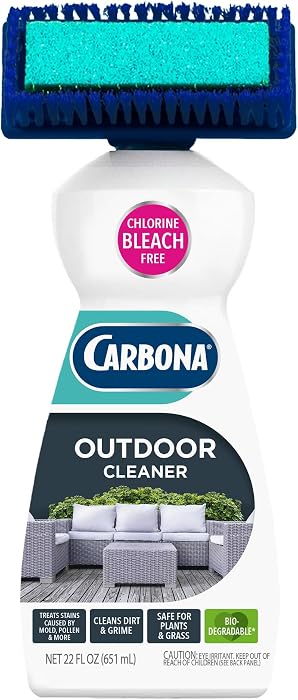
Carbona Outdoor Cleaner Best for Spot Stain Touch-Ups

Carbona Outdoor Cleaner with Built-In Brush

Spot stain touch-ups

Field Score 87/100
Use
Decks and outdoor surfaces
Form
22-fl. oz. spot cleaner
Formula
Chlorine-free oxy
Applicator
Sponge and bristle brush
View on Amazon

Carbona's Outdoor Cleaner is the bottle we keep for the ugly spots: bird droppings on a railing, a greasy drip under the grill, a dark stain by the door. The built-in sponge and bristle brush are the reason it works for this—you can work the foam into the mark without hauling out a bucket. The brush head is the difference between a spot cleaner you use and one that sits in the garage: it is already attached, so there is no pad or bucket to find. It is an oxy-powered, chlorine-free formula, and the label says it is safe around plants, grass, and pets when used as directed.

The 22-ounce bottle is easy to stash in a bucket, and the label does not call out composite, so test a hidden board and rinse well to avoid streaks. For a full deck, start with Simple Green or Mold Armor. Carbona is the bottle that stays in the bucket after the big wash is done.

Worth Noting

  • Spot treatment only
Our Verdict

We keep Carbona's brush-top bottle for spot stains on rails and boards; it's a targeted cleaner, not a whole-deck wash.

Check Latest Price
5

Sun Joe SPX-HDC1G Deck Cleaner Best for Pressure-Washer Owners

Sun Joe SPX-HDC1G House and Deck All-Purpose Pressure Washer Rated Concentrated

Pressure-washer owners

Field Score 86/100
Use
Decks, siding, driveways
Form
1-gallon concentrate
Formula
Bleach-free
Application
Pressure washer
View on Amazon

Sun Joe's SPX-HDC1G is the pressure-washer concentrate in this group, and it is the one we keep for a big, dirty deck when a hose and a pump sprayer turn the job into an all-afternoon affair. It is a gallon of bleach-free detergent, which means no chlorine smell and less worry about runoff on the lawn. The label is aimed at decks, siding, and driveways, and it is meant to run through a pressure washer.

The catch is that pressure washing composite takes some care. A wide fan tip, low pressure, and a steady, overlapping pass are what keep the surface from furring or stripping; a narrow tip held in one spot can do damage. Sun Joe's instructions also tell you to check your pressure washer's manual for the right dilution and injection setup, so this is not a pour-and-go bottle.

We recommend it for pressure-washer owners who want a bleach-free wash without paying the premium for a brand-specific formula. The label does not call out composite, and mildew may need a second pass, so test a hidden board first. The wide fan tip and low pressure matter more than the bottle here; once you get that right, the concentrate does the rest.

Worth Noting

  • Mildew may need a second pass
  • Requires the right pressure-washer setup
Our Verdict

We recommend Sun Joe's bleach-free concentrate for pressure-washer owners who want a lower-cost deck wash, provided they test it on a hidden board first.

Check Latest Price

Four Decks, Six Months, Twelve Cleaners: How We Tested

We built the shortlist from formulas sold specifically for composite, reading each label to confirm the maker didn't warn against capped boards, then kept a mix of concentrates, ready-to-use jugs, pressure-washer formulas, and a brush-top spot treatment. Anything that only listed wood or concrete came off the list.

Testing ran six months, from early spring through the first fall rains, across four decks in different states of neglect. Each of the 12 cleaners got its own section: a full-sun deck with pollen and last summer's grill grease, a shady north-facing deck with green algae, a stretch under oaks with brown tannin stains, plus the railings and stairs. Half went on with a pump sprayer, half through a pressure washer at the dilution printed on the label, and the ready-to-use bottles went on straight from the jug. We let each sit for its labeled time, scrubbed with the same stiff brush, rinsed, then checked again the next day to see what had actually lifted.

At each pass we noted how much mildew came off on the first rinse versus a second application, whether the boards dried evenly or showed a chalky film, and how much scrubbing a stain really took. We timed the mixing, because a two-ounce-per-gallon ratio sounds simple until you're crouched over a measuring cup, and we noted whether a strong smell faded after rinsing or hung around the railing for hours. The brush applicator was judged on a greasy spot alone, no rag or scrub brush allowed.

Along the grass line, we sprayed a few boards and watched the lawn for a week. At the end we weighed what was left in each bottle against the square footage it had covered, since that's the honest way to talk about value here.

How to Choose a Composite Deck Cleaner

Start With Your Deck Manufacturer

Composite boards are not all the same. Some capped brands tell you to use mild soap and water, while others allow a diluted bleach solution for mold; a few will void the finish warranty if you use the wrong thing. Before you buy a bottle, find the cleaning page for your deck brand and follow its dilution and rinse directions. If the maker is silent, choose a peroxide-based or bleach-free cleaner and test a hidden board or the back of a stair tread. That five-minute patch test is cheaper than replacing boards.

Match the Formula to the Mess

For general dirt, pollen, and tannin stains, a peroxide or oxy cleaner is the gentler default, and it won't leave the chlorine smell of a bleach wash. For green or black mold and mildew, a cleaner labeled for those stains does more of the work, but bleach formulas need careful rinsing around plants, metal, and clothing. Keep a separate spot cleaner for bird droppings, grease, and rust; a whole-deck wash wastes product on a single stain. Simple Green's Oxy Solve is the peroxide-style default in this group, while Mold Armor is the mold-specific option.

Pick an Application Method You'll Actually Use

A pump sprayer gives you the most control on stairs, rails, and tight corners. A hose-end bottle is fastest for a simple rectangular deck, but the dilution is fixed and the sprayers can leak or pop off. A pressure washer covers a large deck quickly, but composite needs low pressure, a wide fan tip, and a steady overlapping pass; holding a narrow tip in one spot can scar the surface. If you already own a pressure washer, a concentrate like Sun Joe's is economical, but check the machine's manual for the right injection setup.

Compare Coverage, Not Just the Price Tag

A concentrate can look expensive until you read the yield. Simple Green's Oxy Solve covers up to 6,400 square feet per bottle, while TimberTech's concentrate makes four gallons and treats about 1,000 square feet. For a small deck, a ready-to-use bottle or a spot cleaner may be all you need. For a large deck, do the math: measure length times width, then compare that number with the coverage on the label. A bigger bottle that sits half-used in the garage is not a bargain.

Frequently Asked Questions

Final Verdict

For most composite decks, we recommend Simple Green Oxy Solve Total Outdoor Cleaner. It is labeled for composite, covers up to 6,400 square feet, and works with a pump sprayer or a pressure washer, so it handles a whole deck without a specialty product for every job.

If you own TimberTech capped decking and want the manufacturer's guarantee, TimberTech Composite Deck Cleaner is the specialist. For a deck that is green with mold or mildew, Mold Armor's no-scrub deck wash is the more targeted choice.