The 7 Best Cordless Oscillating Multi-Tools of 2026

An oscillating multi tool solves the jobs no other saw can reach. Its head swings a blade through a few degrees at very high speed, which is how it sinks a flush cut against a doorjamb, slips under baseboard to make room for new flooring, or scrapes old adhesive off a backsplash without gouging the wall behind it. Every one of them cuts — the differences show up in your wrist, your ears, and your blade budget.

I've spent six months cutting oak, drywall, and PVC with 11 of them, and the ones I keep reaching for aren't always the most powerful. They're the ones that buzz less in the hand, change blades without a hunt for a hex key, and have a front end slim enough that you can actually see your cut line. Battery life matters more than the box admits, too, since the same tool that chews through a floor job will sand for only a fraction as long on a charge.

One buying note before you scroll: several of these are bare tools, so factor in batteries and a charger unless you're already on that platform. Blade compatibility is the next thing to check, and blades aren't cheap no matter whose name is on the head. The picks below are the ones that earned a spot in the bag and stayed there.

Our Top Picks

The 7 Best Cordless Oscillating Multi-Tools of 2026

1

DEWALT DCS356B Best Overall
DEWALT 20V MAX XR Oscillating Multi-Tool Cordless

All-around use

Field Score 97/100
Motor
Brushless
Weight
2.4 lb
Battery And Charger
Tool only
Oscillations Per Minute
0-13,000/ 0-17,000/ 0-20,000 OPM
View on Amazon

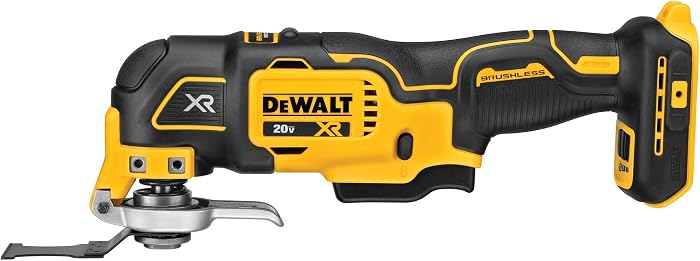
Three speed bands and a variable trigger on the same tool is what put the DCS356B at the top of this list. You set the ceiling at 13,000, 17,000, or 20,000 oscillations per minute and then squeeze the dual-grip trigger to work below it, which is exactly the control you want when you are easing a blade into a door casing and do not want to blow out the far side. Several tools here give you a dial or a trigger. This one gives you both, and that is the difference between a tool you reach for on finish work and one you only bring out to demolish something.

The rest of the design is built for repeat work. The quick-change system swaps blades without a wrench, and the universal adapter takes most other brands' accessories, so you are not locked into DEWALT blades. The LED sits at the head and lights where you are cutting. At 2.4 pounds with a pack aboard it is balanced enough to run one-handed along a baseboard and steady enough for two hands on a plunge cut, and the brushless motor is rated for up to 57 percent more runtime than DEWALT's brushed version.

What to plan around is battery appetite. Long continuous cuts in hardwood pull a pack down faster than a drill would, so a second battery earns its place in the bag — cheap if you already run 20V MAX, an added purchase if you do not. The trigger also locks on for long sanding passes, which we used far more than we expected to. The three-year limited warranty matches Makita and beats CRAFTSMAN, and this is the least expensive bare tool in this group.

Worth Noting

  • Tool only
  • Thirsty in long continuous cuts
Our Verdict

We recommend the DCS356B to most buyers: three speed bands under a variable trigger, wrench-free blade changes, and the 20V MAX packs you probably already own.

Check Latest Price
2

Milwaukee M12 Fuel 2526-20 Best for Tight Spaces

Milwaukee M12 Fuel 2526-20 – 2526-20 M12 Brushless 12-Volt Lithium-Ion Cordless Oscillating Multi-Tool

Overhead work

Field Score 96/100
Motor
Brushless
Weight
1 lb
Speed Range
10,000-20,000 rpm
Battery And Charger
Tool only
View on Amazon

One pound, bare. That is the number that makes the M12 Fuel the tool we grab for anything above shoulder height: cutting out a ceiling box, trimming a cabinet toe kick, or running a sanding pad along a stair stringer. The compact body keeps your wrist where you want it, and the LED illuminates the work without adding bulk to the head.

Do not read the 12-volt battery as a power compromise. This tool tops out at 20,000 rpm, higher than the full-size Milwaukee M18 on this page, and in drywall, pine, and PVC it held its speed without stalling on us. The brushless motor is the reason: it keeps rpm up under load instead of sagging the way a brushed tool does. Blade swaps are quick, and the clamp accepts common aftermarket blades, including Diablo and Dremel accessories.

Where it gives ground is patience. A 12V pack holds less energy than an 18V one, so a long session of continuous cutting means swapping batteries rather than powering through, and this is strictly a bare tool. For trim, cutouts, and sanding in awkward places, that is the right trade — the compact body does work the bigger tools on this page simply cannot do comfortably.

Worth Noting

  • Tool only
  • Costs more than the larger M18 tool here
Our Verdict

We reach for the M12 Fuel when the cut is above our heads or inside a cabinet — a pound of tool that still turns 20,000 rpm.

Check Latest Price
3

CRAFTSMAN CMCE501D1 Best Kit for the Money

CRAFTSMAN V20 Cordless Oscillating Tool Kit Battery and Charger (CMCE501D1)

First-time buyers

Field Score 95/100
Battery
2.0Ah lithium ion included
Voltage
20 volts
In The Box
Charger, two blades, sandpaper, bag
Blade Changes
Tool-free universal attachment
View on Amazon

Open the box and you can start cutting. The CMCE501D1 arrives with a 2.0Ah battery, a charger, a wood blade, a wood-and-metal blade, a sanding platen, four sheets of paper, and a bag. On a page full of bare tools, that is the whole point. The cheapest route to a working oscillating tool is not always the cheapest tool — add a pack and a charger to a bare tool and the arithmetic changes in a hurry.

For a first oscillating tool, that makes it the sensible buy. The variable-speed dial falls under your thumb without a look, the tool-free universal attachment takes standard blades, and the LED does real work under a sink where the light never reaches. It is also part of CRAFTSMAN's 20V system, so the battery you buy today runs a trimmer or a drill later, and the three-year limited warranty matches what DEWALT and Makita offer on their bare tools.

The compromise is the cell. A 2.0Ah pack is the smallest battery in this group: fine for cutting in a door jamb and knocking out a floor patch, less so for an afternoon of continuous sanding, so plan on a second pack or step up to a larger one in the same system. The bag holds the tool and a few blades and not much else.

Worth Noting

  • One small 2.0Ah battery in the kit
Our Verdict

If you own no 20V batteries, we think this kit is the smartest first buy — battery, charger, blades, and bag for less than most bare tools here.

Check Latest Price
4

Makita XMT03Z Best for Makita 18V Users

Makita XMT03Z 18V LXT® Lithium-Ion Cordless Multi-Tool

Makita 18V users

Field Score 94/100
Weight
4 lb
Speed Range
6,000-20,000 OPM
Oscillation Angle
3.2°
Battery And Charger
Tool only
View on Amazon

Two and three-eighths inches is the diameter of the barrel grip on the XMT03Z, and it is why the tool feels different in the hand from everything else here. Wrap a fist around it and the blade reads as an extension of your wrist rather than something hanging off the end of a handle, which shows up in control on a vertical cut or a slow curve in softwood.

The dial runs from 6,000 to 20,000 oscillations per minute, and the low end is where this tool earns its keep: enough speed to sand a cabinet face or scrape glue without burning through the paper. The 3.2-degree oscillation angle is Makita's bid for a balance between fast removal and a clean edge, and the slide switch locks on for long sanding sessions so your thumb can relax. Adapters for other brands' accessories come in the box along with a 1-1/4 inch bi-metal plunge blade, so it is usable on day one if you already own the batteries.

Four pounds is the listed weight, the heaviest on this page, and with a 3.0Ah pack aboard you feel it in a long horizontal cut — though the mass is what keeps the blade from chattering. It also drinks battery, so the low-speed settings are your friend for sanding and a second LXT pack is worth carrying. One compatibility note: Makita calls for 18V batteries with a star symbol, so check the packs you own before you order.

Worth Noting

  • Heaviest tool in this group
  • Goes through batteries in heavy cutting
Our Verdict

Our pick for anyone already on Makita's 18V LXT platform: a slim barrel grip, a wide speed dial, and enough torque to keep up with a corded tool.

Check Latest Price
5

Milwaukee M18 2626-20 Best for Heavy Cutting

Milwaukee 2626-20 M18 18V Lithium Ion Cordless 18

Heavy cutting

Field Score 93/100
Weight
2.9 lb
Top Speed
18,000 rpm
Speed Settings
12
Battery And Charger
Tool only
View on Amazon

An all-metal gear case is the kind of specification that does not sell a tool and does decide whether it survives a jobsite. The 2626-20 pairs it with a rubberized overmold on the handle and an LED mounted at the head, so it works from any angle, including the upside-down ones you get under a sink.

Twelve speed settings give you more adjustment than most people will ever use, and the useful part is the spread: slow enough to start a cut in drywall without a dust storm, fast enough at the top to walk a blade through a door jamb. The five-year tool warranty is longer than any other tool here states, which tells you how Milwaukee expects it to be treated. It is not light at 2.9 pounds, and the mass sits where the motor does, so it tracks straight in a long cut.

Two things to know before you commit. Blade changes need a wrench, and there is no quick release, so the wrench has to live in your bag — a small annoyance that repeats every time you switch from cutting to sanding. And it is a bare tool, so the M18 packs you already own are the reason to choose it; without them the arithmetic favors a kit.

Worth Noting

  • Blade changes need a wrench
  • Tool only
Our Verdict

We like the 2626-20 for people who cut hard and often — a metal gear case, twelve speeds, and a five-year warranty behind it.

Check Latest Price
6

Makita DTM52Z Best for Low Vibration

Makita DTM52Z Li-ion LXT Brushless Multi-Tool

Quiet work

Field Score 91/100
Weight
2.9 lb
Speed Range
10,000-20,000 rpm
Accessory Clamp
Tool-less
Oscillation Angle
3.6°
View on Amazon

Noise and vibration are the two things you notice in the first thirty seconds with the DTM52Z, and they are what keep this tool in reach for work you would otherwise do by hand. The brushless motor and counterbalancing take the buzz out of the grip, and sanding with it was noticeably less tiring than with any other tool here — the difference shows up in your forearm before it shows up in the cut.

The rest of the tool is well sorted. The 3.6-degree oscillation angle is the widest stated here, which is where the cutting speed comes from, and the dial runs 10,000 to 20,000 rpm with soft start and constant speed control so the motor does not sag when the blade loads up. The tool-less clamp holds a blade flat without the wander a worn wrench clamp develops. Anti-restart is the sleeper feature: seat a battery with the switch still on and the tool stays off until you cycle it.

The cost of all that is money and blades. This is the most expensive tool here, and the clamp works with the newer starlock-style blades, which cost more than the older style and are not on every hardware store peg. It is also a bare tool. If you already run Makita 18V LXT and noise or vibration is the problem you are trying to solve, this is the best answer on the page; if you are building a kit from nothing, the money goes further elsewhere.

Worth Noting

  • Most expensive tool in this group
  • Blades for the tool-less clamp cost more
Our Verdict

We recommend the DTM52Z to anyone who has to cut indoors or overhead, where its low noise and near-zero vibration are worth the premium.

Check Latest Price
7

KIMO L23Q3B Best for Occasional Projects

KIMO 20V Cordless Oscillating Tool

Occasional projects

Field Score 88/100
Speeds
6
Battery
2.0Ah with charger included
Speed Range
5,000-21,000 OPM
Kit Contents
26 pieces
View on Amazon

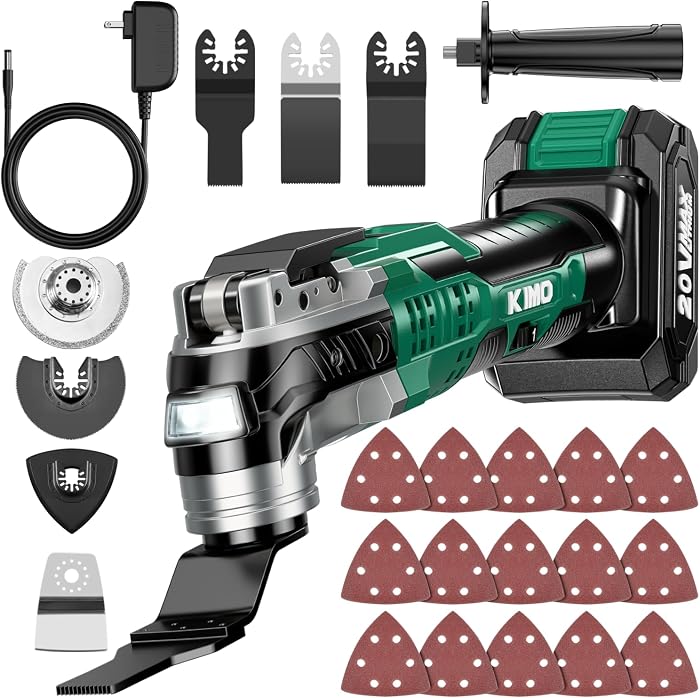
The box is the pitch: a 2.0Ah battery, a 60-minute charger, three plunge-cut blades, a diamond-tipped segment blade, a scraper, a sanding platen, fifteen sheets of paper, a side handle, a depth guide ring, and a bag. For someone who owns no cordless tools at all, that is the shortest path from order to cutting, and the price is the lowest in this group.

It is not just a box of parts. Six speeds from 5,000 to 21,000 oscillations per minute cover a wider range than most tools here, the 3-degree swing is set up for control rather than brute removal, and the tool-free blade change really does take a few seconds. The side handle is the detail we did not expect to use — bolted on, it turns a long cut in plywood from a forearm workout into something you can steer.

The risk is longevity. The one-year warranty is the shortest here, and durability is the thing to watch over months rather than weeks. If your jobs are occasional — a dog door, a floor patch, trimming a few door jambs — the value is hard to argue with, and the bundled accessories alone would cover a good share of what you paid. If you cut every week, spend more and buy once.

Worth Noting

  • One-year warranty, the shortest here
  • Included blades are basic quality
Our Verdict

We think the KIMO kit makes sense for occasional jobs — you get a battery, a charger, and a full accessory set for less than most bare tools here.

Check Latest Price

How We Chose and Tested Cordless Oscillating Multi Tools

We started by pulling every cordless oscillating tool we could find across the major battery platforms, then narrowed the field to models with brushless motors, variable speed, and blade-change systems that don't demand a separate tool. We deliberately kept both bare tools and kits on the list, since whether you're paying for batteries is a big part of the value question. That left 11 tools, which we ran for six months.

Testing happened in a house mid-renovation, not on a bench. Each tool undercut door casing for new flooring, made plunge cuts in oak and pine, notched drywall around outlet boxes, scraped caulk and thinset off a bathroom wall, and sanded the edges of cabinet doors. We also ran every one overhead, cutting into a soffit, because that's where weight stops being a spec and starts being your shoulder.

We timed how long a fresh 2.0-amp-hour battery lasted in continuous oak cuts and again while sanding, then noted how long a recharge took. Blade changes were done with work gloves on and a stopwatch running, and we logged every instance of hunting for a wrench. We judged vibration by how well a one-handed cut stayed on a pencil line, checked whether the LED actually lit the cut line inside a dark cabinet, and noted which accessories dulled or snapped early. Durability got settled the hard way: dropped off a benchtop, pushed until the housing got hot, and used well past the point a sensible person would stop.

How to Choose a Cordless Oscillating Multi-Tool

Start With the Battery You Already Own

A bare tool is not the cheap option if you have to buy a battery and charger to go with it. Add those two items to almost any tool on this page and the total climbs past a kit from a brand you had not considered. So decide the platform first. If you already run DEWALT 20V MAX, Makita 18V LXT, or Milwaukee M18, stay in that lane — the spare pack you need for continuous cutting is already on your shelf. If you own nothing at all, the CRAFTSMAN kit is the least expensive route to actually cutting this weekend.

Speed Bands, Triggers, and Control

Oscillation speed does two jobs. A low setting lets a blade start a cut in drywall or soft trim without grabbing and skipping; a high setting clears material fast. What separates these tools is how you move between the two. A dial is set-and-forget, which is what sanding wants. A variable trigger lets you feather into a cut, which is what a door jamb wants. The DEWALT tool gives you both, in three selectable bands, and that is the single biggest reason it is our default. If your work is all plunge cuts and sanding passes, a dial alone is plenty.

Blade Changes and Accessory Fit

You will change blades more often than you expect, because oscillating blades dull fast in drywall and nail-embedded wood. A tool-free clamp saves minutes on every swap; a wrench clamp means the wrench has to live in the bag. Then check what the tool accepts. Most of these use a universal adapter and take other brands' blades, but a few newer tool-less clamps only take starlock-style blades, which cost more and are not stocked everywhere. Treat blades as a running cost rather than a one-time purchase — on a cheap tool they can outrun the purchase price in a season.

Weight, Vibration, and Where You'll Use It

These tools go where a circular saw cannot: overhead, inside a cabinet, flat against a floor. That makes weight matter more than raw power. A one-pound 12V body is the one you can hold at arm's length long enough to finish a cut; a heavier 18V tool is steadier on a bench and tiring upside down. Vibration and noise follow the same logic. The smoother, quieter tool is the one you reach for on a two-minute job instead of a handsaw, and that is most of the value of owning one.

Runtime, Settings, and Spare Batteries

Continuous cutting drains a pack faster than drilling does, and the smaller the pack the more often you swap. A 2.0Ah battery covers trim and cutouts; a full day of sanding wants a 4.0Ah or larger, or two packs cycling through the charger. Runtime figures are quoted at a given speed, so read them that way — drop a setting and the same pack lasts noticeably longer. If you plan to sand, buy the bigger battery before you buy the fancier tool.

Frequently Asked Questions

Final Verdict

The DEWALT DCS356B is the tool we point most people toward. Three speed bands under a variable trigger give it the widest usable range here, blade changes take seconds, and it runs on DEWALT 20V MAX packs, so a spare is probably already in your garage. It is also the least expensive bare tool in this group.

If you own no batteries at all, buy the CRAFTSMAN kit and start cutting. If the work is overhead or inside cabinets, the one-pound Milwaukee M12 Fuel is worth paying more for.