The 8 Best Deck Stains of 2026

A deck stain is one of the few home purchases where the money is the cheap part — it's the weekend that costs you. Sanding, taping, cutting in around balusters, then two years of squinting at the boards to see whether the finish holds or goes quietly chalky. What you want is boring reliability: color close to the swatch, water that beads instead of soaking in, and no stripping before the next coat.

I've stained my own deck three times in six years, which is one too many, so I had opinions. Over eight months, we tested 12 stains — oil-based, water-based, semi-transparent, and a few for dense hardwoods — on my deck, a shaded side yard, and a sunbaked pergola. One thing first-timers rarely hear: opacity decides most of it. More pigment hides gray longer, but wear shows up as a patchy film instead of an even fade.

Prep and weather do the rest; most of these want dry wood and 50-degree days, which narrows the window to spring or early fall. The picks below held their color and still beaded water months later.

Our Top Picks

The 8 Best Deck Stains of 2026

1

Ready Seal Oil-Based Stain & Sealer Best Overall

Ready Seal Exterior Wood Stain & Sealer

Full-deck staining

Field Score 93/100
Base
Oil-based
Finish
Semi-transparent, matte
Container
5-gallon pail
Recoat Prep
No sanding or stripping
View on Amazon

Rain within minutes of the last pass sounds like something off the label until you have watched a half-stained deck sit under a tarp for two days waiting on the forecast. What sold us on Ready Seal first is that window: it goes on in direct sun, needs no wet edge and no back-brushing, and it can take a shower not long after you finish. If you are staining between fronts on a weekend, that is most of the decision made.

The forgiveness lives in the formula rather than in the technique. This oil-based stain and sealer blends itself, so the lap where you stopped for lunch fades into the boards instead of drying as a dark stripe, and you can work at whatever pace the deck sets. Of everything here, it is the one we trust a first-timer with. It also sprays, rolls or brushes with equal patience, which matters on a railing-and-spindle job a sprayer can't reach cleanly. Dark Walnut goes on almost black and lightens as it cures, so judge the color the next day, not off the wet board.

Five gallons is the only size, and that is the real cost of choosing it: sensible for a full deck, awkward for a porch or a fence repair, and the biggest single outlay on this page. Buy it when the job is genuinely deck-sized and you have a helper to keep the pail moving.

The detail we appreciate most shows up a year later. No sanding or stripping before the next coat turns a recoat into an afternoon rather than a project, and that is the difference between a deck that gets maintained and one that quietly goes gray while you keep putting it off.

Worth Noting

  • Sold only in a five-gallon pail
Our Verdict

We recommend Ready Seal to anyone staining a whole deck themselves: it blends away lap marks, shrugs off sun and rain, and asks less technique than anything else here.

Check Latest Price
2

Thompson's WaterSeal Semi-Transparent Stain Best Value

Thompson’s WaterSeal Semi-Transparent Waterproofing Wood Stain and Sealer

Small decks

Field Score 92/100
Color
Chestnut Brown
Finish
Semi-transparent
Coverage
150–400 sq ft per gallon
Waterproofing
ASTM D-4446
View on Amazon

By price this is the least expensive stain here, and it comes in the size most small jobs actually need. A gallon is rated for 150 to 400 square feet depending on how porous the wood is, so a porch floor, a set of steps or a small deck gets finished without a pail left sitting on a shelf. For a lot of people that math settles the question before anything else does.

The color is the part to slow down on. Chestnut Brown runs far redder than the name and the swatch suggest, and on smooth boards the semi-transparent claim is generous — it can read closer to paint than to stain, which is the opposite of what most people want from a deck finish. On rough or weathered wood it settles down and looks warm rather than red. Test a board, or better, the underside of a step, before you commit the whole can.

What it does well is the part we care about most. Water beads and rolls off after a single coat, the label carries an ASTM waterproofing standard, and it goes on smoothly with a brush, roller or sprayer. That is a fair trade for a color you may have to work around.

Drying is the variable that catches people. In humid air this one stays tacky well past the point where you want to walk on it, and a second coat on a cool evening can push the job into another day. If your forecast is sticky, get the coat down early in the morning and give it the full day.

Worth Noting

  • Chestnut Brown reads much redder than expected
  • Stays tacky in humid weather
Our Verdict

Buy Thompson's when the job is one gallon and one afternoon: strong water beading for the money, as long as you test that red-leaning Chestnut Brown on a spare board first.

Check Latest Price
3

Defy Extreme Wood Stain Best Water-Based

Defy Extreme Wood Stain Light Walnut 1-gallon

Sun-baked decks

Field Score 91/100
Base
Water-based
Finish
Semi-transparent, matte
Coverage
100–150 sq ft per gallon
UV Blocker
Zinc nano-particles
View on Amazon

The zinc nano-particles in Defy Extreme are doing one specific job: intercepting UV before it bleaches the lignin out of the boards, which is the chemistry behind a deck turning silver. It is the most explicitly UV-focused product here, and because it is water-based you clean up with soap and water and work without solvent fumes chasing everyone off the porch.

It goes on thin — actually thin, like water — and that is the point: it soaks in rather than sitting on the surface as a film. It is also why the coverage figure assumes two coats. One pass on thirsty boards leaves a lighter, patchier result than the swatch, so the second coat is not optional.

Durability is where we hesitate. On some decks this holds its color for a couple of seasons; in other cases it has peeled within a couple of months. That split is why it sits below Ready Seal rather than beside it — and still makes it the more interesting of the two water-based stains here if your deck takes hard afternoon sun.

Opacity is the other small surprise. Light Walnut is more transparent than semi-transparent implies, so grain and any variation in the boards stay fully visible. That is lovely on clean, uniform decking and unforgiving on a patchy deck with old stain in the corners.

Worth Noting

  • Peels within months in some cases
  • More transparent than semi-transparent implies
Our Verdict

Defy is our pick if you want a water-based stain with real UV blocking: soap-and-water cleanup, a natural look, and two coats you have to mean.

Check Latest Price
4

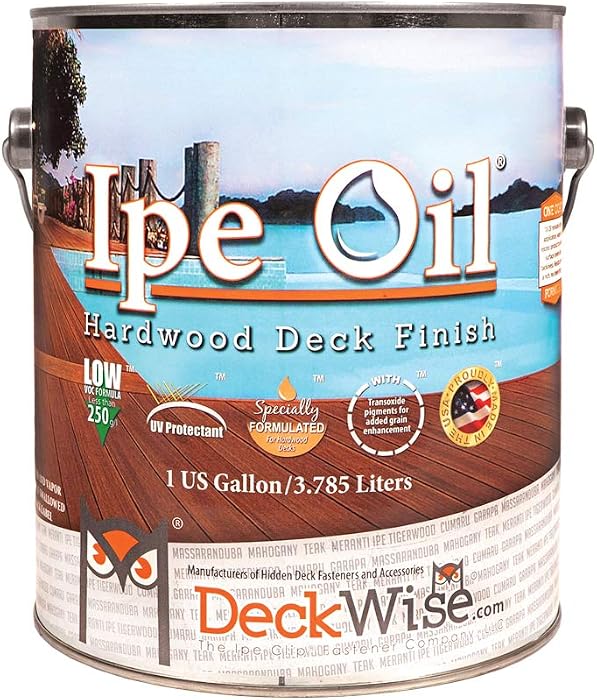
DeckWise Ipe Oil Best for Exotic Hardwood

DeckWise Ipe Oil Hardwood Deck Semi-Transparent 250 V.O.C. Natural Finish

Exotic hardwood decks

Field Score 90/100
Base
Oil-based, 250 VOC
Finish
Semi-transparent, oil
Coverage
250 sq ft per gallon
Wood Types
Ipe, tigerwood, cumaru
View on Amazon

Two oils here are built for dense tropical hardwood, and this is the one with the larger following and the stronger record on looks. Ipe, tigerwood and cumaru do not absorb finish the way cedar or pine does — the boards are tight enough that a surface coating sits on top and wears through in the traffic lanes. That is why this is formulated to penetrate rather than film over, and why it is the first can we reach for on a hardwood deck.

The finish is the reason it earns its price. It brings faded ipe back to a rich brown with no shine at all — the boards look fed rather than coated — and it goes on evenly enough that a mop with a cotton cover does the job. Appearance and ease of application are the two dimensions where this one is at the top of the group, and it delivers both consistently.

The tint is darker than natural implies. On ipe it deepens the brown considerably, and on lighter hardwoods it pushes red; wipe the excess back promptly and it stays closer to the wood's own color. Coverage runs 250 square feet per gallon, on the low side of the oils here, so price the job by the can rather than the label.

One practical catch worth knowing before you order: it is not sold into California's SCAQMD districts or several Southern California counties. If you are inside that footprint, Penofin below is the substitute.

Worth Noting

  • Tint darkens and reddens lighter boards
  • Not sold in parts of Southern California
Our Verdict

If your deck is ipe, cumaru or tigerwood, DeckWise is the finish we reach for: it penetrates dense boards and brings back the brown without laying down a film.

Check Latest Price
5

TWP 101 Pro-Series Cedartone Best for Rough-Sawn Wood

TWP 101 Pro-Series Cedartone Exterior Wood Stain & Protectant

Rough-sawn cedar

Field Score 89/100
Base
Oil-based
Color
Cedartone
Finish
Semi-solid, oil
Coverage
Up to 300 sq ft per gallon
View on Amazon

Rough-sawn cedar, shakes and log walls drink finish in a way a planed deck board never does, and TWP 101 is built for that surface: an oil-based, semi-solid stain that soaks into the texture and leaves a mildew-resistant face behind rather than a coating that can flake off the grain.

Absorption is what to plan around. The label says up to 300 square feet per gallon, and on thirsty wood that up to is doing real work — a log wall or a rough railing can take noticeably more than a smooth deck of the same size. Buy a spare gallon before you start, because running dry halfway across a wall is how you end up with a seam.

We like it best as a problem solver rather than an all-rounder. Cedartone is semi-solid enough to cover grain and even out mismatched boards, and the mildew resistance counts on a shaded wall that never quite dries — that combination is hard to find in one can. On a smooth, pretty deck it is more coverage than most people want, and it reads flatter than the semi-transparent picks here.

VOC limits mean it is not available everywhere, so confirm it can ship to your state before you clear a weekend for it. And because it is oil-based, give it longer to cure than the water-based options.

Worth Noting

  • Coverage runs short on thirsty wood
Our Verdict

For rough-sawn cedar, shakes or log siding, TWP 101 is our pick: it soaks in deep, stands up to mildew, and leaves real color instead of a film.

Check Latest Price
6

Penofin Deep Penetrating Oil

Penofin Deep Penetrating Oil Treatment for Exotic Hardwood Exterior

Natural hardwood finish

Field Score 88/100
Base
Oil-based
Finish
Transparent, oil
Coverage
350 sq ft per gallon
Wood Types
Exotic hardwoods
View on Amazon

Where DeckWise puts a tint in the can, Penofin leaves it out. This is a transparent oil that darkens the boards a shade and lets the figure do the talking, which on a hardwood deck you paid a premium for is the whole argument: you are feeding the wood and blocking UV, not covering up what you bought.

Coverage is listed at 350 square feet per gallon, the most generous of the hardwood oils here, and a little goes further than the price suggests because the technique is wipe-back rather than flood-and-leave. Apply it, give it a few minutes, then take off whatever has not soaked in.

That step is not optional. Oil left standing stays tacky and can go gummy, and once it does the fix is a chemical remover rather than another rag. Work in small sections, keep a stack of clean rags handy, and wipe until the surface is even rather than glossy.

Mildew protection is built in, which counts on a shaded deck, and the color holds to a natural brown instead of the red push tinted hardwood oils give you. What it will not do is hide anything — scratches, water rings and a mismatched board all still show, because there is no pigment to blur them. Against DeckWise it covers more ground per can and leaves the boards lighter, closer to what the tree did.

Worth Noting

  • Excess oil must be wiped or it cures tacky
  • No pigment, so flaws and blotches stay visible
Our Verdict

Penofin suits the hardwood owner who wants the wood's own color back: a transparent oil with UV and mildew protection and the most generous coverage of the hardwood picks.

Check Latest Price
7

#1 Deck Premium Stain & Sealer

#1 Deck Premium Semi-Transparent Outdoor Wood Stain and Sealer in One

Staining damp wood

Field Score 87/100
Base
Water-based
Color
Dark Walnut
Finish
Semi-transparent, matte
Coverage
100 sq ft per gallon
View on Amazon

Waiting for a deck to dry is the quiet bottleneck of this whole job: you clean it, then you watch the sky for three days. This one is labeled for application on damp wood, and once the surface is visibly dry you can get moving. On a fall weekend with rain in the forecast, that is worth more than a slightly better color.

Dark Walnut delivers a rich, even tone that still lets the grain read, and it goes down fast — thin enough to spray, matte enough that it does not look like a coating sitting on the boards. Thin is also the warning: at this consistency it drips off a roller and finds siding, footers and shoes, so mask wider than you think you need to.

Coverage is the trade-off we keep coming back to. A gallon is rated at about 100 square feet, the stingiest figure here by a wide margin, so a mid-size deck takes several cans and the cost per square foot lands well above the shelf price. Two coats on new wood is the expectation, and bare boards drink the first one.

There is also a longevity question we cannot answer cleanly. Some decks hold this for seasons; others have chipped in the traffic lanes inside a year. For a fence, a rental, or a deck you plan to recoat anyway, that is an acceptable bet — and for a showpiece you want to leave alone, it is not.

Worth Noting

  • About 100 square feet per gallon
  • Very thin and drippy to apply
Our Verdict

Choose #1 Deck for a rich walnut tone you can apply to damp wood without waiting on the forecast — just buy more gallons than you think you need.

Check Latest Price
8

Eco Wood Treatment

Eco Wood Treatment – Wood Treatment Stain

Weathered gray look

Field Score 86/100
Form
Mineral powder, mixes with water
Color
Silvery Patina
Finish
Matte, film-free
Coverage
Up to 750 sq ft per 5 gallons
View on Amazon

Not everyone wants a stained deck. If the look you are after is the silver-gray of weathered cedar — new wood aged to match an old fence, or a gray house where a warm brown deck would fight the siding — this is the only thing here that gets you there this season rather than in five years, which is why it stays on our list despite the caveats.

It is a mineral powder you mix with water rather than an oil or a resin, and it works by reacting with the wood instead of coating it. We like that for two reasons: no film means no sheen and nothing to peel or sand back, and the color change is a single reaction rather than a recoat cycle. Mixing takes a minute and cleanup is water.

The gray is not a fixed color. On cedar shingles it has gone dark brown rather than silver, and the tone keeps shifting for a couple of months as it reacts, so treat a board and give it a season before you judge a whole deck. And with no film you do not get the surface shed of a resin sealer.

What it has going for it is coverage and simplicity. Five gallons treats up to 750 square feet, the most generous container-to-area ratio here, and because you are mixing a concentrate you are not paying to ship water. For a long fence line or a deck where a uniform weathered look is the goal, it is the cheapest way here to change the color of a lot of wood.

Worth Noting

  • Can turn cedar dark brown instead of silver
  • One look only: weathered gray
Our Verdict

Eco Wood is for the deck you want silver-gray without waiting a decade: a water-mixed mineral treatment that ages the wood and leaves nothing to peel.

Check Latest Price

How We Tested Deck Stains on Real Decks

We started by pulling every stain we could find that was sold as a stain-and-sealer in one, then sorted by base, opacity, and stated coverage per gallon, so we weren't comparing a small jug against a five-gallon pail without doing the math first. Anything requiring a mandatory primer or a separate topcoat got flagged, since that's a second purchase and a second weekend of work.

The 12 finalists went onto real wood, not scrap boards: my own deck (full sun, a grill, a dog, and people walking on it in wet boots), a north-facing side yard that never quite dries out, a cedar fence, and a pergola. We applied each with a brush and a roller over a measured 100-square-foot section and timed it, then ran a pump sprayer across a second area to see whether it laid down evenly or spotted. We watched for lap marks and streaks while the coat was still wet, because that's when they set.

Dry time got measured twice — touch-dry, then walk-on. Once cured, we hosed each section and counted how long water beaded before it soaked in, then repeated the test after the first freeze. Opacity we judged by how much grain and how many old water rings still showed after one coat versus two, since nearly all of these are sold as one-coat products. Color was checked on a sun-facing board and a covered board in the same month to see how fast it drifted. We stained weathered gray boards and new wood side by side, kept notes on mildew in the shaded section, and figured actual cost per square foot from the coverage we got rather than the number on the label.

How to Choose a Deck Stain

Start With Opacity, Because It Decides Everything Else

Opacity is really pigment load, and it controls two things at once: how much grain you see and how long the color survives ultraviolet light. A transparent oil like Penofin shows every board and lets the sun through. A semi-transparent like Ready Seal or Thompson's tints the wood while keeping the texture readable. A semi-solid like TWP 101 covers grain and evens out mismatched boards.

On smooth, uniform decking, semi-transparent is the sweet spot. On rough-sawn cedar or a deck pieced together from several lumber runs, go one step up in pigment — you will be happier with the even coverage than with the grain you gave up.

Oil or Water: The Choice Shows Up in the Weather and the Cleanup

Oil-based stains penetrate, blend their own lap marks and give you the longest working window, which is why the most forgiving products here are oils. They also smell, cure slowly, and leave you with oily rags that can self-ignite: spread them flat outdoors to dry, never balled up in a bucket or a garage can. Water-based products such as Defy and #1 Deck clean up with soap and water and dry faster, but they can look thinner going on.

Then there is the legal layer. VOC rules keep several oils out of California and a handful of other states, so confirm the can can ship to your address before you plan a weekend around it.

Match the Finish to the Wood You Actually Have

Dense tropical hardwoods are their own category. Ipe, tigerwood and cumaru are tight enough that a film-forming finish sits on top and wears through in the traffic lanes, which is why the two hardwood oils here are built to penetrate instead.

Cedar, pine and pressure-treated lumber are the opposite — porous and thirsty, so a gallon buys less than the label promises and a rough-sawn face can soak up noticeably more than a planed board. If your deck mixes new and old boards, expect the new ones to take more finish and to look lighter afterward.

Buy for the Deck, Not for the Shelf Tag

Coverage figures are best-case numbers measured on smooth, dry wood, and the gap between the label and your deck is where budgets go sideways. The stated ranges here run from about 100 square feet per gallon up to 400 — a fourfold spread for the same volume of liquid — so compare cans on coverage, not just on price.

Buy a spare gallon before you start, because running dry mid-deck is how you end up with a visible seam where the second can went down. And if the job is a porch or a set of steps, buy the small container: a half-used pail of oil does not improve with age.

Plan the Coat Around Drying, Not Around Your Weekend

Dry time is where these products divide most sharply, and nearly all of it comes down to humidity, temperature and how heavy the coat went on. A thin coat on a warm, breezy morning is a different experience from a heavy coat on a cool, still afternoon, and the same product can behave both ways.

Check the label's application range, start early enough that the surface is dry before dew, and give an oil-based coat a full day before walking on it. If rain is coming, know whether your product can take it: Ready Seal can, and most of the others want a longer window.

Frequently Asked Questions

Final Verdict

Ready Seal is the one we hand most people. It is sized for a whole deck, it forgives sun, laps and a passing shower, and it is the stain here that most reliably makes a first-timer's work look like a second-timer's.

If your deck is ipe, cumaru or tigerwood, switch to a hardwood oil — DeckWise to deepen the boards, Penofin to leave them closer to their own color. For a porch or a set of steps, buy the Thompson's gallon, and test that Chestnut Brown on a spare board before you commit the whole can.