The 7 Best Dethatching Rakes of 2026

Thatch is the mat of dead grass and stems that settles between the green blades and the soil, and most people find out the hard way — the rake skates across the lawn instead of digging in. A dethatching rake fixes that with short, hooked steel tines that snag the brown material and drag it up where you can bag it. Whether a rake is any good shows up fast, and mostly in your shoulders.

I've spent the past eight months with 14 dethatching rakes, from spring green-up through fall cleanup, and the pattern held: tine quality and handle length mattered more than head width. An adjustable handle sounds like a gimmick until two people of different heights share the same rake.

Weight is the sneaky variable. A heavy rake feels authoritative on the first pass and miserable by the fifteenth; a flimsy one saves your arms and bends a tine on the first root. The picks below survived both seasons without a wobble at the handle joint, and they cost less than one visit from a lawn service.

Our Top Picks

The 7 Best Dethatching Rakes of 2026

1

GroundsKeeper II Rake Best Overall

GroundsKeeper II Rake – THE GROUNDSKEEPER II Rake 55-inch Lightweight Fiberglass Handle

Whole-lawn dethatching

Field Score 94/100
Tines
28 hardened steel, replaceable
Handle
55 in. fiberglass
Warranty
Limited lifetime
Head Width
21 in.
View on Amazon

Most dethatching rakes drag flat teeth across the turf and make you fight the thatch loose. The GroundsKeeper II works differently: 28 round, hardened steel tines sit in a spring-loaded head, so a steady pull flicks matted thatch and dead grass up and out instead of combing it into a mat. That difference is why it's our top pick, and you feel it in your shoulders before you see it in the pile.

Two details keep it there. Flip the head over and pull it toward you and the tines shed their load in a single pass, so you're not stopping every few feet to strip them by hand. And at about two pounds it's the lightest rake here, with a 21-inch head that covers ground quickly without asking much of you. It's also the only pick with replaceable tines and a lifetime warranty against defects, so the part that wears out can be renewed instead of the whole tool replaced.

The handle is 55 inches of fiberglass, shorter than the adjustable shafts below, and anyone over about six feet will feel that in the lower back after an hour. It's the priciest rake in this set as well. What keeps us coming back is how it treats the lawn: it lifts the dead material and leaves the live blades standing, which is the point of dethatching rather than scalping.

Worth Noting

  • Most expensive rake in this set
  • 55-inch handle is short for tall users
Our Verdict

The one we reach for first: the lightest rake here, with stiff round tines that flick thatch loose instead of dragging it, and a flip that clears them.

Check Latest Price
2

YEELOR Thatch Rake Best Value

YEELOR Thatch Rake – Thatch Rake with 66 Inch Adjustable Handle

Fine, light cleanup

Field Score 89/100
Tines
21 pairs spring steel
Handle
66 in., adjustable
Weight
2.5 lb
Head Width
17 in.
View on Amazon

The part of dethatching nobody mentions is the arm work. The rake's weight, not its teeth, decides whether you finish the lawn or quit halfway, and this one weighs about two and a half pounds. Twenty-one pairs of closely spaced spring-steel tines ride a 17-inch head, so each stroke covers a real strip of turf without hauling a lot of steel around behind it.

We like it best for fine, even cleanup on a lawn that's already in decent shape. The semi-circular hook tines are set close together, which is what lets them pick up the small stuff — acorns, burrs, pine needles, the dead grass that mats between blades — instead of only the big windrows. Where the thatch is deep and spongy, the stiffer tines on the GroundsKeeper II do more of the heavy lifting; for maintenance passes, this one gets the same result with less effort.

The stainless handle breaks into sections and adjusts to different lengths, so a tall gardener and a short one can share it without either stooping, and assembly is a couple of screws and a twist. Seventeen inches is narrower than the widest rake here, and that's the trade for a head you can steer around shrubs and bed edges without dragging the crown through them.

Worth Noting

  • Narrower 17-inch head means more passes
Our Verdict

Our pick for fine, even cleanup on a healthy lawn: dense spring-steel teeth, a two-and-a-half-pound body, and a handle that adjusts to whoever is holding it.

Check Latest Price
3

BlumeTrec Thatch Rake Best for Tall Gardeners

BlumeTrec Thatch Rake – Thatch Rake for Lawn with 74inch Handle

Tall gardeners

Field Score 88/100
Head
Dual-sided manganese steel
Handle
74 in., adjustable
Weight
4.6 lb
Head Width
15 in.
View on Amazon

Most dethatching rakes are sized for a five-foot-eight gardener. If you're taller, you spend the job hunched over a handle that stops at chest height and pay for it the next morning. This one runs to 74 inches, the longest here, on stainless sections that twist together, and the cushioned grip is a small comfort that earns its place by the end of the job.

Length isn't the only reason we kept it. The 15-inch head is dual-sided: one face carries the dethatching tines, and flipping it over gives you teeth for loosening soil and prepping a bare patch for seed, the kind of feature you use once a season and are glad to have. The quenched manganese steel head has the hardness you want for dragging through grit without dulling the teeth.

At four and a half pounds it's as heavy as anything here, and that mass is exactly what keeps the tines biting into thick thatch instead of skating over the top. It's also why we treat it as a two-handed tool and expect to feel it by the last pass on a big lawn.

Worth Noting

  • Heavy at four and a half pounds
Our Verdict

If most rake handles leave you stooped, this is the fix: 74 inches of adjustable shaft, a dual-sided head, and enough weight to bite into thick thatch.

Check Latest Price
4

Walensee Thatch Rake Best Adjustable Reach

Walensee 15-Inch Thatch Rake for Lawn

Small yards, borders

Field Score 87/100
Tines
19 curved steel, dual-sided
Handle
40, 55 and 70 in.
Weight
4.6 lb
Head Width
15 in.
View on Amazon

Nothing else here goes down to 40 inches. The Walensee's sectional handle builds to roughly 40, 55 or 70 inches, and the short setting is the one we didn't expect to care about until we were working the dead grass along a foundation, where a full-length rake leaves you stooped at an awkward angle and a short one leaves you upright and in control.

The head is the familiar dual-sided pattern done well: 19 curved manganese steel tines on one face lift thatch and dead grass, and flipping it over gives you a row of teeth for scratching the surface and loosening topsoil. Fifteen inches across is a sensible width for beds, borders and small yards, and the powder-coated head resists rust between seasons.

Two things to know. At four and a half pounds it's one of the heaviest rakes here, and most of that is in the head, which is good for biting into matted thatch and less good at hour three. The twist-lock joints also work themselves loose under hard pulling, so we make a habit of checking and retightening each section before we start; once that's routine, the tool stays steady.

We rate it as the most configurable rake in this set rather than the best all-rounder. For a small yard, a couple of beds or a strip of parkway, the range of lengths makes it the easier tool to live with. For a whole lawn in one session, the lighter GroundsKeeper II is the one to carry out of the shed.

Worth Noting

  • Head-heavy at four and a half pounds
Our Verdict

Buy it for the length range: 40 to 70 inches covers borders, beds and open lawn, and the dual-sided head handles soil prep as well as thatch.

Check Latest Price
5

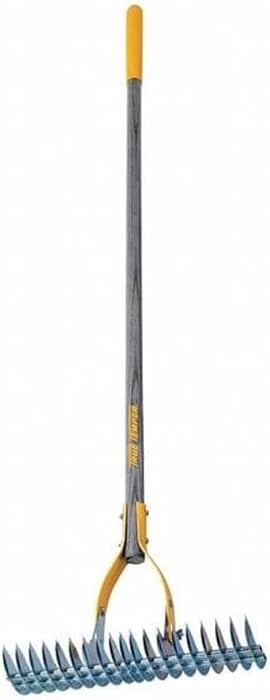
True Temper Thatch Rake Best for Small Yards, Beds

True Temper Thatch Rake – The AMES Companies 2914000 True Temper Thatch Rake

Small yards, beds

Field Score 86/100
Tines
Curved steel
Handle
54 in. hardwood
Warranty
Limited 15 year
Head Width
15 in., adjustable
View on Amazon

The head on this one pivots, and that hinge is the whole idea. You set the angle so the curved steel tines meet the ground flat, lock it down, and pull; set wrong, any thatch rake skips, and set right, this one gets under the dead grass and peels it up in strips. Fifteen inches across is right for beds, borders and small lawns, and the flared points will seed, fertilize and cultivate once the thatch is off.

The handle is North American hardwood, a different animal from the fiberglass and steel shafts on the rest of this list, and it's the part of this rake we enjoyed most. It's backed by a 15-year limited warranty, which runs longer than anything here except the GroundsKeeper II's lifetime coverage.

Here's the technique worth knowing: when the tines load up, push the rake forward a couple of feet instead of lifting and shaking it. The debris sheds off the back of the teeth and you're pulling again in a second. The catch is the shaft — 54 inches, the shortest here — which suits close work and shorter users and punishes anyone much over six feet.

Worth Noting

  • 54-inch handle is the shortest here
Our Verdict

The old-fashioned pattern, done properly: a head that tips to meet the ground and a hardwood handle. Just know the 54-inch shaft runs short.

Check Latest Price
6

Bully Tools Thatching Rake

Bully Tools 24-Tine Thatching Garden Rake for Leaves

Heavy debris

Field Score 85/100
Tines
24 tempered steel
Handle
68 in. fiberglass
Weight
4 lb
Head Width
23.5 in.
View on Amazon

Twenty-three and a half inches is a lot of rake. The Bully head is the widest here, with 24 tempered steel tines that sweep a broad strip in one pull and hold their shape when they meet a root or a chunk of bark. The head-to-handle joint is overwelded rather than bolted, so there's nothing to tighten and nothing to work loose mid-job.

Where it earns its place is heavy debris: pine straw, wet leaves, twigs, the mat of dead grass left after winter. That's a different job from fine thatch extraction. The tines are thick and stiff, so they sweep across the surface instead of raking deep, and on a lawn that needs an even, fine dethatching the spring-steel heads above do better.

We keep it for the cleanup after a storm and for a rough first pass on a patch nobody has touched in years. At four pounds it's a two-handed tool on a thick handle, and light, fine debris skips past the teeth — but it's the most heavily built rake in this set, from the overwelded joint to the tempered tines, and the steel is made in the USA.

Worth Noting

  • Four pounds makes it a two-handed tool
Our Verdict

Pine straw, wet leaves and storm cleanup: a 23.5-inch head and overwelded steel that won't fold, at the cost of four pounds and a fine, light touch.

Check Latest Price
7

CKLT Thatch Rake Best for Spot Repairs

CKLT Thatch Rake – 62.5 Inch Thatch Rake for Lawns 18 Sharp Tempered Spring Steel Tines

Spot repairs

Field Score 84/100
Tines
18 tempered spring steel
Handle
34.5, 48.5 and 62.5 in.
Weight
4.1 lb
Head Width
15 in., dual-sided
View on Amazon

Eighteen tempered spring-steel tines on a 15-inch head is an honest spec for a lawn that needs a tune-up rather than a rescue. The teeth are sharp enough to reach the soil line, they spring back when they catch a root, and the dual-sided head flips over to scratch up soil before you overseed.

Three handle sections give you 34.5, 48.5 or 62.5 inches, which covers close work along a border as well as a normal standing pull, and the whole thing breaks down for a shed corner or a garage hook. At around four pounds it's not the lightest tool here, but the weight sits toward the head where it does some good, and details like 304 stainless screws and a sandblasted, rust-resistant coating usually get skipped at this price.

This is the pick for a small yard, a spot repair or a second rake kept somewhere handy. The 15-inch head means open lawn takes more passes than it does with the GroundsKeeper II, and the three-section shaft gives you more joints to keep tight. What it gets right is the entry point: spring-steel teeth, a dual head and three working lengths at the low end of what this set costs.

Worth Noting

  • Fifteen-inch head means more passes
Our Verdict

A sensible first rake: spring-steel tines, three working lengths and a dual-sided head, sized for small yards and spot repairs rather than a whole lawn.

Check Latest Price

How We Tested the Best Dethatching Rakes

We started with roughly 30 rakes on paper — every listing we could find with steel tines, a head at least 15 inches wide, and a handle long enough to use standing up — then cut the field to 14 that covered the range of prices and handle designs shoppers actually choose between. Over eight months, from the first spring dethatching through fall cleanup, those 14 lived in a garage, got hauled around a quarter-acre fescue lawn, and got lent out to neighbors.

The first test happened in the driveway. We assembled each rake out of the box, timed it, and then loaded the handle joint sideways to see whether the sections twisted or the collar crept under weight. On the lawn, we marked off 10-by-10-foot squares in the same thick, matted patch and counted how many passes it took to fill a leaf bag — plus how much green grass came up along with the brown, since a rake that rips healthy turf is worse than no rake at all. Along a root-bound edge and a chain-link fence, we watched for tines that bent, splayed, or snagged.

Reach and comfort got checked in the least glamorous way: 20 straight minutes of raking per rake, with a 5-foot-4 tester and a 6-foot-1 tester trading off, noting forearm burn, grip comfort through work gloves, and whether an adjustable handle slipped mid-stroke. We shook out every bag of debris to see how cleanly thatch released from the tines, and left each rake outdoors for a week to check for rust at the joints. Value, in the end, came down to passes per dollar rather than the number on the tag.

How to Choose a Dethatching Rake

Start With the Teeth, Not the Handle

Two tooth patterns do most of the work. Fine, closely spaced spring-steel tines, the pattern the YEELOR and CKLT use, comb through turf and lift matted thatch a little at a time, which suits an annual tune-up on a lawn in reasonable shape. Stiffer round steel tines in a spring-loaded head, the GroundsKeeper II approach, flick debris loose and clear themselves as you pull, which is more forgiving for general yard cleanup and established grass.

The trap is buying a stiff leaf rake and expecting it to dethatch. Broad, flat teeth skate across the surface and leave the brown layer exactly where it was. If the turf feels spongy underfoot before green-up, you want fine teeth; if you're mainly clearing winter debris, a stiffer multi-task rake does more of the job you actually have.

Fit the Handle to the Person

A rake is a lever, and the wrong length costs you a stroke's worth of power every time. Stand the tool with its head on the ground and the grip should land between your hip and your chest. Most adults are comfortable between 62 and 70 inches; above six-foot-two, the 74-inch BlumeTrec is the one that stops the stooping, and a shorter user can take the Walensee down to 40 inches for close work along a border.

Adjustability adds joints and a little weight, so pay for it only if two people share the tool or your work includes tight spots where a full-length shaft leaves you hunched.

Weigh the Tool, Then Weigh the Lawn

Light feels better, but weight does work. About two pounds, as on the GroundsKeeper II, is a revelation on the fortieth pass and still fine on the four-hundredth, which matters when the lawn is measured in fractions of an acre. Four and a half pounds, as on the BlumeTrec and Walensee, drives the tines into thick matted thatch with less pulling from you and tires you out sooner.

For a city lot, a couple of beds or a spot repair, take the weight. For anything larger, take the lighter rake and accept a few extra passes.

Check the Joints, Then Check the Second Side

Sectional shafts and bolted heads are where these tools loosen first, and a wobbling handle wastes every stroke. Thread the sections firmly and re-check them at the start of each session, especially on three-piece designs.

The other thing worth paying for is a dual-sided head: flipping it over gives you teeth for scratching up soil before overseeding. That's useful if you're repairing bare patches this fall and dead weight if you only ever pull thatch.

Frequently Asked Questions

Final Verdict

Start with the GroundsKeeper II. It's the lightest rake here, its tines lift thatch instead of dragging it, and it clears itself with a flip, which is often the difference between finishing a lawn and quitting it.

If you want fine, even teeth for less money, the YEELOR does that work on an adjustable 66-inch handle. And if most rake handles leave you stooped, the 74-inch BlumeTrec is the one that fits.