The 8 Best Electric Chainsaw Sharpeners of 2026

A dull chain doesn't announce itself. It just starts throwing dust instead of chips, and you're leaning on the saw to get through a limb you'd have breezed through last season. An electric sharpener puts the edge back without a trip to the shop — and, used carelessly, can grind a cutter down past saving. I filed by hand for years for exactly that reason. Then my team and I spent eight months with 12 electric sharpeners, working through every dull chain we could find.

The field splits in two: bench grinders that clamp to a workbench and spin a wheel, and handheld units that run off a cord, a battery, or a truck's 12-volt outlet. Watts and RPM get the attention, but a sharpener lives or dies on whether the angle guide holds the angle you set and whether it adjusts to your chain's pitch. That's what sorted these — along with which ones had me sharpening five minutes out of the box and which sent me to a video for help.

Our Top Picks

The 8 Best Electric Chainsaw Sharpeners of 2026

1

Oregon 410-120 Bench Grinder Best Overall

Oregon Professional Compact 120-Volt Bench Chain Grinder

Regular workshop sharpening

Field Score 92/100
Motor
220W, 3150 rpm
Chain Pitch
Up to .404 inch
Power Source
Corded electric, 120V
Included Abrasives
3.2mm, 4.7mm, 6.0mm flat disc
View on Amazon

The Oregon 410-120 is a 17-pound bench grinder that bolts to a bench or wall, and that fixed position is the point. The chain sits in a manual clamping vise while a 220-watt motor turns a 3150-rpm wheel. The head adjusts for common pitches up to .404 inch, and Oregon includes two grinding wheels plus a flat depth-gauge disc, a dressing brick, and a profile guide. The one-way rotation is a small safety advantage: the wheel throws sparks away from the operator instead of toward the face.

We make this our default because the clamp and the angle stops do the work a hand file cannot: every tooth meets the wheel at the same setting. On a pile of dull chains, that repeatability is what turns sharpening from a chore into a bench session. The first chain takes patience, but after that the routine is quick. The machine is built to stay put, and the reward is a chain drawer that stays sharp without a trip to the shop.

We compared it with the compact VEVORs and the rotary kits, and the difference is rigidity. A handheld tool depends on your wrist to hold the angle; this one holds the chain and the head. For a homeowner with a mixed drawer of chains and a garage bench, the Oregon is the one that keeps the whole pile cutting like new.

Worth Noting

  • Heavy fixed-station tool
  • Grinding wheels are consumables
Our Verdict

We make the Oregon 410-120 our default bench sharpener because it delivers repeatable edges in a fixed workshop setup.

Check Latest Price
2

Sharp Pebble Cordless Sharpener Best Cordless

Sharp Pebble Electric Cordless Chainsaw Sharpener Kit

Cordless field use

Field Score 91/100
Weight
1.37 lb
Angle Guide
Included
Power Source
Cordless, rechargeable
Included Wheels
4 file-size wheels
View on Amazon

At 1.37 pounds, the Sharp Pebble cordless kit is the sharpener that can live in the saw bag without being noticed. We reach for it when the chain is already on the saw and the truck is nowhere near a bench. The angle attachment and four file-size wheels cover the common chain sizes; the rechargeable body has adjustable speed settings and enough run time for a touch-up, not a full day of production grinding. The kit also includes a wrench and an eBook, which is more useful than another plastic case.

What we appreciate most is the shape of the kit: the angle guide indexes the wheel to the tooth, so you are not freehanding the bit at the wrong depth. It is still a handheld tool, and a bench grinder will hold a more consistent angle over a long chain. The trade is deliberate. For a saw that gets dull in the woodlot, the Sharp Pebble gets you cutting again without dragging a cord or removing the chain.

We compared it with the 12V Oregon and the EzzDoo, and this one has the cleanest all-around package: lighter than the Oregon's corded 12V setup, and with a stronger record on fit and finish than the budget cordless kits. The angle guide is the part that makes it more than a rotary tool in a pouch. That guide is the difference between a quick touch-up and a ruined tooth.

Worth Noting

  • Grinding bits are consumables
Our Verdict

The Sharp Pebble cordless kit is the one we take to the woodlot when a light, self-contained tool matters more than bench-level precision.

Check Latest Price
3

Oregon 12V Sure Sharp Best 12V Field Sharpener

Oregon 12V Sure Sharp Electric Chain Sharpener

Truck and field

Field Score 90/100
Chain Pitch
1/4 to .404 inch
Stone Sizes
5/32, 3/16, 7/32 inch
Cable Length
16 feet
Power Source
12V adapter or battery clips
View on Amazon

The Sure Sharp is not a cordless tool in the usual sense. It runs from a 12-volt car adapter or battery clips, and the 16-foot cable is the freedom it offers: enough reach from a truck battery to a tailgate, not enough to wander into the back forty. The kit includes three stones in 5/32, 3/16, and 7/32 inch, plus a collet wrench, and it covers round-ground chain from 1/4 to .404 pitch.

The angle guide takes the guesswork out of a field touch-up, and the 25,000-rpm motor removes material fast. A light pass is all a dull tooth needs. It is a handheld tool, not a bench grinder, and the three included stones cover the common file sizes. The body is compact enough to live in a tool bag, and the collet wrench stores with the stones.

We keep it in the truck-box conversation because it is quick, compact, and cheap enough to leave in the tool bag. The cord is the trade: you need a battery or outlet nearby, and the tool is tethered while you work. For a saw that dulls during a day of cutting and a truck parked close by, that is a fair bargain. The 16-foot cable is the detail that makes it practical; short cables are the reason many 12-volt tools stay in the box.

Worth Noting

  • Thin instructions
  • Stones wear and add replacement cost
Our Verdict

We keep the Oregon Sure Sharp in the truck-box conversation because it sharpens quickly when a 12-volt source is close at hand.

Check Latest Price
4

VEVOR 230W Bench Sharpener Best Value Bench Grinder

VEVOR Electric Chainsaw Sharpener

Value bench work

Field Score 88/100
Motor
230W, 3000 rpm
Chain Pitch
0.25 to 0.404 inch
Power Source
Corded electric
Grinding Wheel
5.5 inch
View on Amazon

The 230W VEVOR is a fixed bench grinder with a 230-watt motor, a 3000-rpm head, and a 5.5-inch wheel. It handles chain from 1/4 to .404 pitch, and the angle adjustment covers the common cutter settings. At 17.35 pounds, it is heavy enough to stay put on a bench but still light enough to move when you need the space.

We recommend it as the value bench option because the larger wheel does more of the work than the smaller VEVOR's 140-watt head. The 5.5-inch wheel has more abrasive surface, so a light pass covers the tooth without dwelling in one spot. The trade is that it is not as refined as the Oregon: the angle marks are simpler, and the wheel is a wear item you will replace. For a home shop that sharpens a few chains a month, that is a fair exchange.

The 5.5-inch wheel is the detail that separates it from the compact VEVOR. On a long chain, the bigger wheel keeps a more consistent arc across the cutter, and the extra mass helps the grinder feel less frantic. It is still a machine you set up carefully; the payoff is a bench tool that costs far less than the premium Oregon while covering the same pitch range.

Worth Noting

  • Heavy fixed-station tool
Our Verdict

The VEVOR 230W is our value pick for workshop owners who want a larger grinding wheel without premium bench-grinder money.

Check Latest Price
5

VEVOR 140W Bench Sharpener Best Compact Bench Grinder

VEVOR Electric Chainsaw Sharpener

Compact bench spaces

Field Score 87/100
Motor
140W, 5700 rpm
Chain Pitch
0.25 to 0.404 inch
Power Source
Corded electric
Included Wheels
3.2mm, 4.5mm, 6.0mm
View on Amazon

At 5.2 pounds, the 140W VEVOR is the bench grinder that does not demand a permanent corner. It has a 140-watt motor turning at 5700 rpm, three grinding wheels in 3.2, 4.5, and 6.0 mm, and a small LED that lights the tooth line. The body is compact enough to store on a shelf, and the anti-slip handle helps when you move it into place.

The three wheels cover the common chain sizes without add-ons, and the angle adjustment is straightforward. The LED is a small feature that earns its keep under a shelf or in a dim garage, where the tooth line disappears into shadow. The chain guide holds the chain for a pass, though you still need to advance it link by link.

We compared it with the 230W VEVOR and the Oregon, and the 140W is the one for a small bench and a modest chain pile. The light weight is the point: you can put it away, and you do not need a dedicated sharpening station. The three wheels and the LED make it feel more complete than its size suggests.

We choose it for the garage bench because the LED and the three wheels make a small job feel sorted, and the low weight means it can live on a shelf instead of a pedestal. The three wheels mean you do not start with an accessory order, and the LED is the detail that makes it feel less like a stripped-down grinder.

Worth Noting

  • Light motor for long sessions
Our Verdict

For a small shop or garage bench, we choose the VEVOR 140W because it is light enough to move and compact enough to store.

Check Latest Price
6

NEO-TEC On-Saw Sharpener Best On-Saw Sharpener

NEO-TEC Electric Chainsaw Sharpener Kit On-Saw Quick Sharpening Tool with Angle

On-saw touch-ups

Field Score 86/100
Speeds
5 adjustable
Power Source
Corded electric, 180W
Included Bits
6 titanium-plated diamond wheels
Angle Settings
25, 30, 35 degrees
View on Amazon

The NEO-TEC is built to sharpen the chain without taking it off the saw, and that is the reason we keep it in the budget conversation. The 180-watt motor has five speed settings, and the angle guide sets 25, 30, or 35 degrees; six titanium-plated diamond wheels cover 5/32, 3/16, and 7/32 inch file sizes. It sharpens the chain in place, which saves the removal step that slows down a quick touch-up.

The guide is the part that makes on-saw sharpening more than freehanding a rotary bit. It indexes the wheel against the cutter so you can work around the bar without guessing the angle. We like that for a quick touch-up between tanks of gas, especially on a saw that is already clamped in a vise. It is not the tool for a rocked chain that needs serious material removed; that is bench-grinder work.

Compared with a bench grinder, the NEO-TEC trades a clamped head for not removing the chain. That is a narrow but useful place to sit. The angle guide is the detail that keeps it from being just another rotary tool with a chainsaw sticker. The five speeds give you a slower pass for a light touch and a faster pass when a tooth needs more help.

Worth Noting

  • Corded power limits field use
Our Verdict

We reach for the NEO-TEC when we want to touch up a chain on the saw instead of pulling it off.

Check Latest Price
7

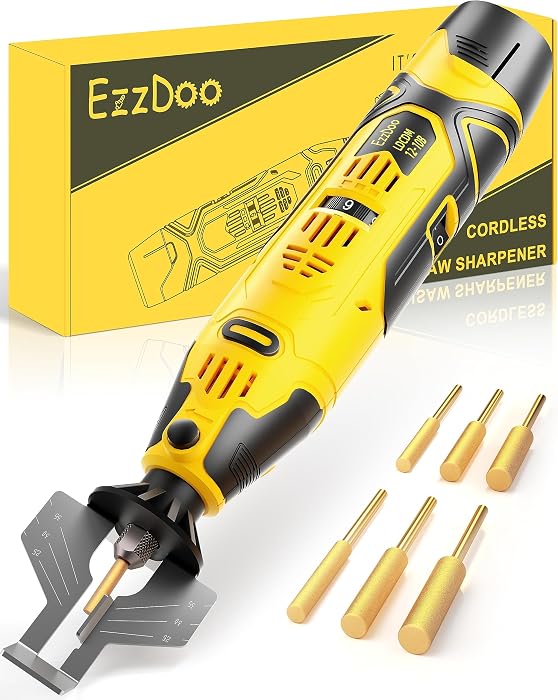
EzzDoo Cordless Sharpener

EzzDoo Cordless Sharpener – Electric Cordless Chainsaw Sharpener Kit

Cordless budget kit

Field Score 85/100
Weight
1.8 lb
Angle Guide
Included
Power Source
12V battery, included
Included Bits
6 titanium-coated bits
View on Amazon

The EzzDoo kit puts a 12-volt battery in the tool, so you do not need a truck outlet or a cord to sharpen in the field. It weighs 1.8 pounds, comes with six titanium-coated diamond bits in three sizes, and includes an angle guide. The body is shaped like a compact rotary tool, and the battery is rechargeable.

The angle guide is the part that makes it useful for a chain: it gives you a reference for the cutter instead of asking you to hold a bit at the right angle by eye. We found the tool easiest to use on a chain that is already off the saw or clamped on a bench; in the field, you are still working around the bar with one hand. The kit includes enough sizes to get started, and the battery charges without a separate dock.

We recommend the EzzDoo for occasional sharpeners who want a self-contained cordless kit and do not want to manage a separate 12-volt cord. The battery freedom is the point. The built-in battery is the real difference from the Oregon Sure Sharp, which needs a truck outlet or battery clips. The angle guide is the part that keeps the bit on the cutter instead of skating across the tooth.

Worth Noting

  • Bits wear out with use
Our Verdict

The EzzDoo cordless kit is our choice for occasional sharpeners who want battery power and a complete bit set in one box.

Check Latest Price
8

KonKell 250W Bench Sharpener Best for Small-Shop Sharpening

KonKell 250W Bench Sharpener – Electric Chainsaw Sharpener

Small-shop sharpening

Field Score 79/100
Motor
250W, 8400 rpm
Mounting
Mountable base
Chain Pitch
1/4 to 3/8 inch
Power Source
Corded electric
View on Amazon

The KonKell's 250-watt motor turns at 8400 rpm, which is a lot of speed for a compact bench sharpener. It fits chain from 1/4 to 3/8 inch, has an adjustable grinding angle, and mounts to a bench through a base that keeps the body from sliding. The dimensions are compact enough for a small shop, and the price puts it in budget bench-grinder territory.

The chain clamp is the part to watch. The chain can be fussy to advance smoothly when you move from link to link. That does not make it unusable; it means you set the chain, sharpen a tooth, release, and advance with more care than the Oregon's vise asks for.

The high rpm removes material quickly, and the adjustable angle covers the common cutter settings. It is not the grinder for a professional queue or for someone who wants a hydraulic clamp. It is the budget option that still gives you a bench-mounted head instead of a handheld rotary tool.

We keep the KonKell in the budget conversation because the 8400-rpm head cuts fast and the mountable base gives you a steadier pass than a handheld tool. The adjustable angle covers the common cutter settings, and the compact body fits a small bench. It is a lot of speed for the money.

Worth Noting

  • Fixed wheel attack angle
Our Verdict

We keep the KonKell in the budget conversation for light-duty bench sharpening, where speed matters more than precise chain advance.

Check Latest Price

How We Tested 12 Electric Chainsaw Sharpeners

We started with spec sheets, the way a shopper would: pitch range, included wheels or bits, whether the angle guide was adjustable, and whether replacement stones were actually available for the tool. Anything that couldn't cover the .325 and 3/8 pitches on typical homeowner and farm saws got cut before we plugged it in. That left 12 sharpeners, and we spent eight months with them.

Every tool sharpened the same chains: loops I had dulled on purpose by dragging them through dirty firewood, plus whatever came off neighbors' saws and a local tree crew's truck. We set a baseline by timing a cut through the same ash log and watching the chips — dust meant dull, curls meant sharp — then sharpened and cut again. After each pass we checked the cutter under a loupe and measured the tooth with a caliper, since the fastest way to wreck a chain is a sharpener that removes too much metal at once.

In the garage, I timed setup solo with a stopwatch, box open to first sparks, and wrote down exactly where the instructions lost me; one manual assumed I already knew what a depth gauge was. Bench units got bolted down and run through three loops back to back to see whether the vise crept, the motor ran hot, or the wheel wore unevenly. Portable ones went into a truck box and ran off a 12-volt outlet in a driveway, because that's where they'll actually live.

We also reset each tool for different pitch chains and noted how much fiddling that took, then counted what came in the box — spare wheels, an angle guide, a wrench — because a sharpener that needs a second purchase to work isn't the value it looks like.

How to Choose an Electric Chainsaw Sharpener

Bench Grinder or Handheld Sharpener?

A bench chain grinder clamps the chain and holds the head at a set angle, which is why it produces the most repeatable edge. It suits a home shop with several chains and a dedicated outlet. A handheld electric sharpener, whether cordless or 12-volt, gives up some rigidity for portability. The Oregon 410-120 is the bench reference here; the Sharp Pebble cordless is the one that goes to the woodlot. If you sharpen once a season, a handheld can be enough. If you sharpen for a living, the bench tool pays back the bench space.

Match the Wheel to Your Chain

Sharpening wheels and stones are sized to the cutter, not to the saw. Common chain pitches run 1/4, .325, 3/8 low profile, 3/8, and .404, and each takes a matching wheel or file size. The Oregon 410-120 covers up to .404 pitch with 3.2mm, 4.7mm, and 6.0mm abrasives. A kit with four file-size wheels, like the Sharp Pebble cordless, is more flexible across a mixed chain drawer. Check the stamp on the drive link or the file size on the chain before you buy; a bargain sharpener with the wrong wheel is no bargain.

Angle Control Is the Whole Job

The difference between a sharp chain and a ruined one is usually the angle, not the horsepower. Look for a sharpener with a clamp or chain guide and repeatable angle stops. Bench grinders let you set the head and vise angle; handheld tools rely on an angle guide and a steady hand. The KonKell's fixed wheel attack angle is simpler but less adjustable, while the Oregon's vise and angle marks give you more control. Practice on an old chain first, and check the cutter after one tooth before you commit to the whole loop.

Plan for Wear and Setup

Every abrasive in these tools is a wear item. Diamond bits, grinding wheels, and stones lose their bite, and replacement cost belongs in the buying decision. A bench grinder with a dressing brick and a profile guide, like the Oregon, is easier to maintain than a kit with no guidance. Setup also takes time: the first chain is slower than the tenth. Buy a sharpener with enough wheels or stones for your chain sizes, and keep a spare set so a dull abrasive does not stop the job.

Frequently Asked Questions

Final Verdict

For most people who sharpen at home, the Oregon 410-120 is the one we recommend: the clamp and angle stops make repeatable edges, and the universal pitch coverage handles a mixed chain drawer. If you need to sharpen away from a bench, the Sharp Pebble cordless kit is the better fit. If you have a 12-volt source and want a truck-box tool, the Oregon Sure Sharp is the cheaper field option. The VEVOR 230W is the value bench alternative when the Oregon is more than the job justifies.