The 5 Best Extension Ladders of 2026

A ladder is the rare purchase where the failure mode isn't a refund — it's a trip to the emergency room. I've cleaned gutters and climbed onto more roofs than I care to count, and a good ladder plants itself while a bad one flexes under your foot by the third rung. What you're buying is safe reach, and a way to get the thing out of the garage afterward.

That second half is the trade-off nobody mentions. A 24-foot fiberglass extension ladder is as steady as they come, but it weighs about as much as a small refrigerator and takes two people to walk across the yard; a telescoping model folds to closet size and slides into a trunk, but you're trusting a stack of locking pins with your weight. Duty rating is the other thing people skim past — 250 pounds leaves little margin once you add a tool belt. We spent six months climbing 11 of these on gutters, attic hatches, and one storm-damaged roof, and the picks below are the ones I'd carry up a flight of stairs twice.

Our Top Picks

The 5 Best Extension Ladders of 2026

1

SocTone Telescoping Ladder 12.5 ft Best Overall

SocTone Telescoping Ladder 12.5 ft

Gutters and RV roofs

Field Score 92/100
Weight
22.3 lb
Stowed Width
19 in
Load Capacity
330 lb
Maximum Height
12.5 ft
View on Amazon

Two triangular braces sit at the base of this ladder, and they are the reason it is our top pick. Telescoping ladders get their wobble at the feet, where a narrow footprint meets a wall, and these braces widen the stance so the whole thing feels planted when you lean it into a gutter or the side of a camper. Rated to 330 pounds across 12 rungs, it carries that on an aluminum frame weighing about 22 pounds, which is a one-handed carry from the garage to the downspout.

Locking is rung by rung. You raise it from the bottom, hear a click at each step, and stop at whatever height the job wants, which is why it works as well at an attic hatch as it does against a roofline. Folded, it is 19 inches wide and short enough to stand behind a truck seat or in a closet corner, and that is the reason it ends up on trips instead of staying in the garage.

Where it gives ground is at the top of a full extension. The last few rungs flex when you lean out to reach, which is ordinary for any telescoping ladder and the reason we stay centered and keep our hips between the stiles up there. On a 12.5-footer that flex is mild and predictable; it is the same quality that turns into a real problem on a 16-foot ladder.

Set against the POONO, which does the same 12.5-foot job for less, the differences are the braces and roughly four pounds. Small numbers, but they decide how the ladder feels two steps up with a paint can in one hand.

Worth Noting

  • Reaches one story only
  • Bundling strap is the weak point
Our Verdict

We point most people here: it is the rare telescoping ladder that feels settled underfoot, and it stores where a full-size ladder cannot go.

Check Latest Price
2

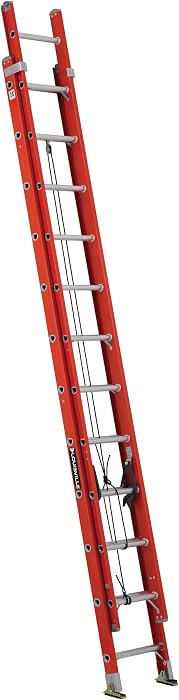
Louisville FE3224 24 ft Extension Ladder Best for Roof and Gutter Work

Louisville 24 ft Fiberglass Extension Ladder

Two-story roof work

Field Score 91/100
Material
Fiberglass
Load Capacity
300 lb
Maximum Extension
24 ft
View on Amazon

The distance between this ladder and everything else here is measured in feet: 24 feet of extension against 12 to 16.5. That is the difference between working a gutter from the ground and stepping off onto the roof. It is a two-section fiberglass ladder, Type IA rated at 300 pounds, with MaxLock rung locks and a QuickLatch that ties the fly and base sections together.

Fiberglass is why we point roof work at it. It does not conduct, so a gutter run that passes near a service drop is not the same gamble it is with an aluminum rail, and the swivel shoes with their metal shields sit flat and turn on uneven ground. It is also heavy enough that walking it up a two-story wall is a two-person job for most people, and the top of it stays quiet underfoot once it is there.

When it arrives, run the rope and pulley through the full extension once and check that each shoe turns freely. Those are the moving parts on a ladder this size, and a stiff, slow extension usually turns out to be one of them rather than the rails.

Worth Noting

  • Scuffs and scratches with normal use
  • Needs garage or shed space
Our Verdict

Our pick if you climb onto a roof more than once a year: 24 feet of non-conductive fiberglass that stays rigid at the top.

Check Latest Price
3

Xtend & Climb 785P+ Telescopic Ladder Best Certified Telescoping Ladder

Xtend & Climb 785P+ Telescopic Ladder – 785P+ Telescopic Ladder (15.5 FT

Jobsite use

Field Score 90/100
Weight
38 lb
Certification
CSA, OSHA/ANSI compliant
Load Capacity
250 lb
Maximum Height
15.5 ft
View on Amazon

The line that separates this ladder from the rest of the telescoping group is the certification: CSA certified and built to meet OSHA and ANSI requirements, which matters the day the ladder goes onto a jobsite instead of into a garage. Each of the 16 rungs locks on its own as you raise it from the bottom, the release is an angled thumb lever that keeps your hand where it belongs, and the sections close on a dampener instead of dropping.

That control costs weight. At 38 pounds it sits closer to a full-size ladder than to the 22- and 25-pound telescoping models here, so getting it out of a truck bed and standing it up is a two-handed job, and carrying it any real distance is a chore. In exchange it folds to 36 inches, so you are paying for a genuinely small package wrapped around 15.5 feet of ladder.

What that weight buys back is behavior at the top of the reach. Fully extended against a wall it stays steady enough to let you work with two hands instead of one, and the individual rung locks mean you are never guessing whether a section has caught. For a ladder used weekly, or one that has to satisfy someone else's safety officer, the premium is easy to justify.

Worth Noting

  • 250-pound rating is the lowest here
  • Bottom sections are slow and fussy to collapse
Our Verdict

We think the OSHA and ANSI compliance and the dampened close earn the premium when the ladder leaves the garage for real work.

Check Latest Price
4

SINMEIRUN Telescoping Ladder 16.5 ft

SINMEIRUN Telescoping Ladder 16.5 ft – Telescoping Ladder

Long telescoping reach

Field Score 86/100
Weight
25 lb
Folded Length
40 in
Load Capacity
330 lb
Maximum Height
16.5 ft
View on Amazon

If 12.5 feet keeps coming up short, this is the reach answer: 16.5 feet of extension, a 330-pound capacity, and 25 pounds hanging off a carrying handle, all of it folding down to 40 inches. That is four more feet than the 12.5-foot models here in a package that still lies across an RV bay or the bed of a truck, which is exactly the trade we want for tall work in a small rig. EN131 certified, with anti-slip feet and a double latch at every step.

What you plan around is the extra ladder above you. Standing near the top of 16.5 feet puts more frame over your hips, so set the base out generously, put both feet on something solid, and keep a hand on the rails on the way up. The 19-inch width is what keeps it manageable overhead, and the straps and handle are the difference between carrying it and dragging it. For camper roofs, tall shelving, and one-and-a-half-story walls, the height is the whole point.

Worth Noting

  • Longest folded length of the telescoping picks
Our Verdict

We send tall-rig and tall-wall owners here when 12.5 feet falls short and a full-size ladder will not fit in the vehicle.

Check Latest Price
5

POONO Telescoping Ladder 12.5 ft Best for Budget Home Use

POONO Telescoping Ladder 12.5 ft – 12.5FT Telescoping Ladder

Budget home use

Field Score 85/100
Rungs
12
Weight
26.1 lb
Load Capacity
330 lb
Maximum Height
12.5 ft
View on Amazon

This is the least expensive ladder in the group, and the finish does not advertise it: matte black rails, rungs listed at 1.56 inches wide, and the same pair of triangular stabilizers at the base that the SocTone uses to settle its footing. Twelve rungs, 330 pounds of capacity, 12.5 feet when it is up.

Weight is where the savings show up. At just over 26 pounds it is the heaviest of the 12.5-foot models here, and near a full extension it is the one that sags most when you shift your weight, a little give at the top rung that you feel in your knees. Treat it as a ladder for work at head height plus a step or two: gutters, a porch light, the top of a camper. Centered between the rails it is fine, and the wide rungs are easier underfoot than narrow ones on a long job.

Stowed, it is 19 inches wide and short enough to stand in a pantry or slide under a workbench, which is the whole argument for it in a small house where a full-size ladder has nowhere to live.

Worth Noting

  • Heaviest of the 12.5-foot models
Our Verdict

We keep this one in the budget conversation because it does the 12.5-foot job for the least money, as long as you keep your work low.

Check Latest Price

How We Tested Extension Ladders: Stability, Setup, and Storage

I started by pulling every extension ladder with a stated duty rating and a working height between roughly 12 and 24 feet, then filtered by price, height range, and whether the maker claimed it would stow in a trunk or a garage corner. Traditional fiberglass rails and telescoping aluminum models went on the same shortlist, since most people are choosing between those two formats rather than within one. Eleven made the cut.

Testing ran six months, mostly at my own house and two neighbors' places: gutter cleaning in the fall, an attic hatch in a cramped garage, trim work on a two-story wall, and a roof patch after a storm. I timed setup alone with a stopwatch, counted how many pins had to engage before the ladder was load-bearing, and listened for the click at each rung. Stability got checked by climbing to the top working rung while a second person pushed at the rails; I noted rail flex, foot creep, and whether the base wanted to skate on concrete, grass, and a slightly sloped driveway.

Portability and maneuverability were the practical tests: I weighed each ladder on a bathroom scale, carried it one-handed up a flight of stairs, walked it around a tight corner, and folded it into a hatchback and an RV storage bay. To judge collapse, I watched how close my hands came to the rungs on the way down and whether the sections dropped fast or eased down under control. Durability meant leaving them out in sun and rain, then checking hinge play, scuffed rails, and worn feet a few weeks later. Capacity got a reality check too — a 200-pound tester with a loaded tool belt, plus a note on how much the rails bowed two rungs from the top.

How to Choose an Extension Ladder

What the Length on the Box Actually Buys You

A ladder needs to stand about three feet above the roof edge or work surface you are stepping onto, so you have something to hold while you move. It also has to lean: at the standard four-to-one angle the base sits a foot out from the wall for every four feet of height, which eats reach. A 12.5-foot telescoping ladder works comfortably at one-story gutters and a camper roof; 15.5 to 16.5 feet covers a one-story roofline without stretching; a second story wants the 24-foot two-section ladder.

The action is simple. Measure from the ground to the eave or to the point you need to reach, add three feet for the standoff above it, then allow for the lean. If the total lands within a couple of feet of full extension, buy the next size up. Working near the top of any telescoping ladder is where it is least steady.

Telescoping or Two-Section

A telescopic ladder folds into a bundle you can stand in a closet, and the ones here run 36 to 40 inches. It also stops at any height, which is what you want at an attic hatch or a bunk in a camper. The price is rigidity: a single column of nested sections flexes near full extension, the rungs lock one at a time, and the taller the ladder, the more of that you feel.

A two-section fiberglass ladder is the reverse. It is solid at height, comes with a rope and pulley, and carries a higher duty rating, but it stores at its full collapsed length, which makes it a garage item rather than a trunk item, and walking 24 feet of it up against a wall is a two-person job. If the ladder lives at home and goes on the roof, buy the two-section. If it travels, buy telescoping.

Duty Rating and the Person on It

Duty ratings run 250 pounds for Type I and 300 for Type IA, and the telescoping ladders here advertise up to 330. That figure covers you plus whatever you are carrying: a paint can, a toolbox, a bundle of shingles. It assumes the ladder is undamaged and set correctly, which is doing more work than the number is.

We pay closer attention to capacity on tall telescoping ladders, where the frame has more room to move. If you are a bigger person working at full extension, a certified 300-pound two-section ladder is the safer buy than a 330-pound claim on a single-section ladder with twelve joints in it.

Aluminum or Fiberglass

Aluminum is lighter, less expensive, and it conducts. Fiberglass is heavier, costs more, and does not. That only matters where the ladder goes: gutters that pass under a service drop, a roof with an antenna, anything within reach of overhead wiring. For a ladder that only ever leans against the house, the weight saving is worth more than the insulation, and at 12.5 feet you will feel every extra pound on the carry.

Frequently Asked Questions

Final Verdict

For most households the SocTone is the ladder to buy: 12.5 feet, 330 pounds of capacity, braces that settle the base, and a folded size that fits a closet or a camper bay. It handles gutters, attic hatches, and RV roofs without turning the job into a workout.

The exception is a roof you actually climb onto. If you are going up two stories, or stepping off onto shingles more than once a year, the Louisville's 24 feet of non-conductive fiberglass is the right money to spend, and plan on a second person to raise it.