The 8 Best Fertilizer Spreaders of 2026

A broadcast spreader is a hopper, a hole, and a spinning disc that flings product in a wide arc. That simplicity is the problem: your gate setting, your walking pace, and how well you overlap each pass decide whether the lawn comes in even or shows a dark stripe where you slowed down. Two spreaders with identical capacity can behave nothing alike.

My first spreader was a hand-me-down that laid everything down in a six-inch band, and I spent a spring watering the burn marks. Over the past eight months, my team and I ran 14 spreaders through spring feeding and fall overseeding — walk-behind broadcast models, chest-mount bags, hand-shakers, and a tow-behind — plus a few icy driveways in January.

Here's what first-time buyers get wrong: capacity is the least interesting number on the box. What matters more is whether the gate holds its setting while you walk and whether the instructions make calibration possible. The picks below are the ones that threw evenly and were easy to live with.

Our Top Picks

The 8 Best Fertilizer Spreaders of 2026

1

Scotts EdgeGuard Mini Best Overall

Scotts Turf Builder EdgeGuard Mini Broadcast Spreader

Typical suburban lawns

Field Score 94/100
Type
Walk-behind
Assembly
None required
Edge Control
EdgeGuard side shield
Coverage Per Fill
Up to 5,000 sq. ft.
View on Amazon

The box shows up with the hopper already calibrated and the handle folded flat, so the first thing you do with this spreader is fill it, not assemble it. That sounds like a small thing until you remember why most lawn tools never get used — an hour of bolts in April is enough to put the job off until the grass is past fixing. It stores compactly too, roughly 21 by 16 inches with the handle down, which is why it sits on a shelf instead of leaning against the garage wall.

For a lawn you can cross in a few dozen steps, this is the broadcast spreader we hand people. The hopper and agitator keep product moving down to the gate so the rate stays steady instead of dumping and starving, and one fill covers up to 5,000 square feet of Scotts product — a front-and-back suburban yard usually takes one or two loads. The feature we value most is EdgeGuard: a shield you swing down on the driveway side so pellets stop at the pavement instead of bouncing into the street and the storm drain. Along a sidewalk or a mulch bed, it's the difference between a clean line and an afternoon with a broom.

The pattern isn't perfect. The throw runs heavier on one side even with the guard pulled back, so plan on two passes at half rate with a few feet of overlap rather than one pass at full. And the dial is marked for Scotts products; with another brand, run a measured strip first and look at the color a week later before you commit to the whole yard.

Worth Noting

  • Plastic wheels bog down on rough, uneven ground
Our Verdict

This is the one we hand most homeowners: it comes out of the box ready, one fill covers a normal front lawn, and EdgeGuard keeps fertilizer off the pavement.

Check Latest Price
2

Scotts Whirl Hand Spreader Best Handheld

Scotts Whirl Hand-Powered Spreader for Grass Seed

Small yards

Field Score 93/100
Type
Hand-crank
Weight
1.2 lb
Arm Support
Adjustable
Coverage Per Fill
Up to 1,500 sq. ft.
View on Amazon

Where the Mini rolls, this one swings. The Whirl is a hand-crank spreader with a hopper rated for 1,500 square feet of product, so it's the tool for the strip between sidewalk and curb, the bare patch behind the garage, and the corner where the mower can't turn around.

It weighs 1.2 pounds empty, and the adjustable arm brace takes the load off your wrist when you're cranking for twenty minutes straight. The gate adjusts in small steps, so you can dial down to a light overseeding rate or open it up for a full feed, and pelletized fertilizer drops through without clogging. The body is poly, which means a season in the shed won't rust it, and it cleans up with a hose.

Under a quarter acre, we take this over a push spreader most days. You can walk it between beds and along fence lines without dragging wheels through wet grass, and you can carry it up a set of steps. The 1,500-square-foot hopper is the limiting factor — a real overseeding job becomes a series of pours — but that's the trade for a tool that fits on a shelf and starts on the first crank.

Worth Noting

  • Refills come often beyond a small yard
  • Arm brace fits smaller frames better
Our Verdict

We keep coming back to this one for small yards and patch work: light enough to carry, cheap enough to own, and easy to aim between beds.

Check Latest Price
3

SOLO 421 Chest Spreader Best Chest-Mount

SOLO Inc 421 20-Pound Capacity Portable Chest-Mount Spreader with Comfortable

Hillsides, food plots

Field Score 91/100
Controls
Adjustable flow and spread fan
Carry Style
Chest-mount strap
Hopper Capacity
20 lb
View on Amazon

Twenty pounds of fertilizer riding on your chest is a different job from pushing it. The SOLO 421 hangs from a cross-shoulder strap, so both hands stay free for the crank and the flow lever and your feet go wherever the ground needs them — up a bank, between garden rows, across a plot too rough for wheels. That's the whole argument for it, and the build backs it up: a heavy-walled hopper, a sealed gearbox, and a crank that doesn't flex in your hand.

The controls are what you're paying for. Flow and spread direction both adjust while you walk, so you can throw wide over open ground and tighten the fan along a fence. It carries 20 pounds comfortably on a long walk, with the strap spreading the load across the shoulder instead of the neck — the difference between finishing a plot in one trip and setting the thing down every fifty yards. Form one habit: keep the crank turning with coarse seed like corn or soybeans, because stopping mid-stride lets the rotor jam. Set the strap before you fill it, not after.

Worth Noting

  • Flow gate can drift open while walking
  • Coarse seed jams if the crank stops
Our Verdict

For hillsides and food plots, this is the handheld we trust: a chest-mounted 20-pounder with commercial-grade parts and controls you adjust mid-stride.

Check Latest Price
4

Echo RB-60 Best Heavy-Duty Walk-Behind

Echo 60 lbs. Heavy-Duty Spreader RB-60

Large lawns

Field Score 88/100
Weight
23 lb
Assembly
Handle only
Hopper Capacity
60 lb
View on Amazon

The gate lever on the RB-60 has a short, firm throw with no wobble in the handle, and that's the first thing you notice. It's the kind of control that suggests the rest of the machine was built to the same standard.

Then there's the hopper. Sixty pounds means a full 50-pound bag of fertilizer goes in with room to spare, and you're not stopping in the middle of the back lawn to refill and re-find your line. Assembly is essentially attaching the handle, so it's spreading within minutes of coming out of the box.

The side guard swings out to keep pellets off pavement, and the oversized tires roll over St. Augustine and uneven ground without bogging. The drop scale is marked clearly enough to read at a glance, which matters when you're changing rates between products.

This is the pick for a lawn you mow in an hour, not fifteen minutes. Capacity is the whole argument in spreading: every refill means stopping, resetting the rate, and re-finding the line you were walking, and a spreader that eliminates two of those per job earns what it costs. Treat it as a stored tool rather than a carried one — it lives assembled next to the mower.

Worth Noting

  • Heavy to push with a full hopper
  • Side deflector lets a few pellets past
Our Verdict

Our heavy-duty pick: a full 50-pound bag goes in the hopper, and the build feels like equipment rather than a seasonal accessory.

Check Latest Price
5

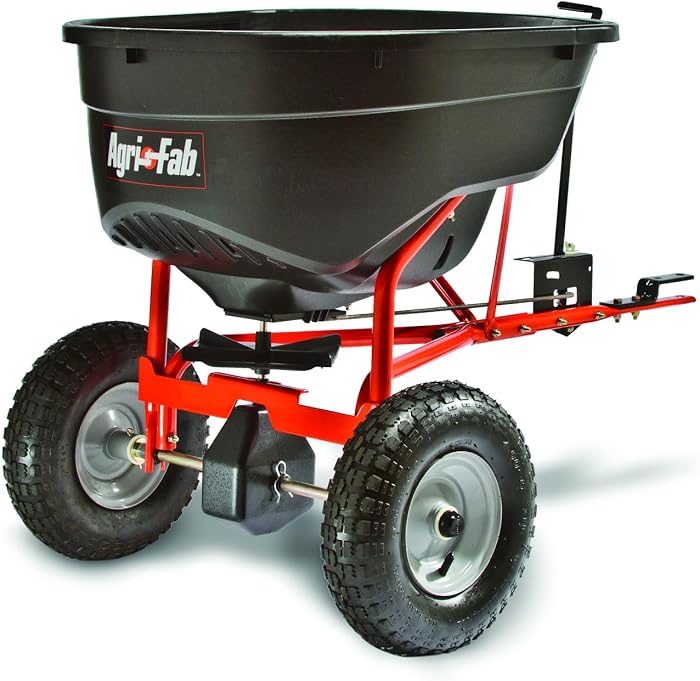
Agri-Fab 45-0463 Tow-Behind Best Tow-Behind

Agri-Fab Pull Behind Broadcast Spreader for Seed

Acreage behind a tractor

Field Score 87/100
Tires
13 in. x 4 in. pneumatic
Spread Width
10 to 12 ft
Hopper Capacity
130 lb
Coverage Per Fill
Up to 25,000 sq. ft.
View on Amazon

The mower does the walking. Pinned to a tractor's hitch, this spreader lays down half an acre at mowing speed, and the 130-pound hopper holds enough that you aren't stopping every ten minutes to reload.

For anyone cutting an acre or more with a riding mower, this is the machine that makes sense. A 10-to-12-foot spread width means far fewer laps than any walk-behind, the frame is inch steel tubing, and the enclosed gearbox and 13-inch pneumatic tires are built for ground that isn't a golf green. The universal pin hitch fits most riding mowers and lawn tractors, so it's a matter of dropping the pin rather than drilling anything.

Assembly is the friction. The instructions are thin and the bolts are close enough in length to mix up, so lay the hardware out by size before you start and you'll save yourself a rebuild. The other thing to plan is the flow lever: behind a tractor it lands near your hand, behind an ATV it's a stretch, so set the gate before you roll instead of reaching back for it while moving.

Worth Noting

  • Instructions are thin on hardware sorting
  • Can tip on steep, uneven ground
Our Verdict

For an acre or more, this is the spreader we point to: 130 pounds on a universal hitch, half an acre per fill, all at mowing speed.

Check Latest Price
6

Chapin 8740A Hand Shaker Best Budget Spot Spreader

CHAPIN 8740A 64 oz All-Season Hand Shaker Spreader

Spot treating

Field Score 86/100
Weight
11.2 oz
Capacity
64 oz
Lid Openings
Three sizes
View on Amazon

Most fertilizer jobs are small. A bare patch where the dog digs, a garden row that needs side-dressing, the strip along the foundation, the sidewalk after an ice storm — none of that justifies wheeling out a broadcast spreader, and all of it is a two-minute job with this. Fill the 64-ounce bottle, twist the lid to one of three openings, and shake.

Those three openings are the whole design. Small for fine seed and sand, large for prills, wide for rock salt, so you match the hole to the material instead of fighting a bridge every few shakes. The handle is big enough for gloves, and you can park the bottle on a shelf with product still inside it. Where it stops working is scale: 64 ounces goes fast over a big area, and shaking lays material down in arcs rather than an even fan.

Worth Noting

  • 64 ounces runs out fast on big areas
  • Hand shaking is less even than a rotor
Our Verdict

The cheapest spreader here and the one we reach for most — spot seeding, garden rows, and winter salt without dragging out a hopper.

Check Latest Price
7

Uniqwamo DeWalt Power Spreader Best for DeWalt Battery Owners

Uniqwamo DeWalt Power Spreader – Handheld Power Spreader Compatible for Dewalt 20V/60V Battery

DeWalt battery owners

Field Score 83/100
Weight
2.81 lb
Battery
DeWalt 20V/60V, tool only
Settings
6 speeds, 8 volume levels
Hopper Capacity
3 L
View on Amazon

If you already own DeWalt 20V or 60V packs, the appeal is obvious: no crank, no cord, and no second battery system to buy into. The unit ships as tool only, so the battery and charger stay with your drill, and this drops onto a pack with a click.

The 3-liter hopper is smaller than a chest spreader's, but you get a trigger instead of a handle. Six spread speeds and eight volume settings, plus a 125-degree adjustable throw, mean you can narrow the fan along a bed edge and open it up over open lawn. At 2.81 pounds with a pack on, one-handed work along a fence line is realistic, and it's quiet enough to use at seven in the morning without waking anyone.

We like this for someone with yellow batteries on the shelf and a yard that's more patchwork than pasture. It's quick, the throw control is the most useful feature on it, and it doesn't care whether you're spreading seed, fertilizer, or salt. Durability is where it sits near the bottom of this set — the housing and gear feel light — so buy it as a convenience rather than as the last spreader you'll own.

Worth Noting

  • Battery and charger not included
  • Smaller hopper than chest-mounted picks
Our Verdict

We like it for anyone already carrying DeWalt packs: trigger spread, adjustable throw, no crank to turn, and no new battery system to buy.

Check Latest Price
8

EarthWay 2750 Bag Seeder Best for Food Plots

EarthWay Products 2750 25lb Nylon Bag Seeder Spreader

Food plots

Field Score 82/100
Weight
2 lb
Gearbox
Sealed
Capacity
25 lb
Carry Style
Cross-shoulder strap
View on Amazon

Walk a rough field with a bag on your shoulder and the shape of this tool starts to make sense. The 2750 is a nylon bag seeder — 25 pounds of seed riding against your hip, a crank in your right hand, a strap across your chest.

For food plots it's the right tool. You can carry it into ground a tractor can't reach, the sealed gearbox and spring-close shutoff stop seed from dribbling when you pause, and the side control lets you aim the throw downwind or uphill. Clover and radish go through as readily as soybeans and buckwheat, which is the range a plot usually needs.

Two weak points to know about. The strap attachments can work loose mid-walk, and the crank gear doesn't tolerate being horsed — a steady, even turn is what keeps it alive. Neither shows up on a short job. Both show up on a long one.

Of the handhelds here, this is the one we take into standing cover and along a pasture edge, where a hopper on wheels has no path. One thing the bag doesn't give you is a rate chart for different seeds, so weigh out a known amount, mark off a known square, and count your cranks until it runs dry. That count is your setting for next spring.

Worth Noting

  • Strap clips can work loose mid-walk
Our Verdict

Our choice for food plots and ground you can't drive to — 25 pounds on your shoulder, a sealed gearbox, and a throw you can aim.

Check Latest Price

What Eight Months of Spreading Taught Us

We built the shortlist from spreaders that come up again and again in extension-office guides and lawn-care threads, then narrowed by hopper capacity, spread width, and whether a single unit could handle fertilizer, grass seed, and ice melt without a second purchase. Fourteen made the cut, and we assembled every one of them ourselves in a driveway, timing how long it took solo and noting exactly where the instructions lost us — a few sent us to a video.

Each spreader got the same job: the same 1,000-square-foot stretch of lawn, the same bag of fertilizer, and a row of shallow pans set out in a grid to catch what landed where. We weighed the catch, walked at a steady pace, and flagged any pass that left a visible gap or an overlap heavy enough to burn. We checked the gate settings against the rates printed on the bag, then ran damp fertilizer through to see what jammed. On the slope behind the garage we loaded each hopper half full and watched for tipping, and on the hand and chest models we wore them for a full yard to see where the straps dug in.

Durability we judged by living with them: eight months in an unheated garage, hosed out and refilled, with gears, cables, and lid openings checked each time and the seams on the bag-style units watched for wear. We weighed cost against accuracy rather than capacity, since a cheap spreader that stripes the lawn ends up costing you a reseeding. Assembly, spread pattern, and whether the thing stayed upright on a slope carried as much weight as price.

How to Choose a Fertilizer Spreader

Match the Machine to the Ground You're Covering

Coverage figures are per fill of product, not per hour of work: a 5,000-square-foot rating means one hopper treats 5,000 square feet at the rate on the label, and a heavier blend or a second pass burns through it faster. A 64-ounce shaker handles beds, bare patches, and winter salt. A handheld crank is the tool for a quarter acre or less. A walk-behind earns its place on a lawn you already mow, and past about half an acre a tow-behind behind a riding mower saves the walking entirely.

The trap is reading compact as a compliment to coverage. A smaller spreader is easier to store, not quicker to finish, and a hopper that empties twice per job is one you stop using by June.

Even Coverage Is Technique as Much as Hardware

Every broadcast spreader throws a fan, not a rectangle, and the outer edge of that fan is thinner than the middle. The fix costs nothing: set the gate at half the label rate and make two passes at right angles, overlapping your wheel tracks, instead of one pass at full. Pace matters for the same reason — the gate meters by the second, so walking faster thins the application and slowing down scorches the turf in stripes.

Along pavement, swing the side guard down before you start rather than after the first pass. Along a bed or a property line, it's often quicker to shut the gate and finish that strip by hand.

The Parts That Fail First

Gears, cables, and the gate linkage are where spreaders die, and the pattern holds across every style here: thin plastic moving parts and unprotected metal do the failing. Rinse the hopper and dry it before winter storage, because fertilizer left sitting pulls moisture and eats whatever it touches. On walk-behind models, pneumatic tires and a steel frame are what let you cross a ditch without bending an axle; on handhelds, a sealed gearbox keeps grit out of the crank.

Paying once for those parts is cheaper than replacing a spreader every other season, which is why we weight build quality above an extra hundred square feet of hopper capacity.

Weight, Refills, and Where It Sleeps

A 130-pound hopper isn't 130 pounds to push. It's that plus the frame, often well over 150 pounds loaded, and a full hopper on a slope is the most common reason a big spreader ends up parked in the shed. Weigh capacity against the flattest stretch of your property rather than its biggest number.

Refills matter just as much: a 60-pound hopper that swallows a whole bag saves two stops per job, while a 1,500-square-foot handheld is a series of pours. Measure the shelf before you order, too — a spreader that has to be taken apart to fit is one that gets left outside.

Frequently Asked Questions

Final Verdict

For most lawns, the Scotts EdgeGuard Mini is the spreader we tell people to buy. It comes out of the box calibrated, one fill handles a normal front lawn, and the EdgeGuard shield keeps fertilizer where you put it instead of on the driveway.

Change the requirement and the pick changes: the Echo RB-60 when refilling is the chore, the Agri-Fab tow-behind when a riding mower does your cutting, and the Chapin shaker for the spots no hopper can reach.