The 9 Best Field Knife Sharpeners of 2026

The moment a blade goes dull is never convenient. It's halfway through breaking down an animal, mid-fillet on a tailgate, or three passes into a rope that should have parted on the first. A field sharpener is the unglamorous fix: a few ounces in a pack or a glovebox that puts a working edge back on a knife in minutes, no bench stone required.

I've carried one version or another for years, and the gap between good and bad shows up fast — bad ones wobble, need two hands, or grind an edge ragged. We spent four months with 16 sharpeners, from carbide pull-throughs to pocket diamond rods and dual-grit stones, working on hunting knives, fillet knives, and a tired pair of pruners.

Here's what first-timers miss: a sharp knife needs a few light passes, not twenty hard ones, and the sharpeners that wrecked edges were the ones we leaned on. A couple of models bundle a ferro rod or whistle, which is handy until the tool no longer fits a chest pocket. The picks below sharpened fast, stayed compact, and survived being thrown in a bag.

Our Top Picks

The 9 Best Field Knife Sharpeners of 2026

1

Work Sharp Guided Field Sharpener Elite Best Overall

Work Sharp Guided Field Sharpener Elite

Serious field sharpening

Field Score 97/100
Case
Zippered carry case
Angle Guides
20° and 25°
Also Included
Ceramic rods, leather strop
Diamond Grits
220 / 400 / 600 / 800
View on Amazon

Four diamond plates at 220, 400, 600, and 800 grit, laid out along one body, is a progression nothing else here attempts. A rolled or chipped hunting blade starts on the coarse plate, works up through the grits, and finishes on the ceramic rods or the leather strop, all from a pack with no power and no bench. Most of the pocket tools here stop at one coarse slot and a ceramic V, which means they can raise an edge but never refine it.

What sold us is the angle guides. Twenty and twenty-five degrees are molded into the body itself, and holding the blade flat against them keeps the bevel consistent stroke after stroke: both sides match, the edge comes back keener than it went out, and the knife does not get slowly ruined by a wobbling freehand pass. That consistency is worth more than the extra grits.

The kit around the plates is just as considered. There is a three-position ceramic rod with a fish hook groove, a separate rod for serrations, a leather strop, and a broadhead wrench in the body, plus a zippered case so the whole thing rides in a hunting pack instead of rolling loose in a truck bed. The broadhead wrench tells you exactly who Work Sharp built this for.

Bulk is the cost. In its case it runs about nine and a half inches, which makes it a pack item rather than a pocket one, and it costs several times what the little pull-throughs here do. For anyone who sharpens through a season rather than once at camp, that is the easiest trade on this page.

Worth Noting

  • Too long for a pocket; it is a pack item
Our Verdict

If you sharpen in the field more than once a season, this is the one we hand people: four diamond grits, real angle guides, and a strop in a case that lives in a pack.

Check Latest Price
2

AccuSharp Knife Sharpener Best for Fast Touch-Ups

AccuSharp Knife Sharpener

Fastest Touch-Up

Field Score 96/100
Length
8.6 in
Weight
1.28 oz
Abrasive
Diamond-honed tungsten carbide
Handedness
Right or left hand
View on Amazon

Two or three firm pulls through the carbide slot and a neglected knife will cut again, and that speed is the whole appeal. Tungsten carbide scrapes rather than grinds, so the AccuSharp takes metal off in a hurry and leaves a toothy working edge: the blade comes back biting through rope, hide, or cardboard, not wearing a polished bevel. On a thin fillet knife, that appetite for steel is the reason to leave it in the truck.

The shape is what keeps it in our kit. The handle is molded to sit in either hand, with a guard between your knuckles and whatever you are sharpening, and at an ounce and a quarter it disappears into a glovebox or a day bag. At eight and a half inches long it is a truck or drawer tool, not a pocket one.

Straight and serrated blades both feed through the same slot, and the cutting inserts are replaceable when they finally go, so a dull sharpener is not a dead one. That is why we keep one in the truck and one in the kitchen drawer: it is the least ceremony of anything here.

Worth Noting

  • Too long to carry in a pocket
Our Verdict

For a truck box or blind bag, this is the sharpener we reach for when a dull blade needs an edge in seconds and the knife is not a precious one.

Check Latest Price
3

SHARPAL 101N 6-in-1 Sharpener Best Multi-Tool

SHARPAL 101N 6-in-1 Pocket Knife Sharpener & Survival Tool

Survival kit

Field Score 95/100
Length
3.54 in
Weight
2.4 oz
Functions
6
Diamond Rod
400 grit, tapered
View on Amazon

If your pack already has a fire kit and a whistle, you are not buying this for those. You are buying a three-and-a-half-inch tool that weighs a couple of ounces and still gives you a carbide slot for a beaten edge, a ceramic slot to finish it, and a tapered diamond rod for serrations, gut hooks, and fish hooks.

The other three functions share the same body: a ferro rod, a whistle, and a lanyard hole to hang the lot off a strap. The fire starter is the one to be skeptical of. It is a small rod in a channel, it needs the coating scraped off before it throws anything worth catching, and even then it backs up real fire-starting gear rather than replacing it.

Where it earns its spot is the diamond rod. Tapered rods are the only thing here that get into a gut hook or the grooves of a serrated blade, and this one is gritted fine enough to leave a usable edge rather than a row of scratches. Alongside the two slots, that makes it the most capability per ounce in this group: a pocket knife sharpener with a survival kit bolted on.

Use the slots in order. Carbide only when the edge is gone, ceramic for the finish, rod for anything that is not a plain edge. Handled that way it does its job without chewing through blades, and the extras earn their space on the lanyard.

Worth Noting

  • Ferro rod needs scraping and may still disappoint
Our Verdict

A real diamond rod, two sharpening slots, and a whistle in a three-and-a-half-inch body: we keep one in a chest pocket and treat the fire starter as a bonus.

Check Latest Price
4

Lansky Blademedic Best for the Tackle Box

Lansky Blademedic – Lanksy Blademedic 4-in-1 Knife Sharpener

Tackle box

Field Score 94/100
Body
Metal
Length
3.25 in
Weight
3.53 oz
Abrasives
Carbide, ceramic, diamond rod
View on Amazon

Most pocket sharpeners stop at the plain edge. Two preset slots and you are done, which leaves the serrated blade on a multi-tool, or the gut hook on a hunting knife, exactly as dull as it was. The Blademedic answers that with a tapered diamond rod that folds out of the body and snaps back magnetically when you are finished.

The rest of the tool is a tungsten carbide draw-through for setting a new edge and a ceramic draw-through for honing, all in a metal body about three and a quarter inches long. The metal matters: it is the difference between a sharpener that lives in a tackle box for years and one that cracks the first time something heavy lands on it.

The ceramic slot wants cleaning more often than the rest of the tool suggests. Metal dust packs into the V, and once it is loaded the slot polishes instead of sharpening, until you scrub it out with a stiff brush and hot water. Two minutes every few knives keeps it cutting.

We keep coming back to it for the rod. A few light passes down each groove of a serrated blade brings the teeth back without rounding them, and the same rod cleans up a hook point in seconds. That combination is why this one rides in the boat bag instead of the drawer.

Worth Noting

  • Ceramic slot loads up and needs scrubbing
Our Verdict

Serrated blades and fish hooks are what sell this pocket tool: a tapered diamond rod, two slots, and a metal body that takes life in a tackle box.

Check Latest Price
5

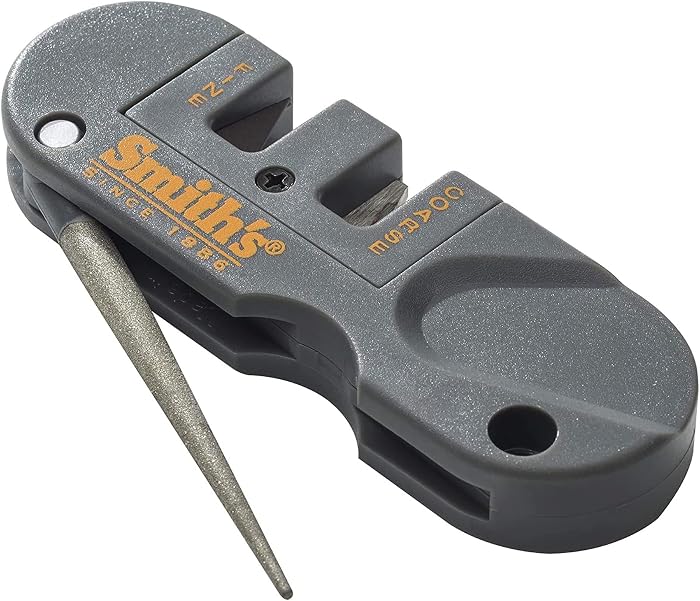
Smith's Pocket Pal PP1 Best Everyday Carry

Smith's PP1 Pocket Pal Knife Sharpener Preset Carbide & Ceramic Stone

Pocket carry

Field Score 93/100
Length
3.5 in
Stones
Reversible and replaceable
Weight
1 oz
Abrasives
Carbide, ceramic, diamond rod
View on Amazon

An ounce. That is the whole case for the Pocket Pal, and it is a good one: a sharpener you forget is in your pocket is a sharpener that is there when an edge goes. It measures three and a half inches by an inch, and the lanyard hole lets it hang off a pack strap or a belt loop instead of rattling loose.

Inside that ounce there is a carbide slot, a ceramic slot, and a fold-out diamond-coated rod for serrations, gut hooks, and fish hooks. The carbide and ceramic stones reverse and replace, which is unusual at this size and means the tool is not finished when the abrasive is.

The rod does the work the slots cannot. It is tapered and gritted fine enough to work a serrated pocket knife groove by groove, or to chase a hook point back to sharp, and it is the function we reach for most.

For everyday carry we take this over the Blademedic: lighter, slimmer, and easier to hang off a strap, and the rod means it can handle blades the preset slots would leave alone. That is the whole difference between a sharpener that lives in a drawer and one that comes home with you.

Worth Noting

  • Carbide slot is for straight edges only
  • Plastic body will not take a toolbox beating
Our Verdict

An ounce, three and a half inches, and a lanyard hole: this is the sharpener we actually carry, diamond rod and all, because nothing about it asks to be left behind.

Check Latest Price
6

Victorinox Dual-Knife Sharpener Best for Swiss Army Knives

Victorinox Dual-Knife Sharpener Perfect for Straight Blades

Swiss Army knives

Field Score 92/100
Design
Pencil-style body
Length
5 in
Stages
Honing stone plus ceramic notch
Weight
1.44 oz
View on Amazon

Against everything else here it looks like a mistake: a five-inch body shaped like a fat pen, with a stone set in one end and a ceramic notch cut into the side. The shape turns out to be the whole idea. It sits in the hand the way a marker does, so the stroke stays flat instead of rocking, and it disappears into a jacket pocket at an ounce and a half.

We reach for it for Swiss Army knives and other small straight blades. The pre-sharpening stone takes a dull pen blade back to useful in a dozen passes, and the ceramic notch refines it afterward. Two stages do more for a two-inch blade than one coarse slot ever will, and the whole process is about as un-intimidating as sharpening gets.

The stone is the weak point. It is a thin abrasive set into the body, and it can crack if the tool is dropped or used to lever something, so treat it as a pocket tool rather than something to toss in a toolbox. The ceramic notch is likewise small: fine on a pen blade, cramped on a five-inch hunter.

Worth Noting

  • Honing stone can crack if dropped
  • Ceramic notch is small for long blades
Our Verdict

We reach for it for Swiss Army knives and small folders: a two-stage stone-and-ceramic tool the size of a marker, backed by a lifetime warranty.

Check Latest Price
7

Smith's DCS4 Diamond Stone Best Truck-Kit Stone

Smith's DCS4 4” Diamond Combination Sharpener

Truck kit

Field Score 91/100
Extra
Micro pad and hook groove
Grits
Coarse and fine
Stone
4 in, double-sided diamond
Handle
Stores the stone
View on Amazon

The handle is the smart part. Pull the four-inch stone out and the rubber grip becomes its case: the stone slides inside, the guard covers the working face, and the whole thing goes into a pack without shedding grit over everything else in it. That storage is why this one lives in a truck kit rather than a drawer.

The stone itself is double-sided diamond, coarse on one face and fine on the other, color-coded so you can grab the right side by feel. Both faces use an interrupted surface, a grid of small pads rather than one flat sheet, which keeps the abrasive cutting instead of loading up with metal dust.

Each face also carries a micro sharpening pad and a groove sized for fish hooks and pointed tools, the detail that makes this as much a fishing tool as a hunting one. Compared with the puck you get a finer finish and a handle to hold onto; compared with the little pull-throughs you get a much bigger working surface for a long blade.

Worth Noting

  • Stone can work loose from the handle
  • Fine face wears first with heavy use
Our Verdict

The handle becomes the case, which is why this four-inch double-sided stone is the one we leave in the truck for knives, hooks, and whatever else went dull.

Check Latest Price
8

Lansky Puck Best for Axes and Tools

Lansky Puck

Axes and tools

Field Score 90/100
Use
Field and shop
Type
Dual-grit puck
Blades
Knives, axes, tools
View on Amazon

No slots, no guides, no preset angle. A puck is a stone, and you are the angle. That sounds like a step backward until you set one against a hatchet: the round face gives you enough surface to sweep a long edge across in one stroke, which a three-inch pocket tool simply cannot do.

It is dual grit, coarse on one side and fine on the other, so a nicked axe head gets reshaped on one face and finished on the other. Lansky lists it for the field and the shop alike, and that is the useful part: the same stone that lives in a hunt pack will true up a machete on the bench at home.

We like it for camp tools more than for knives. An axe, a machete, a long camp blade all fall to the puck, it has nothing to break, and it costs about as little as anything here. Freehand sharpening takes practice, but the puck is as forgiving a place to learn as you will find, because the surface is big enough to feel what you are doing.

Worth Noting

  • No angle guidance, so freehand skill counts
  • Awkward on small pen blades
Our Verdict

For axes, machetes, and camp tools we keep one of these in the truck: a dual-grit stone that works in the field or on a bench and does not care how long the blade is.

Check Latest Price
9

Fallkniven DC4 Best Pocket Stone

Fallkniven DC4 Diamond/Ceramic Whetstone

Edge maintenance

Field Score 89/100
Use
Wet or dry
Faces
Diamond and ceramic
Sheath
Leather, doubles as strop
Stone Size
3.94 x 1.26 x 0.35 in
View on Amazon

This is the slowest way here to fix a damaged edge, and that is not a knock. It is a stone the size of a pocket knife, and a small surface means time. If a blade is chipped, the Work Sharp's coarse plate or a puck will get you there faster. For keeping a sound edge sound, nothing here is nicer to use.

Two faces, diamond on one and ceramic on the other. The diamond cuts a fresh bevel, the ceramic refines it, and the stone is listed for wet or dry use, so you can spit on it in the field or run it dry and brush it out later.

The break-in is real. The diamond face starts a little grabby and cuts rougher than it will after a few knives, so go light at first and let the stone settle. After that it cuts fast for its size without gouging.

The leather pouch is not just a pouch. The back of it works as a strop, which gives you a finishing step most pocket sharpeners have no room for, and the whole package slips into a jacket pocket or a pack lid without adding noticeable weight.

Where it fits is with someone who already knows how to hold an angle and wants the smallest thing that keeps a hunting knife shaving sharp through a week in the woods. It is the wrong pick for a beginner, or for a blade that needs repair, since the surface is small and the work is slow. As pure edge maintenance, it is our favorite item in this guide.

Worth Noting

  • Small surface is slow on long or damaged blades
Our Verdict

A pocket-size diamond-and-ceramic stone in a leather pouch, and the one we carry when the knife is already sharp and we want it to stay that way.

Check Latest Price

How We Tested 16 Field Knife Sharpeners

We started with everything a person could reasonably carry into the field: carbide and ceramic pull-throughs, pocket diamond rods, folding dual-grit stones, and a couple of puck-style sharpeners built for tools as much as blades. Anything too bulky for a pack or too flimsy to survive a season got cut before testing, which left 16 sharpeners. We used them for four months.

Sharpness was measured the same way every time. Each knife started deliberately dull — a tomato that squashed instead of slicing, arm hair that survived — and we counted strokes until it sliced cleanly again, then checked whether the edge felt smooth or ragged and whether a carbide side had scratched the bevel. Serrated blades and fish hooks went through every sharpener that claimed to handle them.

Ease of use and size got tested with cold hands, wet hands, and one free hand, since that's how it goes on a tailgate or a boat ramp. We timed the whole job, noted whether the unit skated across the counter or stayed put under pressure, and judged compactness by actually carrying each one in a chest pocket and a hip pouch for a week.

Durability and value came last: we dropped them on gravel, tossed them loose into packs, and left each one wet overnight to see what rusted or seized. We also counted how many knives each one serviced before the abrasive clogged or glazed, because a sharpener that quits in a month isn't good value. The ferro rods got struck and the whistles got blown, and both were judged on whether they worked and whether the tool still carried easily with them attached.

How to Choose a Field Knife Sharpener

Start With the Abrasive, Not the Gadget

Three abrasives do three different jobs. Carbide is a scraper: it puts a new edge on a dull knife in seconds and takes a lot of steel with it, which is fine on a work blade and wrong on a thin fillet knife. Ceramic hones and polishes. Diamond cuts, and it cuts fast without hollowing the blade. A pull-through with a carbide slot and a ceramic slot covers most days in the field; if you dress game or fillet fish, you want diamond somewhere on the tool, because only diamond will rebuild a bevel properly.

How Small Does It Have to Be?

Compact in a product title is measured against a bench system, not against your jacket pocket, so match the real length to the place the tool will live. The Smith's Pocket Pal is a pocket knife sharpener at three and a half inches and an ounce, small enough to vanish in jeans. The Work Sharp Guided Field Sharpener Elite runs about nine and a half inches in its case, which makes it a pack item, and the long-handled AccuSharp is a glovebox tool. Pick the location first and the size question answers itself.

Guided Angles or Freehand

Every sharpener either holds the angle for you or asks you to hold it. Molded guides, preset V-slots, and pen-shaped bodies do the first job; a stone does the second. The Work Sharp's 20- and 25-degree guides are the clearest version of the idea here, with the blade resting against them so the bevel stays put. Twenty degrees suits most hunting and pocket knives; twenty-five is for blades that take harder use. If you sharpen twice a season, buy the guide. If you enjoy the process, a stone gives you more control.

Serrations, Gut Hooks, and Fish Hooks

A plain V-slot cannot reach the bottom of a serration or the inside of a gut hook, and forcing it flattens the teeth. Those jobs need a tapered round rod, ideally diamond-coated. It is the one feature we refuse to give up on a hunting or fishing sharpener: the Lansky Blademedic, the SHARPAL 101N, and the Smith's Pocket Pal each carry one, and for each of them that rod is half the reason to buy.

What Wears Out, and What You Replace

Abrasives are consumables. Carbide inserts dull, ceramic slots load with metal dust, diamond plates lose their bite, and a sharpener that was brilliant in year one can be polishing instead of cutting by year three. Two things make that easier: a wear part you can replace, such as the reversible stones on the Smith's Pocket Pal, and a body that lets you clean the abrasive properly. Scrub a loaded ceramic slot with hot water and a stiff brush and it comes back to life.

Frequently Asked Questions

Final Verdict

Buy the Work Sharp Guided Field Sharpener Elite if you sharpen more than a couple of times a season. The grit progression and the molded angle guides let you take a dull hunting knife all the way to a polished edge without learning to hold a bevel freehand, and nothing else here does the whole job.

If the sharpener has to live in a pocket, the Smith's Pocket Pal is the one that actually rides there. If there is an axe in your kit, add the Lansky Puck.