The 7 Best Fly Masks for Horses

There's a sound a horse makes when the flies find his eyes: a hard head toss, then the hollow thud of a cheek being rubbed against the fence. A fly mask is the simplest fix in the tack room — mesh over the eyes, sometimes ears, held on with a strap or two — but the wrong one starts its own problems. Slip sideways, chafe at the poll, or peel off in the first good roll, and it's worse than nothing.

I keep two horses in a midge-heavy paddock, so our mask season runs long. Over the past four months we've put 14 masks on narrow pony faces, wide draft crosses, and one mare who chews hardware for sport — eye-only styles, full-face versions with ears, UV-blocking mesh, fleece padding and all.

The lesson that stuck is that fit beats fabric: a mask resting on the eyelashes does more harm than the flies did, and UV coverage genuinely matters on a pink-skinned face. Everything below was judged on horses living outside in mud and dust, not on a show-ring photo.

Our Top Picks

The 7 Best Fly Masks for Horses

1

Cashel Crusader Long Nose with Ears Best Overall

Cashel Crusader Long Nose with Ears

Everyday turnout

Field Score 89/100
Weight
5.1 oz
Coverage
Ears and long nose
Material
Coated nylon micromesh
UV Protection
Up to 70%
View on Amazon

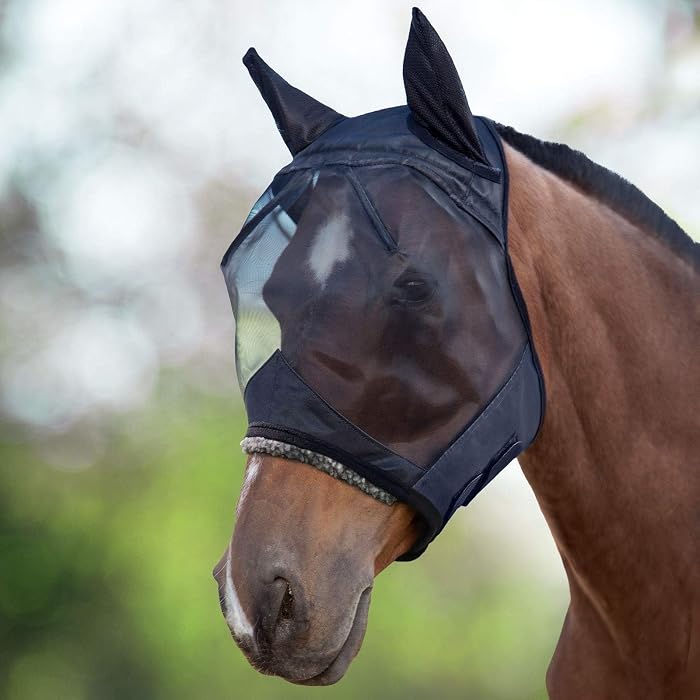
Full coverage is the reason this Cashel is our default: the long nose panel reaches down the muzzle and the ears are built in, so one mask handles the places flies and sun hit hardest. We like that it does this without turning into a heavy hood. The coated nylon micromesh is breathable enough for extended turnout, and the patented three-hole cap keeps the eye openings clear instead of laying mesh across the lashes. For a horse that lives out, that combination is more useful than any single feature.

Fit is the part to get right. The horse size runs large, and that is the one thing to plan around: a pony, a fine-headed Thoroughbred, or a horse between sizes may need the smaller option. On a bigger head, the extra room is welcome, and the ear clearance gives the mask a better chance of staying where it belongs. The long nose also does real work on pink muzzles and white faces.

The mesh is light enough that vision does not look compromised, and the mask has stayed put through ordinary turnout in our experience. We also appreciate that it covers the ears without adding a separate ear net. If you want one mask for most horses and most days, start here; if your horse is smaller than the label suggests, size down rather than hoping it settles.

Worth Noting

  • Long nose can bother some grazers
Our Verdict

This is the fly mask we recommend first for most horses: full ear and nose coverage, clear vision, and a fit that holds up in turnout.

Check Latest Price
2

Cashel Quiet Ride Fly Mask Best for Riding

Cashel Quiet Ride Fly Mask

Riding and trails

Field Score 88/100
Weight
2.88 oz
Coverage
Eyes, cheeks, forehead
Material
Soft nylon mesh
Bridle Fit
Over most bridles
View on Amazon

The Cashel Quiet Ride is built around a different job: it fastens over most any bridle, so you can tack up and head out without swapping masks. The soft nylon mesh is sheer and light, and the cut leaves the eyes, cheeks, and forehead covered while keeping the bridle controls accessible. That makes it the one here we reach for when the ride itself is the reason for the mask.

We think it earns that role because visibility is the whole point of a riding mask, and this one keeps the mesh fine enough to see through without turning the face into a dark screen. The light material is also a relief in heat, and it does not add a bulky layer over the bridle. On the trail, that combination matters more than maximum coverage. It is not the mask we choose for full-time pasture turnout, though: the same lightness that makes it comfortable under tack leaves it exposed to snags and herd play.

Use it for riding and for short turnout in hot weather, and expect to replace it sooner than a heavier turnout mask. The fit over the bridle is the reason it stays useful, and the eye coverage is generous enough to keep gnats out of the corners. If your horse lives out in a herd, the Cashel Crusader Long Nose with Ears is the tougher default; if you ride in fly season, this is the one to keep in the tack trunk.

Worth Noting

  • Light mesh can snag in turnout
  • No ear coverage
Our Verdict

Ride in fly season and this is the mask we hand you: it fits over the bridle, keeps vision clear, and stays light in heat.

Check Latest Price
3

Harrison Howard CareMaster Pro Luminous Best for Sensitive Eyes

Harrison Howard CareMaster Pro Luminous Horse Fly Mask Large Eye Space Standard

Sensitive eyes

Field Score 87/100
Padding
Fleece-lined seams
Coverage
Full face with ears
Eye Clearance
Raised eye darts
UV Protection
60% effective rate
View on Amazon

The large eye darts are what make this Harrison Howard mask worth a look for a sensitive horse: the mesh is lifted away from the lashes instead of resting flat against the eye. Fleece padding runs along the inner forehead and nose seams, which softens the contact points and helps close the gaps that let small flies sneak in. We like that combination for a horse that rubs its face on fences or comes in with weepy eyes after a buggy afternoon.

The standard cut includes ears, so it covers more than the eye area without going all the way to a long nose. The trade-off is that the nose is exposed, which is fine for a horse that mostly needs eye and ear relief but not for one with a pink muzzle that burns. The fit is roomy through the face, and the adjustable touch-and-go straps give you some room to tune it; still, this is a mask to check carefully around the eye opening before you turn out.

Durability is the question we keep an eye on. The mesh and stitching are not the toughest here, and a horse that plays hard can find the weak points. Keep it for a sensitive horse that needs the eye clearance, not for the roughest herd. If you need maximum coverage instead, the Cashel long-nose mask is the more protective choice; if eye rubs are the main problem, this one has the better shape.

Worth Noting

  • No nose coverage
  • Mesh and stitching wear with hard use
Our Verdict

Sensitive eyes are the reason we choose this one: raised darts, fleece padding, and ear coverage without a long nose.

Check Latest Price
4

Harrison Howard Midge-Proof Half Face Best for Midges and Gnats

Harrison Howard CareMaster Midge-Proof Fleece Padding Horse Fly Mask Half Face

Midges and gnats

Field Score 86/100
Padding
Fleece seam padding
Coverage
Half face with ears
Material
Midge-proof fabric
UV Protection
UV-protective fabric
View on Amazon

The Harrison Howard Midge-Proof is a half-face mask: eyes and ears are covered, the nose is left free. That shape suits horses that tolerate a mask over the face but fuss at anything sitting on the muzzle, and it also makes sense for barns where the main annoyance is midges and gnats rather than strong sun. The outer fabric is fine and breathable, with fleece padding along the seams and a dual-color scheme that makes the mask easier to spot in the field.

The eye area has enough shape to stay off the lashes when it is positioned correctly, and the ear covers are soft rather than stiff. We paid close attention to the seam over the brow: if it sits too high, the mesh can crowd the top of the eye, and if it sits too low, the horse has less room to blink. The hook-and-loop closure is easy to adjust, but the generous cut leaves a lot of extra room on a smaller head.

For a midge-prone horse with a tolerant nose, this is a useful specialist. We recommend it when you want eye and ear protection without a long nose panel, and we prefer it to a full-face mask for a horse that rubs its muzzle or grazes constantly. If your horse needs UV protection on a pink nose, choose the Cashel long-nose mask instead; if you want a simple no-ears turnout mask, the Farnam is the easier value.

Worth Noting

  • Runs large for smaller heads
  • Leaves the nose exposed to sun
Our Verdict

A midge-plagued horse that dislikes a nose panel is exactly who this half-face mask suits: soft ears, clear eyes, no muzzle bulk.

Check Latest Price
5

Farnam SuperMask II Best No-Ears Value

Farnam SuperMask II Horse Fly Mask Without Ears For Eyes

Basic no-ears coverage

Field Score 85/100
Mesh
Clear see-through mesh
Trim
Plush fleece
Closure
Adjustable throat latch and double latch
Coverage
No ears, extended face
View on Amazon

The Farnam SuperMask II keeps things simple: no ears, no long nose, just a clear see-through mesh over the eyes and face with plush fleece trim around the edges. The double-latch closure and adjustable throat latch are the parts that matter, because a basic mask only works if it stays on. We like that the fleece sits against the horse rather than raw binding, especially for a horse that has rubbed along the brow with cheaper masks.

For everyday turnout, this is a sensible value. The fit is generous enough for bigger heads, and the open-ear design is easier to settle on a horse that resents having its ears handled. It also leaves the ears and muzzle exposed, so it is not the choice for a pink nose or a horse tormented by ear flies. The mesh is clear enough for good visibility, and the closure gives you more adjustment than a single strap.

Durability is the weak spot to accept. The mask is not the most robust here, and the mesh and closure can wear out with hard use. For a calm horse in a controlled pasture, it is an easy mask to live with; for a herd on rough ground, the Cashel is the better long-term buy. It is also the one we grab when a horse needs basic eye protection without a lot of hardware.

Worth Noting

  • Mesh and closure wear with hard use
  • Leaves ears and muzzle exposed
Our Verdict

For calm horses that need basic eye protection, we recommend this no-ears mask: clear vision, soft trim, and a secure double latch.

Check Latest Price
6

Professional's Choice Comfort-Fit Best Stretch Fit

Professional's Choice Comfort-Fit Fly Mask

Under bridles

Field Score 84/100
Weight
2 oz
Material
Smooth stretchy fabric
Eye And Ear Mesh
Mesh around eyes and ears
Forelock Opening
Yes
View on Amazon

Professional's Choice takes a different approach from the strap-and-mesh masks here: the body is a smooth, stretchy material with mesh around the eyes and ears, and a forelock opening helps it sit naturally. There is no bulky binding to fold under a bridle, and the pull-on shape is quick to position. That makes it a natural candidate for a horse that lives in a bridle or needs something low-profile.

The stretch is what sells the fit. It hugs the face closely, which keeps the eye mesh in place and reduces the gaps that let gnats sneak under the edge. We found it easy to put on and take off, and the light weight is welcome in heat. The close fit does mean there is less room for error: if the mask is not seated evenly, the mesh can sit too near the eye, and the stretch can make it harder to smooth out once it is on.

Durability is the trade-off. The same soft material that makes it comfortable is not the toughest here, and the mesh, seams, and edges can give out with hard pasture use. We recommend it for a horse that is easy on masks and needs a smooth layer under tack, not for a rough herd or a horse that has learned to remove headgear. If you want a riding-specific mask that fastens over the bridle, the Cashel Quiet Ride is the more secure choice; if you need a turnout mask that survives play, the Cashel Crusader is the better default.

Worth Noting

  • Mesh and seams wear with hard use
  • Can be pulled off by determined horses
Our Verdict

We keep this stretch mask for the horse that tolerates masks and needs a low-profile layer under tack: it is comfortable, light, and easy to position.

Check Latest Price
7

Pro-Force Fly Mask Best for Smaller Horses

Pro-Force Horse Fly Mask with UV Protection

Smaller horses

Field Score 83/100
Mesh
Clear View Vision
Closure
Double-locking fastener
Stated Fit
900-1200 lb
Visibility
Equi-Glo nite reflector
View on Amazon

The Pro-Force is sold as a horse mask for 900 to 1200 pounds, but the fit is the first thing to settle. The mask runs small for that range, and average-sized Quarter Horses can be at the edge of the closure. On a smaller, finer-built horse, the same cut gives a close fit without a lot of excess. That is the buyer this mask makes sense for.

The rest of the design is straightforward: clear mesh, fleece-lined trim, a double-locking fastener, and a reflective diamond for visibility in low light. The mesh is sturdy enough for daily turnout, and the closure gives you more security than a single strap. We also like that the mask is easy to wash and does not carry a lot of bulk.

The short hook-and-loop strap under the chin is the limiting detail. It does not leave much overlap on a broader head, and that is where the fit gets tight. The eye area is simple rather than shaped, so check that the mesh is not resting on the lashes before you turn out. It is a basic mask that does basic work.

We recommend it for a smaller horse or a pony that needs a budget turnout mask, not for a warmblood or a horse with a broad jaw. If your horse is closer to the top of the stated weight range, go up a size or choose the Farnam, which has more room through the head. The Pro-Force is the mask we keep as a spare for smaller heads.

Worth Noting

  • Runs small for average horses
  • Short chin strap limits overlap
Our Verdict

We keep this budget turnout mask for smaller horses and ponies: light, reflective, and easy to wash.

Check Latest Price

How We Tested Fly Masks Through Mud, Dust, and Horse Mischief

We started with every fly mask we could find that came in more than one size, then cut the field to 14 by matching sizing charts against the actual head measurements of the horses we had access to. Single-size masks, and masks that covered the eyes with the same mesh as the body, were set aside early.

Testing ran four months, from late spring through the first hot weeks of summer, on horses that live outside. Masks went on at morning turnout in dew-wet grass, came off for riding, went back on overnight, and stayed on through three days of rain that turned the paddock to soup. Two horses wore a mask on twice-weekly trail rides.

At fitting, we measured poll to muzzle and checked whether the eye mesh sat clear of the eyelashes or pressed flat against them, and whether the ears stayed upright or slid forward over the eyes by the end of a turnout. To see how well each one stayed put, we hosed every mask down and watched a full roll in the mud. Straps were fastened and unfastened roughly a hundred times over the four months so we could feel the hook-and-loop weaken, and each mask was washed weekly and checked for rub marks behind the ears and under the jaw.

Effectiveness was judged at dusk by the gate, counting midges on a bare muzzle versus a masked one. After four months we compared stitching, mesh, and closures across the whole group and weighed how each one held up against what it cost.

How to Choose a Fly Mask for Your Horse

Fit Comes Before Size Labels

A mask sold as horse size can fit a pony or swim on a fine-headed Thoroughbred, so start with the manufacturer's measurement rather than height or weight alone. Check the eye opening against the horse's face and make sure the ears are not folded or pinched. We put fit first because a loose mask shifts into the eye, while a tight one rubs at the brow. Size down when a model runs large, as the Cashel Crusader does, and size up when a mask has a short closure.

Match Coverage to the Horse and the Season

Eyes and ears are the minimum for most horses, but the nose is where sunburn and face flies often land. A long nose panel helps a pink muzzle, though it can drag in grass or annoy a horse that grazes low. A no-ears mask is easier to settle on a horse that resents ear handling, while a half-face midge mask leaves the muzzle free but unprotected. Choose the coverage your horse will tolerate, not the coverage that looks most complete on the shelf.

Look for Eye Clearance, Not Just Fine Mesh

A fine mesh can still rub if it lies flat against the lashes. Raised eye darts, stitched shaping, and fleece binding do more for comfort than a tighter weave, and they also keep the mask from collapsing into the eye. After you fasten the mask, check both eyes from the side: the mesh should sit away from the eyelashes and leave a clear line of sight. If the mask has to be forced into position, the shape is wrong for that horse.

Plan for Wear, Closures, and Tack

Fly masks are wear items. Double closures and fleece trim help, but mesh and seams still give out with herd play. For riding, use a mask made for it: the Cashel Quiet Ride fits over most bridles, while a turnout mask can bunch under the leather. If your horse lives out, spend the money on a secure closure and a shape that stays put; that is more useful than another layer of mesh.

Frequently Asked Questions

Final Verdict

For most horses, the Cashel Crusader Long Nose with Ears is the mask we recommend first. The ear and nose coverage earn their keep, and the micromesh keeps the eyes clear; just size down if your horse has a fine head. Choose the Cashel Quiet Ride for riding, the Harrison Howard large-eye mask for sensitive eyes, or the Farnam for simple no-ears coverage. The Pro-Force is the spare for a smaller head, not the default for an average horse.