The 6 Best Garage Heaters of 2026

A garage is the most honest room in the house about heat: thin walls, a slab that stays cold until July, a door that opens straight to the weather. You don't need the whole bay at 70 degrees — you need warm hands and a workbench you can lean on, and that means the heat has to reach you rather than fill the ceiling.

I spent one January rebuilding a snowblower in a garage that hovered around 38 degrees, and I've been picky about garage heat ever since. This past winter my team ran 10 heaters — hardwired ceiling units, propane forced-air boxes, a couple of small radiant portables — through about six months of real work.

Shopping for raw heat is the usual mistake. A 5,000-watt unit aimed at your bench beats a bigger one aimed at the ceiling, and the quiet ones are the ones you'll leave running. Propane portables are cheap to buy and pricey to run; a hardwired 240-volt heater needs a breaker most garages don't have, but it heats fast. The picks below run from a ladder-and-electrician job to something you can carry to a frozen lake.

Our Top Picks

The 6 Best Garage Heaters of 2026

1

Comfort Zone 5,000W Ceiling Heater Best Overall

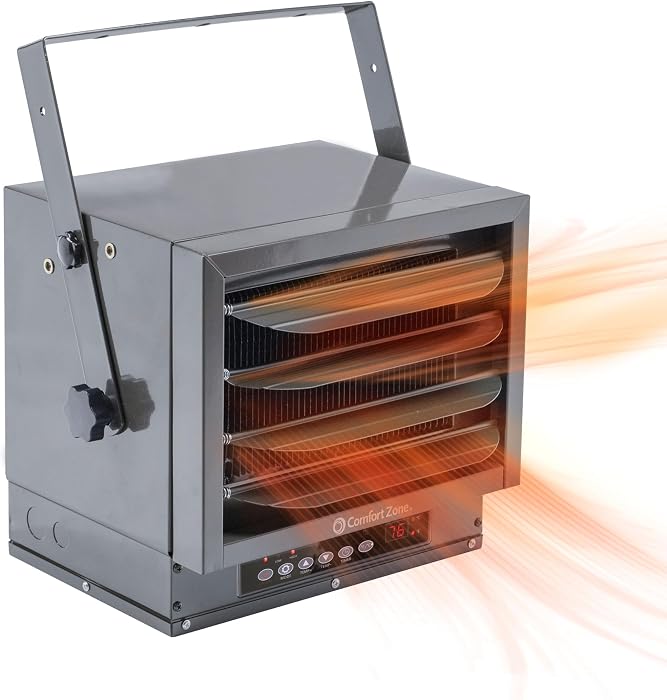
COMFORT ZONE 5000-Watt Fan-Forced Ceiling Mount Garage Heater

Most garages

Field Score 92/100
Power
240V hardwired, 20.9 A
Coverage
1,000 sq. ft.
Mounting
Ceiling
Heat Output
17,065 BTU (5,000 W)
View on Amazon

The 5,000-watt Comfort Zone is the least expensive way to heat a garage properly in this group. It lists 17,065 BTUs and 1,000 square feet, enough for a two-car garage with an insulated door, and the three-position switch lets you run it at 3,000 watts on a 45-degree afternoon instead of paying for full output. Compare it with the DR-975, which costs considerably more and lists less coverage, and the value argument takes care of itself.

Hanging it is the easy half. The bracket tilts and the louvers aim, so you can push the airstream down the length of the bay rather than straight at the floor, and at 20.4 pounds one person can hold it in place while another drives the lag bolts. The hard half is the 240-volt feed: at 20.9 amps this wants a circuit of its own, and that electrician's bill is the real cost of going electric.

What we don't love is the control. The thermostat is a knob on the housing up near the ceiling, so every adjustment is a reach, and there's no remote or timer to save you the trip. Anyone who wants to start the heat from the kitchen should be looking at the 7,500-watt unit instead.

Watch the first month. When something goes wrong with this one, it's usually the fan or the controls, and it happens early rather than after years of service — which is exactly when the warranty still covers it. Hang it somewhere you'll hear it cycle and run it hard before the cold settles in.

Worth Noting

  • Thermostat knob sits on the unit, with no remote
  • Fan or control faults can appear within weeks
Our Verdict

We recommend it for most two-car garages: the least expensive hardwired unit here, 1,000 square feet of coverage, provided you have a 240-volt circuit to feed it.

Check Latest Price
2

Comfort Zone 7,500W Ceiling Heater Best for Large, Cold Garages

Comfort Zone 7,500W Ceiling Heater

Large, cold garages

Field Score 91/100
Power
240V hardwired, 31.25 A
Controls
Digital thermostat, remote, timer
Coverage
1,250 sq. ft.
Heat Output
25,600 BTU (7,500 W)
View on Amazon

This is the heater for the garage that never really gets warm. Comfort Zone lists 25,600 BTUs and 1,250 square feet, more than anything else on 240 volts here, and it has the output to pull a cold three-car bay back toward comfortable rather than just take the edge off.

The controls are the part we keep coming back to. A digital thermostat, a remote, and a 12-hour timer mean no ladder, no reaching over your head, and no wondering whether you left it running when you shut the shop for the night. That's a real difference from the knob on the 5,000-watt unit, and it's most of what the extra money buys.

The thermostat has a quirk worth knowing before you hang it. Its sensor sits inside the housing near the ceiling, so it reads the air around the heater instead of the air at your bench. Expect to set the number higher than the temperature you're actually after, and expect a relay click across the garage each time it cycles; both are normal for this design and neither is a defect.

Reliability is the honest caveat: these can quit outright, or throw an error code and stop. Weigh that against a remote and a timer you'll use every day — if you want this much electric heat with a control you don't have to climb for, nothing else here does it.

Worth Noting

  • Sensor sits in the housing, so setpoints read high
  • Some units quit or fault out with an error code
Our Verdict

If you're heating a big, cold three-car garage and the panel already has 240 volts, this buys the most heat here plus a remote, a digital thermostat, and a timer.

Check Latest Price
3

DR. Infrared DR-975 Best Wall-Mount Option

DR. INFRARED HEATER NEW Upgraded DR-975 7500-Watt 240-Volt Hardwired Shop

Wall mounting

Field Score 90/100
Controls
Remote thermostat, timer
Coverage
800 sq. ft.
Mounting
Wall or ceiling
Heat Output
7,500 W (4,700 W low)
View on Amazon

Here's the odd thing about the priciest 240-volt heater in this guide: it lists 800 square feet, less than the 5,000-watt unit that costs considerably less. We keep it on the list anyway, because coverage isn't the reason to buy it — the wall mount is. If your ceiling is low, or already occupied by door tracks, an opener, and lights, hanging a heater at head height on a wall solves a problem none of the ceiling units can.

What you get for the money is control and airflow: a remote thermostat with a timer, five adjustable louvers, a choice of 4,700 or 7,500 watts, and a fully enclosed motor that shrugs off sawdust in a way an open one doesn't. It hardwires on 8-gauge copper and it's UL/CUL listed. In a working woodshop, that motor and those louvers matter more than the coverage number.

Noise is the dividing line. Mounted high, this is background fan noise you stop hearing; mounted at shoulder height beside a bench, it's the loudest thing in the room, because the blower moves a lot of air by design. At 4,700 watts the airstream reads warm rather than hot — big-volume, moderate-temperature heat, which is fine for a shop and disappointing if you expected a blast furnace.

Reliability is uneven: fans that stop and units that run hot turn up with this model, so mount it where you'll notice a change in sound, and treat the thermostat as a guide rather than a gauge. Buy it for the wall mount and the remote, not for the coverage figure.

Worth Noting

  • Costs more than units that list more coverage
  • Fan failures and hot-running units appear
Our Verdict

Buy it when the wall is the only place a heater can go: the remote thermostat, five louvers, and enclosed motor make it the most flexible hardwired install here.

Check Latest Price
4

Mr. Heater 50,000 BTU Unit Heater Best Gas Heater for Big Shops

Mr. Heater 50,000 BTU Unit Heater

Big shops, barns

Field Score 89/100
Fuel
Propane or natural gas
Coverage
1,667 sq. ft.
Heat Output
50,000 BTU
Ceiling Requirement
10 ft.; 8 ft. to floor
View on Amazon

Read the clearance line first: this unit wants a 10-foot ceiling and 8 feet from the bottom of the heater to the floor. That rules out most attached garages, where the ceiling sits at 8 or 9 feet, and it defines the buyer — a barn, a pole building, or a detached shop with height to spare.

For that building, 50,000 BTUs and a listed 1,667 square feet is serious heat from one ceiling-mounted box, and it's the only gas-fired forced-air unit here. It ships with a natural gas to propane conversion kit, it takes a standard 24-volt or Wi-Fi thermostat, and it comes up to temperature the way a furnace does rather than the way a space heater does.

The install is the project, not the heater. At 60.3 pounds it's a two-person lift overhead, the thermostat is sold separately, and the gas line is a plumber's job. Plan the whole thing before you order, including where the thermostat goes and whether your ceiling structure will take the mounting brackets.

Two things to weigh. Blower and control-board trouble shows up with this model — a blown fuse on the board is the usual culprit, and the unit can shut down mid-cycle — and it's a bare-bones design with no frills to fall back on. Hang it high, wire a thermostat you can reach from the floor, and the height requirement stops mattering.

Worth Noting

  • Needs a 10-ft. ceiling and 8 ft. to the floor
  • Blower and control-board faults in some units
Our Verdict

For a barn or a big detached shop with ceiling height to spare, this is the only heater here that treats 1,600 square feet as an ordinary afternoon.

Check Latest Price
5

Mr. Heater Portable Buddy Best Portable Option

Mr. Heater Portable Buddy

Portable spot heat

Field Score 88/100
Fuel
Propane
Safety
Low-oxygen and tip-over shutoff
Coverage
225 sq. ft.
Heat Output
4,000 or 9,000 BTU
View on Amazon

At 7.1 pounds this is the only heater in the guide you can carry up a ladder, into a blind, or out to the truck one-handed, and that is most of its case.

It's radiant, which changes how you use it. The 4,000- and 9,000-BTU settings warm what the panel faces rather than the air in the room, so you point it at your bench, your chair, or your boots, and the listed 225 square feet is best read as a one-car garage with the door shut. In a cold three-car bay it keeps you warm and leaves the rest of the room alone.

We like it for the small jobs: a power outage, a tack room, the hour before the woodstove takes over. The low-oxygen sensor and the tip-over shutoff are what make that reasonable, and the piezo igniter means no matches in the dark. It runs on small propane cylinders, which is exactly what makes it portable and exactly why it's a poor choice for heating the same space every evening all winter.

Two boundaries to respect. It's an unvented propane appliance, so it needs the ventilation the manual specifies, and it's a spot heater rather than a thermostat. A unit that stops lighting after a season or two is also a known outcome with this model — buy it for portable heat, not as a permanent fixture in the shop.

Worth Noting

  • 225 sq. ft. caps what it can warm
  • Small cylinders mean short run times
Our Verdict

For a one-car garage, a blind, or an outage, this is the portable answer: 9,000 BTUs on high, a low-oxygen shutoff, and 7 pounds to carry.

Check Latest Price
6

DR. Infrared DR-238

DR. INFRARED HEATER Portable Infrared Indoor and Outdoor Space Heater for Patio

Plug-in spot heat

Field Score 87/100
Power
120V plug-in, 12.5 A
Controls
Remote, 3 heat levels
Mounting
Wall or ceiling
Heat Output
900 / 1,200 / 1,500 W
View on Amazon

Start with what this isn't: at 1,500 watts it is not a garage heater the way the ceiling units are. It's a spot heater that plugs into a standard outlet and hangs over a bench, and judged on those terms it earns its place.

The install is the whole appeal. You get wall and ceiling brackets in the box, a remote, three heat levels at 900, 1,200, and 1,500 watts, and an IP55 rating that lets it live outdoors or in a damp bay. No electrician, no breaker, no 8-gauge copper — a drill, twenty minutes, and a free outlet.

We were pleasantly surprised by how much the remote does on a heater this simple: on, off, and three levels from across the shop, which is more control than you get from the knob on a 5,000-watt ceiling unit. What you don't get is a thermostat, so it runs until you switch it off.

Two limits worth naming. Infrared is line-of-sight heat: step two feet to the side and you feel nothing, so it warms a person, not a room. And the element is the weak point — it can quit within a season — so treat this as a convenience for a bench or a doorway and keep a hardwired unit for the space itself.

Worth Noting

  • Element can fail within a season
  • No thermostat, and heat is line-of-sight only
Our Verdict

The pick for a bench, a doorway, or a rental where a 240-volt circuit isn't happening: plug it in, aim it, and stand in the warmth.

Check Latest Price

How We Chose and Tested Garage Heaters

We built the shortlist around how people actually use a garage — a single bay, a two-car workshop, a patio, a tailgate — then filtered by power source, mounting options, and the square footage each unit claims to cover, cross-checking owner reviews for complaints that kept surfacing. Price only counted against output: what a heater cost versus how much floor it could realistically bring up to temperature.

The 10 units then spent one winter, roughly six months, in a detached two-car garage that sits uninsulated in the cold. We hung thermometers at ankle height and at bench height, and timed how long each heater took to move the room from a 40-degree morning to a working 60. We tilted mounts and swung louvers to see whether airflow landed on a person standing at the bench or pooled near the ceiling, and we ran multi-hour sessions to watch how the thermostat cycled — steady holds versus wide swings.

Noise got judged the way you'd notice it: a decibel app at ear height plus a conversation test over the running unit. We did every installation ourselves, one person on a ladder with basic tools, and timed the hardwired jobs separately from the plug-in ones, since that's the real fork in the road for most buyers. The portable propane models went to a cold-weather campsite and a deer camp, where we carried them one-handed, tracked tank life across a weekend, and noted whether they felt stable on uneven ground.

Durability is still accumulating — several of these are heading into a second winter, and we'll keep running them.

How to Choose a Garage Heater

Decide the Power Source First

There are three real options: a 240-volt hardwired unit, a plug-in 120-volt heater, and propane or natural gas. A 240-volt ceiling unit gives you the most heat per dollar you can buy, but at 20 to 31 amps it needs a dedicated circuit and someone qualified to run it. A plug-in heater caps out around 1,500 watts, which is spot heat rather than room heat.

Propane skips the wiring and brings its own bill: fuel, ventilation, and a tank to keep filled. Whatever you choose, a fuel-burning heater needs the ventilation and clearances in its manual — an outdoor-rated patio heater never becomes a garage heater, however much heat it throws.

Match Output to the Space and Its Insulation

Listed square footage assumes a closed door, a sensible ceiling, and at least some insulation. An uninsulated garage with a steel door is worse than its dimensions suggest, and a cold slab keeps the air at bench height colder than the thermostat believes.

A rough guide: 5,000 watts — about 17,000 BTUs — for a two-car garage, 7,500 watts for a big three-car, and 50,000 BTUs of gas for a shop over 1,200 square feet. Size for recovery, meaning how fast a shop heater brings the room back after the door has been open for twenty minutes, not just for holding temperature.

Check the Ceiling Before You Fall in Love

Ceiling mount keeps the floor clear, but the middle of a garage ceiling is usually taken by door tracks, an opener, and lights, and you need enough height that the airstream doesn't blow straight at head level. A wall mount solves both problems and is the reason to pay more for a unit with a smaller coverage number.

Gas unit heaters are the strictest. The Mr. Heater here asks for a 10-foot ceiling and 8 feet from the bottom of the unit to the floor, which is more height than most attached garages have. Measure before you order, not after.

Controls Decide How You Live With It

A thermostat knob on the housing means reaching over your head every time you want a change, which is tolerable for a heater you set in November and leave alone. A digital thermostat with a remote and a timer is worth the upgrade if you want to start the heat without a ladder or shut it off without walking back.

Watch where the sensor sits. A thermostat inside the unit reads the air around the heater, high near the ceiling, so the number on the display runs ahead of the temperature at your bench and the room can feel cold at a setting that says otherwise.

Count the Running Cost, Not Just the Price

Electric heat is metered, so you see it every month; gas heat arrives as a delivery or a tank refill. The bigger the gas unit, the faster the tank empties, and small one-pound cylinders are the most expensive propane you can buy — budget a bulk supply if you plan to run it daily.

Add noise to the same calculation. A fan-forced heater is audible across a two-car garage, and where you hang it decides whether that's background hum or the loudest thing beside your bench.

Frequently Asked Questions

Final Verdict

Most garages are solved by the 5,000-watt Comfort Zone. It's the least expensive hardwired unit here, it covers a two-car garage, and it hangs out of the way — the only real precondition is a 240-volt circuit.

Spend more only for a reason you can name. The 7,500-watt Comfort Zone is for a big, cold three-car bay that needs a remote you can work from the house. The Mr. Heater 50,000 BTU unit is for a shop with the ceiling height and a gas line. And if there's no 240-volt circuit and no way to add one, drop to the DR-238 and accept spot heat.