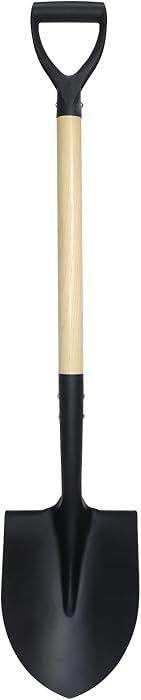
Root Slayer RS220 Best Overall

- Handle
- Ergonomic grip
- Tip Shape
- Sharpened inverted V
- Blade Material
- Powder-coated alloy steel
- Overall Length
- 45 in
A flat blade that meets a root stops dead. The Root Slayer's sharpened inverted V and serrated shoulders turn that same root into a few short strokes: the point starts the hole, the teeth on either side saw through whatever crosses it, and the powder-coated steel head comes back for more in clay that sends a cheap blade skidding. Of everything here, it's the shovel we reach for first when we don't know what's under the soil.
That changes a planting job more than any figure on the listing. Lifting a shrub whose root ball is wider than the hole you planned, splitting a perennial, digging out a bed threaded with old tree roots — the teeth cut the boundary for you instead of you fighting it with a lopper. The 45-inch shaft is the other half of the design: short enough to steer between plants, long enough to keep some of the bend out of your back.
The serrations are for digging, not for moving dirt. Cut planting holes with them all day; load a wheelbarrow and you'll feel the teeth catch and hold soil where a smooth round-point would let it slide. Heft works the same way — all that steel drives the blade into hard ground with less stomping, and it's the last thing you want at the end of an afternoon in soft raised-bed mix. Keep the point out of gravel, too; sharpened steel dulls faster in a driveway than it ever will in a bed.
What We Like
- Serrated V-tip cuts through roots and clay
- Steel shaft stands up to levering
- Sharpened tip starts a hole without stomping
- Lifts shrubs and splits perennials
Worth Noting
- Serrations hold soil instead of releasing it
- Priciest shovel in this set
With roots and clay underfoot, this is the shovel we reach for first: the serrated V-tip saws where a flat blade bounces, and the steel shaft takes the levering.
Check Latest Price