The 7 Best Gas Chainsaws of 2026

The first time a storm drops a white oak across your driveway, you learn fast that a battery saw won't cut it. A gas chainsaw gives you the power to buck a trunk into firewood, limb a downed tree, and clear a fence line without hunting for an outlet. But the wrong saw will flood, bog down in hardwood, or shake your arms numb before the first tank is empty.

Over the past eight months, my team and I ran 11 gas saws through late-winter firewood sessions, spring storm cleanup, and summer fence-line clearing. We tracked cold starts, hot restarts, how often each chain needed tensioning, and whether the power held up in a 16-inch oak log rather than just on the spec sheet.

Engine size and bar length are not a scorecard. A well-balanced 60-cc saw can cut faster than a bigger-displacement model with a longer bar if you're mostly limbing and bucking. Sharp chain, steady oiler, and a tensioner you can adjust without cussing in the brush matter more than bragging rights.

Our Top Picks

The 7 Best Gas Chainsaws of 2026

1

Husqvarna 450 Rancher Best Overall

Husqvarna 450 Rancher 20 Inch Gas Chainsaw

Firewood cutting

Field Score 89/100
Engine
50.2 cc
Guide Bar
20 in
Horsepower
3.2 hp
Powerhead Weight
11.3 lb
View on Amazon

A 20-inch bar on a 50cc engine is the combination most people should start with, and the 450 Rancher is the cleanest expression of it here. The 3.2-horsepower X-Torq engine has enough torque to pull the bar through oak and hickory without the saw feeling like a handful, and the 11.3-pound powerhead is light enough to carry into the woods. That balance is why it leads this group.

We reach for the 450 when the day mixes felling small trees, bucking firewood, and clearing storm damage. The air-purge bulb and combined choke/stop control make the cold-start routine predictable, and the LowVib handle takes the sting out of a long session. We also like the ordinary, open fuel and oil caps; gloves on, no fumbling.

The 20-inch bar is the practical ceiling for casual use. It handles most firewood logs in one pass, and it leaves enough clearance to keep the saw out of the dirt. The Husqvarna dealer network is the other part of the value: parts and service are easier to find than for the import brands.

The 20-inch bar is the line: cross it regularly and the 460 earns the extra weight.

Worth Noting

  • Costs more than budget imports
  • Bar oil can weep in storage
Our Verdict

We recommend the Husqvarna 450 Rancher as the best all-around gas saw for homeowners who cut firewood and clean up storms.

Check Latest Price
2

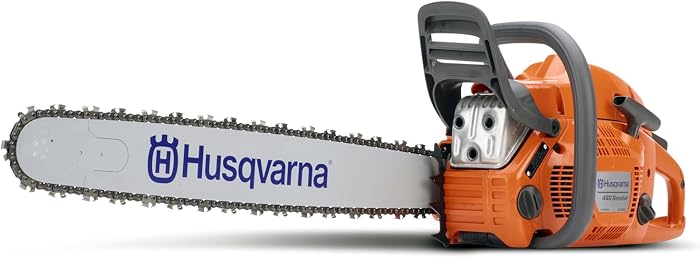
Husqvarna 460 Rancher Best for Large Trees

Husqvarna 460 Rancher Gas Powered Chainsaw

Large trees

Field Score 88/100
Engine
60.3 cc
Guide Bar
24 in
Horsepower
3.6 hp
Powerhead Weight
13.2 lb
View on Amazon

The 24-inch bar is the reason to look at the 460 Rancher, but the 60.3cc engine is what makes it useful. With 3.6 horsepower and a 13.2-pound powerhead, it is a two-handed saw built to pull a long chain through big trunks. The extra length gives you a single pass on logs that stop a 20-inch saw.

Husqvarna's Smart Start and air-injection system are the quiet luxuries here. The purge-and-choke routine is simple, and the centrifugal air cleaner keeps more dust out of the filter when you are cutting in dry wood. The seven-degree offset front handle and LowVib dampeners make a long bucking session less punishing than the displacement suggests.

We prefer the 450 for mixed yard work, but the 460 is the one we want when the wood is genuinely big. It has the torque to keep a 24-inch chain moving, and the weight helps steady the saw in a deep cut.

The 24-inch bar is a commitment: it needs a 60cc engine, a steady hand, and a supply of big logs to justify itself. For everything smaller, the 450 is easier to live with and leaves money for chains and files.

Worth Noting

  • Heavy for overhead work
Our Verdict

We point experienced firewood cutters to the 460 Rancher when the trunks are too big for a 20-inch bar.

Check Latest Price
3

PROYAMA 68cc Best Value Heavy-Duty

PROYAMA 68CC Gas Powered Chainsaw

Heavy-duty cutting

Field Score 83/100
Engine
68 cc
Guide Bar
24 in
Horsepower
4.5 hp
Powerhead Weight
14.5 lb
View on Amazon

A 68cc engine and a 24-inch bar for about the money of a smaller name-brand saw is the whole pitch, and the PROYAMA delivers the part that matters: 4.5 horsepower and enough torque to pull the long bar through hardwood. We think the value case is real, provided you understand what you are buying.

The magnesium chain brake and anti-vibration system are not decorations. The brake housing feels sturdier than the price suggests, and the spring mounts take the edge off a long session. The easy-start system also behaves like a conventional saw: choke, purge, pull, and go. The 24-inch bar is the right length for bucking big logs on the ground; it is too much for limbing.

The 14.5-pound powerhead is the trade-off. It steadies the saw in a long cut, but it is a lot to carry up a slope and not the tool for overhead limbing. A 20-inch bar would make it more nimble, though the 24-inch is what gives the saw its purpose.

For a pile of logs and a willingness to tinker, the PROYAMA is a lot of saw for the money. The Husqvarna is the calmer choice when dealer service matters more than displacement.

Worth Noting

  • Chain can break or jump
  • Recoil starter rope is a weak point
Our Verdict

We like the PROYAMA 68cc for buyers who want big-bore power and a 24-inch bar without paying pro-saw money.

Check Latest Price
4

SUPMIXTOOLS 62cc Best Budget Full-Size

SUPMIXTOOLS 62cc – 62cc Gas Chainsaw 20 Inch Gas Powered Chainsaws 2-Cycle Petrol

Budget firewood

Field Score 82/100
Engine
62 cc
Guide Bar
20 in
Horsepower
4.2 hp
Chain Speed
8,500 rpm
View on Amazon

At the budget end, the question is not whether a 62cc saw can cut; it is whether the rest of the package holds up. The SUPMIXTOOLS answers the first part with a 4.2-horsepower engine and a 20-inch bar, and it answers the second well enough for a homeowner who does not cut every day.

We like the safety switch and the quick-stop chain brake on a saw at this price. The 8,500-rpm chain speed gives it a lively feel in softwood, and the 14-pound powerhead is stable enough to keep the bar level in a cut. Assembly is straightforward, and the included toolkit gets you started without a trip to the hardware store.

The 20-inch bar is the right size for firewood up to about 16 inches, and it leaves room for the occasional larger limb. The engine has enough torque to keep the chain moving when the wood is green, though this is not a saw for a steady diet of 24-inch hardwood. For a first gas saw, the controls are familiar and the learning curve is short.

The 62cc engine is the reason it earns a place, and the 20-inch bar is the reason it stays useful as you move from limbs to firewood. It is a value play, not a lifetime tool.

Worth Noting

  • Bar adjuster can bind
  • No case or spare chain
Our Verdict

We recommend the SUPMIXTOOLS 62cc to shoppers who want a full-size 20-inch saw at the lowest sensible cost.

Check Latest Price
5

JPNTECH 12-Inch Best Compact Limb Saw

JPNTECH 12-Inch – Gas Chainsaw 12 Inch Top Handle Chainsaw 25.4CC 2-Cycle Handheld

Limbing and pruning

Field Score 81/100
Engine
25.4 cc
Guide Bar
12 in
Horsepower
1.2 hp
Powerhead Weight
8.6 lb
View on Amazon

A 12-inch top-handle saw is not a smaller version of a firewood saw; it is a different tool for a different place in the tree. The JPNTECH puts a 25.4cc engine and a 1.2-horsepower output into an 8.6-pound package, with a wrap-around handle that lets you keep the saw close to the branch.

The spring-assisted pull cord and simple knob make the starting routine manageable, and the 11,000-rpm engine has enough speed to zip through green limbs. The 12-inch bar is the point: it reaches into tight crotches and overhead cuts where a 20-inch bar would be in the way. We also appreciate the included mixing bottle and funnel; it removes an excuse to guess at the fuel mix.

We treat the JPNTECH as a limbing and pruning saw. It is happiest in branches up to a few inches across, and it is light enough to carry up a ladder or into a thicket. Use it two-handed even though the top handle invites one hand; the control is better and the kickback risk is lower.

The 12-inch bar is the ceiling, and the 8.6-pound package is the reason it gets carried into places a bigger saw never reaches.

Worth Noting

  • Clutch can slip under heavy load
Our Verdict

We like the JPNTECH 12-inch for limbing and pruning where a full-size saw is too much tool.

Check Latest Price
6

NEO-TEC 62cc

NEO-TEC 62cc – 62CC Gas Powered Chainsaw 20 22 Inch Guide Bar Chain Combo for Wood Cutting

Two-bar kit

Field Score 80/100
Engine
62 cc
Guide Bars
20 in and 22 in
Horsepower
3.5 hp
Fuel / Oil Tanks
550 ml / 260 ml
View on Amazon

Two bars in the box is the practical hook here, and we think it is the right way to sell a 62cc saw: a 20-inch for general cutting and a 22-inch for bigger logs. The NEO-TEC pairs them with a 3.5-horsepower engine and a dual-tank design that separates 550 milliliters of fuel from 260 milliliters of bar oil.

The anti-vibration system and extended pull rope make the saw feel more expensive than the sum of its parts, and the side-mounted chain tensioner is easy to reach. The 25:1 fuel mix is clearly labeled, which matters if you are new to two-stroke equipment.

The NEO-TEC is a kit saw, and that is its appeal. You get the second bar, a mixing container, gloves, and a tool kit in one purchase, so you are not hunting for extras before the first cut. The 20-inch bar is the one most people will leave on; the 22-inch is there for the occasional bigger log.

The two bars are the reason to choose it; the storage and mix are the reasons to think about whether you need the kit. A single-bar saw with dealer support is simpler.

Worth Noting

  • No carrying case included
  • 25:1 mix takes more oil
Our Verdict

We recommend the NEO-TEC kit for buyers who want one powerhead and two bar lengths without shopping for extras.

Check Latest Price
7

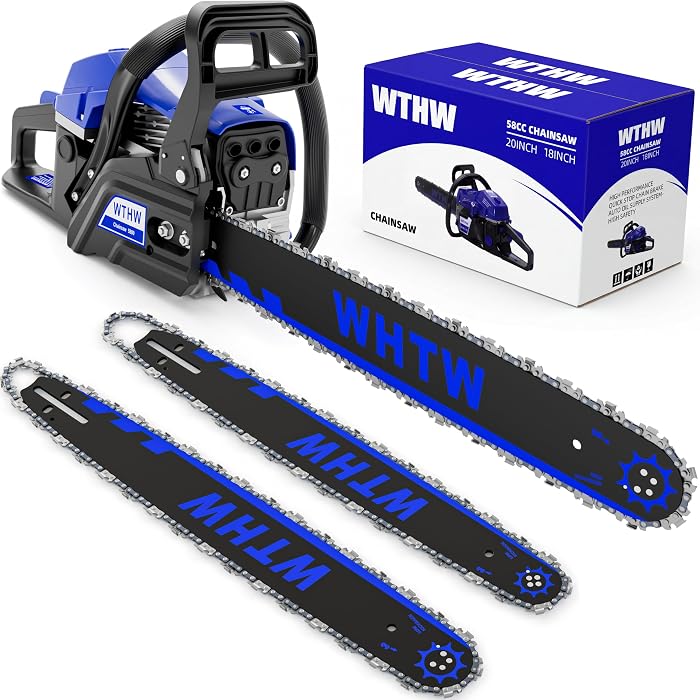
WTHW 58cc

WTHW 58cc – Gas Chainsaw 58cc

Storm cleanup

Field Score 79/100
Engine
58 cc
Guide Bars
18 in and 20 in
Horsepower
3.5 hp
Chain Speed
91 ft/s
View on Amazon

The quick-switch bar mount is the detail that separates this one from the other budget saws. The WTHW comes with an 18-inch and a 20-inch bar, and the mount is designed to let you swap between them without a full teardown.

The 58cc engine makes 3.5 horsepower and turns a 91-foot-per-second chain, which is enough to pull the 20-inch bar through oak and hickory without bogging down. The 14.5-pound powerhead is in the same range as the other full-size saws here, and the double-spring anti-vibration system keeps the handles from buzzing.

The inertial chain brake and automatic oiler are the right features for storm cleanup, where you are moving from one branch to the next and not always thinking about the chain. The 550-milliliter fuel tank and 260-milliliter oil tank are generous enough for a session, though this engine is thirsty when you keep it in the wood.

The 18-inch bar turns the same powerhead into a lighter limber, and the 20-inch bar handles the trunk. That is the case for the quick-switch mount, and the case against settling for a single bar.

Worth Noting

  • No carrying case included
Our Verdict

We see the WTHW as a sensible second saw for storm cleanup, with two bars and a quick-change mount.

Check Latest Price

How We Tested the Best Gas Chainsaws

We started by pulling together 30 gas chainsaws sold by major retailers and specialty dealers, then narrowed the list by engine displacement, bar length, safety features, and how easy each saw was to maintain. We filtered out models with vague service support or no chain brake, and kept a spread of sizes from a 12-inch top-handle saw to 24-inch rear-handle models. The final 11 saws ranged from budget-friendly homeowner tools to larger ranch saws, and we ran them for eight months.

Testing happened where gas saws actually live: a woodpile in late winter, a storm-damaged yard in spring, a fence line choked with volunteer trees in summer, and a fall pruning pile. Each saw bucked the same 16-inch oak logs, limbed softwood branches, and made a few felling cuts on small trees. We noted whether the engine bogged when we leaned on it, how much vibration reached the handles after 20 minutes, and whether the saw felt balanced with a full tank.

Chain tension got checked before every session and again after each tank of fuel. We recorded how often each saw needed adjustment, whether the tensioner was tool-free or needed a wrench, and how much the chain stretched after a few hours. We also kept an eye on the automatic oilers—whether the bar stayed wet and the chain threw a light spray—and inspected chains for worn cutters or loose rivets after repeated sharpenings.

At the end of each session, we checked the obvious wear points: starter covers, fasteners, handles, and bar nuts. We also tracked how each saw started cold, restarted hot, and behaved after sitting for a week. Value came down to what came in the box—bar, chain, toolkit, and whether the saw needed immediate upgrades—not just the sticker. The saws that earned a spot below were the ones that kept cutting without constant fussing.

How to Choose a Gas Chainsaw

Match the Bar and Engine to the Wood

For most homeowners, a 16- to 20-inch bar on a 38- to 50cc engine covers firewood, storm cleanup, and small felling. A 24-inch bar belongs on a 60cc or larger engine, because the extra length needs torque to keep the chain moving in a deep cut. Measure the trunks you cut most; if they are consistently wider than the bar, step up. The 12-inch top-handle saws are a separate tool for limbs and tight access, not a substitute for a firewood saw.

Plan for Starting and Fueling

Every gas saw has a cold-start ritual: choke, purge, pull, and then a fast-idle setting until it warms. The saws with a purge bulb and a combined choke/stop control are easier to live with because the sequence is harder to get wrong. Use the fuel-oil ratio printed on the saw; 25:1 and 50:1 both appear here, and mixing by memory is how engines get ruined. Mix only what you will burn in a few weeks, and use stabilizer if the saw sits.

Weigh Power Against Fatigue

A full-size saw in the 13- to 14.5-pound range steadies a long bar, but you feel that weight at the end of the day and especially overhead. The Husqvarna 450 sits at 11.3 pounds and is the easier all-day choice for most people; the 460 and PROYAMA trade that comfort for more reach and torque. If most of your cutting is above shoulder height, a light top-handle saw such as the JPNTECH is the better tool, as long as you use it within its limbing role.

Check Chain Tension and Oil Flow

A chain that jumps or breaks is usually loose, worn, or not seated properly in the bar groove. Check tension before each session and again after the first few cuts on a new chain; it stretches as it warms. Keep the bar-oil reservoir full, and adjust the oiler if the chain looks dry. Budget saws often use a stamped tensioner, so keep the bar seated and turn the screw gently rather than forcing it.

Decide How Much Dealer Support You Need

A local dealer matters when a saw stops running in the middle of firewood season. Husqvarna's network is the reason the 450 and 460 cost more than the import saws; parts and service are easier to find. The budget saws can be good values, especially the SUPMIXTOOLS and the two-bar WTHW and NEO-TEC kits, but plan on mail-order parts and doing more of your own tuning. If you cut every week, buy the support; if you cut a few times a year, the savings are real.

Frequently Asked Questions

Final Verdict

The Husqvarna 450 Rancher is our pick for most buyers because it balances a 50.2cc engine, a 20-inch bar, and an 11.3-pound powerhead in a package that starts easily and has dealer support behind it. If your wood is consistently larger than the bar, the 460 Rancher is the better tool; if you are limbing and pruning, the JPNTECH 12-inch is the one that saves your shoulders. Buy for the trees you cut most, not the biggest one you might meet.