The 9 Best Generator Covers of 2026

The night the power went out, the generator ran in the driveway under a tarp held down with a bungee cord — until the tarp sagged onto the hot exhaust and I spent the next hour in the rain with a flashlight. A generator cover is supposed to prevent that: keep the unit dry while it runs, and keep it dry and clean during the eleven months it sits idle.

The catch is that a cover has to breathe. Anything that seals a running generator tight is a carbon monoxide problem and an overheating problem, which is why running covers sit open at the ends with a vented top, and why fabric weight and taped seams matter more than padding. We've put twelve covers through eight months of storm-season outages, gravel pads, and one long idle summer, from a 1,500-watt inverter up to a 15,000-watt open frame.

Fit is measured, not guessed. The wattage range on the box is a rough guide, and the covers that stayed put in wind were the ones cut closest to the actual unit and cinched at the hem. The picks below split by duty — running covers, storage covers, and small inverter sizes.

Our Top Picks

The 9 Best Generator Covers of 2026

1

Porch Shield Generator Cover, 38 x 28 x 30 Best Overall

Porch Shield Generator Cover for 5500-15000W

Full-size open frames

Field Score 96/100
Fits
5,500–15,000W generators
Material
600D polyester, taped seams
Cover Size
38"L x 28"W x 30"H
Water Resistance
Waterproof
View on Amazon

Generator covers are sold by wattage, and wattage is the least useful number on the listing. The Porch Shield measures 38 inches long, 28 wide and 30 high, and that shell, not the 5,500-to-15,000-watt range in the title, is what decides whether your machine fits. Measure the frame with the wheels and the handle still attached before you order.

The fabric is the reason this is our top pick. It's 600D polyester over a laminated waterproof backing, and the seams are taped rather than only stitched, which is the difference between a cover that sheds rain and one that wicks it through needle holes. Two vented panels stacked on one side let moisture out, and a Velcro flap on the other gives you a way in to check the oil without peeling the whole cover off.

Wind is where cheap covers fail, and the fix here is refreshingly simple: an elastic hem cord plus a strap that runs under the bottom. The elastic takes up slack, which matters with a universal cut, and the strap keeps the whole thing from lifting in a gust.

That slack is also the thing to plan around. On a Generac GP5500 the 38-inch length is visibly baggy, and loose fabric flaps, and flapping is what wears a cover out along the same fold season after season. If your frame sits at the bottom of the range, size down; a little snug beats a sail.

For a full-size open frame that needs to stay dry between outages, this is the cover we recommend. It is priced well below the frame-based enclosures, it is genuinely waterproof rather than water-resistant, and it has the range to fit a mid-size home backup or a 15,000-watt unit. The one thing left to do is measure.

Worth Noting

  • Generous cut flaps on smaller frames
Our Verdict

Our default storage cover for full-size open frames: taped, waterproof seams and a wide fit range, once you've measured the frame instead of trusting the wattage.

Check Latest Price
2

GenArmor Generator Cover While Running Best Running Cover

GenArmor Generator Covers While Running

Running in storms

Field Score 95/100
Fits
4,000–13,000W generators
Build
Metal frame and waterproof tarpaulin
Weight
14 lb
Water Resistance
Waterproof
View on Amazon

GenArmor's running cover is the heaviest thing in this guide at 14 pounds, and the weight is the point. Instead of bungeeing a tarp over the machine, you bolt a metal frame together and stretch a waterproof tarpaulin across it, so the whole assembly becomes one rigid unit rather than fabric drumming against a hot engine.

Assembly is the cost of that. It isn't a ten-minute job, but the instructions are unusually good, with color photos, and the tools come in the box. Once it's up, refueling and panel access take seconds because the sides open, and you have a shelter you can leave standing through the worst of a storm instead of wrestling a wet shell back on.

If your generator runs while it's raining or snowing, which is exactly when the power is out, this is the enclosure we point people to. It's among the pricier options here, and it is overkill for a machine that only needs dust protection between outages. Check the model images against your frame before ordering: it's built for 4,000–13,000-watt units, and a very tall or very long frame will not be flattered by the word universal.

Worth Noting

  • Slow first-time assembly
  • Costs more than tarp-style running covers
Our Verdict

We recommend it to anyone whose generator has to run during a storm: a bolted frame and a heavy tarp that keep their shape when the wind picks up.

Check Latest Price
3

IGAN Generator Cover While Running Best for Large Frames

IGAN Generator Cover While Running – Generator Covers While Running for most 3500w-12000w Generators

Large frames, repositioning

Field Score 94/100
Fits
3,500–12,000W generators
Frame
5/8-inch stainless steel tubing
Weight
9 lb
Water Resistance
Waterproof
View on Amazon

GenArmor is the enclosure we reach for first, but it is heavy and it is expensive, and the IGAN does most of the same job for less. Its frame is 5/8-inch stainless tubing, the tarp is PVC, and the whole thing weighs 9 pounds. That difference matters when you're dragging a generator out of a shed by yourself at nine at night, and it's why this is the running cover we suggest for a big frame that gets repositioned.

It fits tubular and square frames in the 3,500–12,000-watt class, and the tarp rolls up at the sides so you can refuel and reach the outlets without dismantling anything. The trade-off is coverage at the bottom: on a tall frame the fabric stops short of the ground and leaves the lower bars and wheels out in the weather. On a trailer or a covered porch that's fine; on an open slab it's the reason to look at the heavier enclosure instead.

Plan on about half an hour with the frame pieces. What you get for it is a two-year limited warranty and a profile low enough that the covered generator still tucks under a workbench or a tonneau.

Worth Noting

  • Tarp stops short of the ground on tall frames
Our Verdict

We recommend it to anyone who wheels a large frame around alone: at 9 pounds it moves, assembles fast, and still lets the generator run covered.

Check Latest Price
4

Champion Weather-Resistant Storage Cover Best for Quick On and Off

Champion Power Equipment Weather-Resistant Storage Cover for 4800-11

Quick storage, small frames

Field Score 93/100
Fits
4,800–11,500W generators
Material
Vinyl
Water Resistance
Water resistant
Maximum Generator Size
30.7"L x 23.6"W x 23.6"H
View on Amazon

The Champion is the least expensive cover here, and it is the one we hand to people who mainly need the generator kept clean. There's no frame, no buckles and no pockets, just a vinyl shell with a strong elastic base that pulls on the way a fitted sheet goes over a mattress.

That elastic is the entire design, and it works better than it sounds. The cover goes on in a couple of seconds, grips below the wheels, and stays put in a breeze without a single strap to fasten. Champion rates it water-resistant rather than waterproof, and lists it for 4,800–11,500-watt units or generators up to 30.7 by 23.6 by 23.6 inches, which takes in most mid-size frames with the handle on.

For a generator that lives in a garage, a shed or under a porch roof, this is the sensible buy: it keeps dust, pollen and splashes off for very little money, and it comes off fast when you need the machine. Leave it out in the open through a wet winter, though, and the vinyl and the elastic are working harder than they were designed to, which is where the waterproof fabrics above earn their extra cost.

Worth Noting

  • Water-resistant, not waterproof
Our Verdict

We keep it as the cheap, fast storage cover: an elastic hem that goes on in seconds and grips below the wheels, no straps to thread.

Check Latest Price
5

TENTVIA Generator Cover, 32 x 24 x 24 Best Budget Waterproof Cover

TENTVIA Generator Cover, 32 x 24 x 24 – Generator Cover for 5000 ‑10000W

Budget all-weather storage

Field Score 92/100
Fits
5,000–10,000W generators
Material
600D Oxford, taped seams
Cover Size
32"L x 24"W x 24"H
Water Resistance
Waterproof
View on Amazon

What we noticed first about the TENTVIA is the buckle. Most budget covers give you a drawstring you pull and tie, and the knot works loose the moment the wind gets under it; this one has a single strap and buckle around the base, so you tension it in one motion and it stays. The rest is the specification you want at this money: 600D Oxford with a waterproof coating and taped seams, in a 32 by 24 by 24-inch shell for 5,000–10,000-watt frames.

It's a plain storage cover, so it comes off before the generator runs, and the cut runs a little generous on smaller frames, which leaves the fabric hanging in folds rather than following the case. Nobody will mistake it for a custom cover. For fabric quality against price, though, it's the best balance here, and the finish has held up without fading or tearing.

Worth Noting

  • Generous cut hangs in folds on small frames
Our Verdict

We point budget-minded buyers here: taped seams and 600D Oxford, with a buckle strap that holds better than the drawstrings on most cheap covers.

Check Latest Price
6

Porch Shield Inverter Generator Cover, 19 x 13 x 17 Best for Small Inverter Generators

Porch Shield Inverter Generator Cover for 1500-2500W

Compact inverter generators

Field Score 88/100
Fits
1,500–2,500W inverter generators
Features
Top handle opening, side pocket
Material
600D polyester
Cover Size
19"L x 13"W x 17"H
View on Amazon

Small inverter generators are a different shape problem: 19 by 13 by 17 inches, a carry handle on top, no wheels. A full-size cover drowns one in fabric. Porch Shield cuts this one for that footprint, and it is the only cover here built around the handle instead of over it.

The top is open across the handle, which sounds minor until you use it, because you can pick the generator up and carry it to the truck with the cover still on. The side pocket takes a cord, a funnel and the manual, and it quickly became the place the small stuff lives so it isn't loose in the bed.

The 600D fabric with its waterproof undercoating is the same material as the full-size cover we recommend, and an elastic ring at the bottom plus a shock cord at each end keeps it wrapped rather than draped. We think it's a better buy than a generic tarp for an inverter that lives in a barn, a shed or the back of an RV, because here the fit is the protection.

Two things to know. It's sized for 1,500–2,500-watt inverters, and on the smallest Honda and Yamaha units it runs baggy enough that the extra fabric has to be tucked. And it's a storage cover: it comes off before the unit runs, so it won't help you through an outage in the rain.

Worth Noting

  • Baggy on 1,000-watt-class inverters
Our Verdict

Our pick for a small inverter: the handle stays reachable through the top opening, and 600D waterproof fabric beats draping a tarp over it.

Check Latest Price
7

Westinghouse WGenTent Running Cover Best for Westinghouse Open Frames

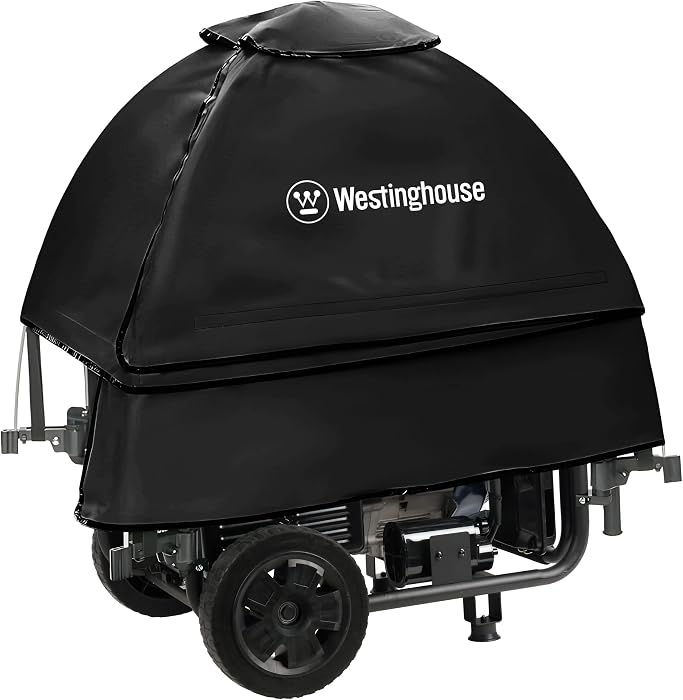
Westinghouse WGenTent Generator Running Cover for Open Frame Generators

Westinghouse open frames

Field Score 87/100
Fits
Open frames with 80" to 107" perimeter
Type
Running cover with vented top
Weight
4.4 lb
Material
Vinyl fabric
View on Amazon

The night you need a generator is usually the night it's pouring. That is the gap the WGenTent was designed around: a cover that stays clamped to the frame and lets the machine run underneath, instead of a fitted shell you peel off and leave in the garage while the rain comes in sideways.

We think it's the smartest of the running covers for a Westinghouse open frame, mostly because of how little there is to it. No tools, no bolts: the frame clamps onto the generator's own tubing, the cover stretches over that, and the top is vented so heat escapes instead of building up under the fabric.

Refueling doesn't require dismantling anything, and you can roll the generator a few feet without pulling the cover. It fits open frames with an 80 to 107-inch perimeter, which takes in the 11,500 series and the ecoGen10000, and Westinghouse rates it for steady rain and snow loads rather than a passing shower.

The hardware is the weak point. The support rods are held by plastic clamps, and a knock against one can crack it in a way glue won't fix, which is worth knowing if the generator lives where people walk past it. It's also a poor match for the biggest frames: on a 14,500-watt unit the cover reaches the fuel tank and not a great deal else.

Worth Noting

  • Plastic rod clamps can crack
  • Doesn't cover the largest frames
Our Verdict

We recommend it for a Westinghouse open frame that has to run in bad weather: no tools, a vented top, and refueling without taking it off.

Check Latest Price
8

GUYISS Generator Cover While Running Best for Occasional Storm Running

GUYISS Generator Cover While Running – Generator Covers While Running

Occasional storm running

Field Score 86/100
Fits
5,000–13,000W generators
Access
Four roll-up sides, opening top
Material
900D over 210D Oxford
Cover Size
32"L x 24"W x 24"H
View on Amazon

Refueling is where most covers turn annoying: the tank is under the fabric, the fabric is under a strap, and you're doing it in the dark with a funnel. GUYISS answers that with a top panel that opens over the fuel tank, so the cover stays put while you fill.

All four sides roll up and secure as well, which does two jobs. It lets heat and exhaust clear while the generator runs, and it gives you a way to reach the panel and the outlets without fighting the cover. For a 32 by 24 by 24-inch shell aimed at 5,000–13,000-watt frames, that's a lot of access, and it costs a fraction of what the frame-based enclosures run.

The fabric is a two-layer build, 900D outside over 210D, rated for rain, snow, sun and dust. What it isn't is rigid: with the sides down in a blow the panels flap, and flapping is what eventually takes stitching apart on any soft cover.

We like it as the middle path, running protection without the price or the assembly of a metal frame, with a top that opens for fuel. Give the seams a look each season and expect to replace it sooner than a bolted enclosure. It suits a generator that runs a few times a year under a porch overhang far better than one that faces a hurricane head-on.

Worth Noting

  • Seams wear faster than a frame enclosure
  • Sides flap in strong wind
Our Verdict

A good middle path for occasional storm running: four roll-up sides, a top that opens to refuel, and no frame to assemble.

Check Latest Price
9

NGB Outdoor Generator Cover

NGB Outdoor Generator Cover

Compact running cover

Field Score 83/100
Material
600D over 210D Oxford
Cover Size
24.8"L x 20.2"W x 20.8"H
Runs Covered
Yes, top opens for refueling
View on Amazon

NGB's cover is small on purpose: 24.8 by 20.2 by 20.8 inches, built for the mid-size inverter rather than the open frame in the driveway. If that's your machine, a full-size cover is the wrong purchase anyway, since you end up with a tent of spare fabric that catches wind and hides the panel.

The build is a double layer, 600D Oxford over 210D, with a top that opens separately so you can refuel with the cover in place, and two straps that pass under the unit to hold it down. It's rated for use while the generator runs, and it is the least expensive of the running covers in this guide.

The straps are the fussy part. Their placement is odd, and in a steady wind the flaps work the corner zippers until they open; a couple of extra ties solve it, but it isn't sorted out of the box. Expect to spend a few minutes the first time you fit it.

We see it as a first cover for a compact inverter: cheap enough to try, light enough to leave in the RV, and specific about the models it fits, with the Predator 5000, Champion 4500 and Westinghouse 3700 all named on the listing. That specificity is worth more than the wattage range most covers lead with, and it's the reason this one stays on the list.

Worth Noting

  • Straps placed awkwardly
  • Corner zippers work open in wind
Our Verdict

Our budget running cover for a compact inverter: a separate top panel for refueling and a stated fit list you can actually check.

Check Latest Price

How We Tested Generator Covers

We started by pulling every cover we could find that published actual dimensions and fabric weight, then narrowed by construction: stitched and taped seams rather than glued, a hem with a drawstring, elastic, or buckle instead of a loose skirt, and a clear answer to whether the cover was built for storage or for running. Covers that listed only a wattage range and no measurements got cut. That left twelve, from fitted inverter covers to full open-frame enclosures, and we've lived with them for eight months.

Testing happened where generators actually live: a driveway during a two-day outage, a gravel pad behind a shed, and a porch where one unit sat idle all summer. We ran two machines under cover, a 5,500-watt open frame and a 2,200-watt inverter, and timed how long one person needed to get a cover on in the dark and the rain. Every cover got a ten-minute hose soak at full pressure, after which we ran a paper towel over the control panel, outlets, and top of the unit to see where water got in and whether it pooled in a sag or ran off the seams.

For fit, we measured each cover against the unit it claimed to fit instead of trusting the wattage on the box, noting whether it dragged on the ground, blocked the exhaust, or buried the panel. Stability got a windy week: we watched which hems lifted, then checked the drawstrings, elastic, and buckles meant to stop that. We also refueled each one hot through its top opening, checked the oil, folded and unfolded them repeatedly, and dragged two across concrete to see how the seams and fabric held. By month three, durability looked like frayed stitching and sun-faded panels.

How to Choose a Generator Cover

Measure the Frame, Not the Wattage

Every listing leads with a wattage range, and that range is a rough proxy at best: a 9,000-watt open frame and a 9,000-watt inverter are nowhere near the same box. Take a tape to the generator with the wheels and handle on, and write down length, width and height.

A cover can be a few inches generous; it cannot be short. Our top pick's 38-inch shell is roomy on a mid-size frame, and roomy beats tight, but loose fabric flaps and flapping is what wears a cover out. If your machine sits at the bottom of a range, size down.

Storage Cover or Running Enclosure?

This is the decision that changes what you spend. A storage cover is a fitted shell that comes off before the engine starts. A running enclosure stays on while the generator works, with a frame, a vented top and clearance built in for heat and exhaust.

If your outages tend to arrive with a storm, the enclosure is the better buy, because the alternative is running bare in the rain. No cover makes it safe to run a generator in a garage or any enclosed space, though; carbon monoxide is the reason, and fabric changes nothing about it.

Waterproof, Water-Resistant, and What Seams Do

Water resistant usually means vinyl or a light coating that sheds a shower. Waterproof means a laminated backing and, just as important, seams that are taped rather than only stitched, because needle holes are where water gets in.

Vents matter too, and not for the reason people expect: they let moisture escape so the generator isn't sitting in its own condensation. A shell with a vented panel on one side and an access flap on the other does more for the machine than a heavier tarp does.

What Keeps It On in Wind

An elastic hem is enough on a covered porch. It is not enough on an open slab in a gale. Look for a bottom strap or a drawstring in addition to the hem, and expect to re-tension it every time you put the cover back on.

Frame-based enclosures answer the question differently, since they're bolted or clamped to the generator and the wind has nothing to grab. If the machine lives where weather reaches it, that is the argument for the extra money.

Access: Fuel, Panel and Exhaust

A cover you have to remove to refuel is a cover that stays off. Roll-up sides, a top panel over the tank and a handle opening all matter more after the first season than they do in the listing photos.

Check that the exhaust is clear on whatever you buy, and check it again after the first windy night. A panel that has worked loose is the thing to fix before the next run, not after.

Frequently Asked Questions

Final Verdict

We recommend the Porch Shield in the 38 x 28 x 30 size for most people: taped, waterproof seams, a vented panel, and a fit range broad enough to sit over anything from a mid-size home backup to a 15,000-watt frame, provided you measure before ordering.

If the generator has to run while the weather is coming down, the GenArmor's bolted frame and heavy tarp are the better purchase, and the IGAN is the version of that enclosure you can carry and set up on your own. Buy for how you actually use the machine: covered between outages, or running through them.