The 8 Best Gutter Cleaning Tools of 2026

The ladder is the dangerous part of gutter cleaning, not the gutters. Every October I promise I'll hire someone, and every October I end up on the top rung, feeling the rails shift whenever I lean for a corner. The right tool keeps your feet on the ground and still drags the packed leaves and shingle grit out of a channel that's been filling since spring.

Since the spring, our team has put 12 tools through eight months of cleanouts — blower attachments, wet/dry vac kits, extension-pole blowers, and plain hand scoops — on my one-story ranch and my parents' two-story. Fit beat raw power: an attachment that wobbles on a blower outlet or won't lock onto a 2-1/2-inch vac hose bleeds airflow at the seam, and a pole that flexes makes you fight the tool instead of the debris.

Battery life and how a nozzle behaves eight feet up matter as much as CFM — more, honestly, on a two-story. Below are the ones worth owning, sorted by whether you already have a blower, a shop vac, or neither.

Our Top Picks

The 8 Best Gutter Cleaning Tools of 2026

1

EGO AGC1000 Gutter Attachment Best Overall

EGO POWER+ Gutter Cleaning Attachment for Electric Leaf Blowers

Single-story homes

Field Score 88/100
Fits
Listed EGO blower models
Reach
8.3 ft
Weight
3 lb
Connection
Screw-lock tubes
View on Amazon

Eight point three feet of tube is the entire argument. Screwed together and locked onto an EGO blower, it puts the nozzle over a first-story gutter while your feet stay on the grass, and it breaks back down into a bundle roughly two feet long for the shelf. Four sections, four collars, nothing to bolt on.

What sold us is how little fiddling the cleaning itself takes. The adjustable head aims the blast down the length of the trough instead of straight into the bottom of it, so dry leaves skate toward the downspout in a couple of passes, and three pounds of tube does not fight your wrist while you walk the perimeter. For anyone already invested in EGO batteries, this is the most direct route to never climbing again.

The swivel at the top will not stay put on its own. Full airflow backs the collar off, the head drifts out of line, and you stop mid-pass to twist it back down. Snug it before you start, check it when the nozzle wanders, and keep a roll of electrical tape in your pocket for the last joint — a single wrap turns an annoyance into a non-issue.

Eight feet reaches a first-story gutter and the low eaves of a ranch; a full second story is still ladder work. For the roofline most of us actually have, that is the trade we take happily: a walk around the house instead of an afternoon of moving rungs.

Worth Noting

  • Fits only the EGO models on the list
  • Blows grit back onto the operator
Our Verdict

If there is an EGO blower in your garage, this is the gutter attachment we recommend first: 8.3 feet of reach, screw-together sections, and airflow enough for wet leaves.

Check Latest Price
2

CRAFTSMAN 2-1/2 in. Gutter Vac Kit Best for Shop Vac Owners

CRAFTSMAN CMXZVBE38640 2-1/2 in. Gutter Cleaning Wet Dry Vac Attachment Kit

Shop vac owners

Field Score 87/100
Hose Fit
2-1/2 in. diameter
Included
Gutter nozzle, blower nozzle, 2 extension wands
Warranty
No warranty
Works As
Vacuum or blower
View on Amazon

Vacuuming a gutter is a different job from blowing one, and this is the gutter cleaning kit we hand to anyone who already owns a shop vac. The curved nozzle hooks over the lip and pulls leaves, sludge, and standing water down the tube instead of flinging them across the siding and your shirt. A blower nozzle and two extension wands come in the box as well, so it works in both directions — but the suction side is the reason to own it.

Reach is honest rather than heroic: two wands and the nozzle put you comfortably over a first-story gutter, and a second story is a ladder job. That is the trade for the containment. Nothing lands in the flower bed, nothing streaks the fascia, and cleanup is one trip to dump the can.

The joints are push-fit, and push-fit means a sideways yank through packed leaves can pop a section loose mid-gutter. Tape the connections before you start and the kit behaves itself; skip the tape and you will be fishing a wand out of the shrubs. For a kit that costs less than most of the alternatives here, that is a fair bargain.

Worth Noting

  • Fits 2-1/2-inch hoses only
  • Sold without a warranty
Our Verdict

The best value here for shop-vac owners: a curved nozzle that vacuums a first-story gutter clean and keeps the mess out of your beds.

Check Latest Price
3

Sealegend 8.3 ft EGO Attachment Best EGO-Compatible Alternative

Sealegend 8.3FT Gutter Cleaning Attachment Compatible with EGO Leaf Blower

Budget EGO setups

Field Score 85/100
Fits
Listed EGO blower models
Head
360° swivel nozzle
Reach
8.3 ft
Connection
Screw-lock
View on Amazon

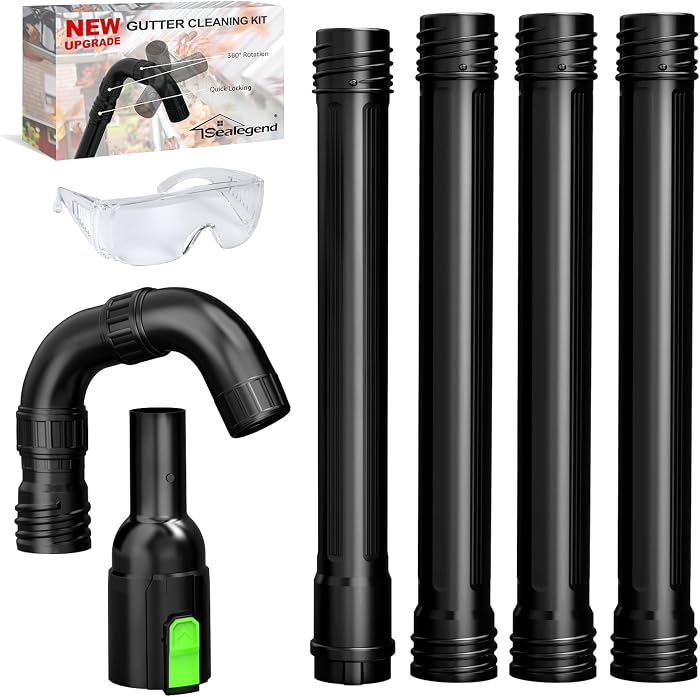
Two companies sell an 8.3-foot tube that clips to an EGO blower, and this one answers the complaint that follows the original around: the tail end swivels 360 degrees, so you can swing the nozzle along a gutter run without unscrewing sections out on the lawn. The collars are screw-lock rather than push-fit, and the tip adjusts separately for corners and roof valleys.

That swivel earns its keep on a long straight run. Walk the gutter line and roll the head with your wrist instead of stopping to re-clock the tube — it turns a stop-and-start job into one continuous pass, and your shoulders notice the difference by the end of the house. It also costs less than the EGO-branded version, which does not hurt.

Putting eight feet between the blower and the leaves costs air. On dry leaves you will not notice; on a mat of wet, packed debris the far end of the tube feels weak and you will want a second pass before you blame the blower. Check the collars as you go — screw-lock holds better than push-fit, but nothing on an eight-foot lever stays tight forever.

Worth Noting

  • Fits only the EGO models on its list
Our Verdict

For EGO owners who want to steer the nozzle without breaking the tube apart, this swivel-head version delivers the same 8.3 feet for less money.

Check Latest Price
4

The Gutter Tool Spoon and Scoop Best Manual Scoop

The Gutter Tool Spoon and Scoop – Gutter Cleaning Spoon and Scoop

Ladder work

Field Score 84/100
Length
16 in.
Weight
9.6 oz
Pull Span
Up to 20 ft
Pole Fitting
Threaded socket
View on Amazon

The hook is the whole idea, and it is the reason this one stays in the bucket. Bent back from the blade, it slides under a hanger strap and drags leaves toward you rather than pushing them down the gutter, so one ladder position clears a longer stretch of trough. A threaded socket in the handle takes a painter's pole, and the top hook hangs the tool from a rung while you move the ladder.

At 9.6 ounces it feels deliberate on the end of a pole without becoming a workout, and the shape reaches places airflow never will — under the straps, behind a skylight curb, around the corner where two runs meet. Dry leaves and pine straw come out in one pull; wet, matted debris takes a couple of passes and a firm wrist. What it buys you is fewer ladder moves per gutter, which on a two-story house is most of the battle.

Worth Noting

  • Needs a ladder or pole to use
Our Verdict

The scoop we keep in the bucket for hands-on gutter work: a hook that drags debris out from under hangers and a pole socket that doubles the reach.

Check Latest Price
5

Alloyman 40V Pole Blower

Alloyman Roof Gutter Cleaning from The Ground

No extra gear

Field Score 83/100
Weight
3.8 lb
Airflow
580 CFM / 180 MPH
Batteries
2 included
Pole Length
55 in.
View on Amazon

If the garage holds no blower and no shop vac, this is the shortest path to a gutter you can clear standing up. It is a complete 40V cordless blower — two batteries, a charger, a brushless motor rated at 580 CFM and 180 mph — with a 55-inch pole section that puts the nozzle above the roofline you can see.

That pole plus your own height covers a single-story gutter and the low eaves of a garage. Point it at a two-story roofline and you will be blowing the fascia instead of the trough; this is a first-story tool, and it is honest about it. On the first story it works with air to spare: dry leaves lift out in one pass, and the 270-degree head lets you aim along the trough without walking backward.

What surprised us is how much blower you get for 3.8 pounds. It clears a deck, a driveway, and a porch as well as it clears a gutter, which is more than most single-purpose attachments here can claim, and the anti-slip grip stays comfortable through a battery. Treat the packs as a pair rather than a spare and the work gets done without a cord dragging off the roof.

Worth Noting

  • Runtime is short on the highest setting
Our Verdict

A complete gutter blower in one box: 55 inches of pole, two batteries, and enough airflow for a first-story roof without owning anything else.

Check Latest Price
6

Sealegend 2-1/2 in. Vac Kit Best for Porch and Garage

Sealegend 2-1/2 in. Gutter Cleaning Attachment Kit for Wet Dry Vac

Porch and garage

Field Score 82/100
Reach
About 5 ft
Hose Fit
2-1/2 in. diameter
Included
3 wands, curved nozzle, tip nozzle
Connection
Locking
View on Amazon

Five feet of wand covers the gutter over a porch, a garage, or the low side of a ranch, and it does it with one hand free to drag the vac along the walk. In the box: three locking wands, a curved nozzle that reaches into the trough, and a tip nozzle that turns the same assembly into a blower.

The locking collars are the upgrade over older push-fit kits. Give each one a firm twist and the sections hold through a long pull; the ones that work loose are usually the ones nobody seated properly. Tape is still cheap insurance on the last joint, especially when the can is heavy and you are pulling against the hose.

Where a vacuum kit beats a blower is the mess. Wet leaves, sludge, and the grit that has been composting in the trough go into the can instead of onto the siding, and a full can dumps in one place. The trade is speed — you are drawing debris toward you a few inches at a time, not blasting a whole run in a pass.

What we noticed after a few cleanings is that this is the kit that stays assembled and hangs on a hook in the shed: three wands, two nozzles, nothing to unbolt. That is a small thing that turns into a big one when the gutters need doing and the alternative is digging parts out of a bin.

Worth Noting

  • Fits 2-1/2-inch hoses only
  • Stops at first-story height
Our Verdict

The tidiest vacuum kit here for one-story work: locking collars, a curved nozzle, and a cleanup that leaves the beds alone.

Check Latest Price
7

Seesii 8.9 ft Pole Blower Best for Long-Reach Blowing

Seesii 8.9 ft Pole Blower – Gutter Cleaning Tools Cordless Leaf Blower for Roof Gutters

Long-reach blowing

Field Score 81/100
Speeds
3
Airflow
700 CFM / 200 MPH
Batteries
2 x 4.0Ah
Pole Length
6.9 to 8.9 ft
View on Amazon

Two batteries and a pole that runs from 6.9 to 8.9 feet are the reasons to look here, and they are not marketing extras. One pack runs while the other charges, and the 180-degree swivel head means you can walk a gutter line with the nozzle pointed into the trough instead of waving the whole blower around to change direction.

Three speeds do more work than the numbers suggest. Low is enough to clear a patio without rearranging the mulch, medium handles dry leaves in a gutter, and high is for the caked material at the mouth of a downspout. When the gutters are finished it converts to a handheld and earns its shelf space on the driveway.

This is the longest reach you can get here without owning another tool, which matters on a low second story and on the tall gable over a garage; on a full two-story wall you will still want the ladder. What we cannot tell you yet is how it holds up, because the model is new and the track record is thin. A pole blower lives or dies on its telescoping sections, so treat the locks gently and store it collapsed.

Worth Noting

  • Newer model, so long-term durability is unproven
Our Verdict

The longest self-contained reach here: an 8.9-foot pole, two batteries, and a blower that pulls yard duty when the gutters are done.

Check Latest Price
8

Vivid Works Gutter Scoop Best for Hand Scooping

Vivid Works Gutter Scoop – Gutter Scoop Cleaning Tools

Hand scooping

Field Score 80/100
Nose
Curved, tapered
Length
16.5 in.
Weight
3.84 oz
Material
High-impact polypropylene
View on Amazon

Width decides whether a scoop is useful, and this one tapers toward the nose for a reason: it drops past hanger straps and into the corners instead of riding up on them. The trough is deep enough that a full load of wet leaves comes out without trailing down the fascia on the way to the bucket.

At 3.84 ounces it is the lightest thing here, and that matters at the top of a ladder where you are working one-handed and reaching. The high-impact polypropylene will not rust, the shape rinses clean in a few seconds with a hose, and it spreads salt or fertilizer in winter, which is more than most single-season tools manage.

Measure before you commit. The taper suits a standard K-style gutter, but a narrow fascia run can bind the scoop, and on a wide one it leaves a strip behind that you will chase with a second pass along the same stretch.

What we appreciate is the honesty of the design: no batteries, no fittings, no compatibility list — a scoop, a handle, and a job. For the smallest outlay of anything here you get the one tool that lifts the matted, half-rotted layer a blower skips straight over.

Worth Noting

  • Width will not suit every gutter profile
  • Hand tool, so you are up a ladder
Our Verdict

A cheap, well-shaped scoop for ladder work: it lifts the wet mat a blower cannot move and dumps without dribbling down the fascia.

Check Latest Price

How We Chose and Tested the Best Gutter Cleaning Tools

We started with about 40 tools and cut the list to 12 based on what people actually own. Most shoppers already have a cordless blower or a shop vac in the garage, so fit drove the first pass: I measured the outlet on every blower in our pool and the collar on every vac hose, then checked which attachments matched which and set aside anything that needed an adapter. The rest were weighed, measured for packed length, and priced against how many feet of gutter they could plausibly clear in one pass.

Testing ran eight months across two houses — my one-story ranch, where every run is reachable from a stepladder, and my parents' two-story, where the second-floor gutters are the only real test of a pole. We used them on dry oak leaves in November, on wet, matted leaves two days after a rain, on shingle grit in the valleys, and on the spring clog of maple whirlybirds and seed pods. Every run was twenty feet of K-style gutter, and we noted what came out, what stayed stuck, and how long the whole job took.

At each run, blowers were cycled through every speed and the battery timed until the tool dropped to its weakest setting. We held each pole fully extended over the gutter edge, watching how much it sagged and how hard the nozzle was to steer, then swung the swivel heads along the channel one-handed. Scoops got dropped on the driveway and jammed into packed, wet debris to see whether the edge held its shape. Wet/dry attachments took the ugliest job — a bucket of soaked leaves and grit, checking whether the locking connection held suction and whether debris blew back out at the seam.

How to Choose a Gutter Cleaning Tool

Start With What's Already in the Garage

Nearly every ground-level tool here is an adapter for something you already own — a leaf blower, a shop vac, or a hose. That is the cheap way in and the most common way to waste a purchase. Blower attachments fit only the models their maker lists, and most shop-vac gutter cleaning kits are built around a 2-1/2-inch hose, the big industrial size rather than the 1-7/8-inch hose on plenty of homeowner vacs.

Write down your blower's model number and measure the inside diameter of your vac hose before you order anything. Both numbers are printed or molded somewhere on the tool, and both decide whether the attachment you are looking at will click on at all.

Match the Reach to the Roofline

Height decides more than brand does. A 55-inch pole held overhead covers a first-story gutter; an 8.3-foot blower tube reaches the low eaves of a two-story house; a five-foot vac kit is a porch-and-garage tool. On most single-story homes the gutter line runs eight to ten feet off the ground, and on a full two-story it sits closer to eighteen. Nothing under ten feet of tube solves the second number.

Wherever you work, keep every pole at least ten feet from the overhead service drop, and add more clearance for a metal water wand. It is the one mistake in this job that does not give you a second chance.

Blow, Vacuum, or Scoop

Each method fails in a predictable way. Blowing is quick on dry leaves and close to useless on wet, matted debris, and it throws grit onto siding, windows, and you. Vacuuming contains the mess and moves sludge a blower cannot, but it is slower and the can fills fast. Scooping is the only method that gets under hanger straps and gutter guards.

Match the tool to the debris you actually have rather than the debris you hope for: dry leaves want air, wet leaves and pine straw want suction or a scoop, and a half-rotted mat at the bottom of the trough wants a scoop every time.

The Joints Fail First

Every one of these tools is a stack of tubes, and the connections are where they give up. Push-fit joints pull apart under a sideways yank, threaded collars back off under airflow, and the stack flexes more the further you extend it. Length multiplies leverage at the top, which is why an eight-foot tube feels so different from a three-foot one.

Prefer screw-lock or locking collars, snug every joint before a run, and keep a roll of tape for the one section that will not stay put. If a joint lets go over a gutter, stop and re-seat it rather than pushing through the wobble.

Guards and Hangers Change the Answer

A mesh or perforated guard sitting on top of the trough defeats most ground-level tools, because blowing from above just pushes debris around the top of the screen. Blower and vac attachments want an open gutter.

For guarded runs you either lift the panels or use a scoop with a hook that slips under the hangers. Check whether your guards clip out, slide, or are screwed down before you spend money on a tool that cannot reach the trough.

Frequently Asked Questions

Final Verdict

The ladder is what keeps most people off their gutters, and the EGO attachment is the tool here that removes it for the widest stretch of roofline. If there is an EGO blower in the garage, that is the one: 8.3 feet of tube, hand-tightened collars, and enough airflow to move leaves that are already wet. Snug the swivel before each pass and the job becomes a walk around the house instead of an afternoon of ladder shuffling.

Shop-vac owners should take the CRAFTSMAN kit instead — it hauls the mess out rather than blowing it onto the siding, which is the difference between cleaning a gutter and redecorating the flower beds. Starting from nothing, the Alloyman puts a blower, a 55-inch pole, and two batteries in one box for first-story work.