The 8 Best Hacksaws of 2026

A hacksaw only comes out when something has gone wrong: the bolt under the sink is frozen, the threaded rod is two inches too long, the bike lock lost its key. A frame that flexes skips out of the kerf and chews the blade, leaving a crooked cut and a scraped knuckle. The right one cuts straight, stays stiff under load, and doesn't make you hunt for a hex key mid-cut.

My team and I spent four months with 14 hacksaws, from full-size high-tension frames to 10-inch models that live in a kitchen drawer, cutting conduit, PVC, copper tubing, and more rusted bolts than I'd like to count. Two things mattered more than anything printed on the package: how much tension the frame holds, and how fast you can change a blade.

The blade does more work than the saw, too. A sharp 24 TPI bi-metal blade in a stiff, inexpensive frame will outcut a fancy handle with a dull one, so blade quality carried real weight in the picks below.

Our Top Picks

The 8 Best Hacksaws of 2026

1

Lenox HT50 High-Tension Hacksaw Best Overall

Lenox Tools HT50 High-Tension Hacksaw

All-around metal cutting

Field Score 95/100
Frame
I-beam aluminum
Blade Length
12 inches
Blade Storage
5 extra 12-inch blades
Blade Tension
Up to 50,000 psi
View on Amazon

The 50,000 psi tension figure is the first thing we noticed, and it is the reason the Lenox HT50 is our top pick. The I-beam frame lets you crank the blade much tighter than a basic stamped frame, so the blade stays straight through pipe and angle iron instead of bowing and wandering. We also like the rubberized handle, which keeps its grip when your hands are cold or damp. This is a full-size frame, and it is built to stay rigid when you lean into a cut.

The details around the blade are what make it more than a one-trick frame. It accepts a Lenox reciprocating blade for jab-saw work, and the I-beam stores up to five extra 12-inch blades inside the frame. That means fewer trips to the toolbox and a faster switch when a tooth strips. The included 12-inch, 24 TPI blade is a sensible starting point for mild steel, though we keep a 32 TPI blade on hand for thin-wall tubing.

We rate it highest here for anyone who cuts metal often enough to care about tension, blade storage, and a frame that stays out of its own way. The jab-saw conversion is the detail that keeps it in our kit between bigger jobs, and the blade storage means we are less likely to start a cut with a worn blade. If your work is mostly small household repairs, the compact Milwaukee or the Pasco mini makes more sense. For the widest range of real work, this is the one we keep coming back to.

Worth Noting

  • Premium price
  • Heavier than compact frames
Our Verdict

We think the Lenox HT50 is the top all-around hacksaw here for anyone who cuts metal often enough to value straight, high-tension cuts.

Check Latest Price
2

Milwaukee 48-22-0012 Compact Hacksaw Best Compact for Tight Spaces

Milwaukee 48-22-0012 Compact Hand Operated Hack Saw w/ Tool-Less Blade Change

Tight-space repairs

Field Score 94/100
Weight
8.01 oz
Blade Length
10 inches
Blade Changes
Tool-free
Cutting Angle
180 degrees
View on Amazon

The cramped repair is where the Milwaukee 48-22-0012 makes its case: a 10-inch frame slips under a sink, inside a cabinet, or beside a pipe where a 12-inch saw will not fit. The tool-free blade clamp is the detail we appreciate most, because changing a blade in a tight spot is usually the moment a simple job turns annoying. The rubber handle and 227-gram frame keep it light enough to hold at an awkward angle.

We keep it as the compact saw for a tool bag or a plumbing kit. It cuts brass rod, PVC, and small bolts without the flex we associate with cheap stamped frames, and the quick-release clamp holds the blade securely. The blade sits firmly with no wobble, which matters more in a short frame than a long one. This is the saw we reach for when the cut is boxed in.

That makes it a specialist rather than an only saw. Pair it with a full-size frame and it earns its space in the bag, especially if you work on fixtures, appliances, or pipe in finished spaces.

Worth Noting

  • Less leverage on long bench cuts
Our Verdict

We choose this Milwaukee when the cut is boxed in and a full-size frame will not fit.

Check Latest Price
3

DeWalt 5-in-1 Hacksaw Best Multi-Use

DeWalt 5-in-1 Hacksaw

Remodeling and demo

Field Score 93/100
Design
5-in-1
Weight
1.32 lb
Blade Length
12 inches
Cutting Angle
45 degrees
View on Amazon

The DeWalt 5-in-1 is less a single hacksaw than a frame that changes roles. It can be set up for standard cutting, flush cuts, angle cuts, and jab-saw work, and the extra handles let you choke up for control in tighter spots. That flexibility is the reason it earns a place here: one tool covers jobs that otherwise send you back to the toolbox for a second saw.

The metal frame is rigid in the cut, and the blade tension is easy to adjust with the protected knob. We found it stable on wood trim and metal track, and the 12-inch blade gives it a long stroke for demolition work. It is not a delicate finish saw; this is a tool for remodeling, repairs, and jobs where the saw may get knocked around.

Our pick makes sense for a remodeler or serious DIYer who wants one frame to handle several setups. The 5-in-1 design is genuinely useful, but learning the five setups takes a little patience, and the full-size frame is more tool than you need for a single loose bolt. If your cuts are mostly in tight cabinets or under fixtures, the compact Milwaukee is the easier choice. For a saw that lives in a demo bag, the DeWalt's rigidity and range are worth the space.

Worth Noting

  • Heavy for overhead work
Our Verdict

We recommend the DeWalt 5-in-1 for remodelers who want one sturdy frame to cover several cutting setups.

Check Latest Price
4

Bahco 319 Hacksaw Best for Comfort

Bahco 319 Hacksaw

Long, controlled cuts

Field Score 92/100
Handle
Non-slip rubberized
Weight
16 oz
Cutting Angle
55 degrees
Blade Material
High speed steel
View on Amazon

Two hands fit on this frame, and that is the first thing we noticed. The Bahco 319 has a long, stiff body and a non-slip back handle plus a front grip, so you can drive it with both arms instead of death-gripping one handle. The one we reach for on long cuts in pipe, rod, and angle stock is this one, because control matters more here than portability. The 55-degree blade mounting also lets you set it for flush cuts, which is a useful trick when the frame otherwise gets in the way.

The frame feels solid without being clumsy, and the rubberized grip stays comfortable when your hands are damp. The 18 TPI blade it comes with is coarse for thin metal, so plan on adding a 24 or 32 TPI blade for tubing and small bolts. We like the simple tension lever under the handle; it is easy to set and holds through a cut. This is a saw for someone who wants a traditional full-size frame with better manners than the cheapest option.

The extra heft is part of the bargain: it keeps the frame quiet through a long stroke and makes the saw feel planted. That also makes it a poor choice for a cramped cabinet, where the compact Milwaukee is the better fit. Keep the Bahco at the bench or the pipe vise and it rewards the space it takes.

Worth Noting

  • Premium price
Our Verdict

We favor the Bahco 319 for long, controlled cuts because its stiff frame and two-handed grip reduce fatigue.

Check Latest Price
5

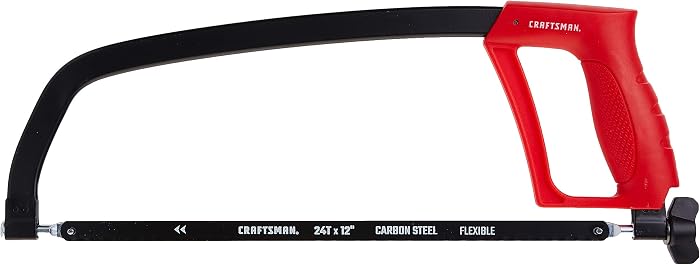
Craftsman 12-Inch Hacksaw Best Budget Full-Size

Craftsman 12-Inch Hacksaw

Occasional home cuts

Field Score 91/100
Blade Angles
90 and 180 degrees
Blade Length
12 inches
Cutting Depth
4.375 inches
Frame Tension
Up to 225 lbs
View on Amazon

The Craftsman is the budget full-size option, and it covers the basics without asking you to spend much. The 12-inch fixed blade gives you a 4.375-inch cutting depth, and the frame adjusts to 90 and 180 degrees for flush cuts. The large tension knob is easy to turn, and the plastic handle is comfortable enough for a few cuts at a time. It is light in the hand and simple to set up.

We see it as an occasional-use saw for metal, plastic, and PVC work around the house. The 225-pound tension rating is modest compared with the high-tension frames here, but it is enough for a straight blade and a controlled cut in light stock. We like the flush-cut angles more than we expected; they make the saw useful for trimming a bolt close to a surface. The 12-inch blade also gives you a long stroke for a saw at this price.

For a homeowner who needs a full-size saw for occasional repairs, it covers the job without the premium. The tension knob and flush-cut angles are the details that make it feel more useful than its simple frame suggests.

Worth Noting

  • Hard use can stress the frame
  • Stock blade can dull quickly
Our Verdict

We see the Craftsman as the budget full-size saw for occasional metal, plastic, and PVC cuts around the house.

Check Latest Price
6

Pasco Tiny Tim Hacksaw Best Mini for Household Repairs

Pasco 4290 Tiny Tim Hacksaw

Plumbing and bolts

Field Score 90/100
Teeth
32 TPI
Handle
Vinyl grip
Weight
3.84 oz
Blade Length
6 inches
View on Amazon

A rusted bolt under a toilet tank is the kind of job that makes a full-size hacksaw feel like a crowd. The Pasco Tiny Tim is built for that gap: a 6-inch blade, a 3.84-ounce frame, and a compact handle that lets you work in a space barely wider than your hand. The 32 TPI blade is fine enough to start a cut on a brass fitting without skating, and the vinyl grip gives you something secure to hold at an awkward angle.

It cuts steel and brass in small doses, and the short frame is easy to control when you cannot get your shoulder behind the saw. We like it for plumbing repairs, hose fittings, and small bolts where a 10-inch frame is still too long. The trade-off is obvious: short strokes and limited depth, so it is not the saw for a long pipe or a thick piece of stock.

We value it as a dedicated tight-space saw, not as your only hacksaw. The low cost makes it easy to keep in a plumbing kit, and the small size means it is there when a full-size frame will not fit. If you need one saw for general metal cutting, start with the Lenox or the Milwaukee compact; add the Tiny Tim when the work gets genuinely cramped.

Worth Noting

  • Blade durability can vary
Our Verdict

We keep the Pasco Tiny Tim for cramped plumbing and bolt work where a larger saw simply cannot reach.

Check Latest Price
7

Milwaukee 48-22-0050 Hacksaw Best Full-Size Blade Storage

Milwaukee Electric Tool 48-22-0050 12" High Tension Hacksaw

Job-site blade swaps

Field Score 89/100
Frame
Reinforced metal
Tension
High-leverage knob
Blade Length
12 inches
Blade Storage
Up to 6 extra blades
View on Amazon

Compared with the Lenox, this Milwaukee makes its case with blade storage: up to six spare blades ride inside the frame, and the high-leverage tension knob makes it easy to crank them tight. The 12-inch frame is reinforced metal, with an overmolded handle and a 32 TPI blade included. If you change blades often on a job site, that storage is more than a convenience; it keeps the next blade with the saw instead of in a drawer.

The frame is rigid and the tension mechanism is straightforward. We found it stable on metal cuts, and the handle stays comfortable through a long stroke. The 32 TPI blade is a good match for thin-wall conduit and tubing, though you will want a coarser blade for thick stock. The high-leverage knob gives you more tension with less hand strength, which is a real benefit when you are cutting overhead or in a hurry.

The blade storage is the reason to choose it: on a job site, having six spares inside the saw is a real advantage. It is a full-size frame, so it takes up more room in a bag than the compact Milwaukee, but it also gives you a longer stroke. For anyone who goes through blades, the storage and tension knob are the features that separate it from a basic frame.

We like it for electricians, plumbers, and serious DIYers who want their spare blades with the saw. For a general-purpose saw, the Lenox is still the better all-rounder. If your routine involves changing tooth counts or replacing a worn blade in the middle of a job, the Milwaukee's storage and tension knob earn their place.

Worth Noting

  • Midrange price for a hand saw
Our Verdict

We lean toward this Milwaukee for job-site users who want six spare blades and high tension in one full-size frame.

Check Latest Price
8

KATA 10-Inch Mini Hacksaw Best for Light DIY Cuts

KATA 10 Inch Mini Hacksaw for Metal Cutting with 3PCS Blades in Tight Space

Light DIY cuts

Field Score 88/100
Frame
Aluminum
Weight
4.8 oz
Blade Length
10 inches
Blades Included
3 bi-metal, 24 TPI
View on Amazon

The first thing you notice about the KATA is the bundle: a 10-inch aluminum frame, one 24 TPI bi-metal blade installed, and two spares in the box. At 4.8 ounces, it is light enough to drop in a tool bag and forget until a small cut comes up. The soft rubber grip is comfortable, and the compact frame is easier to control than a full-size saw when you are working on a rod or a piece of PVC in a tight spot.

It cuts small metal rods, plastic, and tubing without much drama, and the 24 TPI blade leaves a reasonably clean edge. We like the extra blades because a compact saw is often pressed into a job that dulls a blade quickly. The frame is stiff enough for light work, and the blade clamp holds without much fuss. The three-blade bundle is the practical detail that makes it a better toolbox saw than a single-blade bargain.

This is a light-duty tool. The short frame and aluminum body suit small repairs, hobby work, and toolbox duty, not thick steel or demolition. That is the boundary of what it is for, and it is worth respecting. The compact size also means shorter strokes, so it is not the saw for a long pipe run or a heavy metal cutting session.

We choose it for a DIYer who wants a compact saw with spare blades included. The three-blade bundle is the reason it beats a single-blade bargain, and the light frame makes it easy to keep close at hand. For light repairs and a small kit, it is an easy yes.

Worth Noting

  • Blades can dull or snap early
Our Verdict

We like the KATA as a light-duty compact for small repairs, especially when the spare blades are part of the appeal.

Check Latest Price

How We Chose and Tested the Best Hacksaws

We started with every hacksaw we could find from the major tool brands — full-size fixed frames, high-tension designs, convertible and five-in-one saws, and compact 10-inch models built for tight spaces — then filtered by frame material, blade-change mechanism, grip, replacement-blade availability, and price. That left 14 saws, and I spent four months with them in my shop and around the house.

Most of the cutting was real work, not test coupons. We cut half-inch threaded rod and three-quarter-inch electrical conduit to length on the bench, hacked through copper tubing and a seized closet bolt during a Saturday plumbing repair, and sliced PVC irrigation pipe out in the yard. The small saws went overhead, inside a cabinet, and into a wall cavity where a full-size frame simply wouldn't fit.

For each saw, we counted strokes to get through a fresh half-inch rod, watched whether the blade tracked straight or wandered off the line, and squeezed the frame mid-cut to feel how much it flexed under load. Blade changes were timed with a stopwatch — some took a few seconds with bare hands, others needed a screwdriver and a minute of fiddling. We weighed every saw, noted how the handle felt with sweaty and gloved hands, and kept cutting past the point where the factory blade dulled to see how the frame held up and how easy replacements were to find and afford.

How to Choose a Hacksaw

Match the frame to the space

A 12-inch frame gives you the longest stroke and the most leverage, which is why it is the default for pipe, angle iron, and bench work. A 10-inch compact frame is the better choice for a tool bag or a cut inside a cabinet, while a 6-inch mini like the Pasco Tiny Tim earns its place under a sink or beside a rusted bolt. The mistake is buying the smallest saw for everything: shorter frames mean shorter strokes and less leverage, so choose the smallest frame that clears the cut, not the smallest one you can find.

Look for tension and a stiff frame

High tension keeps the blade from wandering, and a rigid frame keeps that tension useful. An I-beam or reinforced metal frame is worth the extra weight if you cut metal often; the Lenox HT50's 50,000 psi claim and the Milwaukee 48-22-0050's high-leverage knob are both aimed at the same goal. More tension is not automatically better: too much can stress a thin blade or make it snap. Aim for a frame that reaches tension easily and holds it without the blade bowing. If the frame flexes when you press, the blade will follow.

Check blade changes and spare storage

Tool-free blade changes matter more on a job site than on a once-a-season repair. The Milwaukee compact's quick-release clamp is the one we appreciate in a tight spot, while the Lenox HT50 and Milwaukee 48-22-0050 hide spare blades in the frame for less digging in a toolbox. Before you buy, check the replacement size and tooth count, not just how many blades come in the box. A bargain frame that only takes an odd blade is a false economy; standard 10- and 12-inch blades are easier to keep on hand.

Choose a handle and weight you can control

A full-size saw with a two-handed grip, like the Bahco 319, gives you control on long cuts and less hand fatigue. A compact or mini frame trades that leverage for access and one-handed control. Weight is a similar trade: a heavier frame feels stable at a bench, but it tires you overhead and in tight spaces. Look for a handle that fills your palm without forcing your wrist into an awkward angle, and choose a frame you can hold squarely through a full stroke.

Match the blade to the metal

Most general metal cutting starts with a 24 TPI bi-metal blade, which balances speed and a smooth finish on pipe, rod, and angle stock. A 32 TPI blade is better for thin-wall tubing and small bolts because it puts more teeth in the cut; an 18 TPI blade cuts faster in thick stock but leaves a rougher edge. The Pasco Tiny Tim comes with a 32 TPI blade for small work, while the Bahco 319's stock blade is coarser. Buy a spare in the tooth count you use most, and replace a blade when it starts skating instead of cutting.

Frequently Asked Questions

Final Verdict

For most buyers, the Lenox HT50 is the hacksaw to own: its I-beam frame and high tension keep the blade straight, and the jab-saw conversion plus five-blade storage make it more useful between jobs.

If your cuts happen under a sink or inside a cabinet, the Milwaukee 48-22-0012 is the one we reach for; its 10-inch frame gets into places the Lenox cannot. On a tight budget, the Craftsman 12-Inch Hacksaw covers occasional metal and plastic cuts for far less. Start there, then add a mini only if the work is genuinely cramped.