The 8 Best Hand Saws of 2026

A hand saw punishes a bad purchase fast. A dull blade skates across bark instead of biting, a flexy spine wanders out of the kerf, and a handle that fights your grip turns a two-minute limb cut into a twenty-minute wrestling match.

One thing worth knowing before you buy: most Western saws cut on the push stroke, while Japanese-style saws cut on the pull, which lets the blade run thinner and the cut come out cleaner once you stop shoving. We spent six months cutting green branches, kiln-dried oak, plywood, PVC, and drywall with 12 hand saws to sort out which designs actually deliver.

Sharpness out of the box was obvious within a few strokes. What took longer was figuring out whether a blade could be replaced or resharpened, how the teeth held up after repeated cuts, and whether the saw was comfortable to carry — a folder that rides in a pocket all day gets judged differently than a fixed saw that lives on a garage peg. The picks below are the ones that cut fast, tracked straight, and still felt worth their price after months of use.

Our Top Picks

The 8 Best Hand Saws of 2026

1

Bahco Laplander Folding Saw Best Overall

Bahco BAH396LAP Laplander Folding Saw

All-around outdoor cutting

Field Score 99/100
Carry
Folds; leather strap included
Teeth
7 TPI XT toothing
Weight
7.52 oz
Blade Length
7-1/2 inches
View on Amazon

Seven and a half inches of blade and 7.5 ounces of saw: that ratio is the reason the Laplander is the one we tell people to buy first. It disappears into a pack or a saddlebag and still has enough blade to take off a branch you cannot push aside.

The teeth are 7 TPI, coarse enough to clear sawdust instead of clogging, and the blade carries a low-friction, rust-resistant coating that earns its keep in sappy pine. Bahco lists green wood, dry wood, bone, and plastic as fair game, which describes a working property saw better than any marketing line: a downed limb, a PVC repair, a stuck lid.

What we paid closest attention to was the lock. The blade locks open and closed, and the release needs a deliberate press rather than a nudge, which is exactly right when your other hand is holding the branch. The two-component handle is long enough to choke up on for controlled cuts and shaped so a work glove does not fight it.

Set it against the Silky saws and you trade some cutting speed and refinement for a saw you do not mind loaning, dropping, or leaving in a damp pack overnight. That is the deal, and for one saw that lives in a truck, it is the right one.

Worth Noting

  • Coarse 7 TPI teeth leave a rougher cut
Our Verdict

We recommend the Laplander as the one saw to keep in a truck, a pack, or a saddlebag: light, locked at both ends, and happy in green or dry wood.

Check Latest Price
2

Corona RazorTOOTH Pruning Saw Best for Pruning and Clearing

Corona Tools 13-Inch RazorTOOTH Pruning Saw

Pruning and clearing

Field Score 98/100
Blade
13-inch curved, chrome-plated SK5
Teeth
3-sided razor teeth
Handle
Pistol grip
Cutting Capacity
Limbs up to 7 inches
View on Amazon

A 13-inch blade with a pronounced curve, teeth that will walk through a limb 7 inches across, and a pistol grip: this is not a pack saw, it is a property saw. The curve does the work, keeping teeth engaged through the stroke and letting you cut at the angles you actually end up in when a branch is above your shoulder or buried in a tangle.

We reach for it first after a storm has dropped limbs across a fence line. The three-sided razor teeth clear a channel instead of polishing the wood, and on green limbs the saw pulls itself down without much pressure from you. It is also the saw here with no pivot to wear out and a lifetime warranty behind it.

It is a fixed blade with no sheath in the box, which is a strange omission on something this sharp; a cardboard sleeve and a hook in the shed solve it. The chrome plating keeps sap from sticking and keeps rust off between seasons, and the handle is shaped so your wrist stays straighter on a long downward pull.

Worth Noting

  • Handle screws can work loose with heavy use
Our Verdict

This is the saw we reach for when limbs come down across a fence line; its curved blade and coarse teeth make fast work of wood up to 7 inches.

Check Latest Price
3

Silky PocketBoy 170mm Best Compact Saw for a Pack

Silky Professional Series PocketBoy Folding Saw 170mm Medium Teeth (340-17)

Pack and glovebox

Field Score 97/100
Carry
Clear plastic belt case
Teeth
8.5 TPI medium
Blade Length
6.75 inches (170 mm)
Cutting Capacity
3.4 inches
View on Amazon

Two locking positions on a folding saw sounds like a small thing until you need to trim a branch flush to a trunk or cut a dowel level with a surface. The PocketBoy's blade locks in line for ordinary work and offset for cutting flat, which is a feature almost nothing else in this group offers.

The rest is Silky's usual approach: a 6.75-inch taper-ground blade with impulse-hardened, non-set teeth, a rubber handle that stays put in a wet hand, and a clear plastic case with a belt clip. Folded, it drops into a jacket pocket. The rated cut capacity is 3.4 inches, so it is a branch saw, not a log saw.

What we noticed in use is how little effort the pull takes. The blade is thin, the kerf is narrow, and the teeth are sharp enough that you guide the saw rather than drive it, which is why this is the one we hand over when a cut has to be clean in a tight spot.

That thinness asks for some respect. Twist the blade in a binding cut and it will bend, and a bent blade is hard to bring back. Keep the stroke straight and let the teeth find their own pace, and the extra money shows up as a cut that barely needs sanding.

Worth Noting

  • Blade bends if twisted in a cut
  • Premium price for a 6.75-inch blade
Our Verdict

We keep the PocketBoy for tight-space cutting, where the fine blade and the offset lock position make the cleanest cut of any folder here.

Check Latest Price
4

Silky BIGBOY 2000 360mm Best for Big Limbs and Firewood

Silky Professional BIGBOY 2000 Folding Saw 360mm XL Teeth (356-36)

Limbing and firewood

Field Score 96/100
Teeth
XL teeth, 78 total
Handle
Double-fist rubber
Weight
1.1 lb
Blade Length
360 mm
View on Amazon

Same maker, same yellow handle, more than twice the blade: the BIGBOY 2000 is the PocketBoy's bigger sibling, and the difference is not cosmetic. At 360 mm the blade takes long strokes that clear a 4-inch limb in a few pulls, and this is the saw we pick when the wood is bigger than a wrist.

The blade is 1.8 mm of SK4 carbon steel with taper-ground, impulse-hardened teeth, and it cuts on the pull stroke, so the saw pulls itself into the wood instead of needing to be shoved. The double-fist rubber handle is shaped so both hands can drive a long stroke without your top hand sliding.

Length and thinness are the trade. A blade this long concentrates stress at the pivot, so treat a bind as a signal to back out rather than to force through. At 1.1 pounds it is a pack saw with a commitment, but it folds, and a folded BIGBOY takes less room in a truck bed than a bow saw.

Worth Noting

  • Heavy at 1.1 pounds for long hikes
Our Verdict

We choose the BIGBOY when the wood is bigger than a wrist: twice the blade of the PocketBoy and a two-handed grip to drive it.

Check Latest Price
5

Mossy Oak 7-Inch Folding Saw Best Budget Folding Saw

Mossy Oak 7-Inch Folding Saw

Budget belt carry

Field Score 95/100
Lock
Auto-locks when fully open
Blade
7-inch Teflon-coated bimetal
Carry
Belt or pack pouch included
Teeth
7 TPI triple-ground
View on Amazon

A saw is only as useful as the way you carry it. Mossy Oak ships this one with a heavy-duty pouch that threads onto a belt or straps to a pack, which is the difference between a saw you have with you in a blind and a saw sitting back in the truck.

At this price the package is hard to argue with: a 7-inch Teflon-coated bimetal blade with 7 TPI triple-ground teeth, an auto-lock that engages the moment the blade is fully open, and a handle with a lanyard hole. We found it goes through two-inch branches without much effort and folds with no exposed teeth.

The blade is the part that gives. Under a hard, twisting pull it flexes, and flexing is what eventually breaks a blade, so cut in line and let the teeth do the work instead of leaning on the handle.

Against the Bahco, it is the cheaper saw with the better carry setup, and the blade is not in the same class. Against a hardware-store special it is a far better tool for the money, and for a go bag, a truck box, or a first saw for someone learning to prune, that trade makes sense.

Worth Noting

  • Blade flexes under a hard twisting pull
  • Lock can be stiff to release
Our Verdict

Our pick when the budget is tight: the Mossy Oak brings a pouch, an auto-lock, and a sharp bimetal blade for less than the saws it competes with.

Check Latest Price
6

KERYE 9.5-Inch Japanese Pull Saw Best Japanese Pull Saw

KERYE 9.5-Inch Japanese Pull Saw – Japanese Pull Saw 9.5"

Workshop and trim

Field Score 94/100
Blade
9.5 inches, 0.02 inch thick
Teeth
17 and 10 TPI double edge
Weight
9.6 oz
Blade Changes
Replaceable SK5 blade
View on Amazon

A Japanese pull saw cuts on the pull, and that one difference explains the rest. Because the blade is in tension during the cut rather than compression, it can be made thin, 0.02 inch here, and a thin blade removes a narrow kerf, tracks a line more easily, and needs far less force from you.

The double edge gives you two saws in one: 17 TPI on one side for crosscuts and joinery, 10 TPI on the other for ripping and rougher work. The SK5 blade is replaceable, and the wrench for the change comes in the box.

Where it earns its place is in the cuts a power saw cannot make: trimming a shelf to fit, cutting a plug flush, notching a post, opening a vent hole in a tight corner. The beech handle is comfortable and the saw is light enough at 9.6 ounces to use overhead, which is more than we can say for most of the saws here.

It is not a pruning saw. Green wood clogs fine teeth and a thin plate resists being horsed through a knot, so keep a coarse folder for limbs and this one for boards. The handle wrap is also the first thing to show wear, which stays cosmetic for a long time and then stops being cosmetic.

Worth Noting

  • Thin blade kinks if twisted or forced
  • Handle wrap wears with heavy use
Our Verdict

We recommend the KERYE for shop and finish work, where two tooth counts and a thin pull-cut blade do what a push saw cannot.

Check Latest Price
7

Goldblatt Folding Drywall Saw Best for Drywall and PVC

Goldblatt Folding Drywall Saw

Drywall and PVC

Field Score 93/100
Blade
5.2-inch bi-metal
Teeth
8 TPI triple-ground
Weight
7.76 oz
Overall Length
11-3/4 inches
View on Amazon

A fixed jab saw is a spike in a tool belt, which is the problem this Goldblatt solves: the 5.2-inch bi-metal blade folds into the handle and locks shut, so it can ride in a pouch or a drawer without a sheath.

Open it and a red button locks the blade in place. The tapered point starts a cut in drywall without a pilot hole, and the 8 TPI triple-ground teeth cut on both the push and the pull, which speeds up outlet boxes and can-light openings.

Build is better than the price suggests. The blade is hardened to HRC 66-68 and backed by a lifetime warranty, the handle is a soft-grip plastic that does not slip in a dusty hand, and the whole saw runs 11-3/4 inches, short enough to work inside a stud bay.

As a drywall and PVC saw it is the one we reach for, and the folding lock makes it the safest thing in the bag to grab blind. That is a narrow job done well, and narrow jobs are what most weekend repairs turn out to be.

Worth Noting

  • 5-inch blade limits cutting depth
  • Too fine for green wood and limbs
Our Verdict

We rate the Goldblatt the best folding jab saw here for drywall, PVC, and panel work, and the lock makes it safe to carry anywhere.

Check Latest Price
8

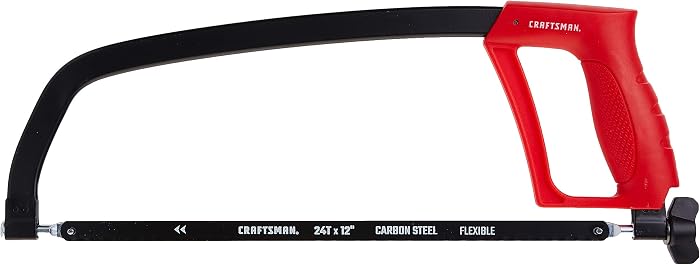
Craftsman 12-Inch Hacksaw Best for Metal and Pipe

Craftsman 12-Inch Hacksaw

Metal and pipe

Field Score 92/100
Blade
12 inches, 4.375-inch cutting depth
Blade Angles
90 and 180 degrees
Frame Tension
225 lb
View on Amazon

A hacksaw lives or dies on frame stiffness, and Craftsman rates this one to 225 pounds of blade tension. That matters because a slack blade wanders: crank the blade tight in a rigid frame and the cut stays where you started it.

The 12-inch blade gives 4.375 inches of cutting depth, and the frame adjusts to 90 and 180 degrees so you can flush-cut a pipe against a wall or a floor. The tension knob is big enough to turn with gloves on, and the full-grip handle keeps your hand clear of the teeth.

Blades are the consumable here, not the saw. Coarse teeth for PVC and copper, finer for steel and bolts, and the frame outlasts both; swapping a blade takes a minute at the tension knob.

For the money, this is the cheapest way to cut metal on the list, and that is the point of a property hacksaw: gate chain, bolts, conduit, and exhaust pipe do not need a fabrication-grade tool. Build quality is the trade, since the frame and handle are made to a homeowner's budget rather than a shop's daily use.

Worth Noting

  • Frame and handle built to a homeowner budget
Our Verdict

We reach for the Craftsman on metal, pipe, and bolts: the least expensive saw here, with an adjustable frame that gets into flush cuts.

Check Latest Price

How We Tested Hand Saws (and What Made Us Put One Down)

We started by pulling every hand saw we could find with real review history behind it — folding saws, fixed-blade pruning saws, Japanese pull saws, a drywall jab saw, a hacksaw — then filtered by blade length, tooth count and geometry, whether the blade could be replaced or resharpened, grip material, and price band. From that pool we bought 12 saws and lived with them for six months.

The testing happened where saws actually get used. In the yard, we cut green limbs up to seven inches across, working overhead and at awkward angles to see whether a blade grabbed, skipped, or wandered out of the kerf. On camping trips the folders got carried in pockets and pouches, opened and closed with cold hands and work gloves, and used to break down firewood. In the shop we crosscut kiln-dried oak, made flush cuts in plywood, and patched a section of drywall with the jab saw; a plumbing repair handed the hacksaw a length of PVC pipe.

We counted strokes to get through the same diameter limb, watched whether wet green wood clogged the teeth, and checked after each session for bent spines, locks that wobbled, and teeth that had rolled. Folders were judged on how securely they locked open and how comfortably they sat in a pocket; fixed saws on sheath and handle comfort over a long afternoon. We noted which blades could be swapped or filed, then rechecked the ones that dulled fastest. The saws that came through six months of that still cutting straight got the nod; the ones that bound, flexed, or lost their edge early did not.

How to Choose a Hand Saw

Match the Teeth to the Material

Tooth count is the first decision. A coarse blade, roughly 6 to 8 teeth per inch, clears sawdust fast and is what you want in green wood, where a fine saw clogs and starts skidding. A fine blade, 17 to 25 TPI, leaves a clean edge on dry lumber and joinery but fights you in a sappy branch. Hacksaws are their own category, with blades chosen for metal rather than wood.

The trap is assuming more teeth means a better saw. Buy fine teeth for boards and coarse teeth for limbs and you stop fighting your tools. The Corona here is a coarse limb saw; the KERYE is a fine board saw; neither does the other's job well.

Folding, Fixed, or In Between

A folding saw puts the teeth away, which is why it can live in a pack, a saddlebag, or a glovebox without a sheath. A fixed pruning saw has no pivot to wear and a stiffer blade, and if the saw is going to hang on a hook in the shed, that stiffness is worth more than portability.

Two traps here. Compact in a listing usually describes the folded length rather than the blade, so check both figures. And most saws in this group ship without a sheath, so add one to the budget if a fixed blade is going into a pack.

The Lock Is Half the Saw

A folding saw with a sloppy lock is a folding saw that closes on your knuckles. Look for a lock that holds the blade fully open and again when closed, and a release that takes a deliberate press rather than a brush.

Before you trust one, open it, lock it, and push the spine against your palm. Any rock at the pivot shows up later as a wandering cut. A two-position lock, like the PocketBoy's, adds an offset setting that is worth having if you trim plugs and dowels flush.

Pull Stroke, Blade Life, and the Cost After Purchase

A Japanese pull saw cuts on the pull, which keeps a thin blade in tension and lets it take a narrow kerf with less effort. The technique is different from a Western saw: no pushing and no leaning, and let the teeth clear before the next stroke.

Most quality hand-saw teeth are impulse-hardened, which means they stay sharp but cannot be filed at home. Saws with replaceable blades, like the KERYE, stay in service; the rest get retired when they dull. That is the real ownership cost to weigh against the purchase price.

Frequently Asked Questions

Final Verdict

We recommend the Bahco Laplander as the hand saw most people should own. Seven and a half inches of blade at 7.5 ounces, a lock at both ends, and teeth that handle green wood, dry wood, and the occasional bit of bone and PVC: it is the saw that stays in the truck because it never gives you a reason to take it out.

If most of your cutting is standing timber and storm damage, the Corona RazorTOOTH's curved 13-inch blade is the faster tool. If the saw has to live in a pack pocket, the Silky PocketBoy earns its premium with the cleanest cut of any folder here.