The 5 Best Horse First Aid Kits of 2026

I have never needed a horse first aid kit at a convenient moment. The most recent one was a Sunday evening, a hind leg, and a flap of skin that looked far worse than it was. What separated a calm twenty minutes in the barn aisle from a frantic drive to the clinic was having the right supplies within reach — a good kit won't replace your vet, but it buys you time and keeps a small wound from becoming an expensive one.

My team and I have spent the past five months working through 14 wound care staples — sprays, powders, and a poultice — on real scrapes, punctures, and one stubborn patch of proud flesh. Format matters as much as formula here: a spray reaches a skinned hock, a coagulant powder stops a slow bleeder on a pastern, and a poultice draws an abscess you can't see.

The unglamorous details turned out to matter just as much. Anything you put on a leg in a barn collects dust, stains something, and smells like something, and that's what decides whether you actually reach for it twice. Each pick below earned a permanent spot in my kit, and each one is there for a specific job.

Our Top Picks

The 5 Best Horse First Aid Kits of 2026

1

Vetericyn Plus Wound Spray Best Overall

Vetericyn Plus Horse Wound Care Spray

Flushing fresh wounds

Field Score 95/100
Size
16 fl oz
Format
Trigger spray
Formula
Hypochlorous acid
Labeled For
Cuts, sores, irritations
View on Amazon

A fresh cut in the pasture reaches the barn before anyone has decided what to do about it, and the first useful move is to wash it out. Vetericyn's 16-ounce trigger spray is the bottle we reach for at that moment. The label calls for flushing cuts, abrasions, sores, and irritations a few times a day, so it is built for a whole course of treatment rather than a single dab.

What earned it the top spot is how horses react to it. The hypochlorous formula is pH-balanced and non-irritating, and it doesn't sting going into an open wound — the horse stands and lets you finish, which is the entire battle with a wound on a hind leg. Nothing has to be scrubbed off afterward, either: no dye, no grease left in the hair, so you can flush a leg in the wash stall and turn the horse back out.

It costs more than a dye spray and it smells medicinal while it's wet, which is the honest downside. What you get for that is volume and frequency — 16 ounces of something you can use several times a day for a couple of weeks without rationing it. This is the flusher, not the barrier. On a wound that needs a coat over the top, or a bleed stopped before you can see the edges, it is step one and not the whole kit.

Worth Noting

  • Pricier than dye-based sprays
  • Medicinal, bleach-like smell while wet
Our Verdict

We make this the default bottle in a horse first aid kit: it flushes a fresh wound clean without stinging, and the 16-ounce trigger spray covers a full course of daily treatment.

Check Latest Price
2

Farnam Wonder Dust Best for Stopping Bleeding

Farnam Wonder Dust Wound Powder

Stopping small bleeds

Field Score 94/100
Size
4 oz
Format
Shaker powder
Bandaging
With or without
Primary Use
Bleeding control
View on Amazon

Blood is what makes people panic, and a clotting powder is what buys you time to think. Wonder Dust is the one we want in the kit for a cut that keeps seeping: shake it, turn the tip up, and puff it over the wound from a couple of inches away, and it dries the surface and starts a scab. It works with or without a bandage, which matters on a horse you can't easily wrap.

The second job it does is the one we didn't expect to care about. It dries the surface and knocks down the smell of a dirty wound, and a dry, scabbed wound is easier to keep clean while it heals — most of the battle in a humid barn. Value is the other argument: it is the least expensive bottle here, and a four-ounce shaker goes a long way when a puff is all you use.

The dispenser is its weak point. The tip clogs, and when it does the powder comes out around the cap instead of through the nozzle, which is a mess in the middle of a hurry. Shake it well, keep the bottle upright, and squeeze steadily rather than hard, and it behaves.

Worth Noting

  • Labeled for capillary and surface bleeding only
Our Verdict

We keep this in the kit for the cut that won't stop seeping: it puffs on without a bandage, dries the surface into a scab, and costs less than anything else here.

Check Latest Price
3

Underwood Horse Wound Spray Best for Slow-Healing Wounds

Underwood Horse Wound Spray Refill

Slow-healing wounds

Field Score 93/100
Size
16 fl oz
Format
Topical spray
Application
Spray plus baking powder
Also Labeled For
Dogs, cats, goats, pigs
View on Amazon

The directions on Underwood's bottle ask for something unusual: spray the wound, then dust it with baking powder to leave a barrier against bacteria. That is one more step than the other sprays here, and it sounds like a barn remedy, but it is why the stuff stays where you put it instead of running down the back of a hock.

Where it earns its place is on the wound that isn't closing. It is sold for cuts, punctures, and sores, and it is the pick when a scrape has gone from fresh to nagging — the kind of thing you treat every day for a week and start to worry about. It doesn't sting, so it goes on a horse that has already decided it hates the spray bottle, and it is labeled for dogs, cats, goats, and pigs as well.

We reach for it on the wound that has stopped being new: a knee that keeps reopening, a sore that scabs and breaks down again. That is a narrower job than flushing a fresh cut, and it is the one that keeps a small problem from turning into a vet visit. If you own the accident-prone horse in the barn, this is the bottle to have before you need it.

Worth Noting

  • The priciest bottle in this group
  • Can mark light walls and clothing
Our Verdict

We keep this one for the wound that has stalled: it doesn't sting going on, the baking-powder step leaves a barrier that stays put on a leg, and it handles cuts, punctures, and sores.

Check Latest Price
4

Farnam Wound-Kote Best Budget

Farnam Wound-Kote Blue Lotion Spray Wound Care for Horses 7 Oz.

Budget everyday scrapes

Field Score 92/100
Size
7 oz
Drying
Quick-drying
Format
Aerosol lotion spray
Storage
Below 120°F
View on Amazon

This is the least expensive bottle in the group, and that is most of its appeal. It is a 7-ounce aerosol that sprays a blue lotion over a cut, disinfects it, and dries to a coating that isn't easily rubbed or washed off — for a fence scrape or a heel grabbed in the field, that is the whole job done cheaply.

The blue is the part we have come to appreciate. It marks the wound, so you can see at a glance whether the coating is still there after a day in the paddock, and it tells you when to spray again instead of guessing. It also holds up through weather and through a horse that rubs its leg on the fence.

Clean the wound first. Wound-Kote coats and disinfects, it doesn't flush, so hose the dirt out before you spray this over the top — otherwise you are sealing something in. Used that way it handles the everyday damage, the scrapes that never warranted a vet call, and it is the can we leave in the trailer.

Worth Noting

  • Cannot be stored above 120°F
Our Verdict

For everyday scrapes we reach for this one: it covers and disinfects in a single spray, and the blue coating tells you at a glance when it's time to reapply.

Check Latest Price
5

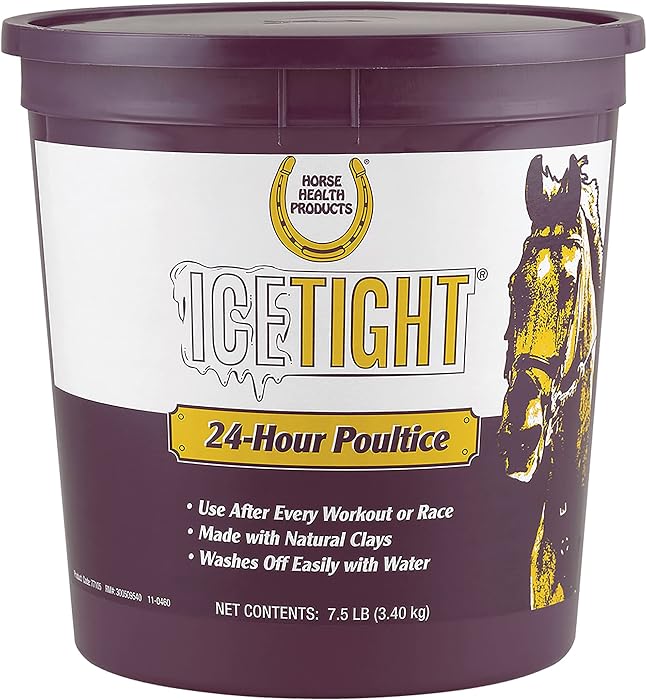
IceTight 24-Hour Poultice Best for Hot Filled Legs

IceTight 24-Hour Poultice 7.5 Pounds

Hot filled legs

Field Score 91/100
Use
Knees, tendons, ankles
Size
7.5 lb
Format
Clay poultice
Wear Time
Up to 24 hours
View on Amazon

This one treats no wounds at all, and that is exactly why it belongs in the kit. IceTight is the other half of first aid: the tub we reach for when a horse comes in with a hot, filled leg instead of a cut. It is a cooling clay poultice for knees, tendons, and ankles, meant to go on after work, a competition, or a race.

The 7.5-pound tub is as much of the appeal as the clay. You can put it on heavily and leave it for the 24 hours the name promises, then hose it off — dried clay brushes out of a white leg, so you are not scrubbing at nine at night. It is gentle on skin, and it comes off with water rather than elbow grease.

Keep the boundary in mind. It goes on whole legs, not into an open cut, and it does not replace anything in the wound-care list — it is the tub for swelling, heat, and legs that stock up after a hard ride. If your first aid kit lives in a trailer box, this is the one item here that stays home.

Worth Noting

  • Legs only
  • Bulky 7.5-pound tub for a trailer kit
Our Verdict

We keep this one for legs rather than wounds: a big tub of cooling clay you can put on thick, leave for a day, and hose off without a fight.

Check Latest Price

How We Tested Horse Wound Care Supplies

We started by gathering the wound care products that genuinely turn up in barn aisles and vet recommendations — sprays, coagulant powders, and poultices — and read every label before anything came near a horse. Anything that didn't state it was safe for use on open wounds, or that listed its ingredients vaguely, got cut. That left 14 products, which my team and I used over five months on three horses with real injuries: fence scrapes, a pastern puncture, a hock that kept granulating, and one hoof abscess.

Every product got used the way it would be at 8 p.m. with a horse dancing on a lead rope: one-handed, in a dim aisle, with no time to reread the back of the bottle. When a small nick bled, we timed how long a powder took to stop the ooze and whether the horse flinched at application. We photographed each wound every other day for two weeks to compare how the edges closed, and noted which ones kept the surface clean enough that proud flesh never got a foothold.

We also sprayed each product onto a white bandage and a concrete aisle wall and checked for staining once it dried, and left containers open in the aisle overnight to see whether powders caked or nozzles clogged in the dust. Sharp-smelling products got flagged if a horse threw its head or refused to stand still. And we counted doses per container, since a refill bottle that lasts a season is worth more than an aerosol that empties in a month. The ones that stayed in the kit were the ones we could grab in the dark.

How to Choose Horse First Aid Supplies

Build the kit around the sequence, not the box

Most kits are a pile of ointments with nothing in them to wash a wound out with, which is backwards. The first thing a fresh cut needs is volume — a spray you can flush dirt and hair out with, more than once a day, without stinging the horse into next week. After that the job splits: a coating to disinfect and scab a small scrape, a powder to stop capillary bleeding, and a healing spray for the days that follow.

Buy in that order and you'll never be standing in the aisle holding a tube of something while a wound sits full of grit.

Spray, powder, or paint-on

Format decides whether you can treat the horse at all. A trigger spray gives you volume and reach, and you can aim it into a wound one-handed while the other hand holds a lead rope. An aerosol paints a neat film but drifts onto everything nearby. A shaker powder is the only one of the three that works on a bleed in an awkward spot where liquid runs straight off.

Match the format to where the wound sits and to how much the horse will tolerate, not to which bottle looks most clinical.

Size the bottle to the treatment, not the shelf

A wound treated a few times a day for two weeks eats an enormous amount of spray, which is why a 16-ounce trigger bottle makes sense for the barn and a small can makes sense for the trailer. Cost per treatment matters more than the sticker on the shelf: a cheap bottle you ration is more expensive than a big one you use properly. Keep one full-size of your main flush and let the rest of the kit run smaller.

Heat ruins a kit faster than a wound does

Tack rooms and trailers get hot enough in summer to degrade a liquid and pressurize an aerosol, and some labels put explicit numbers on the storage temperature precisely because barns blow past them. Keep the kit somewhere shaded and moderate, bring it inside during a heat wave, and don't leave it in the truck between shows.

Check the labels on your bottles once a season — that is the failure nobody notices until the lid comes off in an emergency.

Know what a kit can't fix

Anything deep, anything punctured, anything near a joint, tendon sheath, or eye, and any bleed that doesn't slow after a few minutes of steady pressure is a vet call, not a spray-and-watch. Covering a puncture with powder or blue lotion can also make it harder for a vet to judge what is underneath.

Call first, treat second, and keep the vet's number inside the kit where you will actually find it.

Frequently Asked Questions

Final Verdict

Start with the Vetericyn. It is the step every wound begins with, and it is the one product here a sore horse will stand still for — which decides whether the rest of the kit ever gets used. Pair it with the Wonder Dust if you have watched a small cut keep seeping, and add the Underwood when a wound has stalled and stopped closing on its own.