The 7 Best Horse Poultices of 2026

The first time a horse of mine came in three-legged with heat pouring out of a hoof, I was on the phone with my farrier at nine at night, building a poultice out of a diaper and duct tape. It worked, barely. A good poultice does two jobs at once: it draws heat and drainage out of an abscess, and it takes the sting out of a hot leg after hard work.

What I didn't know then is that the poultice itself is only half the job. Texture decides whether a clay packs into a heel bulb or dries into a chalky crust that fights you at the wash rack, and the format matters just as much, whether that's a bucket of clay, an Epsom salt mix, or a pre-cut hoof pad you slap on and wrap. Over the past four months my team and I put 14 poultices through real barn life to sort out which ones actually earn their shelf space.

One thing worth knowing before you spend a dime: the poultice never works alone. The plastic, the wrap, and the standing bandage do the holding. Below are the ones that came off clean, drew like they should, and didn't make a bad night worse.

Our Top Picks

The 7 Best Horse Poultices of 2026

1

Sore No-More Cooling Clay Poultice Best Overall

Sore No-More Cooling Clay Poultice

Everyday leg care

Field Score 93/100
Use
Legs, body, hooves
Form
Cooling clay
Size
5 lb
Texture
Silky and creamy
View on Amazon

Legs, body, and hooves — the label on this tub covers more ground than anything else here, and that's most of why it's the one we tell people to buy first. The same clay that goes onto a filled tendon after a hard ride can be packed into a sore foot, so you're not buying a second product or clearing a second shelf for the one horse in the barn. When you're building a first-aid kit rather than restocking a whole barn, that range is the whole argument.

The texture is what makes the range practical. It comes out smooth and creamy rather than crumbly, so it goes onto a cannon bone in two passes with a gloved hand and settles around the tendon instead of sitting on top of it. A clay you can spread quickly gets used on a Tuesday night; a clay that fights you waits until the leg is already bad. It's also listed for tightening legs before work as well as cooling them after, which has become the use we lean on most on show mornings.

Five pounds is about right for one or two horses in work, and the 23-pound container exists for barns that go through it. The boundary worth naming: this is a wet clay, so it wants an over-wrap and a hose nearby, and it isn't the formula for a horse living out with a bare leg. At a barn with a wash rack and a stack of wraps, that's not much of a compromise.

Worth Noting

  • Costs more per pound than barn-size buckets
Our Verdict

Our default pick for most horses: a smooth clay that loads up a hot leg in seconds, works on hooves too, and rinses off without a scrubbing session.

Check Latest Price
2

Farnam IceTight 24-Hour Poultice Best for Barns

Farnam Horse Health IceTight 24-Hour Poultice

Barns and multi-horse

Field Score 92/100
Size
46 lb
Formula
Natural clays, glycerine, aloe vera, minerals
Removal
Brushes off when dry
Leave-on Time
Up to 24 hours
View on Amazon

IceTight is the poultice for people who are tired of the wash rack. Put it on thick, leave the horse in, and by morning the clay has set into a crust you curry off — on white legs too, which is not something we can say for every clay here. If poulticing happens after every ride in your barn, the difference between hosing a leg and brushing it is the difference between keeping the routine and letting it slide.

The formula sits on the mild side for a medicated poultice: natural clays with glycerine, aloe vera, and minerals, and it's labeled not to blister or irritate skin. That's what makes the 24-hour leave-on realistic, and 24 hours is generous next to the 12-hour interval on the pads here. For thin-skinned horses and legs that get treated several days running, it's the one we reach for without thinking about it.

Then there's the size of the thing. Forty-six pounds arrives as a pail, and it changes the economics: against the five-pound tubs here, this is the lowest cost per leg treatment of the group by a wide margin. The math only fails if you're buying for one horse with one sore leg.

Our read: for a single horse, buy a tub you can lift. For two or more in work, or a barn where poulticing is a weekly habit, this is the bucket that stops you rationing clay. Everything about it is built for repetition — the drying, the interval, the volume — which is exactly what makes it a poor first purchase and an excellent second one.

Worth Noting

  • 46-pound pail needs floor storage
  • Availability can run one to two months out
Our Verdict

If you poultice more than one horse, buy the bucket: it dries overnight, curries off in the morning, and costs a fraction per leg of anything else here.

Check Latest Price
3

Animalintex Hoof Poultice Pads Best for Hoof Abscesses

Animalintex Hoof Poultice Pads for Horses

Hoof abscesses

Field Score 91/100
Use
Hot, cold, or dry
Form
Pre-cut hoof-shaped pads
Pad Size
5.5 x 5.5 inches
Change Interval
Every 12 hours
View on Amazon

Abscesses announce themselves at bad times — a Sunday, a holiday, ten minutes before you leave for work. The Animalintex pad answers that. It's already hoof-shaped at 5.5 by 5.5 inches, so there's nothing to cut and nothing to guess: soak it, set it cotton side down, secure it with a hoof wrap, and you're done. On a typical 15-hand horse it covers the sole with room at the edges, so nothing needs trimming at ten at night.

The material is the old-fashioned kind — boric acid as a mild antiseptic and tragacanth as the drawing agent — and the same pad is sold for hot, cold, or dry use. Hot to bring an abscess to a head, cold on a hot foot after a hard day or a knock, dry as a dressing over an open wound. We like that one box covers all three, because the routine usually changes before the box is empty.

What you're paying for is convenience, and per treatment these are the most expensive way here to poultice a foot. We keep a box anyway, because a pad that goes on in one pass gets used and a bucket of clay at midnight often doesn't. With a 12-hour change interval, a multi-day abscess doesn't eat the box as fast as you might fear. It's the poultice for the trailer and the first-aid kit, not the one to buy by the case for weekly leg work.

Worth Noting

  • Pads run small for draft-size hooves
Our Verdict

For an abscess, start here — pads already cut to a hoof save the trimming, and one person can get one on in the dark.

Check Latest Price
4

Durvet Epsom Salt Poultice Best Epsom Gel

Durvet Epsom Salt Poultice

Abscesses without soaking

Field Score 90/100
Use
Hooves, muscles, bruising
Form
Epsom salt gel
Size
20 oz
View on Amazon

Durvet's gel is the closest thing to an Epsom soak without a bucket, and it behaves accordingly: thick and tacky, closer to warm taffy than to clay. Gloves are not optional. That tack is also why it works — a blob pressed into a sole stays in the sole while you find the wrap, instead of sliding out the moment the horse shifts its weight.

Where it earns its place is the foot. Epsom salt is the first drawing agent most of us reach for, and having it as a gel means no soaking tub, no wet bedding, and no twenty minutes holding a lead rope while the horse decides whether the bucket is a toy. For a horse that won't stand in a bucket, or a barn with no hot water at the wash rack, that's the entire argument. The active ingredient is Epsom salt, which is also why it's the one we reach for on a thin-skinned horse — and why we keep buying it for feet rather than for legs.

Worth Noting

  • 20-ounce tub goes fast if you poultice legs
Our Verdict

It's an Epsom soak in a tub: pack it into the sole, wrap, and skip the bucket and the twenty-minute stand in the aisle.

Check Latest Price
5

Redmond Red Edge Equine Poultice

Redmond Red Edge Equine Poultice

Full-leg coverage

Field Score 89/100
Use
Legs, tendons, hooves
Form
Natural clay
Size
8.5-pound bucket
Hoof Use
Moisture before shoeing
View on Amazon

Eight and a half pounds of bendable clay is a different proposition from a five-pound tub. You can cover a cannon bone, work down over the fetlock, and keep going without watching the level drop — which is what you want if your version of poulticing is a full-leg wrap after a hard weekend rather than a dab on one spot.

The clay is a natural one rather than a medicated formula, which is why we're comfortable putting it on a thin-skinned horse and also why we don't expect it to do the work a medicated clay does. The label lists it for drawing fluid, tightening tendons, and putting moisture back into a dry, crumbly foot before shoeing. That last use is the sleeper: the bucket that cools a hot tendon can also be packed into a sole the farrier is about to work on.

Where it gives ground is focus. 'Natural analgesic' is a lot to hang on a clay, and in a set this strong it isn't the pick for a hot, swollen tendon — the medicated tubs here give you more to work with. Buy it for coverage and for feet, and keep a medicated tub for the leg you're actually worried about.

Worth Noting

  • Less targeted than the medicated clays here
Our Verdict

Buy this one for coverage — 8.5 pounds of plain clay covers a whole cannon and doubles as a hoof pack before the farrier arrives.

Check Latest Price
6

Numotizine Medicated Clay Poultice Best for Sore Tendons

Numotizine Medicated Clay Poultice – Medicated Clay Poultice for Horses

Sore tendons

Field Score 88/100
Form
Medicated clay
Size
24 oz
Texture
Thick, stays where applied
View on Amazon

Thick is the word for Numotizine. It goes on like cold putty and stays precisely where you press it, so a hock, a knee, or the back of a cannon gets an even layer instead of half of it landing in the bedding. If you've ever fought a runny clay that slides down a vertical leg while you're still looking for the wrap, this is the fix.

It's a medicated poultice rather than a plain clay, and the label puts it after training, turnout, and demanding activity — the leg-care end of the job rather than the abscess end. Twenty-four ounces is a starter size: enough for a couple of weeks of spot treatment, not enough to wrap four legs a night. We like it best on the specific grumpy spot — a sore tendon, a bruise, a stiff hock the morning after a hard day.

The trade is that it's an old-fashioned medicated product rather than a creamy modern clay: fine for a targeted spot, less pleasant when you're wrapping a whole barn. That's a trade we'll take on the leg that's actually bothering us, and it's why this smaller tub lives in the tack trunk while the big ones stay in the feed room.

Worth Noting

  • Strong medicinal smell lingers on wraps
Our Verdict

Thick, tacky medicated clay that stays exactly where you press it — the one for a hock or a knee on a vertical leg.

Check Latest Price
7

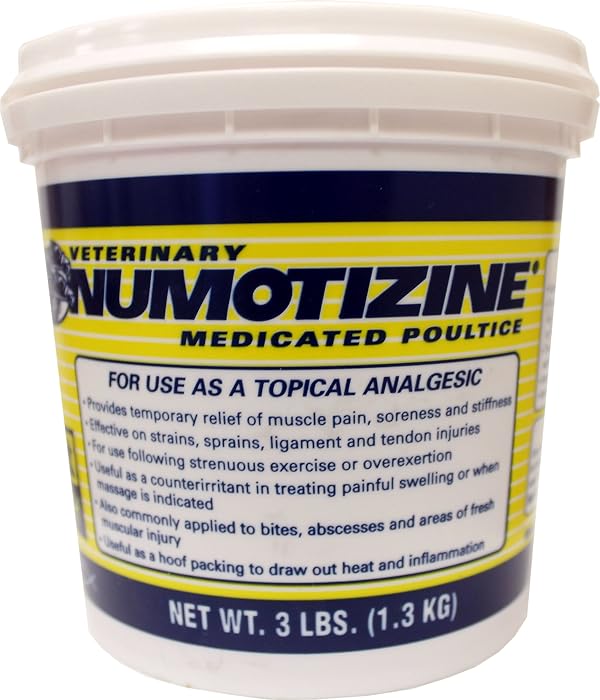
Numotizine Poultice 3 lb

Numotizine Poultice 3 lb – 197564 Numotizine Poultice

Bulk medicated clay

Field Score 87/100
Form
Medicated clay mixture
Size
3 lb
Key Ingredients
Guaiacol, beechwood creosote, methyl salicylate
View on Amazon

Twice the clay of the 24-ounce tub, in the same thick, stay-put formula. That's the whole case, and it's a good one: if you already know you like working with a heavy medicated clay, the bigger tub means fewer reorders and one less thing to remember before a show.

The label reads like an old barn shelf: sprains, tendinitis, bruises, and soreness from overexertion or strenuous exercise. It's a medicated mixture — guaiacol, beechwood creosote, methyl salicylate — which tells you what kind of product this is: targeted, old-school, and not the tub you reach for when you want a pretty, creamy clay for a whole leg.

Where it earns its place is repetition. A horse in full work that gets poulticed after every hard ride, or a barn that goes through clay faster than it goes through duct tape, will finish this tub well before it dries out. Start with the 24-ounce version and graduate to this one when you find yourself scraping the bottom.

Worth Noting

  • More clay than a one-off abscess needs
Our Verdict

The same thick medicated clay in a tub twice the size — the one to buy once you know you'll reach for it after every hard ride.

Check Latest Price

How We Tested Horse Poultices

We built the shortlist the way a barn manager would, asking farriers and vet techs what they actually reach for, then combing tack store shelves and listings to filter by format, ingredients, and how much product you get per container. From there we gathered 14, spanning tubs of cooling clay, Epsom salt formulas, and pre-cut hoof-shaped pads, from small jars up to bulk buckets.

Testing ran four months, straight through hot afternoons, muddy turnout, and one thoroughly miserable week of abscess. Each one got used the way it gets used in real life: packed into a hoof, smeared up a cannon bone after a hard ride, covered in plastic and a standing bandage, and left on overnight.

Texture got the closest look because it drives everything else. We noted whether a poultice spread like thick frosting or crumbled off the fingers, whether it cracked by morning, and whether it stayed where we put it or slid down into the shavings. At the next feed we hosed, picked, and scrubbed to see how much work removal took and whether any hair or skin came with it.

Effectiveness we judged by the horse rather than the label: whether heat and digital pulse dropped overnight, whether a filled leg came down, and how willingly a sore horse walked off the next morning. We also tracked how far each container stretched across multiple applications, since value in this category is really cost per poultice.

How to Choose a Horse Poultice

Clay, gel, or pad

Clay in a tub is the most versatile form: it covers a whole cannon, works over a hock or a knee, and can be packed into a sole. The cost is a wrap and a hose. An Epsom gel is the better fit for a foot you're trying to draw — tacky enough to stay packed in a sole, with no soaking tub involved. Pre-cut pads are for hooves only, and they exist for one reason: speed.

The trap is buying one form for every job. A hoof-shaped pad won't wrap a tendon, and a bucket of clay is a poor abscess kit if you can't keep it on the foot long enough for it to work.

Price per treatment, not price per tub

A five-pound tub and a 46-pound pail aren't really competing products. The small tub costs more per leg but less upfront, stores on a shelf, and is more likely to be finished before it dries. The pail is dramatically cheaper per treatment and makes sense for two or more horses in work or a barn that poultices weekly, provided you have floor space and a lid that seals.

Be honest about frequency. Buying the bucket for a single abscess is how a barn ends up with a rock-hard pail in the corner.

Hot, cold, or dry

Temperature changes what the poultice does. Hot — soak the pad or mix the clay with water around 110°F — draws and helps bring an abscess to a head. Cold takes heat out of a fresh knock, a hot tendon, or a foot worked hard that day. Dry is for covering a wound or protecting a healing sole when you don't want moisture at all.

Then there's the clock. Intervals differ by product: 12 hours for the Animalintex pads, up to 24 for the IceTight. The label's interval beats your instinct to change it more often.

Sensitive skin and broken skin

Medicated formulas are the ones to introduce carefully. Test a patch on an inconspicuous area first, and don't wrap a leg that's already broken out or scurf-heavy. Plain natural clays are the safer starting point for a thin-skinned horse; medicated tubs are for a problem you're actually chasing.

An open cut or a draining abscess is a conversation with your vet, not a poultice decision. Some pads can go on dry as a wound dressing, but nothing here belongs sealed under an airtight wrap over broken skin without direction.

Frequently Asked Questions

Final Verdict

For most horses, buy the five-pound tub of Sore No-More Cooling Clay and be done: it spreads fast, works on legs and feet, and rinses off without a scrub. If the problem is an abscess rather than a leg, the Animalintex pads save you the cutting and the cleanup at the hour when that matters most.

And if poulticing is a weekly habit at your barn, the IceTight bucket is the cheaper way to do it — order it before a leg gets hot, because its availability can run a month or two out.