The 8 Best Horse Trailer Cameras of 2026

Hitching a gooseneck alone is the part of trailering nobody warns you about. You line up the truck, lose sight of the coupler behind the bed rail, climb out to check, climb back in, and repeat until someone takes pity on you with a flashlight. A camera aimed at the hitch turns that ten-minute shuffle into one slow, confident reverse.

We've run a dozen of these systems on trucks and trailers over the past eight months, and most of them really do install in under five minutes. What separates them is everything after: whether the magnet holds at highway speed on washboard gravel, whether the solar panel keeps up through a cloudy week, and whether the picture is still sharp enough at dusk to spot a gatepost.

Price climbs fast once you add a second camera or a bigger screen, and a bigger number on the box doesn't guarantee a better image. Below are the ones that earned a permanent spot on the truck.

Our Top Picks

The 8 Best Horse Trailer Cameras of 2026

1

DVKNM AP7 Best Overall

DVKNM AP7 – Magnetic Solar Wireless Backup Camera with 7" 1080P IPS DVR Monitor

Rear-view towing

Field Score 88/100
Screen
7 in FHD IPS
Battery
9600 mAh
Viewing Angle
140 degrees
Wireless Range
328 ft
View on Amazon

Seven inches is the number that decides whether a trailer camera is worth glancing at on the highway. That is the panel on the AP7, and with a 1080p sensor behind it there is enough picture to tell a sedan from a shadow in the next lane. We move between this and the 5-inch monitors in this set often enough to know the bigger screen is not a luxury — it is the difference between a quick check and a squint.

What sold us is how little ceremony the rest of it requires. The camera goes on with a magnetic base, so it moves from trailer to truck bed in seconds, and it charges by Type-C or the solar panel on top. You get a sunshade, a suction-cup bracket, and a U-bracket in the box, which means the monitor can live on the windshield or on the dash depending on what your truck offers. We are partial to the sunshade: a screen that washes out in afternoon sun is a screen you stop using.

The 140-degree lens is where the AP7 gives ground to the 170-degree cameras here. At the edges you see less of the lane, which matters most when a car is creeping up the left side of a long trailer. The 9600 mAh battery is also smaller than what the two-camera kits carry, and the solar panel helps without rescuing a camera that starts a trip at half charge. Charge it the night before and the panel becomes a bonus instead of a plan.

A three-year warranty on a mid-priced kit is the detail that seals it for us, and it is why the AP7 leads this group. The 328-foot signal rating is comfortable for a bumper-pull and workable on a gooseneck. One trailer, one screen, one camera that goes on in seconds — that is the deal, and for most horse owners it is the right one.

Worth Noting

  • 140-degree view narrower than most here
  • Solar charging lags on cloudy driving days
Our Verdict

Our default pick: a 7-inch screen you can actually read at highway speed, a magnetic camera that moves between trailers, and a price below the multi-camera kits here.

Check Latest Price
2

pemacom M1 Best Two-Camera Kit

pemacom M1 – HD 1080P Dual Wireless Backup Camera: 15200mAh Battery Up to 3-Day Trip

Hitch and rear

Field Score 87/100
Screen
7.2 in split screen
Battery
15200 mAh
Wireless Range
450 ft
Cameras Included
2
View on Amazon

Two cameras on one screen is the entire argument for the M1. The kit ships with a pair of solar magnetic cameras and a 7.2-inch split-screen monitor, so one can watch the road behind the trailer while the other sits over the coupler — the arrangement we want on a gooseneck, where the ball disappears under the bed and someone ends up standing behind the truck waving hand signals.

On paper it is the fullest kit in this group: a 15200 mAh battery rated at 26 hours of continuous use, a 450-foot signal claim, IP69K sealing, a 170-degree lens, and loop recording to a card. The split screen divides that 7.2 inches in half, though, and that is the trade — each view ends up about the size of a small monitor. Mount it close to your sightline.

Battery is where the shine dulls. The panel helps, but on a gray three-day trip the cameras can finish lower than they started, and a trailer camera that quits mid-haul is worse than none. A full charge before you leave and a cord in the cab solve it. The kit is also heavy at 6.2 pounds in the box, so it lives in the truck rather than moving between vehicles.

The card slot is the sleeper feature. Loop recording keeps a rolling record of what the rear camera saw, which is worth having at a crowded showground or a tight fuel stop where you want to know exactly how close that bumper came. Two cameras, one screen, and a record of the trip is a lot of kit for a premium price that still undercuts the four-camera systems.

Worth Noting

  • Solar can fall behind on cloudy trips
  • 6.2-pound kit stays in the truck
Our Verdict

We point two-camera buyers at the M1: hitch view and rear view on one 7.2-inch screen, the fullest kit here, with a battery you have to manage.

Check Latest Price
3

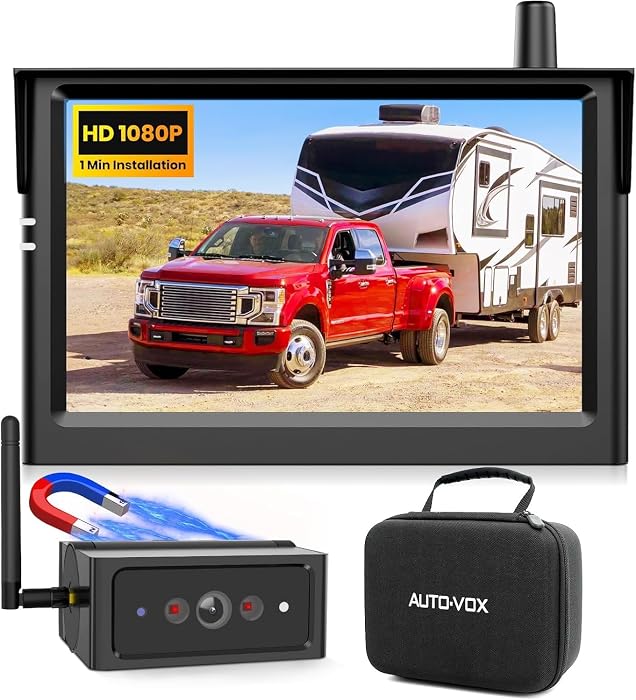
AUTO-VOX S36 MAX Best for Truck-And-Trailer Pairs

AUTO-VOX 2 Solar Wireless Backup Camera System: 3-Min Quick Installation

Truck-and-trailer rigs

Field Score 86/100
Screen
7.2 in split screen
Warranty
18 months
Cameras Included
2 (fixed and magnetic)
Waterproof Rating
IP69K
View on Amazon

The first time you leave the trailer at a campsite and drive the truck into town, the S36 makes its case. One camera is mounted to the truck and stays there, so the pickup still has a backup camera with nothing hitched behind it — which is the half of trailer ownership most kits ignore.

The second camera is the magnetic, solar-charged unit that rides the trailer, and the 7.2-inch monitor splits between the two. Picture is 1080p with infrared for dark loading, the cameras are IP69K rated, and the monitor draws from the 12V outlet. The fixed camera's power lead runs short on some trucks, so trace the path to your reverse light before you commit to a permanent mount.

The monitor mount is the weak link. The adhesive base lets go in heat, and a screen that slides off the dash mid-drive is a distraction nobody needs — a screw-down bracket or a different mount fixes it, and we consider that a required upgrade rather than an option. Battery is the second soft spot: the solar panel keeps up in a sunny week and not in a gray one, so the charge cable stays in the truck.

Splitting 7.2 inches in two leaves each view around three and a half inches wide, which is exactly why the fixed camera earns its place. It is the view you glance at most while driving, it never needs re-aiming, and it is still there when the trailer is 200 miles behind you.

Worth Noting

  • Monitor's adhesive mount loosens in heat
  • Fixed camera's power lead runs short
Our Verdict

Our pick for a truck that tows the same trailer every weekend: the S36 leaves a camera on the pickup and puts a magnetic one on the trailer.

Check Latest Price
4

AUTO-VOX S4B-N Best for Hitching Alone

AUTO-VOX 5 Inch Magnetic Wireless Backup Camera

Hitching up solo

Field Score 85/100
Screen
5 in LCD
Battery Life
Over 15 hours
Viewing Angle
170 degrees
Wireless Range
50 ft
View on Amazon

Fifty feet of rated range looks like a weakness beside the 300- and 400-foot claims in this group, and for watching the back of a 30-foot trailer it is. Hitching is a different job. The camera sits on the coupler or the tailgate, the monitor sits a few feet away in the cab, and short range is a limit you never meet — so the small number buys nothing you need and costs nothing you miss.

What you get instead is staying power. The battery is rated for more than 15 hours of continuous use, and runtime is the dimension we trust most on this camera: the low-power mode and long standby mean it does not drain sitting in the barn between trips. The 170-degree lens takes in the coupler and both sides of the tongue at once, and the 5-inch screen is small but sharp enough to line a ball up under a gooseneck.

The warranty runs one year, the shortest here, and a camera that stops taking a charge is the failure to watch for. Neither changes what this one is for. The monitor's suction mount holds far better than most, which counts for something when the windshield bakes in July.

The 5-inch monitor is the real compromise: fine for hitching, cramped as a rearview mirror on the highway. Buy this as the magnetic hitch camera that lives in the console, and pair it with something larger if you also want to watch traffic behind a loaded trailer.

Worth Noting

  • 50-foot range rules out rear-of-trailer use
  • One-year warranty is the shortest here
Our Verdict

We recommend the S4B-N for hitching up solo: a strong magnet, a 170-degree view of the coupler, and battery life that outlasts a weekend.

Check Latest Price
5

Venluna VA001 Best for Watching the Horses

Venluna VA001 – Dual Magnetic Wireless Backup Camera

Adding cameras later

Field Score 84/100
Screen
7 in
Battery
15000 mAh
Channels
4
Wireless Range
500 ft
View on Amazon

Four channels on a 7-inch screen sounds like overkill for a horse trailer until you count the views you actually want: the road behind, the coupler in front, and the horses themselves. The VA001 arrives with two magnetic solar cameras and accepts two more, which makes it the closest thing here to a system you grow into rather than replace.

The numbers hold up across the board — a 15000 mAh battery, 24 hours of use on a full charge, a 500-foot signal rating with dual antennas, IP69 sealing, a 170-degree lens, and a soft rubber base so the magnet does not scar paint. We think the 30-second auto-sleep is the detail that matters most in practice: the camera nods off when the monitor does, which is how it still has a charge at the ramp next Saturday.

Solar is a supplement here and Venluna says so plainly, describing the panel as extending the battery rather than charging it. Believe that and plan a USB-C top-up before a long haul. Filling all four channels also means buying two more cameras, which changes the math on a kit that already sits near the top of this group on price.

Where it earns its place is the interior view. A camera aimed down the trailer tells you whether a horse has scrambled or a partition has shifted while you are rolling, and no amount of rear coverage replaces that. On a two-horse gooseneck with a dressing room, that third camera is the one you end up watching.

Worth Noting

  • Solar only tops up the battery
  • Filling four channels means buying more cameras
Our Verdict

We like the VA001 for anyone planning a second or third camera later: four channels, a 15000 mAh battery, and 500-foot signal in a kit that starts with two cameras.

Check Latest Price
6

ZEROXCLUB 4 CAM Best for Four-View Setups

ZEROXCLUB 4 CAM – 4 CAM 10.1" Touchscreen Magnetic Solar Wireless Backup Camera

Four-view setups

Field Score 83/100
Screen
10.1 in touchscreen
Battery
9600 mAh
Wireless Range
300 ft
Cameras Included
4
View on Amazon

The most expensive system here, and the only one that hands you a 10.1-inch touchscreen. That screen is the product: four magnetic cameras on one display, each view large enough to read at a glance instead of peering at a quarter of a small monitor while a horse shifts in the trailer.

The kit includes four cameras with 9600 mAh batteries, a 300-foot signal rating with dual antennas, loop recording, and automatic startup and shutdown that follows the monitor. Touch control removes the button shuffling when you switch views, which is the difference between a quick look and a two-handed fumble at a fuel stop.

Battery is the risk you take on. The panels do not always keep up with a long driving day across four cameras, and a set that finishes a trip at half charge takes a while to bring back. Budget an evening to charge the whole set before a haul — at this price, that is a chore you should not have to schedule, but you do.

Two cameras cover most horse trailers, and if that is your rig this system sells you capacity you will never switch to. For a long gooseneck with a dressing room, a side blind spot, and horses to watch, four views on a ten-inch display is a setup nothing else here matches.

Worth Noting

  • The most expensive system here
  • Four cameras to keep charged
Our Verdict

Buy the ZEROXCLUB when four views on one big touchscreen is the point and price is a secondary question.

Check Latest Price
7

BUTOA-X X7

BUTOA-X X7 – X7 Wireless Solar Magnetic Backup Camera for RV Truck

Spare trailer duty

Field Score 82/100
Screen
7 in
Battery
15000 mAh
Warranty
2 years
Wireless Range
320 ft
View on Amazon

A 7-inch screen at the bottom of this group's price range is the X7's whole pitch, and it is a fair one. The trailer does not care what you paid; it cares whether you can see the ramp latch in the mirror-less dark and whether the camera is still stuck to the door at the end of the drive.

You are not giving up much to get there. The camera carries a 15000 mAh battery and a 5-watt solar panel, charges over USB-C, and wakes itself when you start driving. Signal is rated at 320 feet, the lens is wide, the monitor's suction bracket lets you move it between trucks, and two years of warranty covers a kit near the budget end.

The trade-offs are the panel and the mount. Five watts on a battery this size is a top-up rather than a charger, so the long runtime claim depends on the camera sleeping when it should, and the monitor's suction cup is the first thing to let go on a hot windshield. Both are manageable: charge it the night before and park the monitor out of direct sun.

For a stock trailer, a spare rig, or a truck that only pulls a few weekends a season, the X7 does the job the expensive kits do — you see the road and the load behind you — without paying for channels you never switch to. The two-year warranty is the part that tips it for us; budget kits usually ask you to accept less backing than that.

Worth Noting

  • 5-watt panel is a top-up, not a charger
  • Suction-cup monitor mount loosens in heat
Our Verdict

The X7 is our budget pick: a 7-inch screen, a 15000 mAh battery, and a magnetic camera that wakes itself when you pull out.

Check Latest Price
8

VEKOOTO VK7 Pro

VEKOOTO VK7 Pro – VK7 Pro Magnetic Solar Wireless Backup Camera

One-screen simplicity

Field Score 81/100
Screen
7 in IPS touchscreen
Battery
15800 mAh
Magnets
6
Waterproof Rating
IP69
View on Amazon

Antennas that do not screw on are the detail that caught our attention first. The VK7 Pro builds them into the camera and monitor bodies, so there is nothing to lose, bend, or forget to attach — a small thing that matters a great deal on a camera living on the back door of a trailer, where an antenna gets knocked every time the ramp comes down.

Underneath is a 7-inch 1024 x 600 IPS touchscreen with loop recording, a 15800 mAh battery charged by solar or USB-C, six magnets in the base, IP69 sealing, infrared good to about 30 feet, and a 150-degree lens. The monitor takes power from USB-C or a 12V outlet, and setup is a three-minute job once the battery has a charge in it.

Two places it gives ground. The 150-degree lens is narrower than the 170-degree cameras here, so the far edges of a lane show up later, and the kit arrives with one camera where several picks ship with two. If a coupler view or a camera on the horses is on your list, the two-camera kits are the better buy.

What sells it is power sync: the camera wakes and sleeps with the monitor, so you never climb onto a step to press a button on a camera mounted high on a rear door. Anyone who has scraped a knuckle reaching for that switch will understand why we rank it above a slightly wider lens.

Worth Noting

  • 150-degree lens is narrower than 170 here
Our Verdict

We recommend the VK7 Pro to anyone who wants one camera, one touchscreen, and a battery that goes the distance without fiddling.

Check Latest Price

How We Tested Horse Trailer Cameras

We started with more than 40 listings and cut anything that required splicing into the trailer's wiring harness, anything that didn't include a monitor, and anything whose mounting hardware looked like it would rattle apart on gravel. That left 12 systems, which we ran for eight months on a two-horse bumper pull, a gooseneck stock trailer, and the trucks that pull them.

Each one went on the way yours would: at the barn, in the dirt, with a screwdriver and no help. We timed the first install from opening the box to a powered-on monitor, then mounted the camera both on the rear of the trailer and down on the coupler. The magnets got the crude test — highway speeds, washboard ranch roads, a tailgate slammed more times than necessary, and one bad landing off a ramp — and we noted which cameras had shifted by the end of the week.

Picture quality was judged on real things, not test bars: could we pick out a gatepost, a curb, or a horse's legs on the monitor at dawn, at noon, and after dark, and how long did the image take to appear after shifting into reverse. Battery life got logged morning and evening, including a four-day stretch of heavy cloud when the solar panels did almost nothing.

We also ran every camera through rain, dust, and a hose, checked how far each monitor's power cord actually reached across a dash, and weighed the price against what we were still happily using in month eight.

How to Choose a Horse Trailer Camera

Hitch Cameras and Trailer Cameras Do Different Jobs

Backing under a gooseneck is a short-range problem. The camera sits on the coupler or the tailgate, the monitor sits a few feet away in the cab, and a 50-foot hitch camera like the AUTO-VOX S4B-N covers it comfortably. Watching traffic behind a moving trailer is a long-range problem, and that is where the 300- to 500-foot ratings on the 7-inch and two-camera kits earn their keep.

If you want both views, buy a kit with two cameras rather than two separate kits. You save a monitor, a power cord, and a windshield mount, and the split screen keeps the hitch and the road in sight at the same time.

A Magnet Needs Steel, and Horse Trailers Are Often Aluminum

This is the trap. Magnetic mounts are the reason these systems install in minutes, but aluminum and fiberglass trailers will not hold one. Most kits include a steel plate you screw to the trailer so the magnet has something to grab, which means one small hole and a mount point that stays put — and a plate also gives you the same camera position every trip. Run a fridge magnet over the rear door and frame before you order.

Whichever way the camera is held, tether it. A camera that lets go at highway speed becomes road debris, and near a hitch or a loading ramp it is worse than that.

Screen Size and How Many Views You Can Watch

A 5-inch monitor is fine for hitching and cramped for driving. Seven inches is where the road behind the trailer becomes readable at a glance, and the 10-inch systems exist for rigs running three or four cameras. Remember that a split screen divides the panel: two views on a 7-inch monitor give you roughly three and a half inches each, so mount it close to your sightline.

Decide the camera count before you buy — rear only, rear plus hitch, or rear, hitch, and a camera inside the trailer on the horses. Adding a camera later is easy on the four-channel units and impossible on the single-channel ones.

Battery, Solar, and the Routine That Keeps Them Alive

Runtime figures assume a full charge and a camera that sleeps when the monitor is off. Auto-sleep and auto-wake are the features to look for, because a camera that stays awake in the barn is flat by the weekend. Solar panels on these cameras are top-ups rather than chargers; even the makers who lead with solar describe the panel as extending a charge rather than replacing the cable.

Charge everything the night before a haul, keep a USB-C cable in the truck, and treat a sunny week as a bonus. A camera that dies an hour from home is one you stop trusting.

Signal Range, Antennas, and Loading in the Dark

Rated range is measured in open air, and a trailer full of horses and steel is not open air. The distance from the rear of a 24-foot trailer to the windshield is under 30 feet, so range rarely fails on paper — it fails when an antenna lies flat on a dash or the trailer body sits between the two ends. Keep antennas upright and mount the monitor where it can see the camera's end of the trailer.

Infrared matters if you load before sunrise. Every system here claims night vision; the ones rated for about 30 feet are the ones that make out a ramp latch in an unlit barn lot.

Frequently Asked Questions

Final Verdict

For one trailer and one screen, we recommend the DVKNM AP7. The 7-inch panel is readable at highway speed, the magnetic camera moves between trailers in seconds, and the three-year warranty backs a mid-priced kit. Its 140-degree lens is the compromise, and on a bumper-pull it is a small one.

If you regularly tow alone and only need to find the coupler, the AUTO-VOX S4B-N does that job for less with better battery life, and the pemacom M1 covers both views at once when a gooseneck hides the ball. Start with the job you actually have and the rest of this list sorts itself out.