The Best In-Ear Electronic Hearing Protection for Shooting

The first time I stood next to a ported .308 without ear protection, my ears rang for two days. That's why I stopped choosing between foam plugs that mute everything and bulky muffs that fog my safety glasses. Modern in-ear electronic protection is supposed to clamp down on gunshots while letting voices, range commands, and Bluetooth audio through. The trick is finding a pair that actually does all three without falling out, dying mid-session, or sounding like a drive-thru speaker.

Over eight months, my team and I tested 12 pairs at outdoor and indoor ranges, in hunting blinds, and on sweaty afternoons with a string trimmer. We fired everything from .22 LR to 12-gauge, wore them under hats and safety glasses, and took calls and played music between strings. The best sealed without aching, held their noise reduction next to real gunfire, and stayed connected with the phone in a pocket. The details—how many sound modes you need, whether 25 dB is enough indoors, battery life at full volume, and which pairs justified their price—are where the picks separate.

Our Top Picks

The Best In-Ear Electronic Hearing Protection for Shooting

1

Walker's Suppressor Earbuds Best Overall

Walker's Suppressor Bluetooth Earbuds

All-around shooting

Field Score 87/100
Battery
Up to 36 hours
Controls
Walker's Link app
Ear Tips
3 foam and 3 fin sizes
Noise Reduction
30 dB NRR
View on Amazon

Three sizes of Sure-Lock fins and three sizes of memory foam tips come in the box — more sealing options than any other pair here, and on an in-ear protector that's the part doing the actual work. A tip that doesn't seal turns a 30 dB plug into a small speaker resting at your ear canal. We spent our first afternoon with the Suppressor cycling fins and foam until the shell stopped shifting when we turned our heads, and the distance between a good seal and a nearly good one is the whole ballgame at the range.

What earns it the top spot is how the two halves work together. Sound Activated Compression clamps the shot while the microphones keep voices at a level you can follow, and Bluetooth runs underneath, so a call between strings doesn't mean pulling a plug out of your ear. Of everything here, this is the pair that asks the least of you on a range day.

The catch sits in the controls. Sound settings, volume, and battery status all run through the Walker's Link app rather than buttons on the bud, so set your profile and preferred level at home; doing it on the firing line, with a phone in one hand, is nobody's idea of fun. Battery is quoted at 36 hours, the longest claim in this group, and the housing is built for sweat and weather rather than a bench.

Worth Noting

  • NRR listed as both 25 dB and 30 dB
Our Verdict

We recommend the Suppressor to most shooters: the six-piece tip and fin kit gets a real seal, and the compression keeps voices while it clips the shot.

Check Latest Price
2

GLORYFIRE Bluetooth Earplugs Best for the Range

GLORYFIRE Bluetooth Shooting Ear Protection & Clear Sound

Indoor ranges

Field Score 86/100
Sound Modes
Outdoor, Indoor, Silent
Output Limit
85 dB
Shot Response
0.5 ms
Noise Reduction
26 dB NRR (ANSI)
View on Amazon

Three modes you can switch without pulling the buds out — that's what separates the GLORYFIRE from the rest of the amplifying pairs here, and it's the right feature to build a shooting earplug around. Behind it sits a half-millisecond reaction time, the fastest claimed in this group, plus an 85 dB output ceiling, so the plug changes character with the venue instead of asking you to rebuild a profile on a phone.

Indoor is the mode that justifies the design. Concrete walls and a low ceiling turn every shot into a slap, and tightening suppression while keeping speech audible is exactly what a lane wants. Outdoor opens the world back up for a hunt or a walk to the berm, and Silent hands the buds over to Bluetooth, which is a genuinely useful third setting when you're packing up or driving home with protection still in.

The weak spot is the audio path. A steady background hiss shows up on some units, and it's worth testing in the first five minutes: power them on in a quiet room, and if there's a buzz under the silence, send them back rather than learning to live with it. The page also never quotes a runtime, so plan on a charge after every session until you know your own pair.

Worth Noting

  • Steady background hiss on some units
Our Verdict

Our pick for anyone who shoots indoors: three modes on the bud, the fastest suppression here, and a ceiling that keeps output safe.

Check Latest Price
3

ISOtunes Free 2.0 Best for Music and Calls

ISOtunes Free 2.0 Bluetooth Hearing Protection

Music and calls

Field Score 84/100
Battery
7 hr, plus 14 hr case
Output Limit
85 dB SafeMax
Noise Reduction
25 dB NRR
Water Resistance
IP45
View on Amazon

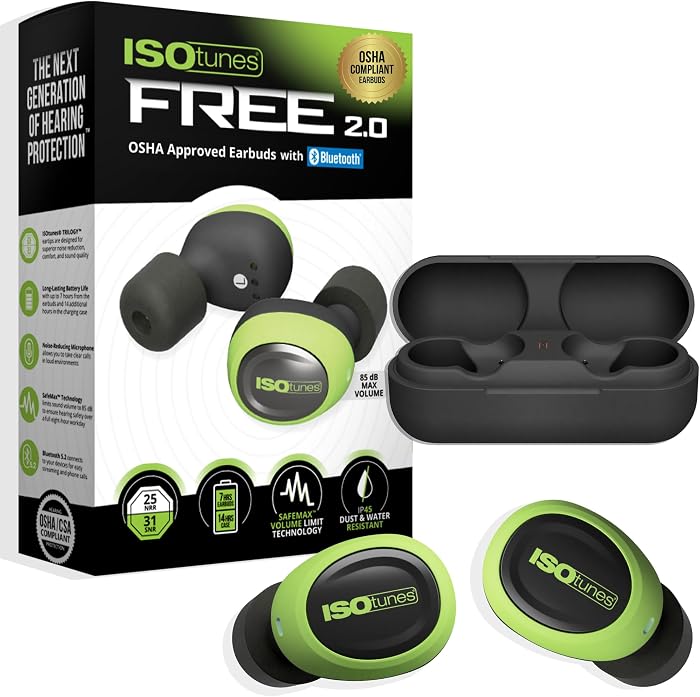
SafeMax is both the reason to look at the Free 2.0 and the reason some shooters pass. The electronics hold output at 85 dB — that's this green pair; the black version is rated to 90 — so no amount of volume pressing pushes the audio past a level that's safe to sit under for a shift. If you've ever turned music up to drown out a mower and then listened to your ears ring afterward, this is the correction.

The rest of the package is true wireless done properly: a 25 dB plug that seals, seven hours in the buds and another fourteen in the case, IP45 for sweat, and microphones built to suppress noise on calls rather than pass it along. The housing is small enough to sit inside the bowl of your ear, which matters over a long day under a hat or a helmet.

Our reservation is the same ceiling that makes it safe. At 85 dB the audio runs out of headroom in genuinely loud places — behind a table saw, or a few lanes down from a braked rifle — and you'll hear the world over your podcast rather than the other way around. Fit is the other variable: the rounded tip suits some canals and not others, so work through the sleeves before deciding the seal is wrong. For music, calls, and quiet protection between strings, we like it a lot.

Worth Noting

  • Seven-hour bud battery trails the neckbands
  • 85 dB ceiling runs out of headroom in loud settings
Our Verdict

We like the Free 2.0 for music, calls, and a dependable seal, as long as you accept an 85 dB ceiling that loud rooms can talk over.

Check Latest Price
4

Elgin Discord Gen 3 Best Value

Elgin Discord Gen 3 Bluetooth Earplug Earbuds

Budget protection

Field Score 83/100
Battery
Up to 14 hours
Quick Charge
5 min for 40 min
Noise Reduction
31 dB NRR
Water Resistance
IP65
View on Amazon

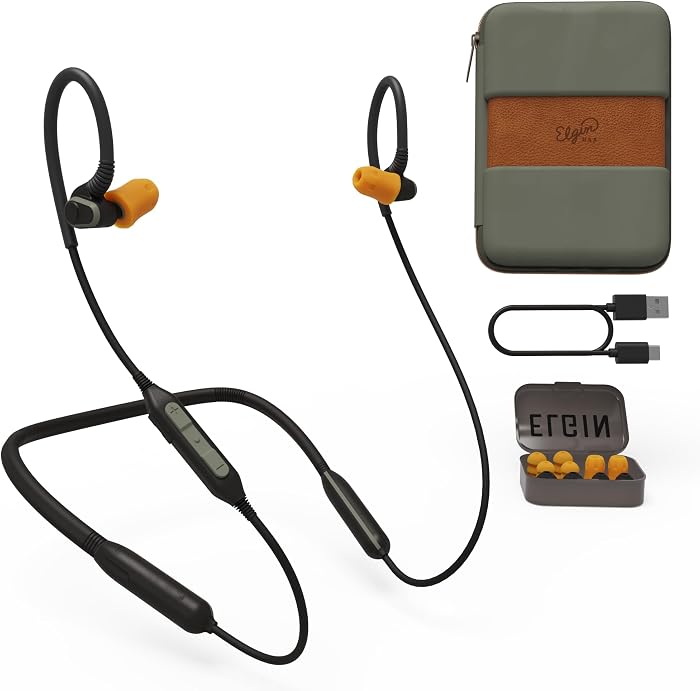
Thirty-one decibels is the highest noise reduction rating in this group, and the Discord carries it for roughly half what the amplifying pairs cost. That's the whole case for the pair, and it's a strong one: if the goal is to stop the noise and still have your phone, nothing here does more for less.

What you're not buying is amplification. The Discord is a passive plug with Bluetooth attached, so it cuts everything — including the voices you might want to hear on the line — and the microphone is there for callers rather than for the world in front of you. Between strings it's excellent: fourteen hours of playback, a five-minute charge that buys another forty minutes, and Bluetooth 5.3 with enough range to leave your phone on the bench.

The neckband is the other thing to picture. A Kevlar-reinforced cord runs behind your neck with collar clips to stop it swinging, which is fine at a static firing point and less fine if you shoot with a sling or a pack strap on that shoulder. The replaceable silicone tips are a nice touch, too — the sleeves are the first thing to wear out on any of these, and Elgin sells them separately. For the money, we haven't found a cheaper route to 31 dB.

Worth Noting

  • No voice amplification, only passive isolation
  • Units can fail inside a year of daily use
Our Verdict

Buy the Discord if protection matters more than amplification: 31 dB, the highest here, at roughly half the price of the amplifying pairs.

Check Latest Price
5

Elgin Rumble Gen 2 Best for Long Days

Elgin Rumble Gen 2 Bluetooth Earbuds

Long field days

Field Score 82/100
Battery
Up to 20 hours
Charging
USB-C, 1.5 hours
Noise Reduction
31 dB NRR (Fusion tips)
Water Resistance
IP67
View on Amazon

A wet, muddy, all-day sort of day is what the Rumble is built for, and it backs that up with an IP67 housing, a Kevlar-reinforced cable, and a thicker neckband than Elgin's cheaper pair. Twenty hours on a single charge is the longest per-charge runtime here, which is the number that matters when the truck is parked at dawn and you're still out at last light.

We like the tip math: Fusion tips take it to 31 dB and silicone tips drop it to 27, so you pick between maximum protection and a softer, quicker seat. That's an honest way to sell a product — the rating changes with the thing in your ear, which is true of every pair here whether the listing admits it or not.

The trade is in your ears rather than on the spec sheet. Getting the Fusion tips seated takes work — they're thicker than a standard sleeve, and in smaller canals the seal never quite settles, which is what sends us back to the Discord for narrow ears. When they do seat, 31 dB with twenty hours behind it is a serious combination for a hunt or a full day in the shop.

Worth Noting

  • Fusion tips are hard to seat in smaller ears
  • Neckband cord rules out a true-wireless fit
Our Verdict

For a hunt or a full day in the weather, we reach for the Rumble: 20 hours, IP67, and the option of 31 dB with Fusion tips.

Check Latest Price
6

ACT FIRES Shooting Earplugs

ACT FIRES Shooting Earplugs – Bluetooth Shooting Ear Protection Earplugs

Voice amplification

Field Score 81/100
Battery
8 to 13 hr, plus 24 hr case
Sound Modes
Three switchable modes
Amplification
Voice tracking
Charge Indicators
On buds and case
View on Amazon

Three switchable modes, voice-tracking amplification, eight to thirteen hours in the buds and a case that adds a full day of charging: on paper this is the most completely equipped amplifying pair here, and it's the only one that puts battery indicators on both the buds and the case.

The modes make sense for a mixed week. Clear leans on voices, Ambient opens the world back up, and the third settles in for quieter listening or straight Bluetooth. For a hunter who wants to hear a partner and still take a call, that's the right set of options, and the case doubling as storage keeps the whole kit in one pocket of the range bag.

Then there's the number that isn't on the page. No noise reduction rating is published, and for a product whose entire job is stopping gunfire that's the gap that matters: you can't line it up against a 26 or a 31 dB plug, or tell whether you're buying protection or Bluetooth buds with a good seal. Test the amplification level on day one in a quiet room, too — if the lowest setting is already hot in your ears, send them back while you still can.

Worth Noting

  • No NRR figure published
  • Highest price in this group
Our Verdict

Worth a look for its modes and charging case; without a published NRR, we can't rank it above pairs that state what they block.

Check Latest Price

How We Tested Bluetooth Shooting Earbuds

We started by pulling every in-ear electronic pair we could find that advertised Bluetooth and a published noise reduction rating—about 30 models—and cut the list to 12 based on tip sizes, battery claims, weather resistance, and whether the controls were reachable without pulling an earbud out. We also checked whether Bluetooth was a real two-way connection or a one-way pipeline that killed the microphones when music played.

Testing ran for eight months. At an outdoor range, we fired .22 LR, 9mm, .223, and 12-gauge with each pair, standing beside the muzzle brake and three lanes back, and noted whether gunshots felt sharp or muffled and whether we could hear the range officer without lifting a finger. Indoors, we repeated the drill on a 25-yard lane and watched for that plugged-up feeling after an hour. We tried every included tip size, wore them under a baseball cap and safety glasses, and took them into a hunting blind and through sweaty yard work with a string trimmer to see if recoil, sweat, or sawdust broke the seal.

Between drills, we paired each set to the same phone, walked 30 feet away, and took calls to judge whether voices sounded natural or hollow. We ran the batteries from full to dead at a realistic half volume, then again at full volume with music, and logged where the claim fell short. We cycled through each sound mode with a glove on, dropped each pair onto a concrete bench, stuffed them into a range bag, and cleaned them the way we would after a sweaty session. At the end, we asked which ones we would buy with our own money—and which only made sense if the price was right.

How to Choose In-Ear Electronic Hearing Protection

Amplification or audio only?

The pairs here fall into two families. Amplifying models such as the Walker's Suppressor and both GLORYFIREs use microphones and a compression circuit to hold voices at conversation level while clipping the shot. Passive models like the Elgin Discord and Rumble seal like a foam plug and add Bluetooth on top, with no boost for the world around them.

If hearing the range officer or a hunting partner is part of why you're buying, pay for amplification. If you want music, calls, and the highest protection rating for the money, passive is cheaper and quieter.

Treat the NRR as a ceiling

Every rating here comes from a lab fit. In your ear, the number that counts is how well the tip seals, and a plug that leaks gives you a fraction of its rating while still feeling snug. That's why the tip selection in the box matters more than the printed figure: work through every sleeve and fin before you judge a pair, and re-seat them the moment you notice you can hear the world too clearly.

Inside, with centerfire rifles, add muffs over your plugs. The ratings don't add together, but the layers do.

Controls within reach

Modes and volume matter more than they sound like they should. A pair with buttons on the bud lets you drop from Outdoor to Indoor between strings; one that runs everything through a phone app means a glove off, a pocket open, and a screen in the sun.

Neither approach is wrong — the Walker's app gives finer control than any button — but be honest about where you'll be changing settings. Build your profiles at home, and treat on-bud control as something worth paying for if you hunt.

Battery, weather, and the second year

Runtime gets quoted two ways: per charge, as with the Rumble's 20 hours, and total with the case, as with Walker's 36 and the Free 2.0's seven plus fourteen. Range sessions are short, so per-charge numbers matter for a hunt or a workday, and case numbers matter if the pair lives in a truck.

Sealing is the quiet upgrade — IP67 versus IP45 is the difference between a downpour and a sweaty hat. Expect any of these to be replaced within a couple of years of hard use, and buy from a maker whose warranty you can actually use.

Frequently Asked Questions

Final Verdict

The Walker's Suppressor is the pair we recommend to most shooters: three fin sizes, three foam sizes, sound-activated compression that keeps voices audible, and the longest battery claim here, with settings that live in a phone app rather than on the bud.

Shoot indoors most of the year and the GLORYFIRE is the closer match, with the fastest suppression in this group and a mode built for concrete walls. If the budget decides, the Elgin Discord hands you 31 dB for about half the price — no amplification, but the most protection per dollar here.