The 5 Best Insulated Work Boots of 2026

There's a specific misery to standing in slush at seven in the morning, feeling the cold crawl up past your ankles before the coffee has even landed. A good insulated work boot fixes that, then keeps you steady through another ten hours of wet concrete, frozen ground, and a truck cab that never quite warms up.

The tricky part is that warmth and bulk trade off. Pairs that feel like a sleeping bag at 20 degrees turn into cinder blocks by noon, and a boot that fits on day one can start rubbing once it breaks in. Over eight months, my team worked in 10 pairs on job sites, on warehouse concrete, and through weekend chores, tracking fit, warmth, water resistance, and how each one held up.

One thing I've learned: the safety toe matters less than the fit around it. A clunky cap in a sloppy boot pinches all day, while a well-shaped one disappears. I also want a pair that doesn't look ridiculous at the hardware store on Saturday. The picks below passed both tests.

Our Top Picks

The 5 Best Insulated Work Boots of 2026

1

Muck Arctic Pro Best Overall

MUCK Men's Arctic Pro Insulated Boot

Wet, muddy chores

Field Score 95/100
Model
Arctic Pro-U
Insulation
Insulated
Listed Weight
6.5 lb
View on Amazon

The morning that decides whether an insulated work boot was worth the money is rarely the coldest one. It's the wet morning hovering just above freezing, when the yard is half slush and the puddle at the gate is over your ankle — and that's the morning the Arctic Pro earns its place at the top of this guide. It's a pull-on, so there's nothing to lace with numb fingers, and the water simply doesn't get in. Of everything here, this is the boot we reach for when the work is wet rather than heavy.

Warmth is the other half of it, and this is the warmest boot in this group. The difference shows up when you stop moving: standing at a gate or a tailgate in cold that has you shifting foot to foot, our feet stayed warm in an ordinary wool sock rather than a heavy expedition one. It's a lot of insulation, and it does its best work outdoors, where a wet cold is trying to get at you.

Sizing is the one thing to get right. The same boot gets called oversized by one pair of feet and snug by the next, wide widths are hard to find, and the opening at the top is snug over a heavy calf — so treat the size chart as a starting point and order where a return is easy. There's no protective toe cap here, which puts this squarely in farm, ranch, and chore territory; if your employer requires one, the Arctic Sport and the Boondock below are the boots. What you pay is the lowest of anything in this guide, which is the part that makes the whole thing easy to recommend.

Worth Noting

  • Narrow opening at the top of the shaft
Our Verdict

The boot we pull on for cold, wet chores: warmest here, genuinely waterproof, and off in one pull at the mudroom door.

Check Latest Price
2

Timberland PRO Direct Attach Soft Toe Best for All-Day Concrete

Timberland PRO Men's Direct Attach Soft Toe Insulated Waterproof Boots

All-day shop work

Field Score 93/100
Toe
Soft toe
Insulation
Insulated
Waterproof
Yes
Listed Weight
4.45 lb
View on Amazon

Where the Arctic Pro is a boot for weather, this one is a boot for hours. It's a 6-inch insulated leather lace-up, and it's the most comfortable thing in this guide from the first wear — no break-in, no hot spots, just a boot that feels settled the day it comes out of the box. If your cold-weather work happens on concrete — a shop floor, a dock, a truck yard — that matters more than a thicker rubber shell.

We like it best as the everyday winter work boot. The insulation is enough for a cold shop and a cold walk across the yard, and the waterproof leather sheds rain and slush all day without the stiffness of a rubber boot. What it won't do is stand in the cold the way the Arctic Pro does; this is a boot for moving, and if your day is more standing than walking, the extra insulation elsewhere in this guide is worth having.

The outsole is the part to watch. On leather work boots, the bond between the sole and the upper usually goes before the leather does, and once it lets go the boot is no longer waterproof. Check that joint at the flex point, just behind the ball of your foot, when they arrive and again at midwinter. They're also the best-looking boots here by a distance — a stitched leather work boot that reads as a work boot rather than a costume.

Worth Noting

  • Soft toe rules out sites that require protection
Our Verdict

Our pick for cold days spent on concrete: comfortable from the first wear, waterproof, and light enough to forget you're in a work boot.

Check Latest Price
3

Muck Arctic Sport Steel Toe Best Waterproof Steel Toe

MUCK Arctic Sport Steel Toe Waterproof Insulated Work Boot

Wet winter jobsites

Field Score 92/100
Toe
Steel safety toe
Insulation
Insulated
Waterproof
Yes
Listed Weight
4.5 lb
View on Amazon

A steel toe and a fully waterproof shell is a combination most makers make you choose between. The Arctic Sport Steel Toe gives you both — the toe cap a site requires, wrapped in the same kind of pull-on rubber that makes the Arctic Pro so easy to live with in slush. If you've been buying soft-toe chore boots and hoping nobody checks, this is the boot that ends that conversation.

What we like is the calibration. It runs warm rather than furnace-hot, which is the right behavior for a boot that goes in and out of heated buildings, and the toe cap doesn't turn the front of the boot into something you're aware of all day. For a wet winter shift, warm without sweat is the whole game, and this one gets it.

The shaft runs high — good in deep snow, noticeable if you're on the shorter side, where it can land right at the top of the calf. Mud comes off with a hose rather than a brush, which after a week of it is its own kind of luxury, and the rubber base means you're never babying the finish the way you would with leather.

Worth Noting

  • Outsole wears through before the upper does
Our Verdict

Buy this one when the job demands a rated toe and the ground is wet: a steel cap inside a waterproof shell that stays comfortable through a shift.

Check Latest Price
4

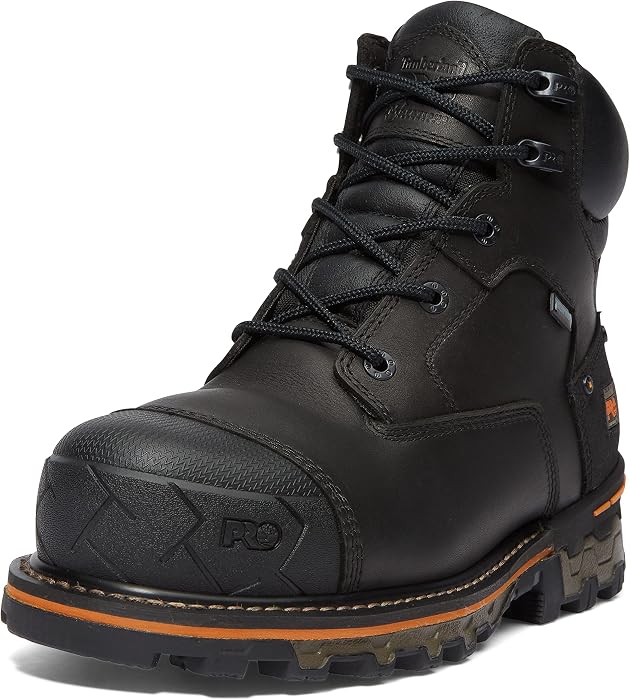
Timberland PRO Boondock Composite Toe Best Composite Toe for Cold

Timberland PRO Men's Boondock 6 Inch Composite Safety Toe Waterproof Industrial

Cold construction work

Field Score 91/100
Toe
Composite safety toe
Height
6 inch
Waterproof
Yes
Listed Weight
4.5 lb
View on Amazon

A composite toe is the quiet advantage in cold weather. Steel pulls heat out of your toes; composite doesn't, so the Boondock gives you the protection a site requires without turning the front of the boot into a heat sink. That's the detail that decides this one for us — the difference between a safety toe you forget about in February and one you spend the winter resenting.

It's a heavy-duty boot and it doesn't pretend otherwise: leather, a stiff sole, and enough structure that a ladder rung doesn't fold it under your arch. Warmth is solid rather than remarkable — enough for a winter site, not the boot for standing still in deep cold. Where it wins is the combination of a waterproof upper, a rated toe, and a sole that takes construction-grade ground without complaint.

Two things to know. The factory insole is the first thing to give out; it flattens well before the leather shows wear, and an inexpensive aftermarket insole fixes it for the rest of the boot's life. The rest of the build is the best in this guide — the stitching, the leather, and the sole are the parts that hold up while the insole under them does not.

Worth Noting

  • Heavy over a long shift on hard floors
Our Verdict

The site boot we hand people who work outside all winter: a rated composite toe that doesn't turn cold, on a build meant for abuse.

Check Latest Price
5

Carhartt Yukon Pac 10-Inch

Carhartt Men's Yukon Pac 10-Inch Work Boots

Deep, dry cold

Field Score 90/100
Style
Pac boot
Height
10 inch
Listed Weight
4.5 lb
View on Amazon

Some cold-weather work is mostly standing in it: a tractor seat at dawn, a gate that won't latch with gloves on, a feeding round that turns into twenty minutes of waiting. The Yukon Pac is built for that — a 10-inch boot with heavy insulation that keeps feet warm and dry when you're not moving enough to make your own heat.

The trade is at the door. Lacing a 10-inch boot with cold hands takes longer than pulling on a rubber one, and taking them off at the end of the day is the same job in reverse. Set them by the door with the top laces loosened and it stops being a fight.

What you get for the trouble is a boot built for the deep end of winter: the most cold-weather-specific of the boots here, with a shaft tall enough that stepping off a packed path doesn't put snow in your sock. If your winters are long and your work is slow, this is the right boot; if you're in and out of a truck all day, the Arctic Pro spares you the lacing.

Worth Noting

  • Stiff upper needs a long break-in
Our Verdict

For winters that are long and work that is slow, this is the warmest, driest boot here — as long as you'll put up with lacing it.

Check Latest Price

How We Chose and Tested Insulated Work Boots

To build the shortlist, I read through hundreds of reviews and spec sheets looking for boots actually built for cold and wet: insulated linings, sealed waterproof construction, and a safety toe or a reinforced soft toe depending on the job. I filtered out anything known to run a full size off or crack at the flex point within a season, then bought 10 pairs and handed them to testers who work outside year-round.

Testing ran eight months, from late fall through a winter of slush and frozen ruts. The boots went to job sites, into a warehouse where the concrete stays cold regardless of the weather, and out on weekend chores involving mud and a hose. Every tester wore the same midweight sock so warmth comparisons meant something, and we checked each pair against a Brannock measurement before forming an opinion on fit.

For warmth, we logged how long toes stayed comfortable standing still in freezing weather, then repeated the same test after twenty minutes of activity. Water resistance got a five-minute run under a hose at the seam line, followed by a sock check, then weeks of real slush. We weighed every pair on a kitchen scale and asked testers how they felt at hour eight. Pull-on versus lace-up came down to a stopwatch: how long each boot took to get on at six in the morning with cold, gloved fingers. Fit was judged at the end of a shift, not at try-on. We checked toe caps, welt stitching, and tread at the one-, three-, and six-month marks, and noted which pairs cleaned up and which looked wrecked.

How to Choose Insulated Work Boots

Start With the Shell: Rubber, Leather, or Pac

Three constructions cover nearly everything here. A rubber pull-on handles standing water and mud better than anything else and comes off with one hand. An insulated leather lace-up breathes better, supports the ankle, and suits a day that's more concrete than creek. A tall pac boot is built for deep, dry cold and long stretches of standing around.

Pick the one that matches the worst conditions you actually work in, not the average. Our top pick is the rubber option for exactly that reason: for most winter work, wet is the variable that ruins the day.

Warmth Only Works If the Water Stays Out

Water is the fastest way to lose heat. A soaked lining stops insulating no matter how thick it is, which is why waterproofing deserves as much attention as the fill. Rubber shells have no seams to leak through; leather depends on the treatment and the seam seals, so it needs re-treating through the season.

On any boot, the bond where the sole meets the upper is the failure that ends waterproofing first. Check that joint when the boots arrive and again at midwinter, and don't ignore a small separation — it becomes a wet sock at the worst possible moment.

Toe Protection Is a Separate Decision

Insulation says nothing about whether a boot is allowed on your site. Steel and composite safety toes are rated; a reinforced rubber toe bumper is abrasion protection and not a substitute. Between the two rated options, composite doesn't conduct cold into your toes the way steel can, which is why we lean toward it for winter work.

Two of the boots here are soft-toe, which is fine for farm, ranch, and shop work and not fine where a toe cap is required. Settle that question before you compare warmth or price.

Shaft Height, Calf Fit, and the Socks You'll Size For

Height is a trade. Ten inches keeps snow out of your sock when you step off a packed path; six inches keeps your pants and your shin free. The dimension that catches people is the opening at the top — a narrow shaft is fine over a thin sock and miserable over a thick one.

Try boots on with the sock you'll actually wear, and size for that sock rather than your street shoe. Wide widths are rare in this category, so if you're between widths, order where a return is easy.

Weight and Getting Them Off at the End of the Day

Insulated boots here are listed from about four and a half pounds to six and a half, and the difference shows up in the last hour of a shift, when you lift each foot a few thousand times. Weight buys structure and warmth, so it isn't a defect — but a heavy boot and a laced shaft together mean a slow exit at the door.

If you're in and out of the house all morning, a pull-on wins on that alone. If you're in them for ten hours, the extra support is worth the extra pound.

Frequently Asked Questions

Final Verdict

The Muck Arctic Pro is the boot we recommend first, because most cold-weather work is wet work and it handles the two together better than anything else here: warm, genuinely waterproof, and off in one pull. Get the sizing right and skip it if you need a rated toe.

If your site requires one, the Arctic Sport Steel Toe adds protection to the same waterproof shell. If you're on concrete rather than in mud, the Direct Attach 6-Inch is the more comfortable boot by a wide margin.