The 9 Best Landscape Lighting Transformers of 2026

The first cool evening on the patio should be the payoff for a weekend spent trenching cable and setting fixtures — not the night the lights click on at 9:40 instead of dusk. Almost every time, the box bolted to the side of the house is the reason. The transformer is the least glamorous purchase in the project and the one that decides whether the system you built behaves.

I've wired more fixtures than I can count, and the pattern repeats: people spend freely on fixtures and go cheap on the power supply. Wattage gets the attention, but what matters is whether the taps let you push a little more voltage down a long run, whether the photocell and timer agree with each other, and whether the enclosure survives a summer of sprinklers. Size sneaks up on people, too.

We've had 12 transformers in real yards for eight months, from plain 60-watt units to app-connected models. The picks below are the ones that held their schedules, fit where they had to, and never sent me back up the ladder.

Our Top Picks

The 9 Best Landscape Lighting Transformers of 2026

1

VOLT Slim Line 300W Best Overall

VOLT 300W Slim Line Low Voltage Transformer (12V/15V) with Timer/Photocell

Whole-yard systems

Field Score 93/100
Wattage
300W
Controls
Timer and photocell included
Enclosure
Stainless steel
Output Taps
12V and 15V
View on Amazon

The Slim Line arrives as a finished unit: the timer and photocell are already inside the housing, visible through a window in the front, so the only thing you supply is wire. The clamp-type terminal blocks are the part we keep telling people about — wire goes in and clamps down in seconds, where ordinary terminal screws can eat ten minutes of a Saturday. It's a serious box at 13 pounds and 15 inches tall, and the stainless enclosure looks intentional on a patio wall rather than something to hide.

Three hundred watts across 12V and 15V taps covers a whole yard of LED fixtures with room to add more, and the toroidal core runs cooler and quieter than a conventional laminated core. It's also backed by a lifetime warranty that covers the core and the stainless housing — the strongest answer here to the thing that actually kills transformers, which is dying in year three. That combination is why it's our top pick: complete out of the box, quick to wire, and built like it intends to stay.

Give it wall space and a little planning. Fifteen inches of height and 13 pounds of transformer won't tuck behind a shrub the way a molded one-pound box will, and the housing needs to sit above grade so runoff doesn't pour through the wire ports. Two screws, an outdoor outlet within reach of the cord, and the hard part is aiming the spotlights.

What you give up is money and taps: this is the priciest transformer in the group, and it offers two output voltages where the Lightkiwi offers four. On a property with a couple of very long runs, that fourth tap is genuinely useful for the last two dim fixtures at the end. Everywhere else, the warranty and the finished housing are worth the difference.

Worth Noting

  • Premium price in this group
  • Two taps where the Lightkiwi has four
Our Verdict

Our top pick: the timer and photocell come installed, the clamp terminals make wiring quick, and a lifetime warranty covers the part that usually fails first.

Check Latest Price
2

Lightkiwi W9715 300W Best for Long Wire Runs

Lightkiwi W9715 300W – 300W Landscape Lighting Transformer

Long wire runs

Field Score 92/100
Wattage
300W
Protection
Thermal and magnetic breakers
Output Taps
12V, 13V, 14V, 15V
Certification
ETL
View on Amazon

Considerably less than our top pick buys the same 300 watts and two more voltage taps. The W9715 outputs 12V, 13V, 14V, and 15V, and those in-between steps are the point: on a long run, the 13V or 14V tap brings the last fixtures back up to brightness without new wire. What it doesn't have is a timer or photocell, so you'll add a smart plug or an outboard timer — we think that's a fair swap for a transformer built this heavily.

Seventeen and a half pounds of it, in fact, with an auto-reset thermal breaker on the primary side and a 25A magnetic breaker on the secondary. That's more protection than most of this group carries, and together with the toroidal core it explains why the unit stays cool and quiet under load. The spring-latch cover and the multiple through-holes for landscape wire are the small things that matter by the third or fourth circuit you add.

For a big yard with several runs and a smart plug already in the plan, this is the better buy; 300 watts will carry a couple of dozen low-voltage fixtures with room to grow. If you want dusk-to-dawn without adding anything, that's the boundary — the VOLT or the Kichler lets the box do its own scheduling.

Worth Noting

  • No timer or photocell in the box
Our Verdict

We recommend it for long, multi-fixture runs: four voltage taps, dual breakers, and 300 watts, provided you add your own timer or smart plug.

Check Latest Price
3

Wohenhao 120W Transformer Best Budget Pick

Wohenhao 120W Transformer – 120W Toroidal Core Low Voltage Landscape Lighting Transformer with Built

Budget yards

Field Score 91/100
Core
Toroidal
Wattage
120W
Controls
Timer, dusk-to-dawn, sun tracking
Dimensions
3.15 x 4.85 x 6.6 in
View on Amazon

The cheapest way into a genuinely smart schedule, this 120-watt unit costs less than several of the plain dusk-to-dawn boxes here and adds Sunwise, which uses your location and the sun's position to shift the on and off times as the days shorten. Anyone who has reset a mechanical timer four times a year will feel the difference immediately.

Five modes cover the basics too: always on, always off, a countdown, plain dusk-to-dawn, and the solar schedule. The toroidal core runs cool and silent, the display shows a load icon and blinks when you overload it, and the housing measures about 3 by 5 by 6.6 inches, so it hangs discreetly beside an outlet. Expect a few minutes with the manual before the astro settings make sense.

For a yard of 12 to 15 LED fixtures on a budget, this is the transformer we point people to, and the one-year warranty is shorter than we like but honest about where it sits in the market. There isn't a deep long-term record on it yet, and what exists includes a unit that didn't survive a winter, so mount it under an eave where water runs off rather than through.

Worth Noting

  • Caps out at 120 watts
  • Astro timer setup takes patience
Our Verdict

We send budget buyers here: a sun-tracking timer and toroidal core for less than the premium boxes, with a 120-watt ceiling to plan around.

Check Latest Price
4

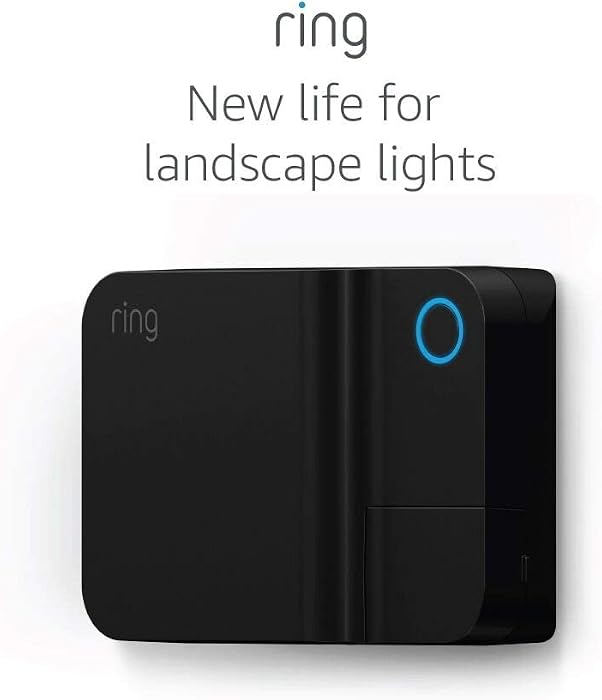
Ring Transformer Best Smart Transformer

Ring Transformer

App control

Field Score 90/100
Control
Ring app via Amazon Sidewalk
Housing
Weather-resistant
Capacity
Up to 200W total
View on Amazon

If the rest of the house already answers to Alexa or the Ring app, this is the transformer that stops being a mystery box on the side wall. It handles up to 200 watts of low-voltage landscape lights, including non-Ring fixtures, and once it's on the network you get schedules, on/off control, and grouping with the rest of your outdoor lighting from the phone.

The catch is the radio. It talks to the app over Amazon Sidewalk, so an Echo or Ring bridge has to be in range, and if it isn't you're left with a plain transformer and an app that can't find it. Everything else lives in software — that's the appeal and the risk at the same time, and it's why the scheduling side gets mixed results in a way the hardware doesn't.

In practice that makes it right for a specific household: one with Ring lights and a bridge already in place, where checking the yard lights from the couch or from a hotel room is worth more than a dial on the box. If you'd rather set a physical control once and forget it, the Kichler or the VOLT will ask less of you over ten years.

Worth Noting

  • Needs Amazon Sidewalk bridge coverage
  • Automation lives entirely in the app
Our Verdict

Our smart pick: app control over up to 200 watts for Ring and Alexa households, provided an Echo or Ring bridge is within range.

Check Latest Price
5

DEWENWILS 60W DC Transformer Best for Small Systems

DEWENWILS 60W Outdoor Low Voltage Transformer

Small LED systems

Field Score 89/100
Output
12V DC
Wattage
60W
Controls
Photocell plus 2/4/6/8-hour countdown
Certification
ETL
View on Amazon

The detail that decides this transformer sits in the fine print: it outputs 12V DC, not AC. That isn't a flaw — DC is what a modern LED path light expects, and it's part of why the case is about the size of a large coffee mug. But DEWENWILS lists this model for LED fixtures, and its AC-output sibling is the one that also lists halogen, so check your fixtures before you buy rather than after.

What you get for very little money is a dusk-to-dawn photocell, a 2/4/6/8-hour countdown that remembers its setting after an outage, a 3.3-foot cord, and a hanging hole that lets one person mount it in a couple of minutes. At 1.3 pounds it goes onto siding or a post without a bracket, and the ETL listing means it's been tested to a published standard rather than only to the seller's optimism.

Two things to plan around. The 60-watt rating is a ceiling rather than a target — it's happiest running four to six LED fixtures, and it's worth leaving real margin instead of loading it to the number. And of everything here, this is the unit with the widest spread of long-term outcomes, so mount it where you can reach it without a ladder and keep the receipt.

For a front walk of four path lights and a couple of spots, none of that matters much. It's the least expensive way here to get automatic dusk-to-dawn lighting, it goes up with two screws and a plug, and at this size it disappears against the siding instead of asking to be hidden.

Worth Noting

  • 12V DC output for LED fixtures only
  • 60W ceiling is easy to crowd
Our Verdict

Our small-system pick: the least expensive route to dusk-to-dawn here, sized for four to six LED fixtures, with DC output that suits LED loads only.

Check Latest Price
6

Kichler 12217 200W Best with Surge Protection

Kichler 12217-200 Watt 12V/15V Multi-Tap Low Voltage Outdoor Landscape

Midrange systems

Field Score 88/100
Weight
8.3 lb
Wattage
200W
Controls
Digital timer with surge protection
Output Taps
12V and 15V
View on Amazon

The line most people skim past on the Kichler spec sheet is the one that matters after the first thunderstorm: a built-in surge protector. Add a digital timer you set once, 12V and 15V taps, and an ETL listing, and you have a 200-watt box that behaves like a more expensive one. We think it's the right midrange buy for a yard with ten to fifteen fixtures.

It's a heavyweight unit at 8.3 pounds, and the display goes dark shortly after you stop pressing buttons, which means no glowing green numbers on the side of the house at midnight. Wiring is straightforward and the timer logic is simple enough that the manual goes back in the drawer after the first season.

Two hundred watts is the ceiling, which is fine for a dozen or so LED fixtures and tight if you're already planning an expansion. And there's no photocell — the schedule runs off the clock, so you'll nudge it a few times a year as sunset moves. For a homeowner who wants a known brand, surge protection, and a display to program once, those are reasonable compromises.

Worth Noting

  • No photocell, so scheduling is clock-based
  • 200W ceiling limits expansion
Our Verdict

Our midrange pick: 200 watts, 12V and 15V taps, a digital timer, and surge protection built in, without the premium price of our top pick.

Check Latest Price
7

Best Pro Lighting 150W Best for Malibu Replacements

Best Pro Lighting 150W – 150W Watt AC to 12V Volt LED & Halogen

Malibu replacements

Field Score 87/100
Wattage
150W
Controls
Dusk-to-dawn photocell
Warranty
Lifetime
Certification
UL
View on Amazon

When an old Malibu power pack finally quits, most people want the same footprint on the wall and the same two wires back in the terminals. This Best Pro box is built for exactly that: it's a direct replacement for Malibu units, UL listed, with a dusk-to-dawn sensor and a lifetime warranty behind it.

Seven pounds of transformer in a four-inch cube, finished in black, with the simple control set that suits a replacement: a photocell that switches on at dusk, plus 4-, 6-, and 8-hour shutoff settings so the lights don't burn until sunrise. There's nothing to program and nothing to connect to a network, which is either the appeal or the limitation depending on the buyer.

The timer side is the weak spot. The photocell is supposed to trip the countdown at dusk, and when it doesn't, the fix is a reset procedure rather than a new unit — worth keeping the instructions in the same drawer as the transformer so you aren't guessing in the dark.

Longevity is mixed in a way that's worth knowing: the design has been on walls for decades, and the housing is the part to watch, since a case that splits lets water in and the lights then stay on permanently. Mounting it under an eave costs nothing and buys years.

For a dead Malibu box on a garage wall, this is the least fussy replacement in the group, and 150 watts carries a dozen LED fixtures. If you're building a system from scratch rather than matching an existing footprint, the Kichler or the VOLT is the better place to start.

Worth Noting

  • Timer can need a reset to engage
  • Case seam can split and let water in
Our Verdict

Our replacement pick: a UL-listed 150-watt box that drops onto an old Malibu mount, with a lifetime warranty and a timer that occasionally needs a reset.

Check Latest Price
8

WILAWELS 300W Transformer Best for Large Loads

WILAWELS 300W Transformer – 300W Low Voltage Landscape Transformer

Large loads

Field Score 86/100
Wattage
300W
Controls
Detachable photocell plus six modes
Output Taps
12V and 14V
Certification
ETL
View on Amazon

Three hundred watts with 12V and 14V outputs puts this in the same working territory as our top pick. Two output voltages at that capacity is a genuinely useful combination on a property with one long run and one short one, since the 14V tap can carry the far fixtures without overdriving the near ones.

The control set is the fullest here: six modes covering manual on/off, dusk-to-dawn, a 2/4/6/8-hour countdown, and clock-based on/off, plus a detachable photocell you can aim independently of the housing. Settings survive a power cut, which matters more than it sounds like it should in a neighborhood with overhead lines.

The case is compact for the wattage at about 3 by 6 by 9 inches, but it's a solid 11 pounds, so plan on a real mounting point rather than a siding clip. Water is the thing to watch: units have both weathered storms and failed inside a month, and mounting under cover is cheap insurance either way.

If you need 300 watts and a sensor you can move, this covers it and then some. It sits in the also-consider tier because the long-term record is thinner than the VOLT's or the Lightkiwi's, not because the design gives anything away.

Worth Noting

  • Water intrusion has caused early failures
Our Verdict

A 300-watt option with six modes and a detachable sensor; we rank it below our top picks because its long-term record is thinner.

Check Latest Price
9

SUNVIE 100W DC Transformer Best for Shaded Yards

SUNVIE 100W Low Voltage Transformer Outdoor

Shaded yards

Field Score 85/100
Output
12V DC
Wattage
100W
Controls
Photocell plus 2/4/6/8/10-hour countdown
Sensor Cord
6.8 ft, replaceable
View on Amazon

A photocell that stares at a porch light or sits in a shrub's shadow will switch your lights on at the wrong time all season. This SUNVIE gets around that with an external sensor on a 6.8-foot cord: the transformer hangs where the outlet is, and the eye goes where the sky is.

The rest is familiar and well done — 100 watts of 12V DC output, a 2/4/6/8/10-hour countdown with memory, a built-in breaker that cuts the circuit on a short or overload, and a weatherproof case that hangs on two screws. The extra 10-hour step on the countdown is a small thing that matters in December, when dusk arrives before dinner.

Two caveats keep it out of the top tiers. The DC output is for LED fixtures rather than halogen, and the durability record is uneven, with units that quit within weeks sitting alongside ones that have run more than a year. For a shaded yard with a modest LED load, though, the remote sensor is the reason to choose it over anything else on this page.

Worth Noting

  • 12V DC output for LED loads
Our Verdict

We point shaded yards here: the photocell rides a 6.8-foot cord, so a wall in shadow doesn't fool it into switching the lights early.

Check Latest Price

What Eight Months in Real Yards Taught Us

We built the shortlist by sorting the category the way a system actually gets limited: total wattage against a typical fixture count, single voltage versus multi-tap outputs, photocell and timer controls, ETL listing, and enclosure material. From that pool we brought in 12 transformers and installed them on posts, walls, and inside garages, then lived with them for eight months.

Installation came first. Working alone, I mounted each unit, ran cable to the same layout of path lights and tree uplights, and noted whether the knockouts, terminal blocks, and voltage taps were labeled clearly enough to wire without the manual. Once powered, I set the photocell and the schedule, then watched over the following weeks to see whether the lights came on at dusk or drifted. I also cut power at the breaker to see which units came back on schedule and which needed a reset.

On the longest run, I measured voltage at the last fixture with a multimeter to see how much each tap recovered. Durability got the hose treatment — ten minutes of spray at the seams — plus a full summer of sprinklers and a stretch of triple-digit heat. The connected model had to survive a router reboot and a week of me ignoring the app. And I noted footprint, since a big enclosure that won't fit behind the shrub is a problem no spec sheet mentions, and weighed what each unit delivered against what it cost.

How to Choose a Landscape Lighting Transformer

Start With the Load

Add up the wattage printed on every fixture you plan to connect — LED path lights usually run 3 to 7 watts, spots 5 to 15 — and keep the total at roughly 80 percent of the transformer's rating. That margin is what lets you add two or three lights next spring without replacing the box. A 60- to 100-watt unit covers a front walk; a full yard with a dozen or more fixtures wants 150 to 300 watts.

Treat the number on the box as a ceiling rather than a promise. A few budget units run out of steam before they reach their stated wattage, which is why we leave more room on a cheap unit than on a premium one.

Match the Output to Your Fixtures

Output type is the spec buyers miss. Transformers that put out 12V DC are sold for LED fixtures; the AC-output models are the ones that also list halogen compatibility, so decide whether you're keeping old bulbs before you order. Voltage taps are the other half of the decision: 12V is nominal, and on a long run the last fixtures dim as voltage drops through the wire. A 13V or 14V tap brings them back, which is why four taps matter on a big property and hardly at all on a short run.

Choose the Control You'll Actually Use

A photocell is the minimum — on at dusk, off at dawn, nothing to program. A countdown timer adds a bedtime: two, four, six, or eight hours after dusk. An astronomical timer tracks your location so the schedule follows the seasons, and we consider it worth paying for if you don't want to touch the box twice a year. App control is only as good as its bridge, so confirm the hub lives within range before you count on schedules.

Weather, Mounting, and Warranty

Molded plastic cases are fine and cheap; stainless and metal housings cost more and shrug off a decade of sun. Whichever you choose, mount it above grade where runoff won't pour through the wire ports, and check cord length against your outlet — some units come with little more than three feet. Then read the warranty, because it's the closest thing to a durability guarantee in this category: VOLT and Best Pro Lighting both back their boxes for life, while the budget brands generally stop at a year.

Frequently Asked Questions

Final Verdict

Start with the VOLT Slim Line if you want the whole job in one box: 300 watts, 12V and 15V taps, the timer and photocell already installed, and a lifetime warranty standing behind the part that usually fails. If your runs are long and you already schedule lights from a smart plug, the Lightkiwi gives you the same wattage with four voltage taps for less money. And if a dozen fixtures and a tight budget describe your yard, the Wohenhao's sun-tracking timer is the best value here.