The 6 Best Lawn Mower Blade Sharpeners of 2026

A dull mower blade doesn't just leave your lawn looking ragged — it tears the grass instead of slicing it, and the frayed tips brown off within a day. I spent most of one summer blaming my soil before a neighbor pointed at the blade. The fix is a sharpener, and the options run from angle-grinder jigs to bench-style grinders with their own motors to palm-sized diamond hones you chuck into a drill.

My team and I have run 12 of them over the past nine months, and the good ones separate themselves fast. Here's what first-time buyers miss: the angle matters more than the motor. Most mower blades want roughly 30 degrees, and a sharpener that can't hold that setting — or repeat it next season — leaves you with an edge that's sharp in one spot and untouched in another. The best of the bunch also let you take off a little metal at a time, because grinding a blade down to nothing is how you ruin a good part. Below are the ones that held their settings, plus a couple I'd hand to a neighbor.

Our Top Picks

The 6 Best Lawn Mower Blade Sharpeners of 2026

1

SporGain Adjustable Sharpener Jig Best Overall

SporGain Adjustable Sharpener Jig – [Updated] Lawn Mower Blade Sharpener 15°-45° Adjustable Frame

Most home mowers

Field Score 90/100
Weight
2.95 lb
Angle Range
15°–45° adjustable
Blade Types
Straight, mulching, high-lift
Blade Width
1.65"–3.60"
View on Amazon

Most people who start shopping for a blade sharpener already own the expensive half of one. An angle grinder plus this jig is a complete sharpening station, and the jig is the part that decides whether the edge comes out even. It clamps to a bench, cradles the blade, and carries the grinder on an arm that holds a set angle while you sweep the disc down the bevel.

The 15- to 45-degree range covers what a mower deck actually asks for: the 30 degrees most blades want, plus the steeper bevels on high-lift and mulching blades. It takes blades from 1.65 to 3.60 inches wide, which covers most of what hangs under a walk-behind or a riding deck. The ball-bearing handle is what makes it usable — you set the angle once, lock the blade down, and the grinder tracks the same bevel from heel to tip instead of drifting as your wrist rolls.

What we appreciate most is how much of the job stops being unpleasant. No vise, no file, no kneeling on the driveway with the deck propped on a brick. Bolt it to a bench and a set of blades is one sitting rather than a weekend, and you stop rationing sharpening to once every third season.

One habit worth forming: sight the first bevel against the factory grind before you commit to a setting. The markings get you close, and a couple of degrees one way or the other shows up later in how the deck cuts. It's a ten-second check on the first blade and nothing after that.

Worth Noting

  • Frame flexes if you lean into the grinder
  • Needs your own grinder and a solid bench
Our Verdict

For most homeowners this is the one: a bench-mounted jig that turns the angle grinder already in the garage into a repeatable, accurate blade edge.

Check Latest Price
2

VEVOR 1HP Blade Sharpener Best Benchtop

VEVOR Lawn Mower Blade Sharpener 1HP with 9" Ceramic Grinding Wheel

High-volume blade sharpening

Field Score 88/100
Motor
1 HP
Angles
30° and 40° brackets
Weight
42.1 lb
Wheel Size
9 inches, ceramic
View on Amazon

Forty-two pounds is the first thing to make peace with. This is a machine that lives in a corner of the shop and comes out when the blades do, in spring and again in fall. What the weight buys is a nine-inch ceramic wheel on a 1 HP motor — enough mass and torque that a thick tractor blade doesn't slow it or set it chattering.

We like the geometry of the thing. The blade sits in a bracket cut for 30 or 40 degrees, and you present the edge to the wheel rather than steering a grinder along the edge. That flips the hardest part of sharpening, which is holding an angle, into the machine's job. Those brackets also cover high-lift, low-lift, gator, and flat blades, more blade variety than the manual jigs here handle without a fight.

The grit collector is the detail we appreciate most, and it's the one nobody advertises loudly. Ceramic dust goes everywhere, and a tray that catches most of it is the difference between sharpening in the shop and sharpening in the driveway. A blade balancer comes in the box too, which matters because a machine that removes more steel from one tip than the other will leave your deck vibrating.

Expect a learning session. The first blade takes noticeably longer than the third, because you're finding the feed and the pressure the wheel wants rather than fighting the setup. Buy it when the blades are thick and the season is long; a single push mower doesn't justify the bench.

Worth Noting

  • Brackets are fixed at 30° and 40°
  • 42.1 pounds to move and store
Our Verdict

Buy it if you sharpen several blades a season and want the angle handled by the machine instead of your hands — this is the most capable sharpener here.

Check Latest Price
3

All American Sharpener 5002 Best Portable

All American Sharpener Model 5002 Lawn Mower Blade Sharpener for Straight

Portable straight-blade sharpening

Field Score 87/100
Weight
4.7 lb
Material
Aluminum
Blade Type
Straight and standard
Power Source
Cordless angle grinder
View on Amazon

Where the SporGain jig wants a bench and a clamp, this one is built to travel. The frame is aluminum, 4.7 pounds, and it takes a standard straight blade against a cordless grinder — carried to the machine instead of the machine carried to it. If your mower sits in a shed six miles from your workbench, that's the difference between sharpening in season and sharpening next spring.

We were struck by how little there is to it: a machined frame, adapter pins that fit most grinders, and a cradle that seats the blade at the 30 degrees most decks want. That simplicity is the whole argument. There's no scale to misread and nothing to drift mid-pass, because the frame does the holding and you only manage the grinder.

The catch is blade shape. This is a straight-and-standard-blade tool; a mulching or high-lift blade with a pronounced sail isn't what the cradle was cut for, and that buyer belongs with the adjustable jig or a bench machine instead. The aluminum is also what you're paying for here — it's the priciest manual jig of the group, and the money buys portability rather than more capability.

Worth Noting

  • Straight and standard blades only
  • Highest-priced manual jig here
Our Verdict

The pick for a mower that lives away from the workbench: an aluminum jig that packs to the trailer and still holds a true 30 degrees.

Check Latest Price
4

SporGain Brushless Blade Sharpener Best Compact Motorized

SporGain Brushless Blade Sharpener – Lawn Mower Blade Sharpener

Compact powered sharpening

Field Score 84/100
Motor
Brushless
Speed
Up to 3000 RPM
Weight
15.4 lb
Wheel Size
7 inches
View on Amazon

The speed dial is the reason to pick this over a fixed-speed machine. Run it up to take down a nick, then back it off for the finishing passes, where a slower wheel takes less steel and leaves a cleaner bevel. It tops out at 3000 RPM, and the brushless motor carries a lifetime warranty — the component most likely to fail is the one the maker stands behind.

At 15.4 pounds it's a machine you can lift onto a shelf when the season ends, which is not true of the 40-pound class. That's the whole pitch: real power and a real grinding wheel without surrendering a corner of the garage to it permanently.

It arrives as a kit, with 30- and 45-degree brackets and both coarse and fine discs, so the first sharpening doesn't need a second order. The brackets are what sell it for us — the blade sits square in the holder and the wheel meets the same bevel on both tips, so you're not counting strokes and hoping the second end matches the first. Bolt it to something solid, though. A light machine on a shaky bench cuts a shaky edge, and that's the honest cost of the smaller build.

Worth Noting

  • 7-inch wheel covers less of a wide blade
  • Has to be bolted to a solid bench
Our Verdict

A powered sharpener that fits on a shelf and still has the torque for a riding deck — the middle ground between a jig and a shop machine.

Check Latest Price
5

UF-SHARP Diamond Drill Sharpener Best Budget

UF-SHARP Diamond Drill Sharpener – Diamond Lawn Mower Blade Sharpener

Quick upkeep passes

Field Score 83/100
Grit
120
Wheel
Diamond, double-sided
Handle
5mm, fits electric drills
Weight
6.7 oz
View on Amazon

Here's the honest case for the smallest tool on the page: most of the time a mower blade isn't damaged, it's just tired. This is a 6.7-ounce diamond wheel on a 5mm shank that chucks into any electric drill, and we think a blade that's merely dull is exactly the job it was made for.

There's almost no commitment involved. No bench, no clamp, no assembly — clamp the blade in a vise, chuck the wheel, and work the bevel in short passes at a shallow angle. It's the tool for a dull blade rather than a damaged one, and it's the one here that packs into a toolbox drawer.

It's also the most broadly useful thing in this group. The same wheel handles rototiller tines and garden shears, and it can be flipped to run on its other face when one side loads up with metal. For a household with one mower and a shed full of edged tools, that versatility counts for more than raw grinding speed.

Worth Noting

  • Angle is set by your wrist, not a jig
  • Slow going on badly nicked blades
Our Verdict

For dull blades and a tight budget, this little diamond disc in a drill is the least expensive way to keep an edge between real sharpenings.

Check Latest Price
6

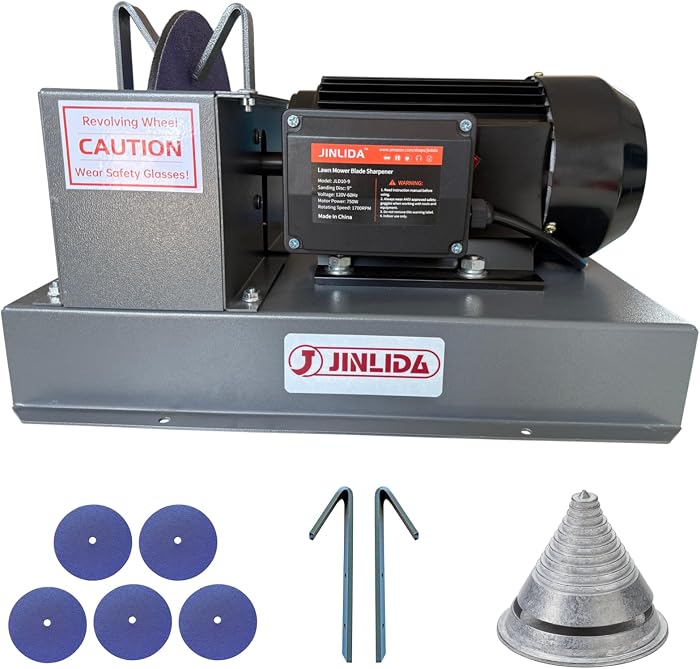
Jinlida JLD20-9 Sharpener Best for Benchtop Kit with Spares

Jinlida JLD20-9 Sharpener – JLD20-9 Lawn Mower Blade Sharpener

Benchtop kit with spares

Field Score 82/100
Motor
1 HP / 750W
Speed
1700 RPM
Weight
36.9 lb
Wheel Size
9 inches, 60 grit ceramic
View on Amazon

Five spare ceramic discs, two blade holders, and a metal balancer come in the crate. For anyone sharpening more than one mower, that's the part that matters, because consumables are the running cost of a bench machine and this one starts you with a stack of them.

The machine itself is a 1 HP, 750W unit turning a nine-inch 60-grit ceramic wheel at 1700 RPM. It's geared slower than the brushless machine here, but the bigger wheel covers more of the bevel in a single pass, and the steel base with its blade bracket keeps the blade from walking while you feed it. The integrated structure is what you notice on the first blade — nothing shifts under load.

What gives us pause is the angle setup. The holders that come with it are cut for 40 degrees, so the common 30-degree bevel runs through the adjustable mounting system, which is more fiddling than swapping a bracket. That's fine for a sharpening session once a year and mildly annoying for anyone doing blades weekly.

Worth Noting

  • 40° holders; 30° runs through the mount
Our Verdict

A complete, sturdy bench machine for the money, provided your blades want a 40-degree holder or you don't mind resetting the mount.

Check Latest Price

How We Tested 12 Lawn Mower Blade Sharpeners

We started with a list of about 30 sharpeners built from spec sheets and retailer listings, then cut it down by asking four questions: which blade types it could hold, whether the angle was adjustable and repeatable, how the blade was secured, and what replacement wheels or discs cost down the road. Anything that accepted only one blade style, or that gripped the blade by its cutting edge, came off. Twelve made the cut, and we ran them for nine months.

Each one got the same job. We pulled blades off our own mowers — high-lift, gator, mulching, and plain flat — set every sharpener up on a garage workbench by its own instructions, and timed setup and sharpening separately, because a jig that takes ten minutes to mount is a different product than one that takes thirty seconds. With a magnetic angle gauge, we checked the setting before the first pass and again after the tenth to see whether the frame or clamp drifted under load. We watched where the sparks and grit went, whether a collector actually caught them, and how much of a mess was left on the bench.

Then the blades went back on the mowers and we mowed. Clippings got spread on white paper so we could look at the tips up close; cleanly sliced grass lies flat, torn grass looks shredded. We hung each finished blade on a nail to see if one side dipped, and ran it on the deck to feel for vibration. Build quality and controllability came down to small things — a handle that wobbled, a clamp that slipped mid-pass, whether we could steer the grinding head with one hand while the other held the blade. Value, in the end, was measured in how many seasons a wheel lasted, not in the sticker.

How to Choose a Lawn Mower Blade Sharpener

Start With the Tool You Already Own

If there's an angle grinder on the shelf, a sharpening jig is the shortest route to a real edge: the jig supplies the angle and the blade cradle, and the grinder supplies the power. No grinder? A drill-mounted diamond disc handles light touch-ups, and a self-powered bench machine skips both tools at once. Match the purchase to the garage, not to the spec sheet — the best sharpener is the one you'll actually set up.

Angle Control Is the Whole Job

A mower blade wants roughly 30 degrees, and the exact number matters less than holding it from heel to tip on both ends of the blade. A jig with a locking arm, or a machine with fixed brackets, gives you that. A disc held in your hand does not.

One trap: printed scales are approximations, and a unit that reads 30 may be cutting 33. Check the first pass against the factory bevel before you grind the whole edge.

Match the Holder to Your Blade

Blade cradles are built around a width range — the common jigs take 1.65 to 3.60 inches — and around a blade profile. Standard straight blades fit almost anything. Mulching and high-lift blades carry a sail that fouls a narrow cradle, which is why the bench machines publish separate 30- and 40-degree brackets for them.

Measure your blade across its widest point before ordering, and if you run gator or high-lift blades, treat bracket options as part of the price.

Decide Where It Will Live

A 4.7-pound aluminum jig goes in a truck box. A 42-pound bench machine wants a permanent corner, a solid surface, and clamps or bolts so it doesn't walk. Weight isn't a flaw in either direction — mass is what stops a grinder chattering — but it decides whether you sharpen in spring or put it off until the grass tells you.

Budget for Consumables and Balance

Wheels, discs, and carbide inserts wear out. A machine that ships with spare discs is cheaper across five seasons than one that doesn't, even when it costs more on the day you buy it. Plan for balance in the same purchase: a blade that loses more steel from one tip than the other will vibrate, so a balancer — in the box with some kits, sold separately for others — belongs alongside the sharpener.

Frequently Asked Questions

Final Verdict

For most households the answer is the SporGain jig. It puts the angle in a fixture instead of your wrist, it fits the blade widths and profiles that come off a typical deck, and it uses the grinder you already own rather than asking you to buy a machine.

If blades come off several mowers a year, the VEVOR's 1 HP motor and nine-inch wheel replace your effort with the machine's weight, and that's worth the footprint. Between them sits the brushless SporGain for anyone with a shelf instead of a shop.