The 7 Best Lawn Mowers of 2026

Every mower is a trade-off, and which one you take matters more than any number on the box. Gas has the muscle and never runs out of power, then bills you in pull starts, oil changes, and a garage that smells like a fuel can. Battery starts with a button and a hum instead of a roar, but you spend the whole cut doing charge math. Corded is cheap and endless, right up until the cord snags the one shrub you forgot about.

My team and I ran 11 mowers through a full seven-month growing season — battery, corded, and gas — on flat lawns, a slope, and a postage-stamp city lot. What separated them wasn't horsepower. It was whether the kit included a second battery, how heavy the thing got with a full bag hanging off the back, and how the deck handled a week of wet, shaggy growth.

Here's what I'd tell a first-time buyer: cutting-height range matters more than deck width. Most lawns want a taller cut in July than in May, and a mower that jumps two inches between settings will scalp you in a dry spell. The picks below earned their spots on grass quality, noise, weight, and value — not on the spec sheet.

Our Top Picks

The 7 Best Lawn Mowers of 2026

1

Greenworks 60V 21" Self-Propelled Best Overall

Greenworks 60V 21in Self-Propelled Lawn Mower

Large suburban yards

Field Score 87/100
Drive
Rear-wheel self-propelled
Power
60V battery, two 4.0Ah
Cutting Width
20.28 inches
Clipping Modes
Mulch, bag, side discharge, turbo
View on Amazon

Two 4.0Ah batteries and a 20.28-inch deck put the Greenworks 60V in the sweet spot for a normal suburban lot: wide enough to cut down the number of passes, with a listed range of up to three-quarters of an acre per charge. That combination is why it is our top pick. We like that the two packs share the load, so a single battery is not the whole job, and the brushless motor keeps the blade speed steady when the grass gets thick.

The rear-wheel drive is the part that makes the mower feel bigger than its price. The pull comes from the wheels, which is what you want on a slope or when the grass is wet, and the variable-speed control lets you slow down around beds instead of wrestling the handle. The drive is smooth once engaged, and you can set a pace that matches your stride.

The 4-in-1 system is more useful than the usual mulch-bag-discharge trio. The turbo leaf pickup is the mode we did not expect to care about and now miss on mowers that lack it: it turns the machine into a fall cleanup tool for a light layer of leaves. The LED headlight is a small thing, but it lets you finish an edge in the evening without moving a work light.

The four-year tool and battery warranty is the reassurance that matters most here. Batteries are the parts that age out first, and covering them for the same period as the tool is a meaningful advantage over the shorter warranties in this group. That is the detail that makes the higher price easier to accept.

Worth Noting

  • Heavy at 65 pounds
  • Drive release can feel stiff when turning
Our Verdict

For most suburban lawns, this is the battery mower we recommend: wide, self-propelled, and backed by a four-year warranty.

Check Latest Price
2

Greenworks 40V 16" Push Best Lightweight Battery Mower

Greenworks 40V 16in Push Lawn Mower

Small yards

Field Score 86/100
Power
40V battery, 4.0Ah
Weight
37.5 lb
Runtime
35 minutes
Cutting Width
15.67 inches
View on Amazon

At 37.5 pounds, the Greenworks 40V is the mower we reach for when the lawn is small and the route to it includes steps. It pushes with one hand, which sounds like a small thing until you are halfway up a flight with the mower in front of you. The 16-inch deck slips between beds and through a gate that a 21-inch mower makes look tight.

This is the small-yard specialist in the group, and that is exactly how we recommend it. The 4.0Ah battery is rated for 35 minutes, which is enough for a courtyard or a townhouse strip; for thicker grass, keep a second pack charged and swap it rather than pushing the first one to empty. The push-button start and single-lever height adjustment keep the routine simple, and the bag is there when you want to collect clippings instead of mulching.

We were surprised by how quiet it is. The noise is closer to a box fan than a gas mower, so an early start is less likely to annoy the neighbors. The 2-in-1 system covers mulch and rear bagging, and the single-lever height adjustment is easy to reach.

For a courtyard, a townhouse strip, or a lawn with more edges than open space, the smaller deck is an advantage, not a compromise. It is the mower that disappears into a narrow shed and comes out without a struggle, and that is most of the reason it earns a place here.

Worth Noting

  • Not self-propelled
  • Small deck means more passes
Our Verdict

We like this light, quiet push mower for small yards and tight gates; it is the easiest one here to carry and store.

Check Latest Price
3

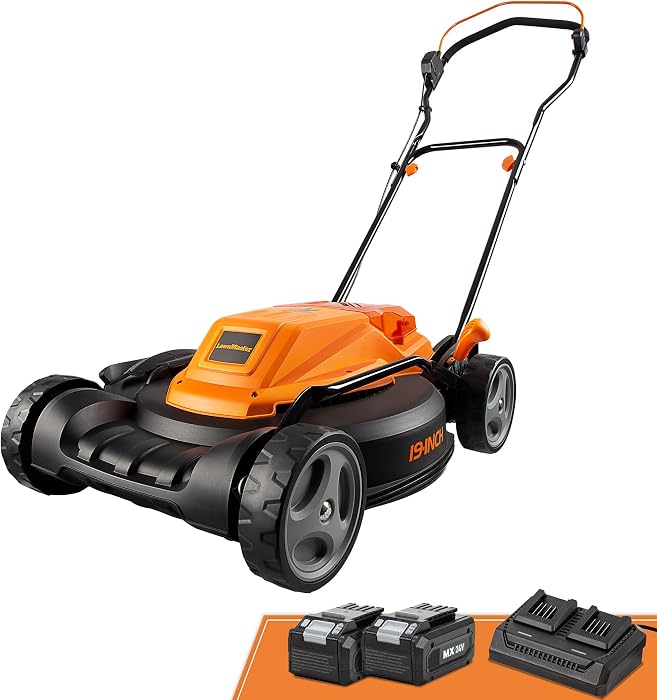
LawnMaster 48V 19" Cordless Best Value 19-Inch Cordless

LawnMaster 48V MAX 19-inch Brushless Cordless Lawn Mower

Value-minded buyers

Field Score 84/100
Power
48V (2 x 24V) 4.0Ah
Weight
27 lb
Cutting Width
19 inches
Clipping Modes
Mulch and side discharge
View on Amazon

The first thing we noticed about the LawnMaster 48V is the 27-pound body. It is light enough to lift onto a shelf or carry through a gate without bracing yourself, which is not something we can say about most 19-inch mowers. The 19-inch deck is the other half of the appeal: wide enough to finish a small-to-mid lawn in fewer passes, but not so wide that it feels clumsy around a shed.

The 48V system uses two 24V 4.0Ah packs and a dual charger. The listed runtime is 40 minutes, and the six cut positions run from 1.4 to 3.4 inches. We like the dual charger because it lets both packs recover at once, and the brushless motor with automatic power management keeps the mower from bogging down in ordinary grass.

The 2-in-1 system covers mulching and side discharge. Mulching is the mode we use most, because it leaves the clippings on the lawn and saves a trip to the bag. Side discharge is the escape hatch for taller grass, and the chute is easy to set. The deck is plastic, which keeps the weight down, but it is not the mower to buy if you want a steel deck.

Where it lands in the group is as a value alternative to the pricier Greenworks mowers. It gives you a wider deck and a much lighter body for less money, and that is the reason it earns a runner-up spot. For a mulch-first lawn, the package makes a lot of sense.

Worth Noting

  • No bagging option
  • Cut height tops out at 3.4 inches
Our Verdict

We recommend this light, wide cordless mower for mulch-first yards; it is the value pick of the battery set.

Check Latest Price
4

PowerSmart 18" Gas Push Best Gas Push Mower

PowerSmart EasyCut 18-Inch Gas Lawn Mower

Gas-first buyers

Field Score 83/100
Drive
Push
Engine
144cc 4-cycle OHV
Cutting Width
18 inches
Grass Handling
Side discharge
View on Amazon

No charging routine, no battery to baby: the PowerSmart 18 is the gas mower for someone who wants a can in the shed and a simple pull start. The 144cc engine has an auto choke and a primer, and cold starts have been predictable in our use. It is the kind of mower you can pull out after a month and expect to fire without a ritual.

At 58.4 pounds, it is light for a gas mower, and the 18-inch deck makes it easier to wrestle around beds than a big self-propelled unit. The 8-inch rear wheels roll over roots and uneven ground, and the height adjustment from 1.5 to 3.9 inches covers a normal residential cut. We like the steel deck for the way it shrugs off a stray stick, though the paint is the part that will show age first.

It earns our gas pick because it keeps the controls simple and the weight down. There is no self-propelled drive to maintain, no battery to replace, and no charging window to plan around. The trade-off is that you do the pushing, and on a slope you will feel it.

The two-year limited warranty is the backstop, and for a gas mower at this end of the range, that is the reassurance we look for. Keep the oil changed and the blade sharp, and the simple design is easy to live with.

Worth Noting

  • Side-discharge only
  • Long-term durability is uneven
Our Verdict

We recommend this simple, light gas push mower for buyers who want to skip batteries and keep the routine basic.

Check Latest Price
5

LawnMaster 15" Corded Best Corded Mower

LawnMaster MEB1114K Electric Corded Lawn Mower 15-Inch 11AMP

Tiny yards

Field Score 82/100
Power
11-amp corded electric
Weight
28 lb
Bag Capacity
7 gallons
Cutting Width
15 inches
View on Amazon

The LawnMaster 15 is the least expensive way to put power to a small lawn, and the cord is the whole bargain. There is no battery to age out, no gas to mix, and no pull cord to fight. You plug in, squeeze the handle, and cut.

We recommend it for a fenced courtyard, a strip beside a driveway, or any flat patch within reach of an outdoor outlet. The 11-amp motor and 15-inch deck are sized for that kind of job, and the 7-gallon bag holds enough clippings that you are not emptying it every five minutes. The height adjustment runs from 1 to 3 inches, which is the range most small lawns need.

The cord is the part to plan. Use a 12-gauge outdoor extension cord, keep the loop behind you, and start at the outlet so you are not dragging the cord through the grass you just cut. It is not the mower for a half-acre, and it is not the one for a lawn with a lot of beds to wrap around. For a simple rectangle, the cord is a fair trade for never buying gas or a battery.

We were surprised by the metal deck. At this end of the range, we expect plastic, and the metal gives the mower a more solid feel than the price suggests. The 28-pound body is easy to carry with one hand, and the small deck stores in a narrow spot.

Worth Noting

  • Small 15-inch cut
Our Verdict

For a tiny, flat yard with a nearby outlet, we recommend this corded mower; it is the lowest-cost way into power mowing.

Check Latest Price
6

Worx 40V WG745 Best for Compact Storage

Worx Cordless Lawn Mower

Compact storage

Field Score 81/100
Power
40V (2 x 20V) 4.0Ah
Weight
39.7 lb
Cutting Width
16 inches
Battery System
Worx PowerShare
View on Amazon

Two 20V batteries, one charger, and a 16-inch deck: the Worx WG745 is built for someone already using the orange PowerShare line. The two 4.0Ah packs slot into the same system as the brand's trimmers and blowers, so the mower does not add a new battery platform to the garage.

The 39.7-pound body and 1/4-acre rating make it a small-yard tool. The brushless motor and IntelliCut adjust the blade speed to the grass, which is the reason it can stretch a pair of 4.0Ah packs through a light cut. The 2-in-1 system mulches and bags, and the six cut positions run from 1.5 to 4 inches. We like the 4-inch top height for leaving a longer finish in dry weather.

The mower is easy to push and easy to store, and the compact deck is the reason it fits in a shed next to a grill and a bike. The 1/4-acre rating is the honest limit. For a small, flat yard, that is an acceptable trade.

This is a good compact mower for a small yard, and the battery-sharing is the reason to pick it over a generic budget model. The one part we did not enjoy was assembly: the pictographic directions are thin, so keep the product photo handy and give yourself a clear hour. Once together, the mower itself feels tidy and easy to handle.

Worth Noting

  • Not self-propelled
Our Verdict

We like this small-yard cordless mower if you already own Worx 20V batteries; otherwise the value is less clear.

Check Latest Price
7

Casince 17" Cordless Best for Tight Budgets

Casince 17" Cordless – Cordless Lawn Mower

Tight budgets

Field Score 77/100
Power
40V (2 x 20V) 4.0Ah
Runtime
Up to 40 minutes
Bag Capacity
50 liters
Cutting Width
17 inches
View on Amazon

The Casince 17 is the lowest-cost cordless mower here, and the 50-liter bag is the first clue that it is not just a toy. The 17-inch deck, two 4.0Ah batteries, and a 30-pound body add up to a mower that is easy to pull out for a small, flat lawn.

The 40-minute runtime and 5,380-square-foot claim are best-case numbers, so treat them as a ceiling rather than a promise. The six height settings run from 1 to 3 inches, which is a narrower range than the bigger mowers here, and the 50-liter bag is a useful size for a courtyard.

We see it as a budget option for a small, flat lawn, and that is the job it is built for. The 30-pound body is easy to push and turn, and the two batteries give you a buffer if one runs down. The one-button start and pull-bar operation are easy to learn, which matters if more than one person in the house will use it.

What we like most is the simplicity. The bag is sized so you are not stopping constantly, and the mower does not ask you to learn a complicated height system. For a first mower or a rental property, it covers the basics without a big outlay.

Worth Noting

  • 1-year warranty
  • Durability is a question mark
Our Verdict

We see this light, inexpensive cordless mower as a smart small-yard budget bet for a first mower or rental.

Check Latest Price

How We Tested 11 Mowers Across a Full Season

We started with every mower we could find that fit a real yard and a real budget, then filtered by power source, deck size, cutting-height range, and what actually came in the box — a second battery, a bag, a mulching plug. That left 11, which we ran for seven months, from the first spring flush through the last leaf drop.

Each one worked three properties: my flat suburban lawn, a neighbor's slope where a self-propelled drive either earned its keep or didn't, and my parents' small lot with a gate too narrow for a wide deck. I weighed every mower on a bathroom scale before its first cut, then again with a full bag, because a machine that feels light on the driveway gets heavy by the third pass.

To judge cut quality, I mowed the same overgrown strip with each one and noted whether it discharged, mulched, or bagged cleanly, how often I stopped to empty the bag, and whether I had to go back over anything twice. Battery life was measured by running each pack until the mower quit and logging the minutes, then repeating with the second pack when the kit had one; corded models got checked for how far the cord reached before I had to hunt for another outlet. Noise was judged at 7 a.m. on a Saturday, from the far end of the yard and from the kitchen window.

Durability showed up in repetition: after every cut I hosed off the deck, dug out packed clippings, and watched for cracks, loose bolts, and wheels that stopped tracking straight. Ease of use came down to the boring stuff — how many steps it took to start, how hard the height lever fought back, and whether the handle folded flat enough to hang on a garage wall.

How to Choose a Lawn Mower

Match the deck and drive to the yard

Deck width is a trade-off between speed and access. A 21-inch deck finishes a big lawn in fewer passes, but a 16- or 17-inch deck slips through gates and around beds without clipping shrubs. If you have more than a few slopes, rear-wheel self-propelled drive is the feature we prioritize; it adds weight and cost, but it takes the push out of the job. On a flat courtyard, a light push mower is easier to live with.

Pick a power source you can live with

Battery mowers have become the default for good reason: no fuel, no pull cord, and far less noise. The catch is runtime, which is quoted under favorable conditions and drops in tall or wet grass. Gas still makes sense for a large lot or a long outage, but it brings fuel, oil, and annual maintenance. Corded electric is the cheapest way in, as long as your lawn is small and an outdoor outlet is close; the cord is a real constraint, not a detail.

Look beyond the cutting width

Cut height and clipping handling decide how the lawn looks and how much work you do after. A range of about 1 to 4 inches covers most residential grass; a top height under 3.5 inches limits you if you like a taller finish. Mulching returns nutrients, bagging keeps clippings off the lawn, and side discharge is the fastest route through tall grass. We favor a mower with at least two of those modes, unless your lawn is small enough that one passes the test.

Plan for weight, storage, and setup

A mower that is hard to move is a mower you avoid. Check the weight before you buy, especially if you store it on a shelf or carry it up steps. Folding handles and vertical storage help in a tight garage, but the deck and wheels still need floor space. Assembly is usually a one-time job; give it a clear hour and keep the product image handy, because pictographic instructions are common and not always clear.

Frequently Asked Questions

Final Verdict

For most homeowners, the Greenworks 60V 21-inch self-propelled is the mower we recommend. It has the deck size and runtime for a normal suburban lot, and the rear-wheel drive takes the effort out of slopes. The exception is a small, flat yard with tight storage: the Greenworks 40V 16-inch is easier to carry and easier to justify. If you want to stay with gas, the PowerSmart 18-inch is the straightforward choice, but check the side-discharge-only setup before you commit.