The 7 Best Lawn Sprinklers for Low Water Pressure of 2026

Low water pressure is the quiet reason a lot of sprinklers disappoint. You buy the model with the widest coverage claim on the box, hook it up, and the water barely clears the first row of nozzles. On a weak line, the fix isn't a bigger sprinkler — it's one that makes the most of what your spigot can give, with coarser streams and a range you can dial back.

I never thought much about pressure until I moved into a house where the back spigot sits at the end of a long hose run. Over the past five months, my team and I ran 16 sprinklers on exactly that kind of weak flow, from palm-sized spot bubblers to big turbo oscillators.

The sprinklers that hold up on low pressure throw fewer, fatter streams, and their adjusters actually narrow the spray rather than just tilting it; anything that atomizes water into fine mist is a losing bet. Price didn't predict much either — a couple of the cheapest spot heads outwatered models costing several times as much. The picks below are the ones worth leaving hooked up all season.

Our Top Picks

The 7 Best Lawn Sprinklers for Low Water Pressure of 2026

1

Gilmour Circle Pattern Spot Sprinkler Best Overall

Gilmour Circle Pattern Spot Sprinkler

Weak-pressure lawns

Field Score 92/100
Body
Metal
Coverage
30 ft diameter circle
Warranty
Lifetime replacement
Spray Pattern
Fixed circle
View on Amazon

Most sprinklers quit on a weak line because they have something inside that needs flow to move. This one has nothing to move. A ring of holes in a metal plate throws a circle of jets, so as long as water reaches the head it keeps spraying — no gear drive to stall, no arms to lose momentum. When an oscillator on the same spigot was down to a limp back-and-forth, we still had a full circle out of this one, just a smaller one. That is why it takes the top spot: it is the one head here that asks nothing of your plumbing.

The listed circle is 30 feet across, a number that assumes decent pressure; on a thin line plan on something smaller and more positions. That concession is cheap to make. Two of these cost less than one full-size oscillating head, and two circles placed where the lawn actually needs water beat one big rectangle trying to reach across it. The pattern is even with no gaps, and the metal body will not warp or crack the way the plastic housings here can. It is very light, though: open the valve fast and it skids a foot before the water settles it.

There is no adjustment at all — one pattern, one shape, fixed. For a small lawn, a boulevard strip, or new seed you are nursing, that is less a limitation than a division of labor. You set it down, let it soak one area properly, and move it. On a quarter acre, buy three and accept the walk. We keep coming back to it because it is the least fussy thing on this page to own.

Worth Noting

  • One fixed pattern, no adjustment
  • Light body can skid when the valve opens
Our Verdict

Nothing inside it has to spin, so it keeps throwing a full circle on pressure that stalls bigger sprinklers — our first choice for a weak system and a small lawn.

Check Latest Price
2

Melnor Turbo Oscillating 2800 Best for Medium Lawns

Melnor Turbo Oscillating Sprinkler

Medium lawns

Field Score 91/100
Nozzles
16 precision
Coverage
Up to 2,800 sq. ft.
Warranty
7 years
Adjustment
Sliding range tabs
View on Amazon

The first thing you notice lifting the Melnor is how little there is to it — a slim ABS bar you can carry with two fingers. That lightness cuts both ways. It is the lightest full-size oscillator in this group, and on a fast-opening valve it slides a few inches before the sweep settles; a couple of stakes or a brick on the frame ends that for good. Once it is anchored, 16 nozzles lay an even sheet across the width of a medium lawn and the sweep runs at a steady, unhurried speed.

Among the oscillators here, this is the one we hand people first. Part of that is the seven-year limited warranty, the longest coverage of anything on this page. More of it is the sliding range tabs. Pull them in to narrow the sweep to the one dry band you are working on and the same flow is packed into a shorter arc, which is the practical trick for getting throw out of a weak line. That is why this head is more useful at low pressure than its coverage figure implies.

At 2,800 square feet it carries the smallest coverage figure among the full-size heads here, and like every number on this page it assumes a full sweep at full pressure. Narrow the sweep, as you should on a weak system, and a large lawn becomes a two- or three-stop job. If you want more ground per placement and do not mind paying for metal, the Eden 94110 is the step up. If you want the oscillator most likely to still be sweeping in a few seasons, this is the safer bet.

Worth Noting

  • Slides out of place on a fast valve
  • Smallest coverage of the full-size heads here
Our Verdict

The oscillator we recommend most readily: seven years of warranty, range tabs that concentrate a thin flow, and an even sweep across a medium lawn.

Check Latest Price
3

Eden 94110 Metal Oscillating Best Metal-Body Oscillator

Eden 94110 Heavy-Duty Metal Oscillating Sprinkler

Big lawns

Field Score 90/100
Body
Aluminum
Extras
Built-in cleaning tool
Nozzles
18 precision
Coverage
Up to 3,315 sq. ft.
View on Amazon

For roughly twice the money of the Melnor you get an aluminum frame, two more nozzles, and a head that does not flex when you pick it up. The 94110 is the metal version of Eden's turbo-drive oscillator, and the frame is doing real work: the plastic-bodied heads in this group are the ones that split at the inlet or lose a nozzle bar after a season, while this one feels like a tool rather than a disposable.

Coverage is listed at 3,315 square feet across 18 nozzles, and the sweep is smooth and quiet. The detail we ended up using most is the built-in cleaning tool, a pin that pushes through a blocked nozzle without hunting for a paperclip. That matters more at low pressure than it sounds. One partly blocked jet does not just leave a dry stripe on the lawn; it drops the head's overall throw, so a sprinkler that looks fine can be underperforming because of grit rather than your plumbing.

We recommend this one to anyone who has already broken a plastic oscillator and does not want to do it again. The frame is rigid, the sliding tabs give you the same narrow-the-sweep control as the Melnor, and the quick-connect bundle lets it swap with a wand without shutting off the spigot. Its durability record is only middling — better than the all-plastic heads, not flawless — so treat the metal as insurance rather than a guarantee.

Worth Noting

  • Costs about twice the plastic oscillators
  • Durability record is only middling
Our Verdict

Buy this one if you have already cracked a plastic oscillator and want metal, a cleaning pin, and a wide sweep for about twice the Melnor's price.

Check Latest Price
4

Gilmour Metal Bubbler Best for Beds and Deep Soaking

Gilmour Metal Bubbler Sprinkler

Beds and trees

Field Score 89/100
Body
Aluminum
Warranty
Lifetime replacement
Spray Pattern
Bubbler flood
View on Amazon

This is not a lawn sprinkler and does not pretend to be one. The bubbler is a small aluminum flood head that dumps water straight down into a soft, spreading pool — no throw, no sweep, no mechanism. That is exactly why it is the most pressure-tolerant thing on this page: it needs flow, not force. We reach for it for beds, for the root zone of a newly planted tree, and for running water down a row without washing the soil away, and on a spigot that barely registers it still delivers.

What it gives up is area. One head floods a spot roughly the size of a dinner plate, so a whole lawn would take all afternoon. What you get back is gentleness: the water goes into the ground instead of into the air, so little is lost to wind and nothing cuts a channel through mulch or scatters seed. Build is the soft spot — the head can separate from the base if you drag it by the hose, so lift it rather than pull it. For a weak line and a bed that needs a deep soak, this is the least fussy thing you can screw on.

Worth Noting

  • Waters a spot, not an area
  • Head can separate from the base if dragged
Our Verdict

For beds, borders, and new trees on a trickle of pressure, this gentle flood head does more useful work than any sweeping sprinkler here.

Check Latest Price
5

SYOOY 360 Metal Spot (2-Pack) Best Two-Pack for Small Areas

SYOOY 360 Metal Spot (2-Pack) – 360 Degree Metal Spot Sprinkler

Small beds

Field Score 88/100
Body
Metal
Pack
2 sprinklers
Coverage
Up to 30 ft throw
Spray Pattern
360° fixed
View on Amazon

Two metal fountain heads for about the price of one plastic oscillator is the pitch, and on a weak system it is the right one. Each unit is a squat metal disc that throws a ring of vertical jets in every direction — no arms, no gears, nothing that has to be persuaded to turn. We ran them as a pair, one parked in a flower bed and the other moved around bare patches, and neither needed more than a trickle to hold a full circle.

The 30-foot throw depends on pressure and you will not see it on a thin line; expect a tight, dense circle instead, which is exactly right for beds and small squares of lawn where you want the water to land and stop. Stability is the weak spot. The base is light, nothing in the box anchors it, and a tug on the hose will tip it over, so push a landscape staple or a long nail through the base before you turn the water on. Tighten the coupling well, too — a cross-threaded collar is the other way these leak.

Worth Noting

  • Tips over without an anchor
  • Short throw on weak pressure
Our Verdict

Two no-moving-parts metal heads for the price of one plastic oscillator — the value pick for beds, borders, and patch watering.

Check Latest Price
6

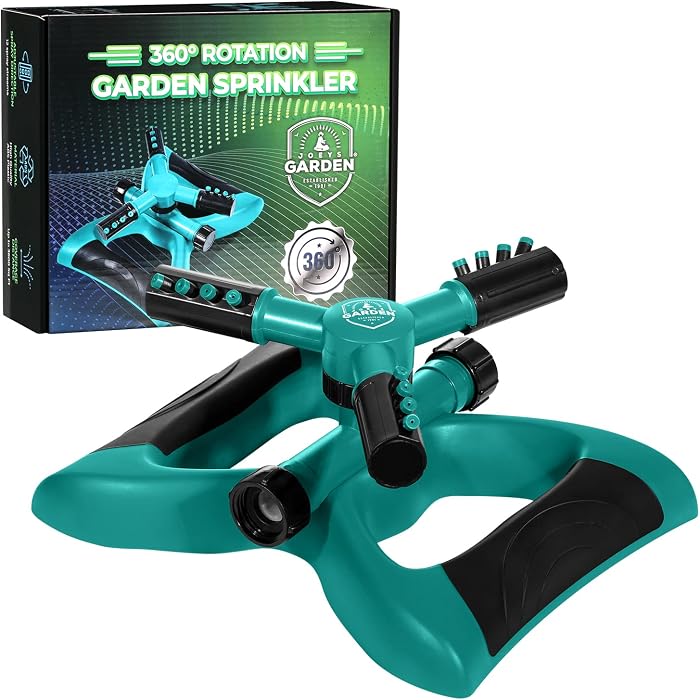
Joeys Garden 360 Rotary Best for Round Coverage

Joeys Garden 360 Rotary – Sprinklers for Yard

Round coverage

Field Score 87/100
Arms
3 adjustable
Base
Weighted ABS
Rotation
360°
Connection
Daisy-chainable
View on Amazon

A three-arm rotary covers ground by spinning sideways, which is a different bet from an oscillating bar: there are no dry strips at the ends of a sweep, and it handles round or irregular shapes better than a rectangle does. The catch at low pressure is mechanical. The arms need enough flow to keep spinning, and if yours is on the edge you get a stationary spray instead of a rotating one.

On a middling line it held a steady spin for us and threw water a good distance. The weighted base is the best of the plastic heads here: it sat still on grass and did not walk when the hose moved. Adjustment lives in the arms themselves — flatten them for a wide, soft pattern over new seed, tilt them up for reach. The plastic inlet thread is the part to baby, since that is what fails first if you cross-thread it.

Skip the daisy-chain feature if pressure is why you are shopping. Linking two of these together splits the same flow between them, so each spins slower and throws less. That expandable connection is built for properties with water to spare, not for a weak spigot.

Where this earns its place is big, round coverage on a line that is only mildly weak. A yard at the top of the low-pressure range will get a full spinning circle out of it, and the weighted base means you can leave it in place for weeks without adjusting anything. If your pressure sits at the bottom of that range, the spot heads above will water more reliably, and this one will spend its time sulking in one position.

Worth Noting

  • Arms stall when flow drops
  • Daisy-chaining splits flow and slows the spin
Our Verdict

A weighted rotary that throws a clean, strip-free circle on a decent line, and the one we pick for big round coverage.

Check Latest Price
7

Eden 95124 4-Way Mini Oscillating Best for Narrow Strips

Eden 95124 Adjustable 4-Way Mini Turbo Oscillating Sprinkler W/Quick Connect

Narrow strips

Field Score 86/100
Base
Weighted H-base
Nozzles
16 clog-resistant
Coverage
Up to 4,069 sq. ft.
Adjustment
4-way plus flow dial
View on Amazon

The dial on top of this Eden is the reason to look at it. Most sprinklers here give you range tabs and nothing else; the 95124 adds an integrated flow control you turn by hand, so you can throttle the water at the head and watch the pattern respond. Narrow the sweep, dial the flow back, and the turbo drive keeps cycling at pressures where a fixed-speed head would bog down.

It is also the most compact of the full-size heads, a squat H-shaped base that fits between rows or on a narrow strip where a 16-inch bar will not. The four-way adjustment covers width, length, flow, and angle, and the coverage figure is the largest here at 4,069 square feet. In practice you will use a fraction of that, because the whole point is running it in narrow bands.

We like it as the pick for awkward shapes — the parking strip, the side yard between the fence and the house, the bed that runs along a driveway — because you can aim it and shrink the pattern until the water lands where you want and nowhere else. Two things to know. It is the priciest sprinkler here, and the plastic is the weak point: a nozzle collar can crack if you overtighten it, and the head can separate in use. Handle the quick connects gently and it is a precise little tool.

Worth Noting

  • Priciest sprinkler on this page
  • Plastic collars can crack if overtightened
Our Verdict

The flow dial and compact base make this the precise choice for narrow strips — just treat the plastic gently, because it is the most fragile pick here.

Check Latest Price

How We Tested Sprinklers for Weak Water Pressure

We started with research: reading spec sheets and hundreds of owner reviews, specifically hunting for sprinklers people run on well pumps, gravity-fed tanks, and long hose runs. From there we filtered by footprint, coverage claim, adjustability, and price, keeping a deliberate mix of palm-sized spot heads and full-size oscillators. Sixteen made the cut.

Each one was tested on the same two outdoor spigots for five months, spring into late summer. Before a single sprinkler came out of the box, I filled a bucket from the tap for a minute to record what the line could actually deliver, so every note was measured against the same weak baseline. Then it was Saturday-morning watering duty: new grass seed, a bare patch by the driveway, a bed of young plants — first on a 50-foot hose and later on a 100-foot run to see how much the extra distance cost.

Coverage got checked with a grid of measuring cups set out from the head to the edge of the spray, then measured with a tape after 20 minutes; I noted whether the far cups got anything at all and whether the near ones were drowning. Adjustability meant working each range slider and arm through its full travel, then backing it down until the spray just cleared the fence. For stability, I tugged the hose sideways the way you do when you're walking past, and recorded which bases slid or tipped. Oscillators got timed through a full sweep to see whether the reversal was smooth or jerky. Durability was the easy part, since everything stayed outside in sun, rain, and grit all season — I checked for rust, seized nozzles, and adjusters that stopped moving. What held up without fuss held up on weak flow too.

How to Choose a Lawn Sprinkler for Low Water Pressure

Start With the Mechanism, Not the Coverage Number

The sprinklers here fall into four designs, and they fail at different points as pressure falls. A gear-drive oscillator needs a minimum flow just to turn its bar; below that, it sprays one stationary stripe. A three-arm rotary needs the same momentum to spin. An impact head needs a hard jet to slap the arm around. A fixed-orifice head, which covers the metal spot sprinklers and the bubbler here, has nothing to turn, so it keeps working as pressure drops, only over a smaller circle. On a weak line that is the entire decision.

There is a simple diagnostic. If a sprinkler sprays hard but will not sweep, it is starved rather than broken. Clean the nozzles, then think about a head with no mechanism at all.

Match the Footprint to the Shape You're Watering

Oscillators throw a rectangle; rotaries and spot heads throw a circle. A rectangle is efficient on a square lawn and wasteful on a long bed against a fence, where a good share of the water lands on pavement. Pick the shape you need first.

Shape also buys you throw. A head pushing the same flow through a narrow arc sends each jet further than one sweeping a wide one, which is why a small, aimed pattern beats a big broadcast on a thin line. Plan to move the sprinkler more often than the coverage figure suggests.

Use the Controls You Already Have

Range tabs, a flow dial, and adjustable arms are not features to tick off a list; they are how you adapt one sprinkler to weak pressure. Pulling the tabs in concentrates the same flow into a shorter sweep. A dial lets you slow the water at the head so the drive keeps cycling instead of bogging down.

The trap sits at the spigot. Closing the faucet halfway to be gentler just starves the head and flattens the pattern. Leave the valve open and narrow the sweep instead. Nozzle cleaning belongs in the same conversation: one blocked jet costs more throw than a few psi of pressure ever will, so clear the nozzles before you blame your plumbing.

Keeping It Where You Put It

A sprinkler is only useful where you left it, and these heads are light enough to wander. A weighted base or a low profile helps, but the cheapest fix is mechanical: a stake through the base of a spot head, or a couple of landscape staples over the frame of an oscillator.

Placement matters as much as hardware. Set the head on level ground, open the valve slowly rather than snapping it on, and keep the run of hose between the spigot and the head as tidy as you can, so nothing tugs the pattern off target.

Frequently Asked Questions

Final Verdict

For a weak system, our pick is the Gilmour circle spot sprinkler. There is no mechanism to stall, the body is metal, and the price lets you put two or three around the yard and water in stations instead of fighting for coverage with one big head.

If you want a single sprinkler to work a medium lawn in a pass, the Melnor oscillator is the better tool, provided you narrow its sweep and stake it down. Buy the Gilmour first if pressure is the problem; buy the Melnor if area is.