The 8 Best Leaf Blowers of 2026

A leaf blower is an argument with yourself about power. Corded models pull hard and never quit, but you spend the afternoon dragging an extension cord around the shrubs. Cordless models free you up, then make you watch the battery gauge instead of the leaves.

I have a corner lot with two mature maples and a driveway that catches every leaf on the block. Over the past eight months, my team and I put 14 corded and cordless models through real yard work — dry leaves, wet leaves, gravel, and one memorable pile of sodden oak leaves after a three-day rain. Two specs matter more than the rest: CFM moves volume, MPH moves speed, and a high-volume, low-speed blower that's lovely on a dry lawn is useless on a wet one.

Weight and battery life are the two things shoppers underestimate. A blower that feels fine in the aisle gets heavy at minute twelve, and a battery that dies at fifteen turns a twenty-minute job into a forty-minute one. Somewhere below is the one that matches your yard, your arms, and your patience.

Our Top Picks

The 8 Best Leaf Blowers of 2026

1

WORX WG520 Best Overall

WORX 12 Amp Turbine Electric Leaf Blower for Daily Leaf Removal

Big yards, corded

Field Score 95/100
Weight
6.4 lb
Airflow
600 CFM
Air Speed
110 MPH
Power Source
Corded electric, 12 amp
View on Amazon

Six hundred cubic feet per minute is the biggest airflow figure in this group, and it is the reason the WG520 is the one we reach for first. That number is about volume, not a narrow jet: the turbine fan pushes a wide stream that rolls a mat of dry leaves down a driveway instead of scattering it into the grass. Pair it with a tarp and a fall afternoon and the rake stays in the shed.

The cord is the whole trade. You need an outdoor outlet within reach, and dragging a cord around a hedge or a trailer is its own small chore. What you get for it is a blower that never slows as a battery fades and never stops mid-pile to recharge, and at 6.4 pounds it is light enough to carry one-handed along a walkway while the other hand moves a tarp.

The speed control earns its keep around mulch beds and gravel, where full airflow would send everything into the neighbor's yard, and the 110 MPH stream clears gutters from the ground with the tube angled up. Where it stops: a large, wet, matted drop of leaves wants more machine than a 12-amp hand-held, and a fence line on the far side of the property is a two-cord job. For a suburban lot with an outlet near the driveway, nothing here is easier to live with.

Worth Noting

  • Tied to a cord and a nearby outlet
  • Heavier than the 2- to 3-pound cordless kits
Our Verdict

For most yards with a reachable outlet, this is the leaf blower to buy: the most airflow in this group, no battery to run down, and manageable weight.

Check Latest Price
2

FAOGO RL-008 Best Cordless Overall

FAOGO RL-008 – 990

Cordless all-rounder

Field Score 94/100
Runtime
26+ minutes combined
Included
Two extension nozzles, storage bag
Batteries
Two, charger included
View on Amazon

The case is the first thing you notice, and it says a lot about how this kit was put together: blower, two batteries, charger, two extension nozzles, and a bag to carry it all. Plenty of cordless blowers arrive as a bare tool and a wish.

Two batteries are what sell us on it. Figure on 26-plus minutes of combined run time from the two packs, so the spare is the difference between finishing the gutters and standing in the driveway waiting on a charger. The extension nozzles reach roof edges and behind shrubs without a ladder, which is the kind of detail that keeps a tool in use instead of in the garage.

In the hand it is light enough for one-handed passes along a fence line, and the force holds up on dry leaves, grass clippings, and garage dust, which is the work most of us actually have. It will bog down in a thick, wet mat, and the RPM figure in the name is marketing rather than something you can shop by. Neither matters much once you are the person who wants the leaves off the porch before guests arrive.

Worth Noting

  • Run time is minutes per pack, not hours
  • Bogs down in thick, wet leaves
Our Verdict

The cordless blower we hand to most people: two batteries, a case, and enough force for decks, patios, and gutters without a cord.

Check Latest Price
3

Milwaukee M18 FUEL Best for Milwaukee Battery Owners

Milwaukee M18 FUEL 120 MPH 450 CFM 18-Volt Lithium Ion Brushless Cordless

M18 owners

Field Score 93/100
Weight
6.7 lb
Airflow
450 CFM
Battery
Sold separately
Air Speed
120 MPH
View on Amazon

It arrives without a battery, and that one fact decides whether this blower belongs in your garage. If M18 packs are already on your shelf, the 2724-20 is near the top of this group on airflow, at 450 CFM and 120 MPH, and it feels like a tool rather than an appliance. If they are not, the pack and charger push the real cost past every complete kit here.

Battery life is the caveat we keep coming back to. On a compact pack the run is short enough that a real yard eats two, and the packs are the expensive half of this platform. Pair it with a high-capacity battery and the balance improves as well, since the extra weight sits behind the grip instead of hanging off the nose.

Where it earns its keep is the work a small kit runs out of breath on: pine needles in gravel, gutter lines, a truck bed, the mirrors and seams after a wash. The trigger is easy to feather for detail work, and 6.7 pounds is light enough to hold at shoulder height for a while. It is not the blower to buy first; it is the one to buy once you know what you are clearing.

Worth Noting

  • Battery and charger sold separately
  • Short run time on compact packs
Our Verdict

Buy it if M18 packs are already on your shelf: near the top of this group on airflow and built for work a small 20-volt kit cannot finish.

Check Latest Price
4

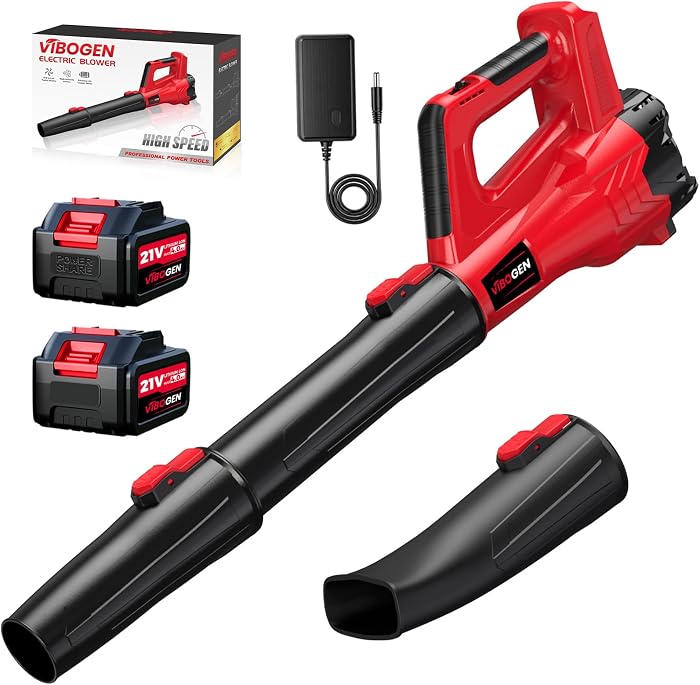
VIBOGEN HG0645 Best Lightweight Cordless

VIBOGEN HG0645 – Electric Leaf Blower Cordless With Battery & Charger for Lawn Care

Light patio work

Field Score 92/100
Weight
2 lb
Airflow
420 CFM
Air Speed
150 MPH
Batteries
Two 4.0Ah
View on Amazon

Two pounds changes who can use a blower. Held out at arm's length, this one does not fatigue a shoulder the way a six-pound machine does, and the extension nozzle gets under benches and into corners without a second hand. If the last blower you owned lived in the garage because it was too much trouble to carry, that is the specification to shop by.

For a small machine it moves a surprising amount of air: 420 CFM at 150 MPH clears dry leaves, grass clippings, and dust off patios, driveways, and garage floors, and the two-speed switch lets you back off around gravel and beds. We were skeptical of those numbers from a body this light, and on hard surfaces it holds up.

What it will not do is a wet, matted drop of leaves, and the two 4.0Ah packs empty quickly on high, which is why the second battery matters more here than on a bigger blower. We also appreciate that both packs and the charger are in the box at the bottom of this group's price range, and that the listed 75 dB is civil enough for a Sunday morning. For the five-minute pass that keeps a patio presentable, that is the whole package.

Worth Noting

  • High speed drains a pack quickly
  • Won't clear soaked, matted leaves
Our Verdict

The pick for patios, walkways, and garage floors: two pounds, two batteries, and the lowest price among the cordless kits here.

Check Latest Price
5

WORX WG509 Trivac Best Blower-Vacuum Combo

WORX Trivac 3-in-1 Electric Leaf Blower/Leaf Vacuum/Leaf Mulcher

Bagging and mulching

Field Score 88/100
Weight
9.3 lb
Airflow
350 CFM
Air Speed
210 MPH
Mulch Ratio
18:1
View on Amazon

This is the only tool here that takes leaves away instead of moving them. Switch the WG509 from blower to vacuum and it shreds what it swallows at an 18:1 ratio, so the debris bag holds what would otherwise be a much larger pile of whole leaves. If disposal is the part of fall that defeats you, the tool you want is a mulcher that also blows.

As a blower it is the weaker of the two WORX tools here, 350 CFM against the WG520's 600, so if all you need is leaves off a lawn, the other one is the better buy. What the extra money buys is the bag, and the 210 MPH airstream is genuinely fast for lifting leaves out of gravel and off a trailer deck.

Nine and a third pounds is the price, and we minded it most in vacuum mode, where the bag and its contents ride in your hands and make a long session a workout. Twigs and wet clumps jam the intake, and the motor is the component that gives out when something does; empty the bag before it fills, keep the nozzle off gravel, and it earns its shelf space. For anyone who has filled bag after bag and still had a lawn to clear, the mulch ratio is the whole argument.

Worth Noting

  • 9.3 pounds before the bag fills
  • Jams on twigs and wet clumps
Our Verdict

The one to buy when bagging matters more than blowing: an 18:1 mulch ratio nothing else here offers, at the cost of 9.3 pounds and a weaker airstream.

Check Latest Price
6

YUQUESEN RL-010 Best for Decks and Porches

YUQUESEN RL-010 – Cordless Leaf Blower

Decks and porches

Field Score 87/100
Weight
2.8 lb
Runtime
13+ minutes per battery
Batteries
Two lithium packs
View on Amazon

The noise is the first thing you notice: a high turbine whine that carries further than the airstream does, and it is why this is not the blower we hand someone with close neighbors. That whine is the tax on a 2.8-pound body producing this much force.

Everything else about it is well judged. Two packs at 13-plus minutes each mean roughly a half hour of work if you keep the charged one in a pocket, the grip is shaped for one hand, and full speed moves leaves and dust with a conviction that does not match its size.

Where it falls down is where the other small cordless units do: a wet, matted layer of leaves is more than the airstream can lift, and full speed empties a pack faster than you would like. Neither is a problem for the job this blower is actually for. The compact body lives where a blower gets used, on a hook by the door, ready for the five-minute pass.

Worth Noting

  • Loud, high-pitched whine
  • About 13 minutes per pack at full speed
Our Verdict

A light, forceful blower for decks and porches, just know that the high-pitched noise travels about as far as the air does.

Check Latest Price
7

WOLFMEN LB-8197 Best for Walkways and Garages

WOLFMEN LB-8197 – Leaf Blower

Walkways and garages

Field Score 86/100
Weight
3.8 lb
Airflow
450 CFM
Voltage
20 volts
Air Speed
150 MPH
View on Amazon

A walkway, a driveway, and a porch: if that is the shape of your leaf problem, this is the shape of blower that fits it. 450 CFM and 150 MPH in a 3.8-pound body, with two packs and a charger in the box.

The two-speed switch is the part that works hardest. Low moves dust and grass clippings off a garage floor without blasting them into the next county; high rolls a drift of dry leaves along a curb and off a sidewalk. Assembly is a couple of minutes, and the tube comes apart so the whole thing stores flat on a shelf.

What it does not do is heavy work. Damp, matted leaves take more motor than this one has, and high speed drains a pack quickly enough that the spare is a scheduling item rather than a bonus. Both are worth knowing before you buy it for a yard full of oaks.

Set against the VIBOGEN, it is nearly two pounds heavier and asks more for similar airflow, so we rank it lower. It keeps its place for the two-speed control and for anyone who wants a little more reach and heft in the hand than the smallest kits provide.

Worth Noting

  • Struggles with damp, matted leaves
  • Heavier and pricier than the VIBOGEN
Our Verdict

A sensible cordless pick for walkways, garages, and porches, as long as wet leaves and long runs are someone else's problem.

Check Latest Price
8

CRAFTSMAN V20 RP

CRAFTSMAN Leaf Blower Cordless with Battery and Charger V20 RP

Quiet premium kit

Field Score 85/100
Noise
71 dB
Airflow
410 CFM with boost
Runtime
Up to 24 minutes
Air Speed
110 MPH
View on Amazon

The boost button is what makes this blower feel bigger than its 410 CFM. Hold it and the airflow jumps for as long as your thumb lasts, enough to break a stuck drift loose, then drops back to a stream you can steer along a bed edge without stripping the mulch.

The rest of the kit is unusually complete for a premium cordless: a 5.0Ah pack and charger in the box, a brushless motor rated for up to 24 minutes, and a stated 71 dB, the lowest noise figure on this page. The variable trigger and trigger lock are the details that matter when you are holding a tool at shoulder height for twenty minutes.

Two things give us pause. Run time under continuous load falls short of the 24-minute rating, and the box holds a single battery, so there is no spare to swap when it goes flat. Neither is a dealbreaker for a homeowner's fall cleanup; both are reasons not to treat it as a commercial tool.

The real decision is between this and the Milwaukee. The CRAFTSMAN includes a battery and charger and runs quieter; the Milwaukee is stronger and only makes sense if you are already in its platform. Starting from nothing, with a three-year limited warranty behind it, this is the easier premium buy.

Worth Noting

  • Run time falls short under continuous load
  • Only one battery in the box
Our Verdict

A quiet, complete cordless kit with a battery, charger, and boost button, for buyers who are not already invested in a tool platform.

Check Latest Price

How We Tested the Best Leaf Blowers

We started by gathering every corded and cordless handheld blower we could find at the price points a homeowner actually shops, then cut the field to 14 based on what comes in the box — battery and charger included or sold separately, one battery or two, and whether replacements are easy to buy — along with nozzle style and stated weight. Then we stopped reading spec sheets and started blowing.

Testing happened where these machines actually live: my own corner lot, a neighbor's postage-stamp lawn hemmed in by a chain-link fence, and a half-acre property with a gravel drive. Each blower ran on dry leaves, on leaves soaked by three days of rain, and on the grit that collects along a garage threshold. We noted how far a pile actually traveled, how many passes it took to clear a six-foot strip of concrete, and whether the nozzle blew leaves or just pushed them. Every unit went on a kitchen scale, and I held each one at arm's length for two minutes to see how fast my forearm started to complain.

On the cordless models, we charged to full and timed high-speed use until the tool cut out, then repeated the run on the second battery to see whether the double-run-time claim held. Ease of use came down to whether we could change speed with work gloves on and swap a nozzle without setting the blower down. Noise was measured at ear height and again at the property line, which is where neighbors form their opinions. Durability meant a season of tailgate drops, fence scrapes, and jammed intakes. For the models that also vacuum and mulch, we ran them over a measured pile of wet leaves and checked how much debris actually reached the bag.

How to Choose a Leaf Blower

Corded or Cordless Comes First

A corded blower never asks for a charge, and the money that would have gone into batteries goes into the motor instead; that is why the strongest airflow on this page belongs to a 12-amp corded model. The cost is a tether. You need an outdoor outlet and a cord that reaches the far corner of the yard, a barn aisle, or a trailer pad.

Cordless is the answer when the leaves are behind a fence, up a bank, or on a roof. Two packs in the box turn a short pass into a real session, so weigh battery count as heavily as the airflow claim.

Read CFM and MPH as a Pair

CFM measures how much air moves; MPH measures how fast it travels. Volume pushes a mat of leaves across pavement, while speed lifts leaves off grass and out of gravel. A big MPH number on a low-CFM machine is a narrow jet that scatters a pile instead of rolling it.

If your leaves sit on asphalt, decks, and concrete, weight the CFM figure. If you are clearing gutters, beds, truck beds, and equipment, weight the speed.

Weight Decides How Long You Work

A blower is held out at arm's length, which multiplies whatever it weighs. Two pounds is a tool you grab for a five-minute pass without thinking about it; six to nine pounds is a tool you use for a purpose and then put down.

The heavier machines usually carry the airflow, so the honest question is how long your sessions run. Short, frequent passes favor light; one long fall cleanup favors power and a grip you can hold for an hour.

Check What Is in the Box and What It Costs Later

Bare-tool listings are the trap. A blower priced like a midrange kit can cost far more once a battery and charger are added, so compare complete kits with complete kits. Two packs beat one on any yard bigger than a patio, because charging takes longer than the job.

Platform matters too. A blower that shares packs with your drill, trimmer, or chainsaw is worth more than its airflow suggests, and a pack you already own is the cheapest battery you will ever buy.

When You Want to Bag Leaves, Not Just Move Them

Blowing relocates a problem; vacuuming and mulching remove it. A 3-in-1 machine shreds leaves at a ratio like 18:1, so one bag of mulch holds what would have been a far larger pile of whole leaves. That is worth the extra weight if you compost, bag for municipal pickup, or clear a barn aisle.

Those machines are also the heaviest and the fussiest about twigs, so buy one only if disposal is your real bottleneck.

Frequently Asked Questions

Final Verdict

The WORX WG520 is the blower we point most people to: 600 CFM, a cord instead of a countdown, and 6.4 pounds you can carry along a fence line all afternoon. If an outlet is not within reach, the FAOGO kit is the cordless default, with two batteries and a case that keeps the whole thing together.

Milwaukee's 2724-20 is the step up for anyone already carrying M18 packs, and the WORX WG509 is the one to buy when bagging leaves matters more than blowing them.