The 8 Best Metal Detectors of 2026

A metal detector is a radio transmitter and receiver strapped to a stick: the coil pushes an electromagnetic field into the ground and reads what comes back. A cheap machine beeps at everything, which is why so many first hunts end with a pocketful of pull tabs and a detector that lives in the garage by August. The machine that can tell you it's a dime, and roughly how deep, is the one that keeps you going back out.

I've hunted a low-tide beach and my own yard more times than I'll admit, and my team has spent the last six months running 12 detectors over park turf, wet salt sand, and plowed field dirt. Beginner-friendliness, steady target ID, honest battery life, and whether the fun survived hour three with the headphones chattering mattered far more than any depth claim on a box.

One thing worth knowing before you shop: a waterproof coil is not a waterproof detector. Nearly every model here can be rinsed off after a sandy afternoon, but only some can go into the surf, and frequency control does more for wet salt sand than a bigger number on the packaging. What follows is sorted by who each machine actually suits.

Our Top Picks

The 8 Best Metal Detectors of 2026

1

Minelab X-Terra PRO Best Overall

MINELAB X-Terra PRO Fully Waterproof Metal Detector for Coin and Treasure

All-around first detector

Field Score 94/100
Weight
2.9 lb
Search Coil
12 inches
Packed Length
25 inches
Waterproof Rating
IP68, fully submersible
View on Amazon

Four manually selectable frequencies are what separate this detector from everything else near its price in this group. A single-frequency machine makes you live with whatever the factory chose; here you can drop down for depth on quiet pasture or step up when wet salt sand starts chattering. Pair that with an IP68 housing that is genuinely submersible, not just a waterproof coil, and you have the reason it earns the top spot.

The rest of the package keeps up. It weighs 2.9 pounds on a three-piece shaft and packs down to 25 inches, short enough to ride in a daypack; we stowed it between sites and had it back together faster than it takes to pull on boots. The 12-inch coil covers ground quickly, the backlit LCD and control-pod flashlight earn their keep at dusk, and 30 discrimination segments give you a useful read before you cut a plug.

Beginners should start in Park mode and leave the frequency menu alone for the first few outings. The tones and the discrimination scale take a session or two to click, and the machine rewards patience more than a single read-through of the manual. Once they do click, you have headroom a fixed-frequency detector never gives you, which is why this one stays useful long after the beginner stage.

Three years of coverage on the control box and coil is the longest stated warranty here apart from the Bounty Hunter, and it tells you how Minelab expects this thing to be treated: beach bag, truck bed, rain. We treat ours as a tool rather than a showpiece, which is exactly the point of buying it.

Worth Noting

  • 12-inch coil sees several targets at once in trashy ground
Our Verdict

We think it is the best all-rounder here: fully waterproof, four switchable frequencies, and light enough to swing all afternoon.

Check Latest Price
2

Garrett ACE 300 Best for First-Timers

Garrett ACE 300 Metal Detector for Adults

Simple park and field

Field Score 93/100
Programs
8
Target ID
0-99 numeric
Battery Life
25 hours
Waterproof Rating
IP54
View on Amazon

Before you dig, this one gives you a number. The 0-99 target ID scale, working with iron resolution, sorts a likely quarter from a bottle cap right on the screen, which is a small thing that saves a great deal of kneeling. Electronic pinpointing in non-motion All-Metal mode then narrows the spot so you are not guessing at the edges of the hole.

What we appreciate most is how little there is to learn. No frequency menu, no ground-balance routine, no charging schedule: sensitivity, mode, and a screen that reads clearly in daylight. We put it in the hands of people who had never detected before and they were swinging competently within minutes, which is the entire argument for choosing it over a more capable machine. Rated battery life of 25 hours covers a weekend of hunting on one set.

Two limits are worth knowing. The control housing is rated IP54, so rain and splashes are fine but the box does not go in the water; the coil does, and that is the part that matters over wet sand. The frequency is also fixed, so saltwater and heavily mineralized ground will test its composure in a way the X-Terra PRO is not tested. For parks, fields, and yards, neither limit bites.

Worth Noting

  • Control housing is only IP54 rated
  • Fixed frequency limits saltwater and hot-ground use
Our Verdict

We point first-timers at the ACE 300 when they want a readable target ID and no menus to learn.

Check Latest Price
3

GreenRex REX8-Ultral Best Value

GreenRex REX8-Ultral – Metal Detector for Adults Professional

Complete budget kit

Field Score 92/100
Modes
5
Weight
5 lb
Search Coil
10 inches
Waterproof Rating
IP68 coil only
View on Amazon

This is the least expensive complete setup in the group, and the one we hand to a family heading out for the first time. The detector arrives with headphones, a folding shovel, and a carry bag, so there is nothing to buy before the first trip. We like that it does not feel like a concession: a 10-inch IP68 coil, five search modes, and an oversized backlit screen are the same spec-sheet language the pricier picks use.

In use it does the basics without fuss. The cam-lock shaft and tool-free coil go together in seconds, the display stays readable in low light, and the modes cover park, field, and shallow water. At five pounds it stayed comfortable through a long session, and a balanced five-pound detector beats a lighter one that fights you on every sweep.

Where it concedes is ground coverage. A 10-inch coil sweeps less per pass than the 12-inch coils on the more expensive picks, so you will work a big field more slowly and lose some depth on small targets. That is the honest cost of the price, and a fair trade for someone hunting a yard, a farm field, or a dry beach.

Worth Noting

  • IP68 rating covers the coil, not the control box
  • Single fixed frequency struggles in salt water
Our Verdict

The best value here for a first complete setup: one box and you are detecting that afternoon.

Check Latest Price
4

SAKOBS Foldable Best for Travel

SAKOBS Foldable – Metal Detector for Adults

Travel and packing

Field Score 91/100
Length
26 to 47 inches
Weight
2.7 lb
Search Coil
11-inch DD
Waterproof Rating
IP68 coil
View on Amazon

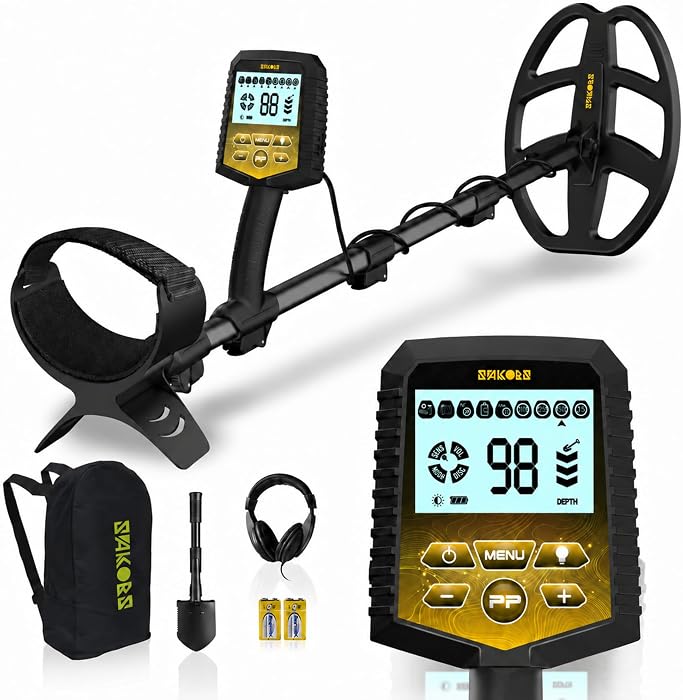
Folded down it measures 26 inches and weighs 2.7 pounds, short and light enough to live behind a truck seat without anyone noticing. The kit adds a carry backpack, headphones, and a digging shovel, so the whole thing travels as one bag. That is the case for it: not the most capable detector here, the easiest one to have with you.

The hardware is better than the travel-first pitch suggests. An 11-inch IP68 DD coil, a 9 kHz circuit, four search modes, and nine target categories on a backlit screen, and the DD coil separates targets better than the round coils on the budget kits, which is what you want in a nail-strewn yard. SAKOBS rates detection to 12.8 inches under suitable conditions; read that as a best case and you will be pleased with what it does.

The one figure to check against yourself is length. Fully extended it reaches 47 inches, fine for most adults and short for anyone much over six feet, who will end up hunched over the handle. If that is you, the 54-inch shaft on the X-Terra PRO is the better fit. For everyone else this is the detector that actually leaves the house.

Worth Noting

  • 47-inch maximum length is short for tall users
Our Verdict

Our travel pick: it folds to 26 inches, weighs 2.7 pounds, and arrives as a backpack kit.

Check Latest Price
5

Garrett ACE 400 Best Step-Up

Garrett ACE 400 Metal Detector

Iron-heavy old sites

Field Score 90/100
Programs
5
Extended Length
51 inches
Waterproof Rating
IP54
Operating Frequency
10 kHz
View on Amazon

Think of the ACE 400 as the ACE 300 with better ears. The step up buys iron audio, so you hear a low tone on iron before committing to a dig instead of only reading a number, plus a 10 kHz circuit and five programs. On an old homesite where every swing turns up nails and horseshoes, that audio is the difference between hunting and excavating.

The rest is familiar Garrett: 0-99 target ID, electronic pinpointing in non-motion All-Metal, adjustable frequency to shake off interference from power lines or a nearby detector, and a coil cover in the box. Build quality matches the ACE 300; what changed is the information the electronics hand you.

We recommend it to the detectorist who has already decided the hobby is for them and hunts trashy, iron-heavy ground. The housing is IP54, so the coil goes in the shallows and the control box stays out of them, and it carries more weight on the arm than the X-Terra PRO. If neither of those stops you, the money over an ACE 300 buys genuinely better information.

Worth Noting

  • Heavier on the arm than the lighter picks
  • IP54 housing stays out of the water
Our Verdict

We recommend it for old, iron-heavy ground, where hearing iron before you dig pays for itself.

Check Latest Price
6

Minelab X-Terra Elite Expedition Best Premium Kit

MINELAB X-Terra Elite Expedition

Serious all-terrain hunting

Field Score 89/100
Weight
2.87 lb
Target IDs
119
Coils Included
V8X and V12X
Waterproof Rating
Submersible to 16 ft
View on Amazon

Two coils, a pair of low-latency wireless headphones, a charging cable, and a PRO-FIND 40 pinpointer come in the box. Buying that list separately is the usual path into serious detecting, and it costs more than the bundle does, which is the argument for this kit in one sentence.

Underneath it is a Multi-IQ machine: simultaneous multi-frequency rather than one frequency at a time, 119 target IDs, and full waterproofing to 16 feet. That combination is what lets one detector work a mineralized field, a trashy park, and the surf without a second machine, and the two coils split the job, with the smaller V8X for separation in trash and the V12X for coverage and depth.

At 1.3 kg, roughly 2.9 pounds, and folding down small, it is not a test of endurance to swing for an afternoon. The cost is setup time. This detector wants ground balancing and per-setting tuning, and the gap between a good day and a frustrating one is whether you did it, so plan on a learning weekend rather than a learning afternoon.

We recommend it to someone who has worn out a beginner machine, or who knows they will hunt field, park, and saltwater and would rather buy once. The premium is real and the gap to the X-Terra PRO is wide; what it buys is a complete kit and frequency technology the cheaper machines cannot match.

Worth Noting

  • Ground balancing and per-setting tuning take practice
  • Premium price for the set
Our Verdict

For a committed detectorist, this is the one-kit answer: multi-frequency, submersible, and bundled with two coils and a pinpointer.

Check Latest Price
7

Gbnryg M55Z Best for Budget Bundle Buyers

Gbnryg M55Z – Professional Metal Detector for Adults.

Budget bundle buyers

Field Score 88/100
Modes
5
Weight
5.8 lb
Search Coil
12 inches
Waterproof Rating
IP68 coil
View on Amazon

At 5.8 pounds this is the heaviest detector in the group, and that weight is the price of a 12-inch coil plus a lot of included gear. Swing it for a couple of hours and you will feel it; the cam-lock and the balance point help, but a lighter machine is easier to keep level, and level is where depth comes from.

What the weight buys is quantity: five modes, a big backlit screen, an IP68 coil, a large backpack, two ready-to-use batteries, headphones, and a shovel. For a casual hunter who wants one order to cover everything, that is genuinely useful, and on open field or dry sand the wide coil covers ground fast.

The catch is what the display tells you. Target identification wavers on deeper and smaller objects here, so you will dig more iron by mistake, and on a trashy site that gets old quickly. Buy it for open ground and weekend trips, where a fast big coil and a full kit do the most good.

Worth Noting

  • 5.8 pounds is heavy for long hunts
  • Target ID wavers on deep or small targets
Our Verdict

A budget bundle for open fields and dry sand, with the coil, batteries, and shovel in one order.

Check Latest Price
8

Bounty Hunter TK4 Tracker IV Best for Casual Backyard Hunting

Bounty Hunter TK4 Tracker IV Metal Detector

Casual backyard hunting

Field Score 87/100
Modes
3
Weight
2 lb
Warranty
5-year limited
Search Coil
8 inches
View on Amazon

Entry cost is the entire pitch: this is the least expensive full-size detector in the group, by a wide margin. Three modes, analog dials, and no screen to interpret. If you want to find out whether you enjoy detecting before spending real money, this is how you do it.

It is also the lightest at two pounds, with an 8-inch waterproof coil that handles damp grass, mud, and the edge of the surf. Bounty Hunter backs it with a five-year limited warranty, longer than either Minelab here, which for a beginner machine is the reassurance that counts.

The trade-off is information. There is no numeric target ID, so discrimination is a judgment call built on tone and dial position, and depth on larger buried objects is the least consistent of these picks. Coins and rings in the top few inches are its business; a can buried a foot down may not register at all.

That makes it a yard, playground, and towel-line detector, and we like it best as a family machine: inexpensive enough to buy two, simple enough that nobody has to read a manual, and clear-eyed about what it will and will not find.

Worth Noting

  • No numeric target ID
  • Least consistent depth on large, deep objects
Our Verdict

The least expensive way to try the hobby, and honest about how deep it will go.

Check Latest Price

How We Tested the Best Metal Detectors

We started by pulling together every detector in the beginner and mid-range brackets that a first-timer could realistically buy, then cut anything with a coil that couldn't handle a wet beach, a single fixed frequency, or a weight that would be miserable to swing for an afternoon. That left 12 machines, which we ran from spring through early fall, roughly six months of weekends plus a lot of weekday evenings.

Most of the work happened on the ground where these things actually live: a freshwater beach at low tide, a 1940s schoolyard, a farm field after the plow went through, a wood-chip playground, and my own backyard, which is apparently full of nails. All-day sessions got packed into a car trunk to see how quickly each one folded down, and evening hunts let us check how readable the display was once the light went.

Before each session we planted a grid of targets, including clad dimes, nickels, pull tabs, and rusty nails, at two, four, six, and eight inches, then noted whether the target ID held steady or bounced, whether pinpointing got us close on the first try, and how much trash we dug per keeper. We also ran each detector over wet salt sand and along fence lines to hear how much it chattered on its own.

Finally, we handed every machine to someone who had never used one and timed how long it took them to make a find without opening the manual, since a beginner-friendly interface is worth more than an extra inch of depth. Battery life got tracked session by session on fresh cells, with speaker use and headphone use logged separately, and we weighed what each detector delivered per hunt against what it asked you to spend.

How to Choose a Metal Detector

Waterproofing: Where You Hunt Decides It

Almost every detector in this category claims to be waterproof, and most of them mean the coil. That is genuinely enough for damp grass, wet sand, and shallow puddles, since the coil is the part that touches the ground. It is not enough for surf: the control housing stays above the waterline, and a wave does not care about intentions.

If salt water is part of the plan, look for a fully submersible IP68 housing, as on the X-Terra PRO, or the 16-foot rating on the X-Terra Elite Expedition. Everything else here is coil-waterproof, which suits a beach at low tide but not a wading session.

Frequency: One, Several, or All at Once

Frequency governs how the machine reads different metals and different ground. A single fixed frequency is perfectly capable in ordinary soil, which is why the Garretts and the budget kits still find plenty of coins. Switchable frequency, as on the X-Terra PRO, lets you trade depth for sensitivity as conditions change, and simultaneous multi-frequency on the X-Terra Elite Expedition does that continuously without your input.

Saltwater and heavily mineralized ground are where the difference shows up. Inland on mild soil, a good single-frequency machine keeps up with the rest. Plenty of listings bill themselves as a gold detector; on a general-purpose machine that usually means an all-metal or gold mode rather than a nugget specialist.

Target ID: How Much Junk You Dig

Discrimination decides whether you spend the afternoon digging nails. A numeric target ID, like the 0-99 scale on the Garretts, gives you a conductivity reading before you cut a plug; iron audio gives you a tone instead of a number; adjustable discrimination blanks a range entirely.

Treat all of it as a guide, because deep or oddly angled targets read low and notching out a whole segment is how good finds get missed. On a trashy site, good iron separation matters more to us than raw depth.

Weight, Balance, and Shaft Length

Two hours of swinging is repetitive motion, and a heavy machine held out at arm's length is the most common reason a new detector ends up in the garage. Two to three pounds is comfortable for most adults; five pounds and up is a workout unless the weight sits well.

Check extended length against your own height, too. A 47-inch shaft suits most people and leaves anyone much over six feet hunched, while 54 inches gives room. If the detector lives in a car or a closet, the packed length matters as much as the weight.

Coil Size: Coverage Against Separation

The coil is where the money shows. A 12-inch coil covers more ground per sweep and reaches deeper on coin-sized targets, which is why field hunters like it; it also sees several targets at once in trash, which is why park hunters do not.

Ten and 11 inches are the sensible starting point, and a DD coil separates better than a round coil of the same size. If you expect to hunt both open fields and crowded parks, a second coil is a better purchase than a bigger one.

Frequently Asked Questions

Final Verdict

Our pick for most people is the Minelab X-Terra PRO. It is the only detector here that is both fully submersible and frequency-flexible at a mid-range price, so one machine covers the surf, the wet sand, and the parks you will actually hunt.

If menus and charging sound like a chore, the Garrett ACE 300 does the simple version for less money. If the budget is tighter still, the GreenRex kit puts everything in the box on day one. And if you already know this hobby has you, the X-Terra Elite Expedition is the buy-once answer.