The 7 Best Portable Generators of 2026

The power goes out at the worst possible time, usually after the freezer is full and the sump pump has something to do. A portable generator is the fix: it keeps the refrigerator cold, the router blinking, and the furnace running until the crews get the lines back up. The category splits fast, though, and the wrong unit is an expensive miss.

I've run generators through a February ice storm and a weeklong summer blackout, and over the past eight months my team put seven of them through real outages, camping weekends, and job-site days. What separates the good ones isn't the wattage on the box. It's whether it starts on the first try after sitting in the garage since March, how far the noise carries to a neighbor's window, and whether it can carry a fridge and a space heater at once without complaint.

The features shoppers tend to underrate are the ones that decide an outage: dual- or tri-fuel flexibility when the gas station is closed, an electric start you don't have to fight at 2 a.m., and clean inverter power for laptops and phones. The picks below held up under all of it.

Our Top Picks

The 7 Best Portable Generators of 2026

1

Westinghouse WGen9500DF Best Overall

Westinghouse 12500 Watt Dual Fuel Home Backup Portable Generator

Whole-home backup

Field Score 95/100
Fuel
Gasoline or propane
Runtime
Up to 12 hours
Starting
Remote fob, electric, recoil
Running Watts
9,500 gas / 8,500 propane
View on Amazon

Running watts are the number that decides whether a generator carries your house, and this Westinghouse has 9,500 of them on gasoline, with 12,500 in reserve to absorb the surge when a well pump or a compressor kicks on. That lands it in the sweet spot for whole-home backup: a 50A 14-50R outlet for a big load, a transfer-switch-ready 30A twist-lock, two GFCI household outlets, and enough headroom that you aren't standing in the dark deciding which appliance to unplug. The remote fob is the detail that sold us. You start it from inside, then walk out once it's already settled into an idle.

Setup is refreshingly boring. Oil, funnel, battery charger, tool kit, and an already-paired key fob come in the box, and after the first fill it's a button press and a choke. The 6.6-gallon tank is rated to 12 hours, which covers an overnight outage on the fridge, the furnace blower, and a few lights. We also got more use than expected out of the digital display cycling watts and hours; the hour meter is what makes you change the oil on schedule instead of on memory.

It is an open-frame machine, and it takes up real ground: roughly 27 inches on each side. Plan on a pad near the panel and a cover between storms rather than a shelf in the garage. That's the honest trade for this much power, because every quiet inverter in this guide gives up thousands of watts to sit at this size.

What we didn't expect to care about is the low-oil shutdown. On a machine this size you're checking oil between outages, and the shutdown turns a forgetful week into ten minutes of irritation rather than a seized engine. Run it once a month under a load, log the hours, and that routine is the whole reliability story with a unit like this.

Worth Noting

  • Propane trims running output to 8,500 watts
Our Verdict

For most houses this is the one we recommend: 9,500 running watts on gasoline, propane as a backup fuel, and a remote fob that starts it from the porch.

Check Latest Price
2

Honda EU2200i Best for Quiet Camping

Honda EU2200i 2200 Watt Inverter Generator (EU2200ITAN)

Quiet camping

Field Score 94/100
Noise
48–57 dB(A)
Output
2,200 watts
Weight
51 lb
Runtime
3.2–8.1 hours
View on Amazon

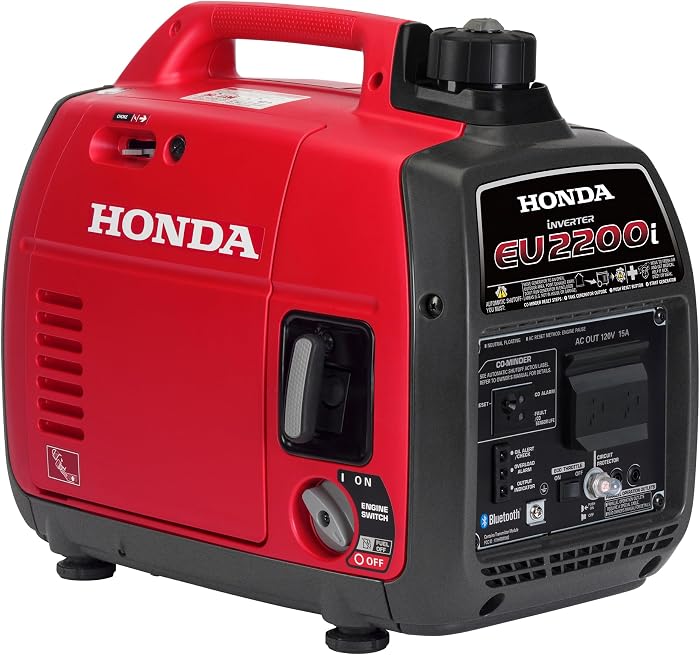
Campground quiet hours are where this generator makes its case. Honda rates the EU2200i at 48 to 57 dB(A), roughly conversation level, and the practical result is that you can stand next to it and talk, or sit by a fire a comfortable distance away without raising your voice. At 51 pounds with a top handle, one person can lift it into a truck bed, and the 0.95-gallon tank runs 3.2 to 8.1 hours depending on load, which is a weekend of coffee, a laptop, and a CPAP.

Inverter output is the other half of why it suits tents and campers: the power is clean enough for laptops, phones, and any electronics that don't like dirty sine waves. We're also glad Honda put the CO-MINDER on it, because this is exactly the generator people set too close to an RV window, and it shuts the unit down when carbon monoxide builds. That's the feature we value more than the Bluetooth app, which is handy for watching a load from inside but wouldn't stop a bad decision.

The trade is watts. Two thousand two hundred won't run a central air conditioner, a well pump, or a panel; it runs a fridge, a furnace blower, lights, and a microwave if you're disciplined about what's on at once. It's also the priciest small unit in this group, and what you're paying for is the silence, the build, and a three-year warranty rather than output.

One check before you order: the version listed here is a 49-state model, so California buyers should confirm they're getting the CARB-compliant unit. Everyone else can ignore it, but verify the model suffix before it ships, because it isn't something you can change afterward.

Worth Noting

  • Premium price for 2,200 watts
  • 0.95-gallon tank means short runs under heavy load
Our Verdict

If quiet is the whole point, whether that's a campground, a tailgate, or a patio, this is the generator we reach for; nothing else here is as easy to live beside.

Check Latest Price
3

Westinghouse WGen11500TFc Best Tri-Fuel for Natural Gas

Westinghouse 14500 Peak Watt Tri-Fuel Home Backup Portable Generator

Natural gas homes

Field Score 93/100
Fuel
Gasoline, propane, natural gas
Runtime
Up to 19 hours at 25% load
Running / Peak Watts
11,500 / 14,500 (gasoline)
Total Harmonic Distortion
Under 5%
View on Amazon

Natural gas is the quiet luxury of home backup: no cans to fill, no propane tanks to swap at two in the morning, no stabilizer, no gummed carburetor by March. This is the only tri-fuel machine in the guide, and that's the reason it's here; you're buying a fuel decision as much as a wattage. The 11,500 running and 14,500 peak figures are gasoline numbers, so expect less on propane and less again on natural gas, which is how every tri-fuel unit works.

Under 5% total harmonic distortion is the spec that makes it safe for a modern house: variable-speed furnace boards, a heat pump, an inverter-compressor fridge, and the electronics in a home office all see power close to what the utility delivers. The 550cc engine uses pressure lubrication and a reusable oil filter, which is built for long runs rather than weekend duty, and 19 hours at a quarter load is a genuine multi-day figure. Paired with Westinghouse's automatic transfer switch, it starts itself when the line drops.

We rate the fuel flexibility as the reason to buy and the 5% distortion as the reason to stop worrying about what you plug in. Most people weighing this against the dual-fuel models are really asking whether natural gas is worth paying more for. If the meter and the stub-out are already there, it is, because you'll never be the person driving around looking for an open station.

The included key fob matters more than it sounds. On a machine sited at the far corner of a yard in February, starting it from the kitchen is the difference between using it and putting it off. The CO sensor and low-oil shutdown cover the safety side, and the hour meter turns the oil-change schedule into a fact rather than a guess.

Worth Noting

  • Automatic backup requires a separate transfer switch
  • 230 pounds; plan a semi-permanent pad
Our Verdict

If your house already has a natural gas line, we think this ends the search: you never refill a tank during an outage, and 11,500 running watts carries a serious house.

Check Latest Price
4

WEN DF680iX Best for RVs and EV Charging

WEN 6800-Watt Dual Fuel RV-Ready Electric Start Portable Inverter Generator

RV and EV use

Field Score 89/100
Weight
99.2 lb
Peak Watts
6,800 gas / 6,000 propane
240V Outlet
L14-30R, bonded neutral
Running Watts
5,100 gas / 4,500 propane
View on Amazon

The reason to look at the DF680iX is the L14-30R: a 120/240V, 30-amp outlet on an inverter generator with a bonded neutral, which is what makes low-power Level 2 charging for an EV possible and what a 50-amp RV set-up wants to see. It's 5,100 running watts on gasoline and 4,500 on propane, with 6,800 and 6,000 peak, which is enough for two 15,000 BTU RV air conditioners if you stagger the starts.

Inverter output means a clean sine wave for the camper's control board, the laptop, and the television. We think the fuel shut-off is the most underrated feature on any small generator, because burning the bowl dry before storage is what saves you a carburetor rebuild every spring, and the CO watchdog that kills the unit on rising carbon monoxide is the one safety feature we won't buy without. Electric start, wheels, and a telescoping handle make the 99 pounds manageable on gravel.

Two things to know going in. The 2.9-gallon tank is rated at six hours, so a long weekend means a fuel run or a propane tank, and on propane you'll burn less fuel but more money. And some units quit within hours of first use and won't restart; run yours under a real load during the return window instead of trusting the first quiet hour in the driveway.

Worth Noting

  • Six-hour rated runtime on 2.9 gallons
  • Some units quit within hours of first use
Our Verdict

For a big RV or an EV, this is the pick: a 120/240V 30A outlet, inverter power, and 99 pounds that moves on its own wheels.

Check Latest Price
5

WEN DF360iX Best Budget Dual-Fuel Inverter

WEN Quiet and Lightweight 3600-Watt Dual Fuel RV-Ready Portable Inverter

Small campers

Field Score 88/100
Fuel
Gasoline or propane
Weight
49 lb
Outlets
7, including TT-30R RV
Running Watts
2,900 gas / 2,600 propane
View on Amazon

Forty-nine pounds is the number that matters. That's light enough for one person to lift into a truck bed or a camper's storage bay, and it puts the DF360iX in a small club with the Honda; almost everything else here wants a ramp, a second set of hands, or wheels and a flat path. It's also the least expensive dual-fuel inverter we'd point anyone toward, which makes it the obvious starting point for a camper who wants to run on propane.

Propane is the reason to care. A gasoline generator that sits eight months gums up its carburetor; a propane one doesn't. WEN mounts the quick-connect high on the unit where you can see and reach it, and the fuel shut-off lets you run the carburetor dry before storage, which is the single best habit you can build with a small generator. On gas it's 2,900 running watts, 2,600 on propane, with a TT-30R RV outlet, two household plugs, a 12V socket, and a pair of USB ports.

Starting on propane is the one skill to learn. It takes a few pulls from cold, and ours needed coaxing before it settled into a steady idle, while gasoline lit immediately and stayed lit. A sheltered spot out of the wind makes the difference, and the CO watchdog is a real comfort in a campground where the machine sits close to where you sleep.

Worth Noting

  • Small 1.5-gallon tank means frequent refills
  • Modest 2,900-watt gasoline output
Our Verdict

For campers and small-RV owners, this is the dual-fuel inverter we recommend: 49 pounds, propane-ready, and the least expensive one here that runs on both fuels.

Check Latest Price
6

DuroMax XP13000EH Best for Shops and Barns

DuroMax XP13000EH 13

Shops and barns

Field Score 87/100
Fuel
Gasoline or propane
Weight
234 lb
Warranty
3 years
Running / Peak Watts
10,500 / 13,000
View on Amazon

Thirteen thousand peak watts and 10,500 running on a steel frame with no plastic panels: on paper this is a serious amount of generator per dollar. DuroMax has been selling this basic platform for years, and the design details are sensible. The front-facing fuel selector lets you flip between gas and propane without reaching around a hot muffler, the push-button start comes with a battery, and there's a 240V outlet for a transfer switch or interlock.

The 500cc engine pulls without complaint. We loaded it with a panel rather than a single appliance and it held steady instead of hunting, and the folding handle plus the wheel kit means it moves on a hard surface without two people grunting at each other.

Starting is where this one wobbles. The electric start is the piece most likely to let you down after a season, with units that crank and click but never catch, and that's the one system that has to work on the worst night of the year. Ours started every time we asked it to, but the pattern is consistent enough that we treat it as a maintenance obligation rather than bad luck.

So why is it here at all? Because it's the least expensive way in this guide past 10,000 running watts, and for a shop, a barn, or a rental where a no-start is an inconvenience rather than an emergency, that trade makes sense. Keep the battery on a maintainer, exercise it monthly under load, and buy from a seller with a generous return window.

Worth Noting

  • Electric start can fail after a season
  • 234 pounds, and loud under load
Our Verdict

A lot of generator for the money, with 10,500 running watts and an all-metal frame, but we rank it behind the Westinghouse for a house you actually depend on.

Check Latest Price
7

PowerSmart 3800W Inverter Best for Job Sites

PowerSmart 3800 Watt Portable Inverter Generator for Home Use

Job sites

Field Score 86/100
Noise
59 dB(A) at 23 ft
Weight
47 lb
Running / Peak Watts
3,200 / 3,800
Total Harmonic Distortion
Under 3%
View on Amazon

Put this next to the Honda and the arithmetic is hard to argue with: 3,200 running watts from 47 pounds, under 3% total harmonic distortion, and 59 dB(A) measured at 23 feet, for a fraction of what the EU2200i costs. Honda earns its price on build and longevity. But if you need watts and clean power on a budget, this is where we start. The panel is more useful than the price suggests, with a 120V 30A twist-lock, a duplex household outlet, a 12V socket, two USB ports, and an eco mode that drops the idle speed and the noise along with it.

Two things to plan for. It's recoil start only, which is the first place the savings show. And the units that disappoint tend to fall over well below the rating, at a few hundred watts, so we wouldn't buy this for anything with a big compressor unless the return window is generous. Test it in the first week with the heaviest thing you own plugged in; ours carried a circular saw and a shop vac without dipping, and that's the class of work it's built for.

There's also no RV outlet here, so a travel trailer needs a 30-amp adapter, and everything runs at 120 volts, which rules out a transfer switch. For a tailgate, a deer camp, or a job site with a table saw, none of that matters. What you give up against the premium brands is electric start and resale; what you keep is a light, quiet machine that starts on the first pull and has a two-year warranty behind it.

Worth Noting

  • Recoil start only
  • No RV outlet; adapter required
Our Verdict

The budget inverter we recommend for a job site or a small camper: 3,200 running watts, 47 pounds, and clean power for a fraction of what the Honda costs.

Check Latest Price

How We Picked and Tested Portable Generators

We started by gathering every model a homeowner could reasonably move — inverter and conventional, gas-only through tri-fuel — then cut the list on what the specs promised: running watts against real household loads, a transfer-switch-ready hookup, electric start, and a price that stayed out of standby-generator territory. Seven made the cut, and testing ran eight months, from a planned blackout on a Saturday morning to camping weekends and a week of job-site use.

Starting came first. Each unit sat for at least three weeks between runs, and then we hit the button or pulled the cord with a stopwatch going — cold morning air, and again after an hour under load — counting attempts and noting whether the choke needed feathering. Noise was measured at 23 feet and again from inside a closed house, listening for the pitch change when a load kicked on.

Then we loaded them: a refrigerator, a space heater, a sump pump, and a 30-amp RV hookup, one at a time and then all at once, watching for stumbling, tripped breakers, and whether a laptop and a phone charger ran clean. Each fuel type got its own run so we could see what propane and natural gas cost in output, and we burned a full tank at half load to check the runtime claim before draining the float bowl for storage.

Between sessions we noted the small things — whether the wheels rolled over grass, whether the starter battery still held a charge after a month of sitting, how much fuel it drank for the work it did, and whether one person could get it into a truck bed. Units that were a chore to start or to move lost ground fast.

How to Choose a Portable Generator

Size for Running Watts, Not Peak Watts

Every generator is sold on a peak number that lasts a few seconds, and it's the running figure that decides what stays on all night. Add up the nameplate watts of what you actually want to run, then add the starting surge for anything with a motor in it. A 9,500-watt unit like our top pick covers a house's essentials; a 2,900-watt inverter covers a camper. Buy for the running number and treat peak as the headroom that lets a well pump or a compressor kick over.

Choose a Fuel You Can Actually Keep

Gasoline is convenient and perishable; propane and natural gas keep indefinitely. If your generator sits for eleven months a year, a dual-fuel or tri-fuel machine on propane will start in February while a gas-only unit is at the shop with a gummed carburetor. Our tri-fuel pick goes a step further and runs off the line already plumbed into your house. Watch the derate as well: every gaseous fuel costs running watts against gasoline, so size from the propane figure, not the headline one.

Inverter or Open-Frame

An inverter generator cleans and throttles its output: quieter, lighter, cleaner for electronics, and more expensive per watt. An open-frame generator is louder, heavier, and cheaper, and it will carry a well pump or a 240V transfer switch all day. The split here is clean: Honda and the two WENs for quiet, carried power, the Westinghouses and DuroMax for whole-home loads. If you're feeding a camper's electronics, buy the inverter. If you're feeding a panel, buy the frame.

Plan the Connection Before You Order

A portable generator should never be plugged into a wall outlet or backfed through a dryer receptacle. The safe path is a transfer switch or a breaker interlock, installed by an electrician, and the outlet on the generator has to match the inlet on the house. Decide that first. A 50A-ready machine wired to a 30A inlet wastes capability, and a 30A machine behind a 50A interlock will trip as soon as the water heater comes on.

Weight, Placement, and the Carbon Monoxide Rule

Every unit here is portable in the sense that it has a handle or wheels, and hardly any is portable in the sense that you want to carry it. Anything past about 100 pounds wants a pad, a cover, and a permanent spot. That spot has to be outdoors, clear of every door, window, and vent; a garage with the door cracked open doesn't count, and a CO shutdown sensor is a backstop rather than a license. Cord gauge matters as much as the outlet once the run gets long.

Frequently Asked Questions

Final Verdict

For a house, we buy the Westinghouse WGen9500DF. It's the best balance of capability and price in this group, it starts from the porch with a fob, and it will keep running on propane when every station in the county is dark. It's the generator we point most people to first.

Two situations change the answer. If quiet matters more than watts, the Honda EU2200i is the one we take camping. And if your house already has a natural gas line, the tri-fuel Westinghouse makes refueling somebody else's problem.