The 8 Best Portable Power Stations of 2026

The power went out at 9:40 on a Tuesday, and by 9:45 I had counted what I actually needed: the router, the fridge, a phone at 8 percent. That's the job a portable power station does — a battery in a suitcase-sized box that keeps the essentials running when the grid quits, or when there was never a grid to begin with.

Shopping for one comes down to two numbers people mix up: watt-hours is how long it runs, watts is what it can start. A 300Wh pack charges laptops and pushes a fan overnight; a 3,000Wh unit holds a fridge and a space heater. Chemistry matters too — lithium iron phosphate shrugs off years of charging and doesn't mind sitting full.

We've spent eight months with 12 of these, from a pack that fits in a daybag to a 3,600Wh box with wheels, through real outages, campsites, and a hot garage. Size on paper turned out to be the least interesting number. What separated them was how fast they refilled and how they felt on the stairs, and the picks below are the ones I'd plug my own fridge into.

Our Top Picks

The 8 Best Portable Power Stations of 2026

1

Jackery Explorer 1000 v2 Best Overall

Jackery Explorer 1000 v2 Portable Power Station

Camping and outages

Field Score 94/100
Weight
23.4 lb
Capacity
1,024Wh
AC Output
1,500W (3,000W surge)
Recharge Time
50 min (fast mode)
View on Amazon

The 1,024Wh Explorer 1000 v2 sits at the point where a power station stops being a phone battery and starts being useful backup. At 23.4 pounds it is still a one-person carry, and its 1,500W AC output (3,000W surge) covers a fridge, a router, lights, and a laptop without making you choose. That balance is why it is our overall pick: it does enough for a weekend or a short outage without turning into a two-person lift.

The 50-minute recharge is the detail we appreciate most. Jackery requires the app's emergency charging mode to hit that number, and we like having the option rather than a fixed slow charger. A 10ms UPS mode also means it can sit between a router or desktop and the wall, though this is not a whole-home transfer switch. For campsite use, the two AC outlets, two USB-C ports, USB-A, and 12V car port cover the usual mix of gear.

We found the folding handle and 12.3 by 7.9 by 9.2-inch body easy to wedge behind a seat or carry into a cabin. The 1,500W ceiling is the real boundary: a full-size fridge, space heater, or well pump may demand more. That is the point where the Anker's extra output starts to matter, but for most plugs in a house or a camper, this is enough.

Where it wins is as a default, not a specialist. It has enough capacity for a car fridge or a few days of essentials, enough output for most household plugs, and a recharge fast enough that a lunch stop can reset it. If your load includes a pump or several high-draw appliances at once, step up to the Anker; otherwise this is the one we reach for first.

Worth Noting

  • Only two AC outlets
Our Verdict

For most campers and households, the Explorer 1000 v2 is the portable power station to buy: it runs the essentials, recharges before lunch, and one person can move it.

Check Latest Price
2

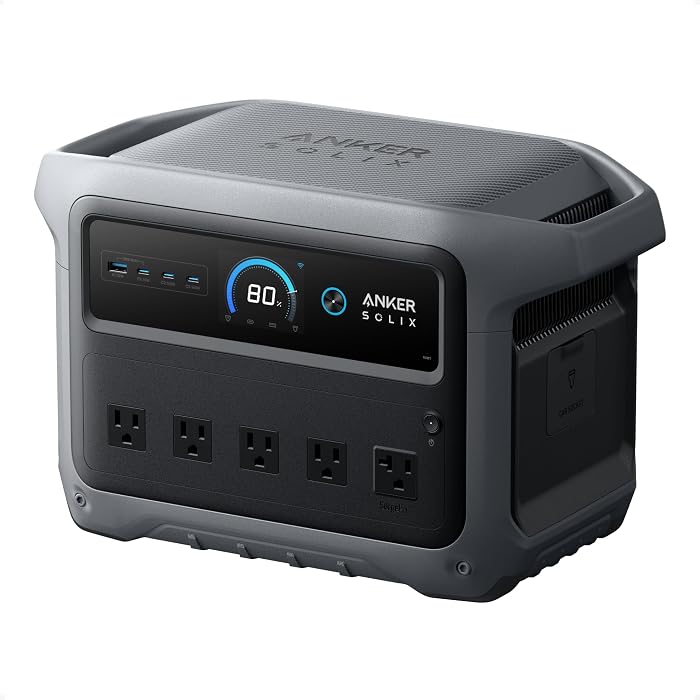
Anker SOLIX C1000 Gen 2 Best for High-Power Loads

Anker SOLIX C1000 Gen 2 Solar powered Generator

High-power appliances

Field Score 93/100
Weight
24.9 lb
Capacity
1,024Wh
AC Output
2,000W (3,000W peak)
Recharge Time
49 min
View on Amazon

Two thousand watts is the number that separates the SOLIX C1000 Gen 2 from the 1,500W stations here. That extra headroom is what lets it start a fridge compressor, a space heater, or a circular saw without tripping, and the 3,000W peak covers brief surges. We noticed the difference when comparing loads that sit near a smaller station's ceiling: this one has room to breathe.

The 1,024Wh LiFePO4 battery is the same headline capacity as our top pick, but Anker pairs it with a 49-minute recharge and a claimed 4,000 cycles to 80% capacity. The unit is about 24.9 pounds, so it is a two-hand carry for most people, and the 10 ports include enough USB-C for laptops and cameras. The app adds monitoring and charging modes; basic use does not require it.

We like the two-handle shape for moving between a kitchen, garage, and truck, and the 10ms UPS mode makes it a better fit for a desktop or router that cannot blink. The 2,000W ceiling is also more forgiving with power tools than the 1,500W units, which is the practical reason to pay attention to this model rather than treat it as another 1kWh box.

The case for the C1000 Gen 2 is narrower than the top pick's and stronger for one kind of buyer: someone whose appliance list includes a high-draw tool or a fridge that needs a clean start. If your load is lights and phones, save the weight and money. If it is a pump, heater, or workshop tool, the 2,000W ceiling is the reason to choose this one.

Worth Noting

  • Fastest recharge requires app mode
  • Solar panel sold separately
Our Verdict

The C1000 Gen 2 is the one we point to when a 1,500W station cannot start the load; its 2,000W output and quick recharge suit power-hungry appliances.

Check Latest Price
3

Jackery Explorer 300 Best Compact

Jackery Explorer 300 Portable Power Station

Lightweight camping

Field Score 92/100
Weight
7.1 lb
Capacity
292Wh
AC Output
300W (600W surge)
Recharge Time
4 hr AC
View on Amazon

At 7.1 pounds, the Explorer 300 is the station we grab when the walk from the truck is part of the trip. The integrated handle makes it a one-hand carry, and its 9.1 by 5.2 by 7.8-inch body fits on a tailgate or under a camp chair. You give up capacity for that convenience: 292Wh and 300W continuous output are sized for lights, phones, a fan, a laptop, and a CPAP, not a fridge or a heater.

The useful surprise is the LiFePO4 battery, which Jackery rates for more than 4,000 cycles to 70% capacity. At this size that matters more than a big output number, because a small station is often bought for years of occasional use. We like the 100W USB-C port for a laptop and the 12V car port for a cooler or inflator. A 600W surge gives small motors a brief push, but it does not turn this into a high-draw tool battery.

The AC charger is a wall-tethered affair, and a 100W solar panel is the better camp answer if you already own one. For a solo camper or a light emergency kit, the size is the feature. For a family outage, step up to the 1,000Wh picks. The Explorer 300 ends up being the smallest station here we can recommend without a list of exceptions.

Worth Noting

  • 4-hour AC recharge is slow
Our Verdict

Buy the Explorer 300 when the day's gear is phones, lights, and a CPAP and you want a station that disappears into the truck.

Check Latest Price
4

BLUETTI Elite 30 V2 Best for CPAP and Router Backup

BLUETTI Elite 30 V2 Portable Power Station 288Wh 600W LFP Solar Generator

CPAP and routers

Field Score 90/100
Weight
9.5 lb
Capacity
288Wh
AC Output
600W (1,500W lifting)
Recharge Time
45 min to 80%
View on Amazon

The Elite 30 V2 is not the station for a fridge, a space heater, or a whole-room backup. It is the one we choose for a CPAP, a router, a laptop, and a few lights, where a 288Wh battery and a 10ms UPS handoff are more useful than a bigger box you cannot carry. At 9.5 pounds it still fits in a backpack, and the 600W continuous output is double what several small stations here offer. The body is small enough to stash under a desk or in a truck cab, which is not true of the 1kWh units.

What makes it credible is the power-lifting mode: BLUETTI claims 1,500W for brief loads, which can help a small appliance start, but we treat that as a short burst rather than a continuous rating. The 380W wall charge reaching 80% in 45 minutes is the other practical advantage; it turns a lunch stop into a useful recharge. The 60-month warranty is longer than most here, and the nine outlets cover USB-C, USB-A, and AC gear. Five years of coverage on a battery this small is a meaningful vote of confidence.

Worth Noting

  • 288Wh limits longer outages
Our Verdict

The Elite 30 V2 makes sense for a CPAP, router, or laptop that must keep running through a short outage, with a UPS handoff and real 600W output.

Check Latest Price
5

PECRON F3000LFP Best Large-Capacity Value

PECRON Portable Power Station F3000LFP

Large home backup

Field Score 89/100
Weight
63.3 lb
Capacity
3,072Wh
AC Output
3,600W
Recharge Time
2 hr AC
View on Amazon

Two hours is the recharge claim that first got our attention: the F3000LFP can go from empty to full on a 1,800W AC circuit in about that time, which is quick for a 3,072Wh battery. That matters in a real outage, when you may have a short generator window or a wall outlet between storms. The 3,600W output and 13 ports also put it in a different class from the 1,000Wh stations here.

At 63.3 pounds it is not a camping carry. Think of it as a two-person home unit that can move to an RV or job site. The LiFePO4 battery, 8-20ms UPS mode, and expandable capacity to 10,752Wh make that role coherent. We also like the six AC outlets, which let you leave a few things plugged in instead of playing outlet roulette.

The value case is the one we keep coming back to: this is a lot of capacity and output for the money compared with the flagship home batteries here, and it does not force you into a single-brand ecosystem to get started. Fan noise is the thing to check before putting it beside a bedroom, since a large inverter has to shed heat. For a garage, basement, or cabin, that is an easy trade. This is the large-capacity pick we recommend when the budget is real but the load is serious.

What it is not is a grab-and-go station; that is the 1,000Wh group's job. If you need to carry power up a trail, the smaller picks are better. If you need to keep a fridge, well pump, or several rooms alive, the F3000LFP earns its space.

Worth Noting

  • App and Bluetooth can be finicky
Our Verdict

For a large outage load on a tighter budget, the F3000LFP delivers 3,072Wh and 3,600W without the flagship-home-battery price.

Check Latest Price
6

EcoFlow DELTA Pro Best Expandable Home Backup

EcoFlow DELTA Pro – EF ECOFLOW Portable Power Station 3600Wh DELTA Pro

Expandable home backup

Field Score 88/100
Capacity
3,600Wh
AC Output
3,600W (4,500W X-Boost)
Recharge Time
2.7 hr at 120V
Expandable Capacity
Up to 25kWh
View on Amazon

The DELTA Pro is less a portable power station than a home battery that happens to have a handle. Its 3,600Wh LFP battery and 3,600W AC output can carry a fridge, lights, and a few small appliances, and the unit expands to 25kWh with extra batteries. That expandability is the reason it is here: it lets a buyer start with one box and grow into a larger backup system.

The 2.7-hour recharge on a 120V wall outlet is quick for this capacity, and EcoFlow lists five charging paths including solar, car, and EV station. The 4,500W X-Boost mode can run some appliances that draw more than the continuous rating, but it is a managed mode rather than a free wattage upgrade. We like the app control for watching loads and planning a recharge, though the sheer size means this lives in a garage or utility room.

Two units can be paired for more output, which is the detail that makes it a genuine home-backup candidate rather than a big camping battery. That setup also pushes it well beyond one-person portability and into installation planning. If your goal is a transfer-switch setup or phased whole-home backup, the expandable architecture is worth the premium. If you just need a weekend station, it is more machine than you need.

Our reservation is that the DELTA Pro asks you to buy into a system. The base unit is already premium, and the ecosystem is part of ownership. That is a fair trade for a homeowner planning for multi-day outages. It is the wrong first station for someone who mainly camps. We recommend it for the expandable-home role, not as the default portable pick.

Worth Noting

  • Expansion batteries are extra
Our Verdict

The DELTA Pro is for the buyer planning whole-home backup and future expansion, not for carrying to a campsite.

Check Latest Price
7

MARBERO M188

MARBERO Portable Power Station 350W Peak Camping Solar Generator Laptop Charger

Budget emergency power

Field Score 86/100
Weight
5.7 lb
Outlets
2 AC, USB, DC
Capacity
296Wh
AC Output
300W
View on Amazon

The M188 is the budget station we point to when the job is phones, a fan, a light, and maybe a laptop. Its 296Wh battery and 300W AC output are modest, and the two AC outlets are the main event; the USB and DC ports cover the rest. At 5.7 pounds it is easy to move from a shelf to a table when the power goes out.

We like the built-in LED light and the simple port layout for an emergency kit, and the 296Wh capacity is enough to charge a phone many times or keep a small fan going overnight. The unit is not a fridge or heater solution, and the AC output should be treated as a hard ceiling rather than a suggestion. Keep it topped off between uses, because the recharge is not something to start when the lights are already out.

The reason it stays on the list is price. It gives a first-time buyer a real AC outlet and a usable battery for much less than the 1,000Wh stations, and the controls are simple enough to hand to someone who does not want an app. We keep the recommendation narrow: short outages, light devices, and a budget. If you need to run a compressor or a heater, this is not the station, and the 1,000Wh picks are the better spend.

Worth Noting

  • 7-8 hour AC recharge
Our Verdict

The M188 is the budget station to keep for phone charging and short outages, as long as you stay under its 300W ceiling.

Check Latest Price
8

Daran YOUYO R100

Daran Portable Power Station 89.6Wh LiFePO4 Battery 100W(200W Peak) Solar Power

Backpack carry

Field Score 85/100
Weight
2.54 lb
Capacity
89.6Wh
AC Output
100W
Battery Cycles
3,500+
View on Amazon

The R100 is about the size of a thick smartphone and weighs 2.54 pounds, so it disappears into a backpack or glovebox. That is the entire appeal: 89.6Wh and 100W AC output are enough for a laptop, a camera, a phone, and a small light, not for a cooler or a camp fridge. The two AC outlets are real, which is more than a USB power bank offers, and the soft handle and four-level light are useful touches in a tent.

For a station this small, the LiFePO4 battery and fanless design are the two details that make it worth carrying; we were glad to see LiFePO4 at this size. The 100W ceiling is the number to respect; a device that pulls more will trip the output, even if a higher-wattage appliance looks like it should work. The seven ports include USB-C PD and two AC outlets, so it covers a small work or camera kit well.

The 89.6Wh capacity is honest about what it can do: a phone several times, a laptop for a work session, a camera battery and a light. We keep it in a camera bag for that reason. It will not replace a 300W station, and it should not be asked to.

Worth Noting

  • 89.6Wh needs frequent recharging
Our Verdict

The R100 is for a backpack or glovebox, where 100W is enough and 2.54 pounds is the whole point.

Check Latest Price

How We Tested Portable Power Stations

We started with about 40 models on the shelves at the big retailers and cut the list using specs that actually change daily life: lithium iron phosphate batteries, a wall recharge under two hours, at least one USB-C PD port, and an output rating that made sense for the price. That left 12 units across four size classes, all purchased at retail so nothing arrived pre-conditioned by a brand.

Those 12 spent eight months where power stations actually live. A pair sat on a home office floor through a 14-hour outage, a couple rode in a truck bed to campsites and a tailgate, and the wheeled ones moved between a garage and a laundry room. We timed every recharge from zero to full on a standard outlet, then again off a 200W solar panel on a partly cloudy afternoon, watching the input number fall as the panels heated up. Each unit got weighed and carried up a flight of stairs one-handed, because the handle matters more than the spec sheet.

For performance, we ran the same loads in every size class — a mini fridge, a box fan, a CPAP, a laptop dock, and a hair dryer for the peak-output test — then pulled a steady 500W load until each battery died so we could compare real watt-hours against the label. A decibel meter at arm's length gave us noise numbers while fast-charging and under load, and one unit per class spent a night at the foot of a bed. We paired every app and walked out of Bluetooth range to see whether it reconnected on its own, dropped tailgates on the corners, and left the big units in a 100-degree garage all summer to check for capacity drift.

How to Choose a Portable Power Station

Start With the Load, Not the Watt-Hour Rating

Add up the watts of the devices you want to run at the same time, then check the station's continuous AC output. A 300W unit can handle a fan, lights, and a laptop; it will not start a fridge compressor or a space heater. Surge or lifting ratings are brief, so do not treat a 1,500W peak as a continuous 1,500W. We prefer a station with honest headroom over one that only clears the load on paper.

Match Capacity to the Outage You Expect

Watt-hours tell you how long, not how much at once. A 300Wh station is a phone, light, and CPAP kit; a 1,000Wh unit can carry a fridge, router, and a few comforts through a short outage; a 3,000Wh-and-up box is a home-backup purchase. Actual runtime falls as the load rises, and a cold night or an old fridge can pull more than the label suggests. Buy for the longer of your camping trip and your typical outage, not the best-case number.

Portability Is a Weight and Handle Decision

Portable covers everything from a 2.5-pound packable battery to a 63-pound home unit. For camping, look at carry weight, handle shape, and whether it fits behind a seat; for home backup, wheels and a place near the door matter more. A 24-pound station is a one-person lift for many adults but not a long hike. We treat 20 to 25 pounds as the practical upper end for routine camping, and we move to a different design above that.

Recharge Speed and Sources

Fast charging is useful only if it fits your power source. A 50-minute recharge needs a high-output wall circuit and, on some models, a fast mode in the app; a 100W solar panel will not refill a 1,000Wh station in an hour. A solar generator is simply a power station with a solar input, and the panel is usually sold separately. Match panel wattage to battery size, and keep a car charger as a backup rather than a primary plan.

Ports, UPS, and Expandability

Count the AC outlets before you buy, especially if a family will share the station. USB-C PD is the port that matters for laptops and phones, while a 12V car socket keeps a cooler or inflator working. A UPS mode with a 10ms switchover protects a router or desktop, but it is not a whole-home transfer switch. Expandable models let you add batteries later; buy that architecture only if you plan to use it.

Frequently Asked Questions

Final Verdict

For most buyers, the Jackery Explorer 1000 v2 is the portable power station to start with. It has enough capacity and AC output for a fridge, router, and lights, and at 23.4 pounds one person can still move it. The 50-minute recharge is the practical bonus that makes it useful between outages, not just during them.

If your load includes a pump, heater, or power tool, choose the Anker SOLIX C1000 Gen 2 for its 2,000W output. If you are building a larger home backup system and can plan around the size, the EcoFlow DELTA Pro is the expandable route.