The 8 Best Power Banks with Built-In Cables of 2026

A dead phone at 2% is annoying. A dead phone and no cable is a small emergency. That’s the appeal of a power bank with a built-in cable: the cord is already there, so you’re not excavating a bag while your battery icon turns red. But the cable is only half the story. Some banks have one short USB-C cord; others have four cables and enough ports to charge a phone, earbuds, and a tablet. The ones worth carrying are also light enough to forget, small enough for a jacket pocket, and fast enough to add real juice in a 20-minute stop.

I’ve carried a rotating cast in a tote, a car console, and a jacket pocket. Over six months, we tested 12 power banks through commutes, weekend trips, and airport days. We weighed them, timed how quickly they charged a low phone, counted full charges before a recharge, and checked whether the price matched the capacity. We also noted whether the built-in cable stayed put and whether the battery readout told the truth. The picks earned a permanent spot in a bag.

Our Top Picks

The 8 Best Power Banks with Built-In Cables of 2026

1

Orfeika K26F Best Overall
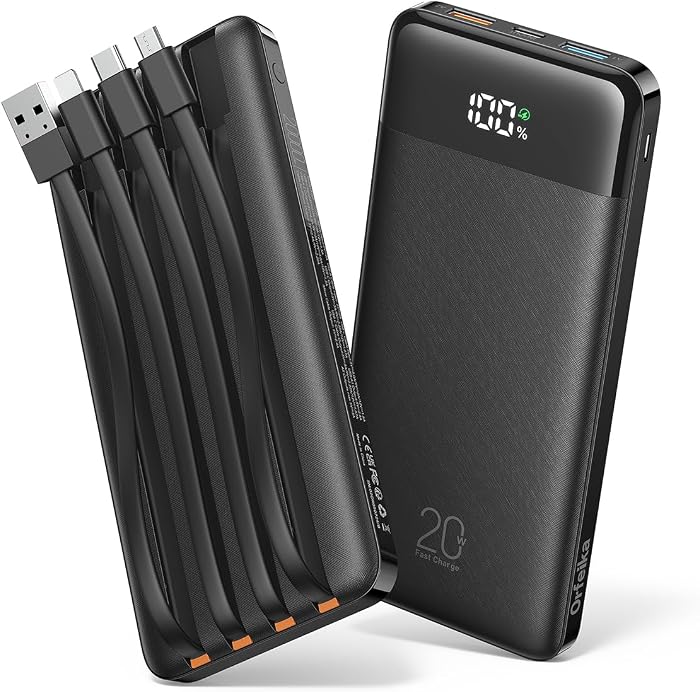
Orfeika 20000mAh Power Bank

Everyday all-round charging

Field Score 94/100
Weight
0.73 lb
Capacity
20,000 mAh
Max Output
20W USB-C PD
Built-in Cables
4 (3 output, 1 input)
View on Amazon

A day away from an outlet usually means three things need charging: a phone, a headlamp or earbuds, and whatever else rode along in the truck. The Orfeika K26F is built for that day — a 20,000mAh pack with four cables folded into the body (iPhone, USB-C, micro-USB, and USB-A) plus three external ports, so six devices can draw from it at once.

What makes it our pick is the input side. Two of those built-in cables and two of the ports refill the bank itself, so it tops up from a USB-C wall charger, a truck's USB-A port, or a laptop without hunting for the one cord that fits. That's where power banks actually fail people: the output works fine, but the pack dies because the cable you brought charges the phone and not the battery. Here it recharges off whatever is already in the vehicle.

Capacity is honest for the size. Orfeika rates 20,000mAh at roughly three full charges of an iPhone 16, and the USB-C port runs 20W, which the maker puts at half a phone in about 45 minutes. At 6.33 by 2.85 by 0.74 inches and 0.73 pound it slides into a door pocket, a saddle bag, or a pack lid without a bulge to explain, and the percentage readout tells you it's at 43% instead of leaving you to guess from four little lights.

Orfeika covers it for two years, longer than most of the packs here, and on a battery that's going to get dropped in a truck box that counts as part of the specification rather than a footnote.

Worth Noting

  • 20W output, so it won't charge a laptop
Our Verdict

We recommend it as the default for a mixed bag of gear: four built-in cables, four ways to refill it, and three phone charges at 0.73 pound.

Check Latest Price
2

Anker Zolo 20K Best for USB-C Households

Anker Power Bank

USB-C-only households

Field Score 93/100
Weight
12.9 oz
Capacity
20,000 mAh
Max Output
45W total, 40W to iPhone 17
Built-in Cables
2 USB-C
View on Amazon

Two USB-C cables are built into this one, and that single decision tells you who it's for. If everyone in your truck is on an iPhone 15 or newer, or on Android, there is nothing else to bring: two phones charge at once with no cords, no dongles, and no argument about whose cable is whose. It's the cleanest version of the idea in this group, and the price reflects it.

The power is the part that surprises people. Anker rates 45W total, up to 40W into an iPhone 17 series, shared across the two built-in cables plus a USB-C port and a USB-A port. The whole pack holds four full iPhone 16 charges in 12.85 ounces — about two ounces less than our 87W pick, which is the sort of difference you notice in a jacket pocket.

The limit is the cable set. Two USB-C cables and nothing else means an older iPhone on Lightning, a headlamp on micro-USB, or a GPS collar still needs a cord you supply. For a household that's entirely USB-C it's the nicest pack here to live with; for a mixed bag of gear, the four-cable packs below cover more ground.

Worth Noting

  • No Lightning or micro-USB cable built in
Our Verdict

The pick for a household that's fully USB-C: two built-in cables, 45W, and four phone charges in a 12.85-ounce body.

Check Latest Price
3

Anker 87W Best for Laptops

Anker Power Bank

Laptops and cameras

Field Score 92/100
Weight
15.2 oz
Capacity
20,000 mAh
Max Output
87W total, 65W single device
Built-in Cable
1 USB-C
View on Amazon

Eighty-seven watts is the number that matters, and it changes what this pack is for. An ordinary 20,000mAh bank tops out around 22.5W and won't meaningfully charge a laptop. This one pushes 65W into a single device and splits 87W across three, which puts a 14-inch MacBook, a tablet, or a camera battery on the list of things you can keep alive from a truck seat.

The case for spending more is simple: one permanently attached USB-C cable, enough headroom that you stop carrying a laptop brick on a two-day trip, and a refill of about an hour and a half through USB-C — faster than nearly anything else here. Anker rates the capacity at four full iPhone 16 charges, so it is still a phone pack when the laptop stays home.

It is also the heaviest 20,000mAh pack in this group at 15.2 ounces, and the single built-in cable is USB-C only. Neither is a dealbreaker for the job it does — nobody buys an 87W pack to save weight — but if your heaviest device is a phone, the Zolo above does the same work at two ounces less.

Worth Noting

  • Heaviest 20,000mAh pack in this group
  • Only one built-in cable, and it's USB-C
Our Verdict

Choose it when the device that has to survive the trip is a laptop or a camera, and 65W to one port is worth 15.2 ounces.

Check Latest Price
4

LHUOED X6 Best for Basecamp

LHUOED X6 – Portable Charger 50000mAh

Basecamp weekends

Field Score 91/100
AC Plug
Foldable, built in
Capacity
50,000 mAh
Max Output
22.5W
Built-in Cables
2 (USB-C and Lightning)
View on Amazon

A foldable AC plug is built into this one, and it is the only pack here that refills itself from a wall socket with nothing else in your hand. That's the whole argument. At a cabin, a motel, a barn office, or the outlet behind the truck seat, you plug the battery in like a phone charger — no cable, no brick, no adapter left at home. For a basecamp weekend, that's the difference between a full pack on Saturday morning and a dead one.

The capacity is rated at 50,000mAh, which LHUOED puts at about 8.5 full charges of an iPhone 17 Pro Max or 7.6 of a Galaxy S24. Four devices can charge at once from two built-in cables — USB-C and Lightning — plus a USB-C port and a USB-A port. The built-in USB-C cable handles 22.5W, and a refill from the wall takes roughly six hours, so it goes on the charger overnight and comes off ready.

LHUOED backs it for three years, the longest coverage in this group, and on a pack doing this much work that reassurance is most of the reason to spend more than a no-name big battery costs. This is the pick for a wall tent, a horse trailer, or a storm week: one box that holds everything and plugs into a wall by itself.

Worth Noting

  • Two built-in cables, and neither is micro-USB
  • Basecamp-sized rather than pocket-sized
Our Verdict

For a wall tent or a cabin, the built-in AC plug makes it the easiest big pack here to keep topped up.

Check Latest Price
5

Zmmyuluo N1 Best Small and Light

Zmmyuluo N1 – Portable Charger 10000mAh with 4 Built-in Cables 40% Smaller

Pocket and purse

Field Score 90/100
Weight
6.63 oz
Capacity
10,000 mAh
Recharge Time
About 4 hours
Built-in Cables
4
View on Amazon

Weight is the whole story with the Zmmyuluo N1: 188 grams, roughly a phone with a case, and slim enough that it stops being something you think about in a jacket pocket. Four cables are built into it, covering Lightning, USB-C, and micro-USB, so the pack and the cords you'd otherwise carry are one object.

The rest is sensible rather than exciting. 10,000mAh, three amps out, five devices at once, an LED display that reads in actual percent rather than four dots, and a four-hour refill. That capacity is good for about two phone charges, which is a day out and not a weekend.

Buy it as the backup that lives where you do — glovebox, tack trunk, saddle bag — rather than as your only pack. It's the cheapest way here to get four cables plus a readable percentage display, and what it gives up is capacity, not convenience. For a trail ride or an afternoon in a blind, two charges is the right amount; for a three-day hunt, it isn't.

Worth Noting

  • Good for about two phone charges, not four
  • 3A output won't fast-charge a tablet
Our Verdict

Our pocket pick: 188 grams, four cables, and two phone charges for the day you didn't plan to be out this long.

Check Latest Price
6

OHOVIV N10 Best for Long off-Grid Trips

OHOVIV Portable Charger Power Bank 50000mAh

Long off-grid trips

Field Score 89/100
Size
5.82 × 2.83 × 1.18 in
Capacity
50,000 mAh
Max Output
22.5W PD/QC 4.0
Built-in Cables
4 (iPhone, USB-C, micro, USB-A)
View on Amazon

There's no way around the size: 5.82 by 2.83 by 1.18 inches and most of a pound of battery. This is the pack that lives in a truck box or a gear crate, not a jacket. What the bulk buys is a 50,000mAh rating that OHOVIV puts at ten charges of an iPhone 15, which is a different category of backup from everything else here.

Four cables are built in — iPhone, USB-C, micro-USB, and USB-A — plus two USB-A ports and a USB-C port, for six devices at once. Output runs to 22.5W on PD and QC 4.0, and the front panel shows a number instead of a guess.

That micro-USB cable is the detail we keep coming back to. Headlamps, game cameras, GPS dog collars, and a lot of older outdoor gear still run on it, and the premium packs here don't include one — so a big pack with a full cable set covers camp in a way a nicer pack with two USB-C cables doesn't.

Refilling a battery this size is the slow half of owning it. Plan on an overnight every night you use it, and treat the rated ten charges as a ceiling: a cold morning, a phone working hard on a weak signal, and two devices charging at once each take a bite out of it. For a wall tent or a truck that's away from home for days, this is the most capacity you get for the money here.

Worth Noting

  • Heavy and bulky enough to rule out pocket carry
Our Verdict

The capacity play — 50,000mAh and a cable set that includes micro-USB, for a truck box rather than a pocket.

Check Latest Price
7

HELLEE N18

HELLEE N18 – 15000mAh Portable Charger Power Bank

Middle capacity

Field Score 88/100
Weight
8.82 oz
Capacity
15,000 mAh
Max Output
22.5W
Built-in Cables
4
View on Amazon

Fifteen thousand milliamp-hours is the size nobody advertises and a lot of people actually need. It sits between the pocket 10,000mAh packs and the 20,000mAh bricks: HELLEE rates it at up to 3.5 charges of an iPhone 17, which covers a two-night trip without the extra ounces a 20,000mAh pack costs you.

The hardware is complete — four built-in cables, six outputs, a bi-directional USB-C port, 22.5W fast charging rated at half a battery in 30 minutes, and a display that shows where you stand. HELLEE lists a three-hour refill, quick for this capacity and enough to take the sting out of remembering to charge it.

Ignore the 40% smaller framing; the measurements are what matter, and 6 by 3.2 by 1.1 inches at 250 grams is a pack that fits a coat pocket or a saddle bag pocket. It is lighter than every 20,000mAh pick here and heavier than the 10,000mAh ones, which is exactly the trade it's making.

This is the pick when 10,000mAh has left you short and 20,000mAh feels like too much pack: same cable coverage, more headroom, and a refill that fits in an afternoon. If you routinely charge two phones and a tablet at once, step up to 20,000mAh instead — the extra capacity is doing real work there.

Worth Noting

  • 22.5W output, so tablets charge slowly
Our Verdict

The middle is the point: 15,000mAh and 250 grams for anyone who finds 10,000 short and 20,000 too much pack.

Check Latest Price
8

VRURC T1116 Best for Clipping to Packs

VRURC Portable Charger

Clipping to packs

Field Score 87/100
Weight
9.17 oz
Capacity
10,000 mAh
Watt-hours
37Wh
Built-in Cables
4
View on Amazon

A lanyard and a color other than black: the VRURC T1116 is the portable charger you clip to a saddle bag D-ring or a backpack strap and forget about until someone needs it. Lavender is the version we have, and the small things — a strap, a travel pouch, a display that reads in percent — are what separate it from a generic black slab.

Under the shell it's a 10,000mAh pack rated at 37 watt-hours, comfortably inside the carry-on limit for lithium batteries and the reason it's sold as flight-safe. Four cables are built in, five devices can charge at once, the USB-C port works in both directions, and a full refill takes about six hours.

The catch is speed: output is 5V/2.4A, so there's no USB-C PD fast charging here, and six hours to refill is the slowest ratio in this group. What you get instead is the complete cable set for less than most of the packs on this page — the sensible buy if the phone charges overnight and the pack is there for the flat tire, the late ride home, and the friend who forgot theirs.

Worth Noting

  • No USB-C PD, output is 5V/2.4A
  • About six hours to refill the bank
Our Verdict

The value pick for a full cable set and a percentage display, provided fast charging isn't the reason you're buying.

Check Latest Price

How We Tested Power Banks With Built-In Cables

We built the shortlist by scanning specs and customer reviews for power banks with the cable attached—not a loose cord in the box—then filtering for a mix of capacities, cable types, output counts, and sizes. The final 12 banks ranged from pocket-size models to high-capacity travel packs. We spent six months rotating them through my morning commute, weekend trips, a few long airport days, and ordinary desk-and-couch charging at home.

Charging speed got timed, not guessed: we drained a phone to 10%, plugged in the built-in cable, and recorded the battery percentage after 20 and 30 minutes, noting whether the connector or phone got warm. For battery life, we ran each bank through repeated full phone charges until it needed a wall outlet, counting how many it delivered and whether the last one felt slower. We weighed every bank on a kitchen scale, then carried it in a tote, backpack, or jacket pocket to see whether the weight and size became a nuisance by the end of the day.

Built-in cables got their own handling test: we pulled each one out, plugged it into USB-C and Lightning phones, tilted and moved the phone, and checked whether the connector stayed seated or popped free. We also loaded two or three devices at once to judge charging capability and port layout, compared price against capacity, cable count, and observed speed for value, and checked each digital readout against the charge we actually gained. A bank that was fast but bulky, or pocketable but slow, lost points; the best balanced all of it without making me hunt for a cord.

How to Choose a Power Bank with Built-In Cables

Count your connectors first

A pack advertised with four built-in cables may give you three outputs and one input, or four outputs and no cable at all for refilling the battery. Read the list, then read your own. An iPhone 15 or newer, a modern Android, and most tablets all take USB-C, so two USB-C cables cover an entire family. Add Lightning if someone is on an iPhone 14 or older, and micro-USB if you carry a headlamp, a game camera, or a GPS dog collar.

The test we run before a trip is simple: lay out every device, name the port on each, then pick the pack whose built-in cables cover the most of them without an adapter.

Match capacity to the length of your day

Capacity is the number people buy on and the one that misleads most. A 10,000mAh pack is good for roughly two phone charges, which is a day out and not a weekend. 20,000mAh gets you three to four, enough for a two- or three-day trip with a tablet along. The 50,000mAh packs are rated far higher than they deliver, especially in cold weather or on a weak signal, so treat ten charges as a ceiling rather than a promise.

We default to 20,000mAh: it's the point where capacity stops being the thing you think about and the pack is still light enough to carry.

Let weight decide where it lives

Weight is the tax on capacity. 188 grams rides in a coat pocket. Around 250 grams is a saddle bag or a glovebox. Three-quarters of a pound and up belongs in a truck console or a gear crate, and anything past a pound you'll feel on a hike.

The trap is the word slim. It describes the body, not the plug ends, which sit in a channel and stick out far enough to catch on a pocket lining. Decide where the pack will live before you decide how big the battery should be, and the shortlist picks itself.

Watts decide what you can actually charge

Milliamp-hours tell you how long; watts tell you how fast, and they also set what kind of device you can charge at all. 20 to 22.5W is fine for a phone and slow for a tablet. 45W is where tablets and small laptops start, and 65W is what a 14-inch laptop wants. Output is shared, so a pack rated at 45W across two cables is giving less than that to each one.

If phones and a headlamp are the whole list, buy on cables and weight and skip the wattage you won't use.

Frequently Asked Questions

Final Verdict

The Orfeika K26F is the one we hand people heading out for a weekend: four built-in cables, four ways to refill it, and 20,000mAh at under three-quarters of a pound. Start there unless something specific rules it out.

If every device you carry is USB-C, the Anker Zolo does the same job with two cables and 45W. If the trip ends at a wall tent rather than a motel, the LHUOED's built-in plug is worth the size.