The 8 Best Recurve Bows of 2026

Recurve bows are beautifully simple—one string, two limbs, a riser, no cams to tune. That simplicity is also the catch. A bow that feels smooth in the shop can stack at full draw, rattle loose after a season, or arrive with limbs that never line up right. What you want is a bow that assembles without a fight, holds steady, and sends arrows where you look.

I've shot short metal-riser takedowns and long one-piece wooden bows, and weight and noise are the quiet deciding factors. A few ounces too heavy and a 30-minute session becomes a workout; a bow that hums or slaps makes it hard to focus on form. Over eight months, my team and I tested 12 recurve bows, from beginner kits with arrows and stringers to stripped-down hunting models, at a local range and in my backyard.

We noted which ones a first-time archer could assemble and shoot without a coach, and which left room to grow. The winners balanced construction, accuracy, and day-to-day livability—not just good looks. The picks below cover beginners, teens, and hunters.

Our Top Picks

The 8 Best Recurve Bows of 2026

1

Samick Sage Recurve Bow Best Overall

Samick Sage Archery Takedown Recurve Bow 62-inch

First serious bow

Field Score 92/100
Weight
1.5 lb
Bow Length
62 inches
Draw Length
28 inches
Draw Weight
40 lb (25 to 60 lb options)
View on Amazon

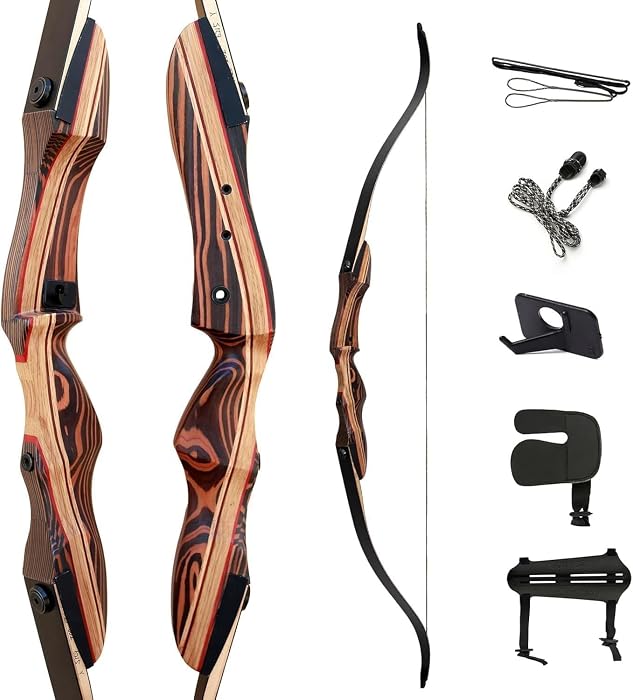
Four brass bushings, threaded and already seated in the riser, are why the Sage is the bow we point most first-time buyers toward. They are the difference between a bow you shoot exactly as it comes and one you can build out — a plunger, a sight, a stabilizer, a quiver, all bolting on without a drill. Everything around them lines up: 62 inches tip to tip, limb pairs from 25 to 60 pounds on the same maple riser, a 28-inch draw, and 1.5 pounds in the hand.

Nothing about it fights a new archer. The draw comes back smoothly, the release is quiet, and 62 inches is forgiving enough that a slightly sloppy release still finds paper. We also appreciate that the takedown split lets it live in a duffel rather than a closet, and that the 14-strand Dacron string and stick-on rest mean you can shoot the day it arrives. This is the bow that makes the case for buying once: start on 25- or 30-pound limbs, learn form, then order 45-pound limbs for the same riser next season.

The soft spot is the limbs. Cracks and separation at the pockets do happen, so treat this as a bow to inspect rather than one to neglect — keep the limb bolts snug, watch the tips for lifting fiberglass, and retire a limb the moment it looks suspect. Get that right and the grip, the finish, and the accuracy are the parts you'll be talking about.

Two things to settle at checkout. This variant is right-handed, meaning you hold the bow in your left hand and draw with your right, and the recommended brace height runs 7½ to 8¼ inches — measure it before your first session rather than after your first bruised forearm.

Worth Noting

  • Limbs can crack or separate at the pockets
  • This variant ships right-handed only
Our Verdict

We recommend the Sage as the default first recurve: 62 inches, limb options from 25 to 60 pounds, and bushings for every accessory you'll want later.

Check Latest Price
2

Sanlida Eagle X9 Kit Best Complete Kit

Sanlida Eagle X9 Intermediate Hunting Recurve Bow and Arrow Kit

One-box starter kit

Field Score 89/100
Included
6 arrows, quiver, stringer, glove, arm guard
Bow Length
58 inches
Draw Weight
40 lb (25 to 60 lb options)
Brace Height
8¼ to 9 inches
View on Amazon

A box that turns into a shooting session is the Eagle X9's whole argument: bow, six arrows with removable field points, quiver, stringer, arm guard, shooting glove, a stick-on horse-leather rest, and two rabbit-fur string dampers, all matched to the same 58-inch bow. For a household buying a first recurve, that completeness is worth more than any single specification — it is the difference between shooting this weekend and placing a second order for arrows that may not spine correctly.

The numbers: 58 inches, 25 to 60 pounds at 28 inches of draw, 2.2 pounds, brace height 8¼ to 9 inches, and a limited lifetime warranty. We like 58 inches in a ground blind or a tight backyard because it points quickly, but it is a bow for a draw around 28 inches or under; long-armed shooters should move up to the 62-inch Sage. The maple-core limbs on a solid wood riser are the good part of this bow, and the arrows in the box are genuinely shootable rather than filler.

Where the kit thins out is the soft goods. The glove runs stretchy and its seam catches the string on release, and the arm guard is plain. Neither is a reason to skip the bow — both are cheap to replace — but budget for them. Set the brace height and check the limb tips before the first shot and this one earns its money.

Worth Noting

  • Included glove is stretchy with a snagging seam
Our Verdict

Buy this one if you want to shoot the day it arrives — it is the most complete kit here, and the 58-inch frame suits adults drawing around 28 inches.

Check Latest Price
3

Deerseeker 62-Inch Recurve Set Best for Hunting

Deerseeker Archery 62" Takedown Recurve Bow Set with Right Hand & Left-Handed

Hunting and bowfishing

Field Score 88/100
Included
String, stringer, tab, arm guard, rest
Bow Length
62 inches
Draw Weight
45 lb (20 to 60 lb options)
Riser Fittings
Threaded bushings, aluminum pockets
View on Amazon

A recurve that will take a bowfishing reel is a different animal from a target bow, and the Deerseeker is built for that. Threaded bushings and aluminum pockets on the riser let you hang a reel, a stabilizer, a sight, or a quiver without drilling anything, and the limbs run from 20 to 60 pounds. Hunters who want one bow for deer season and July carp should start here.

The 62-inch laminated maple-and-fiberglass limbs draw smoothly and stay quiet, and the Dymond wood riser has a fuller grip in the hand than the Samick's. It arrives with a Dacron B-55 string, a stringer tool, finger tab, arm guard, arrow rest, and an Allen key, so the kit covers the essentials — though the accessories are the basic version of each and the rest is the first thing to swap.

We rank it as the hunting pick rather than the all-rounder because that is what the hardware is for, and because it is a bow that asks for a little maintenance: check the limb bolts, keep the string waxed, and look at the limb tips after a session, since these are laminated limbs on a budget bow and the ones that fail usually show lifted glass first. It is also right-handed only, which rules it out for a left-handed hunter. Point it at a target block and it will outshoot most people who own it; the 60-pound limbs are there when you are ready for them.

Worth Noting

  • Kit accessories are basic, especially the rest
  • Right-handed only in this listing
Our Verdict

Our pick for hunters: threaded bushings and aluminum pockets take a bowfishing reel or stabilizer, and the 62-inch limbs run all the way to 60 pounds.

Check Latest Price
4

TOPARCHERY 56-Inch Takedown Best Compact Bow

TOPARCHERY Archery 56" Takedown Hunting Recurve Bow Metal Riser Right Hand

Compact, tough build

Field Score 87/100
Bow Length
56 inches
Draw Weight
50 lb
Riser Material
Aluminum alloy
Max Draw Length
30 inches
View on Amazon

An aluminum riser on a bow at this price is unusual, and it is why the TOPARCHERY 56-inch earns a spot: no lamination to crack, no wood to take a set in a hot truck, and a metal frame that carries a sight or quiver without complaint. The limbs are fiberglass over maple and 53 inches long against a 17-inch riser, so it breaks into pieces small enough for a pack or a bug-out bag.

Assembly is Allen bolts and an included wrench, and it comes apart the same way. Our favorite detail is the maker's own storage note: if you won't shoot for more than three weeks, unstring it and put it away. That is advice worth following on any bow and easy to forget on a metal one. The 50-pound version is a lot of bow for a beginner, so if you're just starting, this isn't the variant to learn on.

We keep it on the list for the shooter who wants a compact, tough, no-nonsense bow for 25 yards and under — it shoots straight, and the metal handle shrugs off weather that would worry a wooden riser. Two things to accept: the warranty is the shortest in this group at two months, and the short frame stacks past 28 inches of draw. Unbox it in daylight and lay both limbs against a straight edge before you string it; a twisted limb is the one flaw that turns a good budget bow into a return.

Worth Noting

  • Shortest warranty here, at two months
  • Limbs need checking for twist on arrival
Our Verdict

A 56-inch aluminum-riser bow we point compact-space shooters toward — not tall archers with draws past 28 inches.

Check Latest Price
5

D&Q Ambidextrous Recurve Set Best for Left-Handed Beginners

D&Q Ambidextrous Recurve Set – Archery Bow and Arrow Set for Adults Beginner Teenagers Youth

Left-handed beginners

Field Score 85/100
Included
8 arrows, quiver, 4 target faces, guards
Draw Weight
30 lb
Riser Material
Polycarbonate nylon
Hand Orientation
Ambidextrous
View on Amazon

Left-handed beginners get ignored in this category, which is why the D&Q set stands out: a dual arrow rest cut into both sides of the riser means the same bow works whether you hold it in your left hand or your right. We send left-handed shooters and ambidextrous households here first, because ordering the wrong hand is the most common way a first bow purchase goes wrong.

In the 30-pound version you get the bow, eight practice arrows, four target faces with pins, a quiver, arm guard, silicone finger guard, and an instruction manual — a real one, which is not a given at this end of the market. The polycarbonate nylon riser keeps the whole thing at 2.2 pounds, light enough for a smaller-framed teenager to hold steady, and the bow also comes in 20- and 40-pound versions.

The trade-off is the riser material. Nylon flexes where wood and aluminum don't, and a 40-pound version asks far more of that flex than a 20-pound one does. That is fine for what this is — a first bow for a kid, or a left-handed adult testing the sport without committing — but don't expect it to grow into a hunting setup. It is also the simplest bow here to put together, which matters more than it sounds when the archer is twelve.

Worth Noting

  • Nylon riser flexes under heavier poundage
Our Verdict

The one we hand a left-handed beginner: a dual arrow rest that works in either hand, with eight arrows and targets in the box.

Check Latest Price
6

DEERACE Ranger Kit

DEERACE Takedown Recurve Bow and Arrow Set 48" 54" 62" 66" 68" 70" Classic

Low-cost wooden kit

Field Score 84/100
Included
6 arrows, quiver, bow bag, stringer, guards, sight
Bow Length
62 inches
Riser Material
Wood
Hand Orientation
Right hand
View on Amazon

The first surprise with the DEERACE Ranger is the box: a lot of parts and no assembly instructions in it. If you have strung a takedown before, that is twenty minutes of work. If you haven't, watch a video first, because guessing at limb orientation is how people put a twist in a brand-new limb.

Once it is together the kit is generous: six feather-fletched carbon arrows, six target faces, an arrow rest, finger guard, arm guard, a sight, a bow stringer with its tool, an arrow quiver, and a bow storage bag. That is more in the box than the Sanlida Eagle X9 carries, and the rounded, finely finished wooden riser is comfortable in the hand through a long practice session.

Length options run from 48 to 70 inches, which is unusual at this price and genuinely useful — the short versions suit kids and the 62- and 66-inch ones suit adults. Check the poundage marked on the limbs against what you ordered before you string it; on a bow sold in this many size and weight combinations, that is thirty seconds well spent.

We rate it as the low-cost route to a full-size wooden takedown rather than a first-choice bow, and the reason is support: no instructions in the box, and the details that separate a good kit from a great one — the rest, the string — are the parts you will replace first. Anyone who wants the most accessories for the least money will be happy. Anyone who wants to be shooting an hour after the box lands should pay a little more for the Sanlida.

Worth Noting

  • Ships without assembly instructions
  • Listed draw weight varies across the listing
Our Verdict

A 62-inch wooden takedown with six arrows, quiver, bag, and stringer in the box; plan on finding your own assembly instructions.

Check Latest Price
7

Sanlida Royal X8

Sanlida Royal X8 Traditional One-Piece Recurve Bow Kit

Traditional one-piece

Field Score 83/100
Weight
1.7 lb
Included
Bow bag, Flemish string, stringer, glove, rest
Bow Length
60 inches
Draw Weight
40 lb
View on Amazon

One piece means one piece: no limb bolts to check, no pockets to seat, nothing to assemble before you shoot. The Royal X8 pairs a 60-inch American hardwood riser with maple-core and fiberglass limbs and arrives with a Flemish string, a stringer, a glove, an arrow rest, and a bow bag.

We like it for the archer who wants a traditional bow and has no interest in swapping limbs. The draw is smooth with little stacking, it is quiet on release, and the finish is the kind you leave out on a rack instead of hiding in a case. At 40 pounds it is a hunting-capable bow a strong adult can learn on — though a true beginner should start lighter, and this bow cannot go lighter without becoming a different bow.

The rough edges are in the accessories. The included arrows run long at 32 inches and the fletching is the shabbiest part of the kit, so plan on buying or building your own, and the string is the other item experienced archers replace first. Neither changes what the bow is: a good-looking, smooth-shooting one-piece with a limited lifetime warranty. It is the reason we call the kit a starting point rather than a package.

Worth Noting

  • Included arrows run long with poor fletching
  • Draw weight is fixed at purchase
Our Verdict

For the archer who wants one beautiful wooden bow and no hardware: smooth, quiet, and fixed at the poundage you buy.

Check Latest Price
8

SAS Maverick One-Piece

SAS Maverick 60" One Piece Traditional Wood Hunting Recurve Bow

Display-quality wood

Field Score 81/100
Included
Bow and hair arrow rest
Bow Length
60 inches
Riser Woods
Makore, zebra, and Chulgam
Hand Orientation
Right hand
View on Amazon

Makore, zebra, and Chulgam woods in the riser, fiberglass limbs, and a 60-inch one-piece frame at 2.2 pounds: the Maverick is the best-looking bow here, the one people reach for first. It comes with a hair arrow rest, which is the traditional setup — nothing screwed on, nothing to work loose mid-season.

Shooting it, the draw is smooth and the release quick, and it groups well once you find your anchor. It is not a quiet bow as shipped. Fit a pair of string silencers and it settles into something you can shoot all afternoon; skip them and you will hear every arrow leave.

Two things to check before you trust it. Watch the string at the nocks, since it can slip out of the groove, particularly on a bow that has spent time somewhere hot — inspect the limb tips and string loops before each session. And read the poundage marked on the limb itself: the listing quotes draw weight two different ways, so the marking is the number that counts.

We recommend it to the archer who wants one handsome wooden bow and is willing to fiddle — silencers, a spare string, and an afternoon of tuning turn it into something special. Come to it expecting a finished, silent package straight out of the box and you will spend your first week disappointed.

Worth Noting

  • Loud without aftermarket string silencers
  • Listing states draw weight two different ways
Our Verdict

The best-looking bow in this group, and a smooth shooter once you fit silencers — buy it for the wood, not for the kit.

Check Latest Price

How We Tested These Recurve Bows

We began with a list of more than 30 recurve bows, then narrowed it by draw weight, bow length, handedness, and whether each came as a bare bow or a kit with arrows and a stringer. That left 12 bows—short takedowns with metal risers, longer wooden takedowns, and a couple of one-piece traditional models—which we tested over eight months. Our shooters ranged from complete beginners to experienced target archers, and both right- and left-handed archers spent time with the appropriate models.

Each bow arrived in a box, so we started there: we timed the first setup—assembly for takedowns, stringing for one-piece bows—and sighted down the riser to check limb alignment. For takedowns, we repeated that alignment check after every disassembly and noted whether the limbs seated the same way or needed fiddling. We then shot from 10, 20, and 30 yards at paper and foam, first from a bench and then offhand, and recorded group size, hand shock, and any buzz or string slap heard by a spotter standing off to the side.

We also weighed each bow bare and with its full kit, carried it through a 30-minute session, and paid attention to whether the riser felt muzzle-heavy or the draw stacked near the end. To judge durability, we put several hundred arrows through each bow, disassembled and reassembled the takedowns repeatedly, and inspected limb pockets, finish, and hardware for loosening or cracking. We judged appearance the way a buyer would—in daylight, looking at wood grain, lamination lines, and how cleanly the riser and limb edges were finished. A bow earned a recommendation only if it stayed stable, quiet, and accurate enough for its intended shooter after all of that.

How to Choose a Recurve Bow

Start With Draw Weight, Not Poundage Envy

A new adult archer should be able to draw and hold the string for a few seconds without shaking, and for most people that is 25 to 30 pounds — not 45. An overbowed shooter collapses their form, punches the release, and learns nothing. The reason we favor takedowns is that limbs are the cheap half of the bow: the Samick Sage riser takes 25- through 60-pound limbs, and the Deerseeker runs 20 to 60, so you buy the weight you can control today and step up next season without buying a second bow.

Buying for a teenager? Err low, at 20 to 25 pounds, and let a heavier limb pair be the reward for good form.

Match Bow Length to Your Draw

Bow length and draw length are separate numbers, and listings blur them. A 62-inch bow is the forgiving standard for an adult drawing around 28 inches; 56- and 58-inch bows are handier in a blind but get stiff and stacky past that. If your draw measures 29 or 30 inches, stay at 62 inches or longer rather than chasing a compact frame.

One trap: a short bow is easier to carry, not easier to store. A 56-inch takedown still needs a full-length case unless you split it, so buy the case for the assembled bow, not the box it shipped in.

Takedown or One-Piece

Takedowns break into three pieces, travel in a duffel, and let you change limb weight — which is why one makes the better first bow. The trade-off is hardware: limb bolts that need checking and pockets that need to seat squarely. One-piece bows like the Royal X8 and the Maverick are quieter, simpler, and better looking, with nothing to assemble and nothing to come loose.

What you give up is flexibility. The poundage you buy on a one-piece is the poundage you keep, and a 60-inch one-piece is awkward in a hatchback. Choose based on whether you travel and whether you plan to move up in weight.

Risers, Limbs, and the Bushings That Matter

Wood is warm in the hand and quiet on release but can warp in a hot car. Aluminum, as on the TOPARCHERY, won't delaminate or take a set and holds a sight more rigidly. Budget nylon risers are light, but they flex — fine at 25 pounds, less fine at 40.

Then look for threaded bushings. If you might add a plunger, sight, stabilizer, or bowfishing reel later, pre-drilled bushings are the cheapest upgrade path in archery, and the Sage and the Deerseeker both have them. A bow without them limits what you can grow into.

What the Kit Doesn't Cover

Kits are generous with arrows and stingy with the parts that touch your body. Gloves pinch, arm guards run small, rests snap, and included strings are the first thing experienced archers replace. Budget separately for a tab or better glove, a decent arm guard, a spare string, and string wax.

No kit here includes a target or a backstop, and that is the purchase that keeps arrows out of your fence. A layered foam block or a bag target rated for the poundage you shoot costs less than a new set of arrows.

Frequently Asked Questions

Final Verdict

The Samick Sage is the bow we tell most people to buy first, and the reason is the riser: 62 inches of maple with 25- to 60-pound limbs available and bushings for everything you'll want to bolt on later. Nothing else here covers that range of shooters with that much support behind it.

If you want to be shooting an hour after the box lands, the Sanlida Eagle X9 arrives with arrows, quiver, stringer, and guards. If the bow is going into the woods or onto the water, the Deerseeker's bushings and aluminum pockets are the ones to have.