The 6 Best Right Angle Drills of 2026

The first time you need a right angle drill, you probably already own three that don't fit. Mine came flat on my back under a kitchen sink, a shutoff valve six inches from my face and no room to swing a handle — twenty minutes of work a compact right-angle body turns into five. It goes where a standard drill physically can't, and keeps its torque while doing it.

Over the past eight months, my team and I ran 10 right angle drills through sinks, stud bays, and basement joists, and the differences are bigger than those similar-looking bodies suggest. Some bog down the moment you lean on a hole saw; others keep cutting. We weighed each with the battery in, timed how long it ran before the electronics quit, and noted whether the chuck bites without two hands. Value got equal weight, since so many ship as bare tools.

Voltage tells you less here than you'd think: a well-geared 12-volt can out-drill a tired 18-volt inside a cabinet, and a brushless motor buys runtime and a smaller body more than raw speed. The ones below earned their spot, palm-sized to hole-hog big.

Our Top Picks

The 6 Best Right Angle Drills of 2026

1

DeWalt DCD740B Best Overall

DEWALT DCD740B 20-Volt MAX Li-Ion Right Angle Drill (Tool Only)

Deep, tight spaces

Field Score 94/100
Weight
3.3 lb
Chuck Size
3/8 in
Head Depth
4.0 in
Speed Ranges
0-650 / 0-2,000 rpm
View on Amazon

Four inches is the number that decides most right angle drill purchases, and it is the dimension DeWalt builds this tool around: the head is 4.0 inches front to back. That is short enough to drop between a stud bay and a cabinet side, and it is why this is the drill we hand to someone with one bad spot to reach. The 3/8-inch ratcheting chuck adds a detail that is easy to miss, a deep hex pocket, so a 2-inch bit seats fully inside the jaws instead of hanging out front and eating the reach you just paid for. DeWalt ships a 2-inch Phillips bit in the box for exactly that reason.

The 20-volt motor backs the shape up. Two ranges, 0-650 and 0-2,000 rpm, give you a slow gear for a hole saw and a fast one for pilot holes and driving, and the multi-grip trigger lets your hand slide forward along the body when the space only fits fingertips. This is a capable compact drill rather than a novelty, and the power is why it holds the top spot: the Milwaukee M12 below is lighter and slimmer, but this one wins whenever the gap is deep rather than narrow.

One habit worth forming: shift the two-speed selector while the motor is turning. Moved with the trigger released, it can grind and refuse to engage, which is the sort of thing you learn once and remember every time after. Otherwise the tool asks very little of you: no key, a belt hook if you want it within reach on a ladder, and a trigger that falls where your fingers already are.

Worth Noting

  • Battery and charger not included
  • 3.3 lb gets heavy overhead with a pack
Our Verdict

If you are buying one right angle drill for tight spaces, this is the one: a 4-inch head, real 20-volt power, and a chuck that swallows a 2-inch bit.

Check Latest Price
2

Milwaukee 2415-20 M12 Best for Tight Spaces

Milwaukee 2415-20 M12 12-Volt Lithium-Ion Cordless Right Angle Drill

Narrow gaps

Field Score 93/100
Weight
2.3 lb
Chuck Size
3/8 in
Max Torque
100 in-lb
Tool Length
11 in
View on Amazon

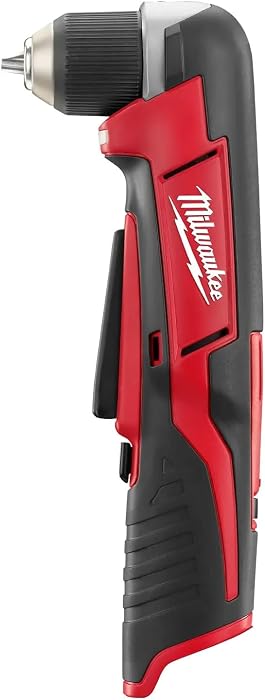
Set this M12 beside the DeWalt and the difference is not size, it is silhouette. The head is 1.75 inches wide and the body runs 11 inches back from it, so the tool goes where a gap is narrow but has some depth: between a stud and a pipe, alongside a cabinet carcass, inside a drawer box. It also weighs 2.3 pounds bare, light enough to hold up in a cabinet with one hand while the other one finds the screw.

What we appreciate most is the control. The paddle switch runs along the body instead of sitting in a trigger well, so whatever grip the space forces on you, choked up, sideways, one finger, the switch is under something. The shape cuts both ways. Eleven inches of body needs room to swing, so in a shallow, wide gap where the DeWalt's short head walks straight in, this is the wrong tool for the job.

Power is the other honest limit. At 800 rpm and 100 in-lb it is a pilot-hole and driving drill; it will turn a small hole saw, but boring is not what it was built for, and you feel that in hardwood. It runs on M12 packs, and the compact ones are what keep it at just over two pounds, so plan on carrying two for a day of cabinet work.

Worth Noting

  • 800 rpm and 100 in-lb cap it at light work
  • Needs depth behind the gap, not just width
Our Verdict

For a narrow slot rather than a shallow one, this is the right angle drill we reach for, provided the job is pilot holes and screws rather than hole saws.

Check Latest Price
3

Bosch PS11-102 Best Pivoting Head

BOSCH PS11-102 12V Max 3/8 In. Right Angle Drill/Driver Kit with 2.0Ah Lithium

Changing angles

Field Score 92/100
Speed
1,300 rpm
Battery
12V 2.0 Ah included
Max Torque
115 in-lb
Pivoting Head
5 positions, 90° to 180°
View on Amazon

The head pivots through five positions between 90 and 180 degrees, and that is the whole argument for this Bosch. Set it square to reach into a corner, then swing it into a straighter line for a run of screws without changing tools. For work where what you can see and what you can reach keep changing, inside a cabinet, behind a panel, under a sink, it is the most adaptable tool here. It also arrives as a kit with a 2.0 Ah battery and charger, which several of the bare tools on this list cannot claim.

The trade sits in your trigger hand. There is one speed and no torque adjustment, so nothing dials back when a screw seats, and flush driving becomes a matter of feel and a quick release. We minded it less than we expected on small screws and pilot holes, and the motor brake helps you stop where you mean to; it is large fasteners and hardwoods that expose the gap.

At 1,300 rpm and 115 in-lb it lands in the same league as the Milwaukee M12, and the 3/8-inch auto-lock chuck takes standard bits without a key. The head itself is one of the bulkier ones in this group, so an opening the DeWalt slides into can stop this Bosch at the housing. Check the width of your gap, not only its depth, before you commit.

Worth Noting

  • Single speed with no clutch
  • Bulkier head than the dedicated tools here
Our Verdict

Buy this when the gap changes shape as you work: the head pivots to five positions, and the kit includes the battery and charger the bare tools leave out.

Check Latest Price
4

Ryobi ONE+ HP 18V Best Value

RYOBI ONE+ HP 18V Brushless Cordless Compact 3/8 in. Right Angle Drill (Tool

Budget deck work

Field Score 91/100
Weight
2.9 lb
Chuck Size
3/8 in
Max Torque
350 in-lb
Speed Ranges
0-450 / 0-1,700 rpm
View on Amazon

The Ryobi is the least expensive way into an 18-volt right angle drill here, and it carries the highest torque figure of any compact on this list: 350 in-lb from a brushless motor, with two ranges at 0-450 and 0-1,700 rpm. That is an odd thing to lead with for a tool whose job is fitting where other drills cannot, but it is what earns this one a place. It is not a delicate tight-space tool; it is a full-size 18-volt drill that happens to turn at 90 degrees.

That torque has a cost at the trigger. A right angle drill pushes back sideways rather than down, and 350 in-lb will twist a loose grip before the bit bites. Feather the variable-speed trigger, let the bit start its own hole, then lean on it. The long handle helps here, because it gives you something to hold against the reaction in a way the stubby 12-volt tools do not.

What gives us pause is the fine print rather than the tool. The warranty is 30 days, and the listing itself notes it is sold from abroad with separate terms and labeling, a much shorter safety net than the three-year coverage the DeWalt and Bosch tools carry. If you are already on the ONE+ platform and want one 18-volt angle drill for a season of deck and fence work, that is a trade worth making knowingly.

Worth Noting

  • Bare tool; battery and charger sold separately
  • Little room to tighten the chuck by hand
Our Verdict

The most torque for the least money in this group, as long as you already own ONE+ batteries and can live with a short warranty.

Check Latest Price
5

Bosch Flexiclick GSR12V

BOSCH GSR12V-140FCB22 12V Max Drill/Driver

Occasional 90° access

Field Score 90/100
Batteries
Two 2.0 Ah
Max Speed
1,300 rpm
Max Torque
265 in-lb
Included Heads
Right angle, offset, bit holder, chuck
View on Amazon

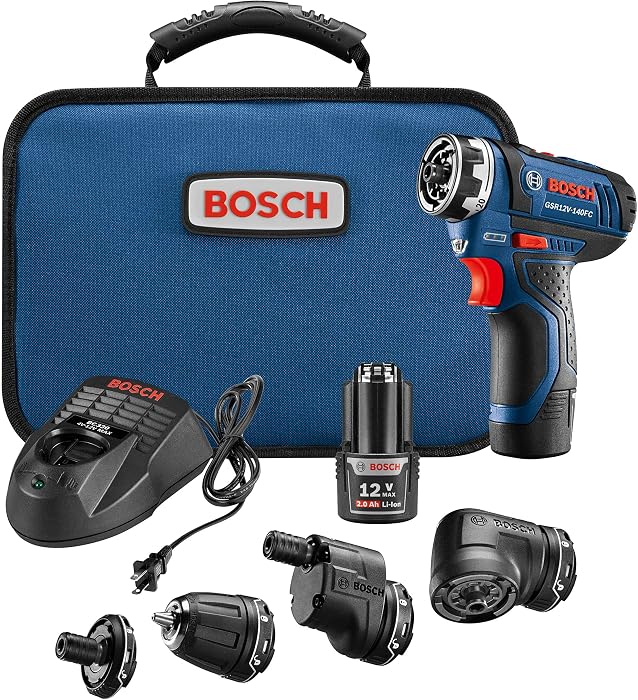
Four heads come in the case: a keyless chuck, a locking bit holder, an offset head that puts a bit right at the edge of the tool, and the right angle head itself, which rotates to 16 positions without coming off. Bosch calls it a 5-in-1, and that is the honest way to read it. The 90-degree work is one of five jobs it does, not the only one.

As a compact 12-volt drill it is genuinely good: 265 in-lb, two speeds to 1,300 rpm, a clutch that keeps fasteners from stripping, and two 2.0 Ah batteries in the kit. What we do not like is buying it as a right angle drill. Every head sits ahead of the motor, so the assembly is longer than a dedicated tool's, and swapping heads mid-job is precisely the pause you do not want while reaching behind a panel.

The offset head is the sleeper of the set, driving a screw close to a perpendicular face where no drill body fits, and the second battery means one is always charged. Just do not buy it as your only route into tight spaces: that is the job the dedicated tools do with a shorter, stiffer head, and most of them do it for less.

Worth Noting

  • Right angle head adds length
  • Most expensive tool in this group
Our Verdict

The right angle head is one of four, and that is the point: a compact 12-volt drill for everyday work that reaches 90 degrees when a job demands it.

Check Latest Price
6

Milwaukee Hole Hawg 2807-20

Milwaukee M18 FUEL HOLE HAWG 1/2" Right Angle Drill (Tool-Only)

Big-hole rough-in

Field Score 84/100
Speed
1,500 rpm
Weight
7.7 lb
Chuck Size
1/2 in
Wood Capacity
2.63 in
View on Amazon

At 7.7 pounds and 15.6 inches long, the Hole Hawg is not really competing with the compact tools on this list. It is a rough-in drill that happens to turn at 90 degrees, built to swing a 2-5/8-inch bit through framing without stalling, and every one of its proportions says so before you pick it up.

The 1/2-inch chuck and brushless motor are why it exists. At 1,500 rpm with that much mass behind it, you can lean into a self-feed bit or a big hole saw in a stud bay and the tool keeps cutting, where a 12-volt drill in the same hole stalls and your wrist takes the difference. It is also the one tool here whose weight is the point rather than a compromise.

Our view is simple: this is the right angle drill for rough-in, not for finish work. Overhead it is a two-handed tool, and your shoulders know it by the end of a run, which is the trade you accept for the power. Plan on the big M18 packs. A drill that pulls this hard deserves the batteries that feed it.

Worth Noting

  • Heavy at 7.7 pounds, especially overhead
  • Tool only; needs M18 packs and charger
Our Verdict

This one is for boring big holes through framing, not for cabinets: 7.7 pounds of brushless right angle drill that will not stall on a 2-5/8-inch bit.

Check Latest Price

How We Tested the Best Right Angle Drills

We started by pulling every right angle drill we could find from the major tool brands — roughly two dozen models — and sorting them by chuck size, voltage, whether they ship as a bare tool or a kit with batteries and a charger, and price. That left 10 we bought ourselves and put to work for eight months, on weekend remodels and small paid jobs, with a couple of electricians and a plumber letting us watch how they actually reach for one.

The tight-space test was a mocked-up cabinet interior 14 inches deep with a supply line in the way, plus a stud bay with a 9-inch gap between joists. We noted whether the chuck could reach the fastener, whether the body cleared the obstruction, and whether we could tighten the bit one-handed in work gloves. A few collars slipped under load, and one drill needed two hands every time, which defeats the entire point of the tool.

For power and drilling performance, we bored 1-inch auger holes through stacked 2x10s and cut 4-inch holes in pine with a hole saw until the tool stalled or the electronics cut out, timing each run. We drove 3-inch screws into pressure-treated lumber to feel where the torque fell off, and counted holes per charge so battery life comparisons were honest — a bare tool's runtime depends entirely on what you feed it. Every drill also went on a kitchen scale with its battery in, then overhead into a ceiling joist for two minutes, because a pound matters at arm's length.

Quality showed up in chuck runout, housing flex, and how the switch and direction selector felt through a glove. We finished by tallying what actually came in the box, since a cheap bare tool plus a battery and charger is often the more expensive drill.

How to Choose a Right Angle Drill

Which Dimension Does Your Gap Block?

This is the question that separates the picks above. A short head, like the DeWalt's 4.0 inches front to back, gets you into a deep cavity with a small opening: a stud bay, a recessed cabinet, the space behind a drawer. A narrow head, like the Milwaukee's 1.75-inch width, gets you into a slot where the obstruction sits beside the tool rather than in front of it.

Measure both before you shop. An angle drill that is short but wide, or narrow but long, solves only half the problem, and no spec sheet will tell you which half you have.

Match Torque to the Bit, Not the Label

Pilot holes and driving screws want roughly 100 to 150 in-lb and a slow gear; hole saws and augers want 250 in-lb or more and a tool with the mass to keep the bit fed. Underpowered drills do not just cut slowly. They stall, and the reaction lands in your wrist, because a right angle drill pushes back sideways instead of down.

Be honest about the biggest bit you will use. If that is a 2-inch hole saw, none of the compact drills here is your answer; step up to a rough-in tool or rent one for the day.

Bare Tool or Kit: Price the Batteries First

Most of the picks here ship bare, and both Bosch kits include a battery and charger. Add packs and a charger to the bare tools before you compare, and check which platform you already own: 20V MAX, M18, M12, ONE+, and Bosch 12V do not mix.

The warranty deserves the same glance. The DeWalt and Bosch tools carry three years; the Ryobi listing shows 30 days and notes that it ships from abroad with separate terms. A short warranty is not disqualifying, but it changes what you are paying for.

Chuck Type and Bit Access

Ratcheting chucks hold well and let you tighten by hand in a cramped space; auto-lock chucks are quicker but fussier when the head is buried; keyed chucks, found on the big rough-in drills, hold hardest and cost you a key.

The detail worth hunting for is a deep hex pocket, which lets a short bit sit inside the jaws instead of adding an inch of length to a tool you bought for its reach. In a very short head, expect to need both hands to change a bit.

Frequently Asked Questions

Final Verdict

Buy the DeWalt DCD740B. A 4-inch head and a two-speed 20-volt motor cover the widest range of tight-space work, and it is the drill we reach for when the gap gives us one shot. If your opening is narrow rather than shallow, the Milwaukee M12 is the one that slips in; if you are already on ONE+ batteries and want the most torque for the least money, the Ryobi earns its place.

The rest are specialists: a pivoting head, a convertible head, or a 7.7-pound rough-in tool. Pick one of those only when a specific job says so.