The 8 Best Roof Rakes of 2026

The first sign is usually a stain: a tea-colored ring spreading across a ceiling in January, nowhere near any plumbing. That's an ice dam. Snow sits on the roof, melts against the warm shingles, refreezes at the cold eaves, and the next melt has nowhere to go but sideways — under the shingles and into the house. A roof rake heads that off: pull the snow off the bottom few feet of roof and along the gutters, and the meltwater drains where it should.

The trouble is that a roof rake is a 20-foot lever you hold over your head, so what separates a tool you'll actually use from one that leans in the garage comes down to weight, how the sections lock together with gloves on, and whether the blade rides on rollers instead of scraping your shingles. My team spent a full winter with 12 of them — from the first storm in November to the last melt in April — and the picks below are the ones that made the job short.

Our Top Picks

The 8 Best Roof Rakes of 2026

1

USA Handy Tools 20 ft Roof Rake Best Overall
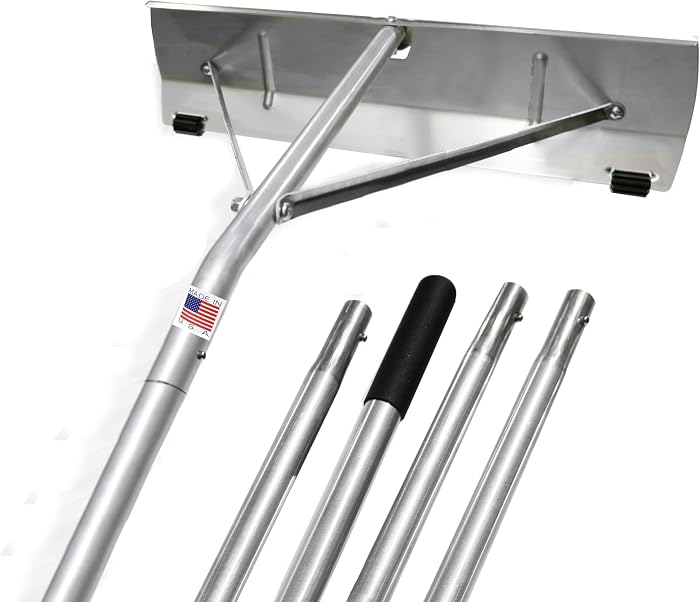
USA-Made Snow Roof Rake with Shingle Saver Rollers (20 Foot)

Everyday snow clearing

Field Score 90/100
Head
Aluminum with rollers
Reach
20 ft
Handle
Aluminum
Blade Width
24 in
View on Amazon

What sold us on this one is a pair of rubber rollers at the corners of the blade. They hold the 24-inch aluminum head a couple of inches off the shingles, so you are sliding a tool across the roof instead of dragging a metal edge over it — and on a low-pitch roof, that is the difference between clearing the snow and spending spring patching granules. It is the rake we point most homeowners to, and the one we are most confident recommending to somebody clearing a roof alone.

The handle is aluminum in sections, and adding or pulling one takes seconds, so you can start short over the porch and go long for the main roof without hunting for a wrench. Budget a few minutes for the rollers at first assembly; they are the one part that does not drop straight into place, and forcing them is how people tear a thumbnail. Keep gloves on while you push the sections together, too — the cut aluminum edges are sharp enough to catch a knuckle.

Twenty feet covers the eave line and the first several courses of a single-story house, which is exactly where an ice dam starts. It is not the answer for a full two-story gable, and an aluminum blade will not do what a bristle brush does with wet oak leaves. For snow on an asphalt-shingle roof, it is the one we come back to.

Worth Noting

  • Rubber rollers are fiddly to seat
Our Verdict

We recommend this one to most homeowners: the rollers protect the shingles, the 20-foot aluminum handle breaks down without tools, and it is the pick here we are most confident in.

Check Latest Price
2

Snow Joe RJ204M Roof Rake Best Budget

Snow Joe Telescoping Roof Rake

Tight budgets

Field Score 89/100
Reach
21 ft handle, 27 ft overhead reach
Weight
4.8 lb
Warranty
2 years
Blade Width
25 in
View on Amazon

At the low end of this set, the RJ204M buys more reach per dollar than anything else here. The twist-lock aluminum handle extends to 21 feet, and once you add your own height and arm reach the blade sits roughly 27 feet overhead — enough for a full single story. It weighs 4.8 pounds, the lightest of the rakes here with a published weight, and that matters more than it sounds when you are holding a pole out at arm's length in 20-degree weather.

We think it is the right first roof rake for a ranch house and the wrong one for a steep second story. The 25-inch poly blade is 6 inches tall and scoops fresh snow well. The collars are the part we paid closest attention to: tighten them by hand until they stop, keep grit out of the joint, and they hold. Lean on them with a wrench and you will be fighting that same collar in March. Assemble it indoors once and tape the section you use most, so you are not counting collars in the cold.

There is no second head, no wheel, no adjustable angle — you get a pole, a blade, and a two-year warranty. That is the honest shape of a budget roof rake, and for a driveway-side eave or a porch roof it is plenty. A steep pitch and a deep, settled load are what send you further up this list.

Worth Noting

  • Blade struggles with wet, packed, icy snow
  • Head bracket is the weak point under load
Our Verdict

The budget answer: 27 feet of overhead reach and the lightest pole in this set make it the rake to buy for a single-story roof, as long as you keep to fresh snow.

Check Latest Price
3

Avalanche! SnowRake! Deluxe 20 Best Shingle Protection

Avalanche! SnowRake! Deluxe 20

Protecting shingles

Field Score 88/100
Reach
20 ft
Weight
5.8 lb
Wheels
1.5 in built-in
Blade Width
24 in
View on Amazon

The catch with this one is not the tool, it is the calendar. Delivery is listed six to seven months out, so a November order is really a next-winter order. Treat the Deluxe 20 as a pre-season purchase and buy it in summer if you want it hanging in the garage before the first storm.

What arrives is the most complete package here: a 24-inch plastic head on 1.5-inch wheels, five 46.5-inch aluminum sections that snap together without tools, a wall bracket for storage, and a head rated for shingles, architectural asphalt, shake, tile, metal, and solar panels. The wheels do the job the rollers do on our top pick — the head skims, you do not gouge — and plastic is the right material over a metal roof or an array.

We rate the five-section build above the telescoping poles here. The lengths are fixed, so there is nothing to re-tighten halfway across a roof, and you can leave a section in the garage instead of fighting a collar. At 5.8 pounds it is heavier than the lightest rakes, but the weight is spread along the whole pole rather than hanging off the end, and it steadies up nicely overhead once the head is planted.

Worth Noting

  • Grip slides off the handle
  • Plastic head can crack under a heavy load
Our Verdict

If your roof is metal, tile, or solar, this is the rake to order: wheels and a plastic head protect hard surfaces, and the five snap-together sections are the simplest setup here — just buy it months ahead.

Check Latest Price
4

Snowpeeler 30 ft Roof Rake Best for Tall Roofs

Snowpeeler 30 ft Roof Rake – Premium Roof Rake for Snow Removal

Very tall roofs

Field Score 87/100
Reach
30 ft telescopic
Weight
13 lb
Warranty
2 years
Blade Width
18 in
View on Amazon

Thirty feet is the number that decides this one. It is the longest pole in the set by a wide margin, and we read it as the whole reason to buy rather than a spec line: on a full two-story house with a steep pitch, a 20-foot rake leaves the top third of the roof untouched, and this telescopic handle reaches it from the ground.

It also cuts. Crusted, week-old snow that stops a lighter rake is where the aluminum head and the tear-resistant slide earn their keep — the slide peels the load off in sheets rather than dribs, so a pass finishes a strip instead of smearing it. The 18-inch blade is narrower than the 24s and 25s here, which means more passes for the width you give up.

We recommend it narrowly and enthusiastically: this is the rake for the homeowner whose roof nothing else reaches, and overkill for a ranch house that a 20-foot pole clears from the driveway. Buy it for reach, and accept that the last few feet of pole cost you some control over where the head lands.

Worth Noting

  • 13 lb pole goes top-heavy at full extension
  • Thin assembly instructions
Our Verdict

Buy it only if your roof is tall or steep: at 30 feet it reaches where nothing else here does, and the trade-off — 13 pounds of pole at full extension — is one you can work around.

Check Latest Price
5

Roof Razor Roof Brush and Rake Best for Leaves and Needles

Roof Brush + Snow Rake All-in-One Tool

Leaves and needles

Field Score 86/100
Head
18 in brush and rake
Handle
Four quick-connect poles
Weight
7 lb
Head Angle
Adjustable
View on Amazon

Every other rake here is a snow tool that tolerates leaves. This one is a roof brush first: 18 inches of polypropylene bristles on an aluminum pole, a rake edge on the back of the head, and an angle you can lock in. Pine needles, oak leaves, moss, and the debris that collects in valleys are what it was built for, and it is the tool we reach for in October, long before anyone thinks about snow.

The adjustable angle is what makes that useful rather than clever. Lay the head flat and it sweeps shingles; angle it and it gets into a valley or under a soffit where a fixed blade skims past. The four aluminum poles screw together fast and break down small enough to hang on a garage wall. At 7 pounds it is heavier than the lightest rakes here, but the brush does the sweeping — you are not muscling a blade through a drift.

Snow is where expectations need setting. Eighteen inches of bristles clears a dusting and the first inch of a storm; it is not a 25-inch blade, and it will not pull a foot of wet snow off a low pitch. What it will do is keep valleys clear of the needles and leaves that hold water all winter, which is most of the year in the woods.

Worth Noting

  • Noticeable wobble between pole sections
Our Verdict

For year-round roof cleaning this is the one: the brush side clears needles, leaves, and moss from valleys that a blade skips over, and it handles light snow when winter finally shows up.

Check Latest Price
6

VEVOR CY-SF02 Roof Rake

VEVOR CY-SF02 Roof Rake

Cheap long reach

Field Score 84/100
Reach
5 to 21 ft
Weight
6.8 lb
Blade Width
25 in
Blade Material
ABS plastic
View on Amazon

A 25-inch ABS blade on an aluminum-alloy pole that adjusts from 5 feet to 21 feet, at 6.8 pounds: the VEVOR is the same basic recipe as the Snow Joe at about the same money, with one structural addition. Two bracing pillars run from the blade back to the handle and form a triangle with the pole, which is what keeps a wide plastic blade from folding when you lean on it.

The blade is cupped, so it grabs snow instead of skimming over it, and the handle grip stays put in gloves. Assembly is five steps and needs no tools, and the sections come apart for storage on a garage hook.

Where it lands for us: a solid second option behind the top pick. The brace and the wide blade make it steadier in a straight push than a bare pole, and the price sits down with the budget rakes. What it does not have is a wheel or roller anywhere on the head, so on a solar array or a standing-seam roof you are trusting your own arms to keep the blade off the surface. On asphalt shingles that is a reasonable bet; on metal, pay for the wheels.

Worth Noting

  • ABS blade will not scrape hard crust
  • 6.8 lb is heavier than the lightest rakes
Our Verdict

A decent second option at a low price: the braced 25-inch blade scoops snow well, though without rollers the head relies on your arms to stay off the roof.

Check Latest Price
7

EZ Smart Adjustable Roof Rake Best for Low-Slope Roofs

EZ Smart Adjustable Roof Rake – Patented Adjustable Snow Roof Rake with 16 ft Pole

Low-slope roofs

Field Score 81/100
Reach
16 ft
Weight
5.84 lb
Storage
Mesh bag included
Head Width
36 in adjustable
View on Amazon

If your problem is a valley, a dormer, or a low-slope porch roof where a 24-inch blade will not fit, this rake was designed around you. The head is 36 inches of polyethylene, and the umbrella-style linkage lets you narrow it and set the angle, so you can work a channel between two roof planes instead of shoving a rigid blade at it.

The 16-foot sectional pole decides the rest. On a cape, a ranch, or a porch it puts you comfortably above the eave; on a full two-story it leaves the upper half of the slope out of reach, and the sections do not extend any further. What it does especially well is storage — everything collapses into the mesh bag that comes with it and hangs flat against a wall.

The adjustable head is not a gimmick. Set narrow, it works a valley end to end without gouging the shingles on either side; set wide, it covers a flat run at a decent clip. That flexibility is the reason to own it, and it is why this one sits alongside a longer rake rather than replacing one.

Our read: the adjustable head is a real solution to a specific problem, and the 16-foot pole is what keeps it from being a general-purpose rake. Buy it for a low-slope run or a valley you can reach from the ground, and keep a longer rake for the main slope if the house has one.

Worth Noting

  • Head flexes under a full load of wet snow
  • Section clips stiffen in cold weather
Our Verdict

Buy it for the shape of the roof, not the height of it: the adjustable 36-inch head gets into valleys and low-slope runs that fixed blades cannot, provided you can reach the work from the ground.

Check Latest Price
8

EXTEND-A-REACH Telescoping Roof Rake Best for Leaves and Gutters

EXTEND-A-REACH Telescoping Roof Rake – 4-12 ft Telescoping Roof Rake for Leaves and Pines (20 ft Reach)

Leaves and gutters

Field Score 80/100
Warranty
3 years
Rake Head
5.3 in metal
Attachments
Universal thread
Pole Length
4 to 12 ft
View on Amazon

This is not a snow rake, and it does not pretend to be. What it is: a 4-to-12-foot telescoping aluminum pole with a folding metal rake head and a universal thread at the top, sold for pulling leaves and pine straw off a roof from the ground. Set it beside the 25-inch snow blades here and the difference is obvious — the rake head is 5.3 inches wide.

The universal attachment point is why it stayed in the roundup. Spin off the rake and the same pole takes a duster, a squeegee, or a gutter scoop, and the pole itself is the sturdy part of the package: aluminum sections, a real locking collar, and a three-year warranty behind it.

Leaves on a one-story roof, pine straw in a valley, cobwebs under a soffit — that is the job. Control is the compromise. You sweep in short strokes and let the tips do the work rather than trying to drag a mat of leaves off in a single pull, which is where people end up wrestling the pole instead of the roof.

Our verdict is narrow but real: if what lands on your roof is leaves, needles, and grit rather than snow, this does the job for a fraction of the price of a snow rake and stores in a closet. If you get real winters, it is a supplement, not the answer.

Worth Noting

  • Pole gets whippy at full extension
Our Verdict

For leaves and gutter debris it is a bargain: the telescoping pole takes other attachments and keeps you off a ladder, though it is no substitute for a snow rake.

Check Latest Price

How We Tested Roof Rakes Through One Full Winter

We started by rounding up every roof rake we could find in stock, then narrowed by stated reach, blade material, handle style — telescoping versus sectional aluminum — and price. We cut anything under 16 feet, since most one-story eaves need at least that much once you're standing back from the house, and anything that took two people or a toolbox to raise.

That left 12 rakes, which we used from November through April on a one-story ranch, a two-story colonial with a steep pitch, and a low-slope porch roof. Each one got assembled alone in the driveway in the cold with gloves on, and we timed it, because aluminum sections that won't line up are a different job at 25 degrees than in a warm garage. At full extension we paid attention to where the weight sat in our front hand, whether the locking collars slipped under load, and how long we could hold the pole overhead before our shoulders quit.

Then we raked. Every model got a 10-inch wet snow, a dry 6-inch snowfall, and a crust that had iced over, and we watched how much snow came off per pull, whether it slid clear of the roof or landed on our heads, and how the blade met the shingles. Rollers and wheels held the leading edge up off the asphalt; on the rakes without them, we checked for scuffing after repeated passes. We also steered each one around a dormer and down a valley to see how the head turned.

Durability showed up in the bad moments: blades that caught a gutter edge, aluminum that bent and stayed bent, pins that froze shut in single digits. In October, before the snow arrived, we dragged the same rakes through wet leaves and pine needles to see which ones earn garage space year-round. And we asked the boring price question: at what point does a heavier, wider rake stop saving you time and start costing you your shoulders?

How to Choose a Roof Rake

Reach, Measured to the Blade

The number on the box measures the handle, not the working height. The head hangs below the tip, and the angle you hold the pole at costs you more, so add your own height and arm span to the pole figure and subtract a little for the blade. That is the reach you actually get.

For a single-story ranch, the 20- and 21-foot rakes here cover the eave line and the first several courses, which is exactly where ice dams begin. A full two-story with a steep pitch is where the 30-foot Snowpeeler stops being overkill.

Weight and Balance at Full Extension

A 4.8-pound rake and a 13-pound rake feel identical leaning in the garage. Ten minutes into a roof, they do not. Weight at the far end of a long pole multiplies with every section you add, and a heavy head is harder to steer onto the line you want, especially one-handed.

Buy the lightest pole that reaches your roof. If you need the extreme reach, plan on shorter passes and let the tool pull snow down rather than shoving it uphill.

The Head: Wheels, Width, and Angle

Wheels or rollers are the best upgrade money buys on a roof rake. They hold the head off the surface, which protects asphalt granules, painted metal, and solar panels, and they make the tool track straight down a slope. A bare blade with sharp corners is the wrong tool over a metal roof.

Width is a straight trade. A 24- or 25-inch blade clears a wide path on a flat run; an 18-inch brush or an adjustable head fits a valley, a dormer, or a tight low-slope section where a wide blade will not sit flat.

Joints Are What Fail First

Collapsible poles use twist-lock collars, snap buttons, or spring clips, and the joint is where a roof rake usually gives trouble. Twist-locks hold hardest but seize if you overtighten them or let grit into the collar. Snap buttons cannot slip, though the holes can wallow out over seasons. Clips are quickest and stiffest in the cold.

Assemble a new rake indoors, work every joint once before the season, and store it dry. A collar that will not come apart in March is a collar you overtightened in January.

Snow, Leaves, or Both

Roof rakes split by what lands on your roof. If it is snow, buy a wide plastic or aluminum blade with a roller, and buy it before the first storm rather than after. If it is pine needles, oak leaves, and moss, a bristle brush with an adjustable angle clears the valleys without tearing at the shingles.

A pole with a universal attachment thread lets one handle carry a brush, a rake, and a duster, which costs less than two tools and takes up less wall space in a garage that is already full of them.

Frequently Asked Questions

Final Verdict

Most homeowners should buy the USA Handy Tools 20-foot rake. The rollers keep the blade off the shingles, the aluminum sections come apart without a tool, and it is the pick here with the fewest caveats attached to it.

If budget decides the purchase and your roof is one story, the Snow Joe RJ204M does the same work for less and asks a little more of your hands. If nothing shorter will reach your eave, the Snowpeeler's 30 feet is worth the weight.