The 8 Best Rotary Hammer Drills of 2026

Hammer drills and rotary hammers are not the same tool, and the difference is the whole reason this category exists. A hammer drill chatters two ridged plates together while the bit spins, so it skates across a foundation wall. A rotary hammer drives a piston that pounds the bit straight into the material while the SDS-Plus chuck lets it slide. One gets you through a concrete lintel; the other leaves you with a smoking hole and a bent bit.

That distinction is what you're actually paying for, and it's what my team and I spent six months chasing across 10 rotary hammers, corded and cordless, on concrete, brick, and old thinset. Power and durability get the headlines, but the tool that wins is the one still pulling on the tenth hole, with hands not yet numb and, on the battery models, charge to spare. A safety clutch that genuinely catches and vibration control that isn't just a line on the box matter more than an amp rating, and that's before you get to what actually ships in the case. The picks below are the ones that proved it.

Our Top Picks

The 8 Best Rotary Hammer Drills of 2026

1

Bosch GBH2-28L Bulldog Xtreme Max Best Overall

BOSCH 8.5 Amp GBH2-28L SDS-plus Bulldog Xtreme Max 1-1/8 In. Rotary

All-around concrete work

Field Score 95/100
Tool Weight
6.4 lb
Max Capacity
1-1/8 inches
Power Source
Corded, 8.5 amp
Impact Energy
2.4 ft-lbs
View on Amazon

Corded rotary hammers are usually heavy, and the light ones are usually cordless and short of power, which is why the Bulldog caught us first on weight. It comes in at 6.4 pounds with an 8.5-amp motor behind 2.4 ft-lbs of impact energy, enough to make anchor holes in old concrete a short job instead of an afternoon. What earns it the top spot, though, is KickBack Control: a sensor cuts rotation the instant a bit binds, and rebar is exactly where that happens.

The counter-balanced vibration control is the second thing we appreciated. Long chipping runs are where a hammer's vibration works into your hands, and this one stays civil through them. Vario-Lock then rotates and locks the chisel at whatever angle the work needs, so the tool scrapes a floor as readily as it hammers a wall, and the variable-speed trigger with reverse lets you start a bit gently instead of skating it across the surface.

The one thing it can't do is follow you to a site with no power. That's the whole case for the Milwaukee 2712-20, which gives up about a third of the impact energy to cut the cord. Everywhere else the trade favors corded: the last hole of the day drills exactly like the first, and there's no pack to buy, charge, or replace.

Worth Noting

  • Caps out at 1-1/8 inches on SDS-Plus bits
Our Verdict

Our default for concrete and masonry: corded power, 6.4 pounds in the hand, and kickback control that keeps a bound bit from getting away from you.

Check Latest Price
2

DEWALT DCH133M2 20V MAX XR Best Cordless Kit

DEWALT DCH133M2 20V Max XR Brushless 1” D-Handle Rotary Hammer Kit

No-platform cordless kit

Field Score 94/100
Modes
Drill, hammer drill, chip
Tool Weight
8 lb
Power Source
20V MAX battery
Impact Energy
2.6 joules
View on Amazon

The box is the pitch here. DEWALT ships the DCH133M2 as a kit: the hammer, a side handle with an integrated depth stop rod, a charger, a soft case, and 20V MAX packs to run it. Most cordless rotary hammers in this set arrive as bare tools and leave you shopping for batteries before you can drill the first hole.

That's why we point anyone starting from zero at this one. The 2.6 joules of impact energy land between the compact cordless tools and the big corded hammers, which is the right place for tapcons, wedge anchors, and half-inch holes through a foundation wall. A rotating dial selects drill, hammer drill, or chipping, and the brushless motor keeps the 8-pound body steady once the bit starts biting.

The D-handle shape puts your hand behind the bit rather than on top of it. We liked that for driving holes downward into a slab and minded it on a ladder, where a lighter barrel-grip tool is easier to hold overhead. If 20V MAX packs already live in your truck, the batteries in this box are a bonus; if they don't, they're the reason it beats a bare tool on day one.

Worth Noting

  • Eight pounds makes overhead work tiring
  • Batteries only pay off inside the 20V MAX system
Our Verdict

The cordless kit we hand first-time buyers: tool, batteries, charger, and case in one box, with enough impact energy for anchors and half-inch holes.

Check Latest Price
3

ENEACRO ENRH3201 Best Corded Value

ENEACRO 1-1/4 Inch SDS-Plus 13 Amp Heavy Duty Rotary Hammer Drill

Chipping and demo

Field Score 93/100
Tool Weight
12.6 lb
Max Capacity
1-1/4 inches
Power Source
Corded, 13 amp
Impact Energy
5.5 ft-lbs (7.4 joules)
View on Amazon

Thirteen amps and 5.5 ft-lbs of impact energy are the numbers we expect on a tool in a different price bracket entirely, and they are the whole reason to look at the ENRH3201. On a footing, a fence line, or a slab you're breaking out, it removes material at a rate that makes a compact cordless hammer feel like a toy, and we never found the motor wanting.

The package is unusually complete. You get three SDS-Plus drill bits, a flat and a point chisel, grease, a set of replacement carbon brushes, and a molded case, which is a real saving once you price the bits separately. The safety clutch releases the drive when a bit jams, the 360-degree handle indexes where you want leverage, and the vibration control keeps a long chipping run from buzzing your hands numb.

Durability is the open question at this end of the market, and the 24-month defect warranty is what makes the risk tolerable. We think of this as the tool for a specific job rather than a lifetime purchase: the fence, the footing, the bathroom floor. Bought once against what a rental would cost for the same weekend, it makes an easy kind of sense.

Worth Noting

  • Twelve and a half pounds to hold up
  • Corded only, so the work needs an outlet
Our Verdict

Seven-plus joules and a full bit-and-chisel kit at budget money, as long as the work sits at waist height or lower.

Check Latest Price
4

Milwaukee 2712-20 M18 Best for M18 Users

Milwaukee 2712-20 M18 – Cordless Rotary Hammer

M18 owners

Field Score 92/100
Tool Weight
6.9 lb
Power Source
18V M18 battery
Impact Energy
1.7 ft-lbs
Blows Per Minute
0-4,900
View on Amazon

Take the top pick, cut the cord, and you have the shape of the 2712-20, with one number changed. Milwaukee rates it at 1.7 ft-lbs of impact energy against the Bulldog's 2.4, and that gap is what you feel in old, hard concrete where the bit stops wanting to advance.

The rest of the tool is built around the pack. It runs 0-1,400 rpm and 0-4,900 beats per minute in three modes, with a brushless motor and full-circle communication between tool, battery, and charger that shuts the tool down before an overload or a hot pack turns into a dead one. At 6.9 pounds it sits in the middle of this group: heavier than the compact Milwaukee, lighter than any corded tool here.

Where it makes sense is a job with no outlet and a list of anchor holes. Half-inch wedge anchors and 3/8-inch tapcons are well inside its range, and the tool holds a line at chest height without the arm ache a twelve-pound corded hammer brings. We rank it behind the Bulldog for floor-level work with power available, and ahead of every other cordless tool here for someone already carrying M18 packs.

Worth Noting

  • Bare tool: no pack, charger, or case
Our Verdict

The cordless rotary hammer we hand M18 owners: enough impact energy for anchor work, in a 6.9-pound body that holds a line at chest height.

Check Latest Price
5

Milwaukee 2613-20 M18 Brushless Best Lightweight Cordless

Milwaukee 2613-20 M18 Brushless

Overhead anchor work

Field Score 91/100
Tool Weight
5.3 lb
Power Source
18V M18 battery
Impact Energy
1.95 ft-lbs
Holes Per Charge
Up to 100, 3/8 by 2 inch
View on Amazon

At 5.3 pounds without a pack, the 2613-20 is the lightest rotary hammer in this group, and it isn't close: the next cordless pick up is 6.9 pounds, and the corded hammers start at 6.4 and climb from there. Half a pound to two pounds sounds trivial until the bit is above your head.

Weight is the specification that decides whether you finish an overhead job, and it is the whole case for this tool. Drilling a ceiling for anchors, or working under a deck where you can't get your shoulder behind the tool, 5.3 pounds is the difference between a straight hole and a bit that wanders because your arm is giving out. Milwaukee builds it around a brushless motor and rates it at up to 100 holes of 3/8 by 2 inches on an XC5.0 pack.

It's a bare tool, which makes sense only if M18 packs are already in your kit; if they aren't, the DEWALT kit is the smarter entry into cordless. What you get for the compromise is the AVS anti-vibration system and a body light enough to carry up a ladder with one hand and drill with the other, which is a combination none of the corded tools here can offer.

Worth Noting

  • 1.95 ft-lbs is modest for hard concrete
  • Single speed, so less control on tile
Our Verdict

Buy this one if the holes are overhead: at 5.3 pounds it is the lightest tool here, and that matters more than impact energy once your arms are up.

Check Latest Price
6

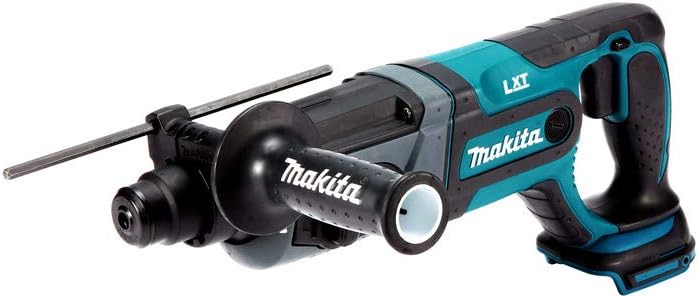
Makita XRH04Z Best for Light Anchor Drilling

Makita XRH04Z 18V LXT® Lithium-Ion Cordless 7/8" Rotary Hammer

Light anchor drilling

Field Score 90/100
Tool Weight
7.4 lb
Max Capacity
7/8 inch
Power Source
18V LXT battery
Blows Per Minute
0-4,000
View on Amazon

Seven-eighths of an inch is the smallest capacity in this group, and that single figure explains the XRH04Z: 1/4 to 5/8-inch anchor holes, conduit drops, hangers, and strut. It is not the tool for coring a vent through a foundation, and Makita doesn't pretend otherwise.

The rest of the spec sheet is straightforward. Makita rates it at 0-1,200 rpm and 0-4,000 beats per minute in three modes, with a torque-limiting clutch that disengages the gears when a bit binds instead of letting the tool spin your wrist. The handle is shock absorbent, the body is 7.4 pounds, and the depth gauge and side handle ship in the box while the batteries do not.

For an electrician or plumber already running LXT packs, this is an easy second tool to keep in the van, small enough to carry up a ladder one-handed and capable on the hole sizes that trade actually drills. It gives away impact energy to the Milwaukee 2712-20, and both are bare tools, so the Makita's case rests on the packs you already own. Its whole argument is capacity: if your holes stay under 7/8 inch, this does the job.

Worth Noting

  • Tool only: no batteries, charger, or case
Our Verdict

A sensible van tool for LXT owners drilling anchor and conduit holes, provided the work stays under its 7/8-inch ceiling.

Check Latest Price
7

DongCheng DZC03-28 Best for One-Off Demo Jobs

DongCheng 1-1/8 Inch SDS-Plus Rotary Hammer

One-off demo jobs

Field Score 89/100
Tool Weight
11 lb
Power Source
Corded, 9.2 amp
Impact Energy
3.6 joules
Blows Per Minute
5,000
View on Amazon

The name on the side doesn't prepare you for the numbers: a 9.2-amp motor, 3.6 joules of impact energy, and 5,000 beats per minute. Those are professional-tool figures, and they put the DZC03-28 near the top of this group for raw hammering speed, ahead of corded tools that cost considerably more.

The hardware backs it up. Capacity runs to 1-1/8 inches on SDS-Plus bits, rotation tops out at 1,300 rpm, and there's a mechanical safety clutch plus a shock-absorbing handle. The kit is genuinely complete: three SDS-Plus drill bits, a flat and a point chisel, spare carbon brushes, grease, and a molded case.

Chipping is where the energy shows. Three and a half joules behind a flat chisel lifts a tile bed or walks through a chimney breast without the stalling that turns a two-hour job into a weekend, and the hammer-only setting is a real demolition mode rather than a token one.

What tips it toward the value end of our list is who it's for. A crew running a hammer every day wants the Bosch's kickback control and its lighter body; a homeowner with one slab or one chimney in front of them wants 3.6 joules and a case full of bits, and this delivers both. The eleven pounds and the cord are the cost of that energy, and you notice them only when the hole is above your head.

Worth Noting

  • Corded, so it needs an outlet
Our Verdict

Pro-grade hammering figures in a complete kit; the right buy for a homeowner facing one slab, one chimney, or one bathroom floor.

Check Latest Price
8

DESHUO DS-LD26 Best for Homeowner Odd Jobs

DESHUO DS-LD26 – 1" SDS-Plus Lightweight Rotary Hammer Drill for Concrete/Masonry

Homeowner odd jobs

Field Score 88/100
Modes
4, with reverse
Tool Weight
7.2 lb
Power Source
Corded, 9 amp
Impact Energy
3 joules (2.21 ft-lbs)
View on Amazon

The forward and reverse buttons are what made us look twice at the DS-LD26. A bit that jams and won't back out is the fastest way to lose an afternoon on a tile floor, and reverse is the feature we check for first on any budget rotary hammer.

The numbers are respectable for the money: a 9-amp motor, 3 joules of impact energy, 0-1,100 rpm, and 0-5,300 beats per minute in four modes, plus a variable-speed trigger with a lock-on button and a safety clutch that releases when a bit grabs. Three SDS-Plus drill bits, a flat and a point chisel, spare brushes, and a case come in the box.

At 7.2 pounds it is within a pound of the Bosch, which is unusual for a budget corded tool and the reason it works on a wall rather than only on the floor. The four-mode selector adds a rotary-only setting for light work in brick, and the lock-on trigger is a small thing that matters when you are chipping rather than drilling.

For a homeowner with a dozen anchor holes and a bathroom floor to strip, this does the work of tools that cost far more, and the four modes mean the tool won't be what limits the job. What it can't offer is confidence in a long service life: a hammer at this price can quit early, and the 24-month warranty is what makes that a reasonable bet rather than a gamble.

Worth Noting

  • Three joules is the least among the corded picks
  • Corded only, so it needs an outlet
Our Verdict

A light, four-mode corded hammer for a homeowner with a finite list of holes; the two-year warranty is what makes the price palatable.

Check Latest Price

How We Tested: Concrete, Brick, and Old Thinset

We started with SDS-Plus tools only, since that shank size covers everything from a 3/16-inch anchor hole to a 1-inch bore, then filtered by impact energy, amp draw or battery platform, and what came in the box — bits, chisels, a case. Price factored in, but a bargain that quits on the third hole isn't a value. We landed on 10 units, corded and cordless, and ran them for six months.

Most of that time was spent in a basement, drilling 1/2- and 3/4-inch holes along a chalk line up a poured concrete wall. We timed every hole and noted whether the bit walked before it bit, then drove 4-inch tapcons into 1950s brick to see which tools torqued them down without spinning. Mode changes got timed too, since a four-function collar that fights you is a daily annoyance.

For chisel work, we removed a row of tile and the thinset under it, watching how each tool handled at an angle and whether our hands were still steady after ten minutes of hammering. Cordless models were run until the battery quit, with holes counted per charge and recharge times recorded. We also weighed each tool set up the way you'd carry it and drilled overhead into a ceiling to see which ones wore us out first, and swapped bits repeatedly to check whether the collar needed two hands.

Bit binding served as our durability test: we leaned into a few holes on purpose to see whether the safety clutch slipped or the tool twisted back at us. Two machines ended up living in the truck bed, which is where switch feel, cord wear, and regreasing intervals showed themselves.

How to Choose a Rotary Hammer Drill

Corded or cordless comes first

Decide this before anything else, because it eliminates half the list. A corded hammer holds full power from the first hole to the last and never asks you to buy a pack, which is why a mid-priced corded tool does more concrete work per dollar than any cordless option here. Cordless buys you a wall with no outlet nearby.

If you already own 18V or 20V packs from one of the big brands, a bare tool is the cheap route in. If you don't, compare against a kit like the DEWALT DCH133M2, which includes the batteries, charger, and case a bare tool leaves out.

Impact energy is the number to compare

Impact energy, quoted in joules or foot-pounds, is how hard the piston hits. In this group it runs from 1.7 ft-lbs on the compact cordless Milwaukee to 7.4 joules on the corded ENEACRO, and that spread shows up as speed in old concrete, not as a comfort feature.

Anchor holes and half-inch drilling are comfortable around 2.5 to 3 joules. Chipping, coring, and one-inch holes want 3.5 joules or more, and the price of that energy is weight in your hands and torque in your wrists.

Weight and vibration decide whether you finish

A rotary hammer spends much of its life above shoulder height, and 12 pounds held overhead is a different tool from 6. Every corded model here outweighs every cordless one, which is the least discussed reason crews go cordless. Judge the job, not the spec sheet: if the holes are in a ceiling or under a deck, take the lighter tool and give up some impact energy.

Vibration control and a side handle matter nearly as much, and a safety clutch is not optional equipment on a tool that can bind in rebar.

Check the chuck before you buy bits

Every tool in this group takes SDS-Plus bits, and none of them will accept the round-shank masonry bits already in your toolbox without an adapter. The capacity figure, 7/8 inch on the Makita up to 1-1/4 inches on the ENEACRO, is the largest bit the tool is rated for rather than a suggestion.

If you plan to chip and scrape, confirm the SDS-Plus rotary hammer you pick has a hammer-only mode and a chisel you can lock at an angle. SDS-Max is a separate class of tool for demolition work.

Kits and bare tools change the real cost

Two tools can look like the same purchase and be very different ones. A bare tool assumes packs and a charger, and a hammer without a case lives loose in a truck bed. Several picks here, including the ENEACRO, the DongCheng, and the DESHUO, arrive with bits, chisels, grease, and a case, which is money you don't spend later.

Budget for bits either way. A rotary hammer with one dull bit is a slower rotary hammer, and chisels are an extra purchase on every bare tool in this set.

Frequently Asked Questions

Final Verdict

The Bosch GBH2-28L Bulldog Xtreme Max is the rotary hammer we point most people to. Corded power means the last hole drills as fast as the first, 6.4 pounds is light enough to work a wall, and KickBack Control covers the moment a bit grabs rebar. Nothing else here balances those three things as well.

If there's no outlet, the Milwaukee 2712-20 does the same job off an M18 pack, and if you don't own packs at all, the DEWALT DCH133M2 kit arrives ready to drill. For ground-level demolition on a tight budget, the ENEACRO's 7.4 joules are hard to argue with.