The 8 Best RV Battery Chargers of 2026

A dead house battery announces itself at the worst possible moment: the furnace fan slows at 2 a.m., the inverter beeps, and the rest of the night goes to voltage math. The fix isn't simply more amps. It's a charger matched to the chemistry you actually own, one that tapers off as the bank fills instead of pushing current until something smells hot.

I cooked a lead-acid battery once by leaving a dumb charger on it all winter, so temperature compensation and a real float stage are the first things I check. Over the past nine months, my team has run 12 chargers through real RV duty: driveway shore power, a storage lot with no outlet in sight, and boondocking weekends where every amp counts. We timed recovery on a depleted bank, listened for fan noise from the bunk, checked how legible the voltage readout was at midday, and counted how long a permanent mount took. Chemistry matters as much as amperage, and the picks below cover everything from a handheld maintainer to a full converter swap.

Our Top Picks

The 8 Best RV Battery Chargers of 2026

1

NOCO GENIUS10 Best Overall

NOCO GENIUS10 10A 6/12V Smart Battery Charger

Most RV batteries

Field Score 95/100
Output
10 A
Weight
4 lb
Warranty
3-year limited
Battery Types
6V/12V lead-acid and LiFePO4
View on Amazon

Two features earn this one the top spot. The first is chemistry: selectable modes for flooded, AGM, gel, and LiFePO4 mean it follows you from a lead-acid starting battery to a lithium house bank without a second purchase. The second is force mode, which sends charge into a battery the charger otherwise refuses as too flat — the state a coach battery reaches after a winter of parasitic draw. On its own it also starts charging from as low as 1 volt, which covers most of what a stored RV battery does.

Ten amps is the number that decides whether this suits you, and we think it's right for the common case: one 100Ah battery brought back overnight or held at float through the off-season. On a 400Ah bank it's a slow tool, and that's the point where the PowerMax or a bigger portable earns its money. What we appreciate beyond the charging is the hardware — a mounting bracket with a Velcro strap, and needle-nose clamps with eyelets built into them, so you can bolt the leads to the posts, tuck the charger on a shelf, and unplug the connector when you pull out.

The one thing we can't promise is longevity. Units that quit within months and units that run for years both exist, and the three-year limited warranty is what turns that into a nuisance rather than a loss. Register it.

Worth Noting

  • 10 amps is slow on a large house bank
  • No weather rating, so mount it dry
Our Verdict

For most RVs this is the charger we point people to: 6V or 12V, lead-acid or lithium, plus a force mode for batteries other chargers refuse.

Check Latest Price
2

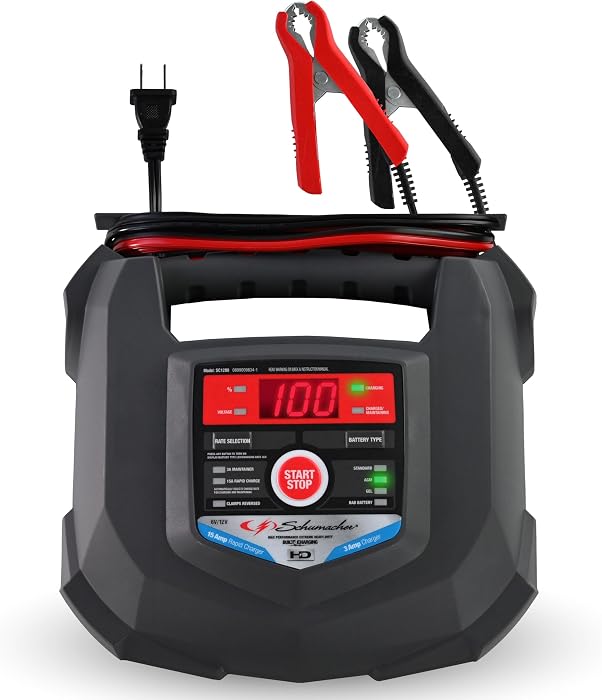
Schumacher SC1280 Best for Faster Lead-Acid Charging

Schumacher Electric 15A Car Battery Charger & Maintainer

Faster lead-acid charging

Field Score 94/100
Output
15 A
Weight
2.7 lb
Battery Types
6V/12V standard, AGM, gel, deep-cycle
Trickle Charge
3 A
View on Amazon

Fifteen amps instead of ten, and a display that shows voltage and percent charged rather than a row of blinking lights — that's the case for the SC1280, and it's why we keep it as the lead-acid alternative here. When a chassis battery goes flat in a cold snap, the extra amperage and a readable number matter more than a longer feature list. The 15-amp bulk rate steps down to a 3-amp trickle at the top, and auto-detect sorts 6-volt from 12-volt for you.

It's a four-in-one: charge, maintain, test, restore. The restore mode is the one we've watched bring a sulfated deep-cycle battery back to something useful. The test function is the part to treat with suspicion — it can call a battery bad that still takes and holds a charge, so confirm with a voltmeter before you spend money on a replacement.

Where it falls short for RV duty is chemistry and connection. There's no lithium profile, so a LiFePO4 house bank is out. And the clips are the only connection in the box — no ring terminals — which makes this a charger you clamp on and take off rather than one you wire in and leave. At 2.7 pounds it lives on a shelf, and the warranty runs a single year against three on the NOCOs.

Worth Noting

  • No lithium charging profile
  • Clips only, no ring terminals
Our Verdict

If your rig runs on lead-acid and you want more amperage than the NOCO delivers, the SC1280's 15 amps and readable display are the reason to pick it.

Check Latest Price
3

PowerMax PM3-55LK Best Converter/Charger

PowerMax PM3-55LK 55A 12V RV Converter Charger

Dead converter replacement

Field Score 93/100
Output
55 A, shared with DC loads
Footprint
7.8 x 9.5 x 3.5 in.
Fixed Output
13.0 to 16.5V adjustable
Charge Stages
3-stage, 14.6V / 13.6V / 13.2V
View on Amazon

This is the pick for a specific morning: the converter in your RV has died, the lights are dim, and the house battery isn't charging from shore power anymore. The PM3-55LK is a deck-mount converter and charger in one, 7.8 by 9.5 by 3.5 inches, feeding 55 amps into the 12-volt system — a different order of speed from anything portable on this list.

Read that 55 amps carefully. It's shared between whatever your DC loads are drawing and what's left for the battery, so with the fridge, fans, and lights running you may see closer to 30 amps going into the bank. For lead-acid it runs a three-stage profile with presets around 14.6, 13.6, and 13.2 volts. For lithium you switch to fixed output and dial the voltage yourself between 13.0 and 16.5 — and that is a power supply set to your battery maker's spec, not a managed lithium charge. Worth knowing before "lithium compatible" reads like the NOCO's LiFePO4 mode.

We like it for what it is: a straightforward replacement that goes in with hand tools and patience. The wiring is the real work — 8 AWG cable, a 120V outlet within 36 inches, an inch of free air at each end, and enough capacity on that circuit. Get those right and it quietly upgrades the whole DC system. The fan runs only when it's needed rather than constantly; even so, mount it where you won't hear it at night.

Worth Noting

  • Output is shared with DC loads
  • Needs an outlet within 36 inches and clearance at both ends
Our Verdict

If your RV converter has failed, this is the replacement we recommend: 55 amps into the whole 12-volt system, with a lithium setting you configure by hand.

Check Latest Price
4

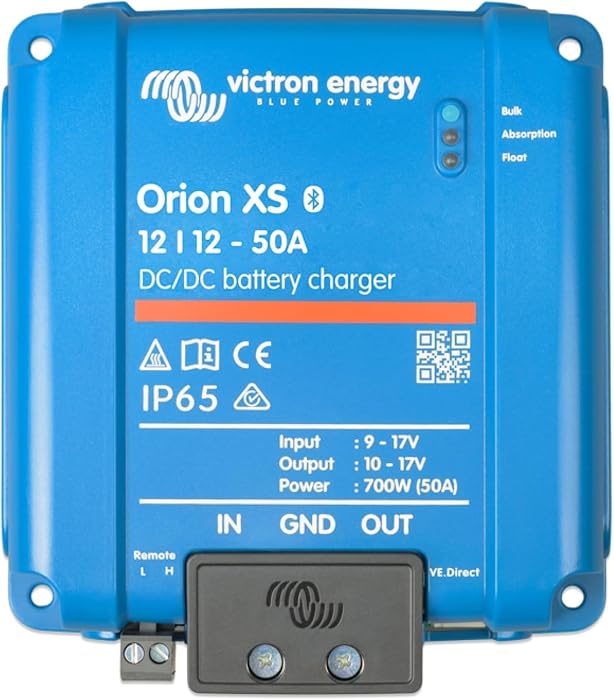
Victron Orion XS 50A Best for Charging While Driving

Victron Energy Orion XS Smart (Bluetooth) DC-DC Charger 12/12V 50A 700W

Charging while driving

Field Score 92/100
Output
50 A / 700 W
Weight
16 oz
Efficiency
98.5%
Weather Rating
IP65
View on Amazon

The Orion XS answers a question a lot of RVers ask after they add lithium: why isn't the house bank charging while I drive? Wired between the start battery and the house bank, it takes alternator voltage in and puts out a controlled 50 amps at 12 volts — 700 watts at 98.5 percent efficiency. On a long drive that's enough to replace a day's draw on a sizable lithium bank without leaning on the alternator beyond what it can give.

The configuration is what makes it worth the install. You set input and output current limits in the VictronConnect app, so a modest alternator isn't asked for more than it can supply, and engine-running detection starts and stops the charge on its own — no ignition wire to run through the firewall. The app also keeps a 30-day history, which is how you find out the house bank was never as full as the panel suggested.

Two boundaries. It's 12 volts in and 12 volts out, so a 24-volt system is out of scope, and IP65 means spray-resistant rather than dunkable. The other is that it isn't a shore charger at all: with the engine off it does nothing, so it sits alongside a converter or a portable charger instead of replacing one. At 16 ounces and under six inches long, it tucks in near the battery and stays out of the way.

Worth Noting

  • 12 volts in and out, so no 24-volt systems
  • Does nothing on shore power
Our Verdict

For charging the house bank off the alternator while you drive, this is the one we trust: 50 configurable amps that won't ask more of your alternator than it has.

Check Latest Price
5

NOCO GENPRO10X2 Best Onboard Multi-Bank

NOCO GENPRO10X2 12V 20A 2-Bank OnBoard Marine Battery Charger & Maintainer

Two-battery onboard setup

Field Score 91/100
Banks
2, independently configured
Output
20 A total, 10 A per bank
Weight
8.7 lb
Weather Rating
IP68
View on Amazon

Buying this one commits you to an afternoon. The GENPRO10X2 is an onboard charger: it bolts into a compartment, gets permanent ring terminals on the posts, and is fed by a shore-power cord you install. Nothing about it is portable, and at 8.7 pounds in a 10.28 by 9.25 by 6.06-inch body, it needs a real mounting spot.

What you get for that is the setup we like best for a two-battery rig: two banks, each with its own mode — 12V, 12V AGM, 12V lithium, or repair — so a sealed AGM chassis battery and a LiFePO4 house bank can charge at the same time on their own profiles. That per-bank selection is what separates it from a plain two-bank charger. Ten amps per bank, 20 total, is enough for a typical pair of 100Ah batteries, the IP68 rating lets it live in a damp compartment, and a thermal sensor trims the charge in heat and cold.

Two things to weigh. It costs more than any of the portable chargers here, and it earns that only if it stays installed — if the rig sits in storage and you charge once a month, a portable does the same job for less. And some of these fail inside the first year, so mount it where you can reach it without unloading the compartment, and keep the receipt for the three-year warranty.

Worth Noting

  • Requires permanent mounting and AC wiring
  • Costs more than any of the portable chargers here
Our Verdict

For a two-battery rig with mixed chemistries, this is the onboard charger we recommend: two sealed banks, each on its own profile, wired in and forgotten.

Check Latest Price
6

LiTime 12V 20A Best Dedicated Lithium Charger

LiTime 12V 20A Lithium Battery Charger

Lithium house banks

Field Score 90/100
Output
14.6V / 20 A
Warranty
2 years
Connector
Anderson 50A, M8 terminal
Battery Types
LiFePO4 only
View on Amazon

14.6 volts is the whole story: that's the absorption voltage a 12-volt LiFePO4 battery wants, and it's fixed here because this charger only does lithium. There's no flooded, AGM, or gel setting and no way to select one. If your RV runs a lithium house bank, that single-mindedness is a feature. If you still have a lead-acid starting battery to top up, it isn't the tool.

Twenty amps into a 100Ah bank is roughly twice the rate of the 10-amp chargers here, and the 0V activation function is the detail we care about most: when a lithium battery's BMS has shut it down, the charger can wake it and begin a normal cycle instead of flashing an error. An Anderson 50A connector and M8 terminals make it easy to hard-wire to a bus bar, and the aluminum housing and cooling fan keep it steady through a long charge.

The placement problem is real. The listing says plainly that it isn't waterproof and isn't for marine use, so it can't live in a wet compartment or anywhere road spray reaches. It also gives you nothing for lead-acid, which rules it out as the only charger in a mixed-chemistry rig. As a dedicated lithium charger for boondocking and off-grid use, though, 20 amps at the right voltage for a midrange price is a clean answer, and the two-year warranty is a fair match.

Worth Noting

  • Lithium only, with no lead-acid profile
  • Not waterproof, so it needs a dry mounting spot
Our Verdict

If your house bank is LiFePO4 and nothing else, buy this: 20 amps at the right voltage, with a 0V wake-up for a battery the BMS has shut down.

Check Latest Price
7

Haisito 20A Best for Budget 20-Amp Charging

Haisito 20-Amp Smart Battery Charger (Lithium LiFePO4 & Lead-Acid)

Budget 20-amp charging

Field Score 89/100
Output
20 A at 12V, 10 A at 24V
Display
LCD with amps, volts, temperature
Battery Types
LiFePO4, AGM, gel, SLA, lead-acid
View on Amazon

This is the least expensive 20-amp charger here, and the only one that handles 12-volt and 24-volt systems automatically. For a rig with a 24-volt bank — some diesel pushers and ex-military conversions — that combination is hard to argue with, since nearly everything else on this list is 12-volt only.

The 20 amps applies at 12 volts; on 24 volts it drops to 10, which is worth knowing before you buy it for a large 24-volt bank. There are three separate profiles, including a dedicated LiFePO4 setting, plus a pulse repair mode, and the LCD shows amps, volts, temperature, and battery percentage as it works — more information than the blinking-light units give you.

One function deserves a mention: if a very flat 24-volt battery gets misread as 12-volt, you can force the charge manually instead of watching it sit there. That's the kind of detail that matters exactly once, and when it does, it's the difference between a recovered battery and a wasted afternoon.

Where it lands for us: the value pick for a 12-volt rig that wants 20 amps, and the only automatic 24-volt option in the group. When the choice is this or a 10-amp unit for a bit less, we take the extra amps. When the choice is this or the NOCO for a bank you depend on, we take the NOCO.

Worth Noting

  • Only 10 amps on 24-volt systems
Our Verdict

The value pick if you need 20 amps for less, and the only charger here that handles a 24-volt bank without a second piece of gear.

Check Latest Price
8

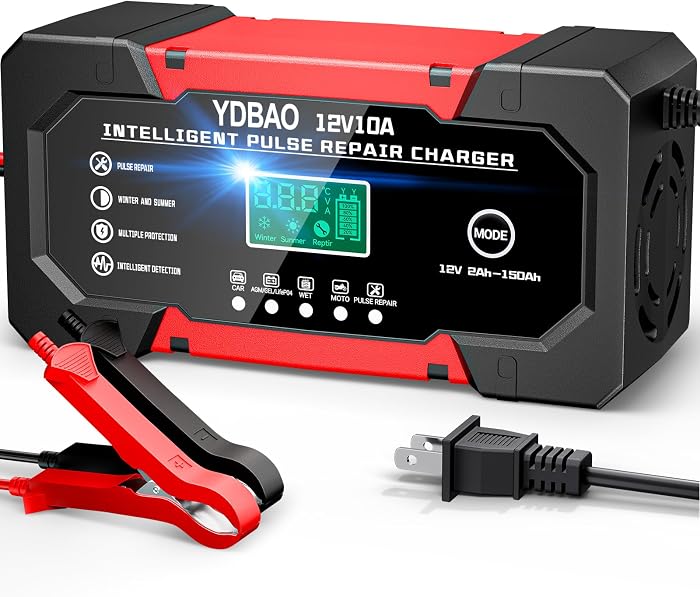
YDBAO 10A Best for Single Battery Top-Ups

YDBAO 10A – Car Battery Charger 12V 10A Smart Trickle Charger Fully Automatic

Single battery top-ups

Field Score 88/100
Output
10 A at 12V
Weight
1.28 lb
Display
LCD
Battery Types
12V lead-acid and LiFePO4
View on Amazon

Ten amps, 12 volts, no 6-volt setting and no 24-volt mode. That's the whole scope of this one, and it's why it sits here as a budget entry rather than a do-everything pick: it charges a single 12-volt RV battery, slowly, and that's the job it was built for.

The feature list runs longer than you'd expect for the position it occupies. An LCD shows voltage, current, battery level, and ambient temperature before you even connect, eight protection layers include reverse polarity and short circuit, and a pulse repair mode is aimed at sulfated batteries.

The seasonal setting is the detail we didn't expect at this level. Instead of sensing temperature, it asks you to choose summer or winter, which changes the charge voltage — handy for topping up a cold battery in an unheated trailer in February, as long as you remember to switch it back when the weather turns.

Our take: this is a second charger, not a primary one. It's small enough to live in a bag, it's the least expensive way onto this list, and the one-year warranty tells you what the maker expects of it. One battery, a monthly top-up, and a day to spare is its natural job. A bank, or lithium at volume, belongs with the NOCO or the LiTime.

Worth Noting

  • One-year warranty
Our Verdict

A cheap, competent top-up charger for one 12-volt battery — as long as you aren't asking it to manage a bank or a lithium system.

Check Latest Price

How We Tested RV Battery Chargers

We started by sorting the field into three jobs: portable chargers you carry out to a battery, onboard units that stay mounted in the rig, and converter chargers that take over from shore power. From there we filtered on chemistry support, amperage relative to the bank sizes RVers actually run, sealed housings for anything living in a compartment, and price against output. Twelve units made the cut, and we spent nine months with them.

Testing happened where these chargers live. We charged from a driveway outlet, hauled the portable models to a storage lot with no power available, ran the onboard units through a full boondocking weekend on a depleted house bank, and used a DC-to-DC model on a tow vehicle's dual-battery setup over a long highway drive. For winter layup, the maintainers stayed connected for six weeks straight so we could see what happened to a battery left entirely alone.

At every stage we clamped a meter on the cables and timed how long a bank at half charge took to reach full, noting where in the cycle each unit backed off. We checked each voltage readout against a multimeter to see how far it drifted, felt case temperature after two hours of work, ran a decibel app to compare fan noise at bunk height, and timed a permanent mount from first screw to last — along with whether the compact units actually stowed in a toolbox afterward.

Reliability and value got judged the slow way. After weeks on a shelf and in the sun, we hooked each charger back up to a tired, older battery and watched whether it behaved the same, then rechecked resting voltage a week after a full charge to see which ones held a battery up. Nothing was rated on its spec sheet.

How to Choose an Rv Battery Charger

Four Kinds of Charger, Four Different Jobs

A portable AC charger plugs into any 120V outlet and clamps to the battery, which makes it the right tool for storage season and campground pedestals but useless while you drive. An onboard multi-bank charger is bolted in and wired to shore power, and it charges the house and chassis batteries separately. A converter/charger replaces the RV's own power center and feeds the whole 12-volt system, not just the battery. A DC-DC charger runs off the alternator while the engine is turning and does nothing on shore power. Choose the type from how you actually use the rig, then compare within it.

Most rigs eventually want two of them: a converter or an onboard unit for pedestal power and a DC-DC for the road.

Match the Charge Profile to the Chemistry

Flooded, AGM, and gel batteries want different absorption and float voltages, and LiFePO4 wants roughly 14.4 to 14.6 volts with no equalization stage at all. That's why selectable modes matter more than the amperage number on the box. The trap is the phrase "lithium compatible" on a converter: the PowerMax handles lithium through an adjustable fixed output between 13.0 and 16.5 volts, which is a power supply you set by hand and leave there — it does not manage the battery the way a dedicated lithium mode does. If you might change chemistries, buy modes, not a voltage dial.

Where the Charger Lives Decides the Enclosure

An onboard unit sealed to IP68 can live in a compartment that gets damp; a portable charger with no weather rating needs a dry shelf. Ventilation matters as much: the PowerMax asks for an inch of free air at each end, and the outlet has to be within reach of the cord — 36 inches in its case. Heat is the other half of the decision. A fan-cooled converter cycling under the bed at two in the morning is a different product from the one you never hear, so pick the mounting spot before the model.

Flat Batteries and Long Storage

Recovery modes separate a charger that gives up on a deeply discharged battery from one that tries: the NOCO units push charge into a battery at zero volts, and the LiTime wakes a lithium pack whose BMS has shut it down. What none of them do is resurrect a battery that has already failed a load test, so treat a repair or desulfation cycle as a last attempt rather than a cure.

For storage, the useful habit is leaving a smart multi-stage charger connected as a battery maintainer through the off-season. It tapers to float and holds there, which is cheaper than a new battery every spring.

Frequently Asked Questions

Final Verdict

Most RVers should buy the NOCO GENIUS10. It covers both chemistries you're likely to own, it will attempt a battery other chargers write off, and the eyelet clamps let you leave it wired to the posts for storage season. If the converter has died, the PowerMax PM3-55LK fixes the whole 12-volt system rather than just the battery; if you want the house bank charged while you drive, the Victron Orion XS is the one to install.

And for a lithium-only house bank, the LiTime's 20 amps at 14.6 volts is the cleanest match — as long as it can live somewhere dry.