The 8 Best Seed Starting Trays of 2026

For years, my seed-starting setup was a yogurt cup with a hole poked in the bottom. It worked right up until the plastic split and the soil dried out faster than I could water it. A real tray holds moisture evenly, keeps the soil warm under a dome, and lets seedlings come out at transplant time with their roots intact.

The trouble is that trays are usually the cheapest plastic in the whole operation. Some arrive cracked, some domes sit crooked, and a cell count that looked generous online turns out not to fit a standard flat. We've spent the past four months starting seeds in 16 trays — tomatoes and peppers on a heat mat in the basement, lettuce and herbs on a kitchen windowsill — and the keepers share a few traits.

Domes and vents matter more than most first-timers expect: a lid that seals unevenly dries out one corner of the flat, and vents that won't open wide leave you wiping mold off the soil. Cell depth counts too, since deeper cells mean less root disturbance at transplant. Below are the trays that earned a second season.

Our Top Picks

The 8 Best Seed Starting Trays of 2026

1

MIXC 120-Cell Seed Starter Kit Best Overall
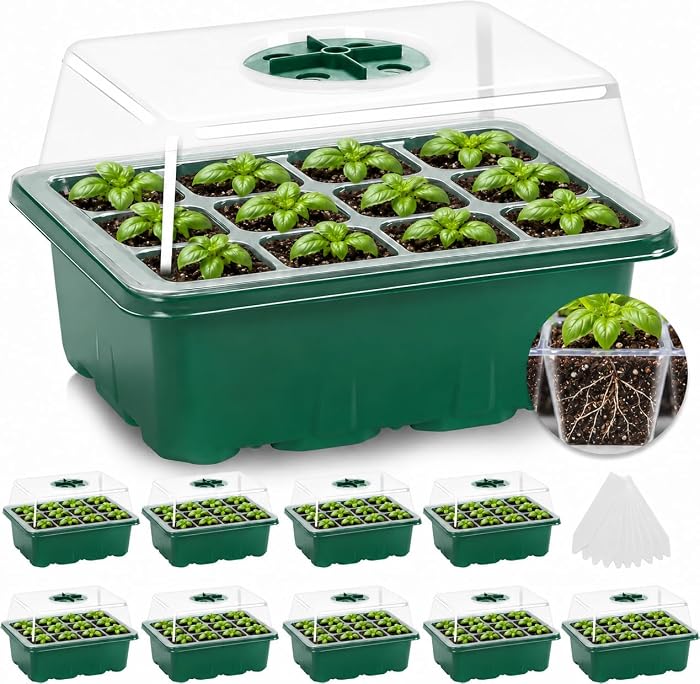
MIXC 10 Pack Seed Starter Tray

Beginner indoor kits

Field Score 94/100
Total Cells
120
Humidity Dome
10 with adjustable vents
Drainage Holes
Yes
Trays Included
10
View on Amazon

The MIXC kit is the one we reach for first when someone wants a complete indoor setup without hunting for domes and base trays. It arrives with ten 12-cell inserts, ten watertight bases, ten vented domes, and labels, so you can fill a tray, water from below, and close the lid without adding parts. That completeness is why it earns the top spot: it removes the small decisions that trip up a first seed-starting season.

The adjustable vents are the detail we appreciate most. You can crack them open as seedlings emerge instead of propping the lid with a pencil, and the drainage holes let excess water pass into the base instead of sitting around the roots. Because the cells are split across ten separate trays, you can sow a cool-weather crop in one and hold another back for a later sowing date.

The clear domes make it easy to watch moisture, and the bases are deep enough to hold runoff without spilling when you move a tray. We also like that the empty trays nest for storage, which matters if you start seeds in a closet or garage.

Worth Noting

  • No grow light or heat mat included
Our Verdict

We recommend the MIXC kit first for most indoor gardeners because it arrives with domes, bases, vents, and drainage in one box.

Check Latest Price
2

Burpee SuperSeed 36-Cell Tray Best for Easy Transplanting

Burpee SuperSeed 36-Cell Reusable Seed Starting Tray for Indoor Seedlings

Easy transplanting

Field Score 93/100
Cells
36
Drainage
Molded corner slots
Cell Style
Flexible silicone pop-out
Dome Included
No
View on Amazon

Burpee's SuperSeed tray attacks the messiest part of seed starting: getting a healthy seedling out of a narrow cell without tearing its roots. The 36 cells are made of soft silicone, so the whole cell flexes and the root ball slides out when you press from the bottom. That is a different approach from the rigid plastic inserts most kits use.

We like it best for gardeners who start a modest number of tomatoes, peppers, or flowers and want to transplant without a knife. The silicone is gentle on roots, and the molded corner slots help water drain. The catch is that the tray has no humidity dome, so you need your own cover or a sheet of plastic to keep moisture in until germination.

One practical note from using flexible cells: water the tray before you pop a seedling out. Dry soil crumbles and takes roots with it, while moist soil holds the root ball together.

Worth Noting

  • Rigid frame can crack in shipping
Our Verdict

We reach for the Burpee tray when transplanting is the part you dread; the silicone cells release seedlings without a fight.

Check Latest Price
3

Bootstrap Farmer 1020 Trays Best Heavy-Duty Flats

Bootstrap Farmer 5-Pack Black 1020 Trays

Heavy-duty bottom watering

Field Score 92/100
Material
BPA-free PP
Tray Size
21.1 x 11 x 2.5 in
Pack Count
5
Drain Holes
No
View on Amazon

Most seed-starting trays flex when you pick them up full; the Bootstrap Farmer 1020s are the exception in this group. They are thick, rigid flats with a 2.5-inch depth, and they hold their shape when loaded with wet soil or a row of pots. We trust them for the carrying-and-shuffling part of seed starting, which is where flimsy trays fail.

The solid bottom is intentional. These have no drain holes, so you use them as a bottom-watering reservoir under cell inserts or pots, or as a flat for microgreens and wheatgrass. The outside measures about 21 by 11 inches, which is the standard 1020 footprint, so they slide into greenhouse racking and fit standard inserts. We also like the opaque black plastic for blocking light during germination.

The heavier plastic is what you're paying for, and it makes sense if you already run standard 1020 inserts and domes. If you want an all-in-one setup, a kit like the MIXC is the easier start.

Worth Noting

  • Sold without inserts or dome
Our Verdict

We trust the Bootstrap Farmer flats to carry a wet load without buckling, and that makes them worth the premium for serious setups.

Check Latest Price
4

Gardzen 400-Cell Propagator Set Best High-Capacity Kit

Gardzen 10-Set Garden Propagator Set

High-capacity sowing

Field Score 91/100
Drainage
Yes
Total Cells
400
Humidity Dome
10 with two vents each
Cells Per Tray
40
View on Amazon

Gardzen's set is built for volume: ten trays, each with a 40-cell insert, a base, and a vented dome. That adds up to 400 cells, which is enough to sow a cutting garden, a block of vegetables, and a few trays of flowers without running out of room. The domes have two adjustable vents apiece, so you can regulate humidity without lifting the lid.

The 40-cell inserts are small, so this is a germination setup rather than a place to grow seedlings on for weeks. Plan to pot up before roots circle, especially with tomatoes and peppers.

We recommend the Gardzen set for someone who wants a lot of cells and a complete dome-and-base kit in one purchase. It is not the sturdiest plastic in this group, but the capacity is hard to match for the price. If you only need a windowsill's worth of starts, a smaller kit is less fussy.

Worth Noting

  • Lids rest loosely, so secure them outdoors
Our Verdict

We like the Gardzen set for sowing in bulk; ten vented 40-cell trays handle a lot of seedlings without a custom setup.

Check Latest Price
5

Bonviee 12-Cell Starter Kit Best for Windowsills

Bonviee 12-Cell Starter Kit – 5-Pack Seed Starter Trays

Windowsill growing

Field Score 90/100
Total Cells
60
Humidity Dome
5 with adjustable vents
Cells Per Tray
12
Heat Mat Compatible
Yes
View on Amazon

The Bonviee 12-cell kit is the compact option: five trays, five domes, five bases, and ten labels, for 60 cells total. Each cell insert is clear, so you can see moisture and early roots without lifting the tray, and the adjustable vent on each dome gives you a way to let humidity out as seeds sprout. The set is also sized for a heat mat and a bright windowsill.

We like this set for herbs, flowers, and a few tomatoes where space is tight. The cells are small and the domes rest rather than snap, so it is not the kit for someone who wants to grow big seedlings for weeks or move trays in and out of the wind. The small footprint is the point: it is easy to fill, water, and rotate.

Worth Noting

  • No grow light included
Our Verdict

We recommend the Bonviee kit for a bright windowsill where five compact, vented trays are enough.

Check Latest Price
6

Bonviee LED Seed Starter Kit Best with Grow Lights

Bonviee LED Seed Starter Kit – Seed Starter Trays with 12-LED Grow Lights

Lit indoor starts

Field Score 89/100
Power
USB, 5V/2A
Grow Light
12 LEDs per tray
Total Cells
60
Humidity Dome
5 vented domes
View on Amazon

The Bonviee LED kit takes the same five-tray, 60-cell format and adds a 12-LED grow light to each dome. A single USB cable splits five ways, so you can power all five trays from one adapter, and each dome still has a vent for humidity control. The cell inserts are clear, and the bases catch runoff from the drainage holes.

The light is supplemental, not a replacement for a proper shop light once seedlings get tall. It is best for a windowsill that gets some sun but not enough on a gray week, or for keeping starts from stretching on a dim kitchen counter. You need a 5V/2A USB adapter, which is not in the box, so plan for that before you set it up.

We like this kit when light is the missing piece and you want it bundled with the trays. The built-in strips are convenient and keep the footprint small, but they won't turn a dark closet into a grow room. If you already have a light, the standard Bonviee kit costs less and does the same tray job.

Worth Noting

  • Domes feel thin
Our Verdict

We like the Bonviee LED kit when your windowsill lacks light and you want a starter setup that includes the lamp.

Check Latest Price
7

Hydroponic City 216-Cell Trays Best for Budget Modular Cells

Hydroponic City 216-Cell Trays – Seed Starter Trays

Budget modular cells

Field Score 88/100
Trays
36
Drainage
Slits
Cell Size
1.5 x 1.5 x 2.25 in
Total Cells
216
View on Amazon

Hydroponic City sells these as 36 six-cell trays, not one big flat. That modular format is the appeal: you can fill three trays for a windowsill, stack the rest, or arrange the 2x3 blocks around a heat mat. The set totals 216 cells, and each cell has drainage slits and measures 1.5 inches square by 2.25 inches deep.

The plastic is thin enough that we treat these as germination trays rather than long-term homes. They work best for herbs, flowers, and quick vegetables that you pot up promptly. The five included stakes are a small help, though you'll want more labels if you sow a lot.

Because the trays are separate, they are easy to move and easy to lose. Keep them on a 1020 flat or a cookie sheet when you water, especially if you use a bottom-watering setup. The modular size is also handy for giving away extra seedlings without handing over a whole kit.

We recommend these for a budget-minded gardener who wants a lot of cells and doesn't need a long-term tray. They are the cheapest way here to try several sowing dates, and the 2x3 blocks are easier to shuffle than a full flat. If you want a tray that lasts for years, spend more on the Bootstrap flats or a heavier cell kit.

Worth Noting

  • Cells are too small for large seeds
Our Verdict

We keep the Hydroponic City trays for cheap, modular germination runs where small cells are fine.

Check Latest Price
8

Living Whole Foods 1020 Flats Best for Budget 1020 Flats

Living Whole Foods 1020 Flats – 10 Plant Growing Trays (No Drain Holes)

Budget 1020 flats

Field Score 87/100
Depth
2.38 in
Tray Size
Approx. 21 x 11 in
Pack Count
10
Drain Holes
No
View on Amazon

The Living Whole Foods trays are solid-bottom 1020 flats, about 21 by 11 inches at the top and 2.38 inches deep. There are no drain holes, which makes them a bottom-watering reservoir or a liner for cell inserts, pots, and microgreen pads. The ten-pack is a practical way to set up a whole shelf at once.

The plastic is thin and flexible, so these are not the flats to carry around full of wet soil without support. Set them on a sturdy shelf or a second tray, and lift from the bottom rather than the rim. Used that way, they do the job: they hold water, contain runoff, and fit standard 1020 inserts.

We like them for bottom watering because the solid bottom lets you leave a shallow reservoir for pots to drink from. They also work for wheatgrass and microgreens, where you want a shallow layer of medium without water running straight through. The 27-cup capacity is enough for a small crop, but not for deep-rooted starts.

We recommend these as budget liners and watering trays, not as your only seed-starting tray. If you already have cell inserts or small pots, they are a cheap way to give everything a reservoir. If you need a tray that can be lifted and moved full, the Bootstrap Farmer flats are the sturdier choice.

Worth Noting

  • No dome or cell inserts included
Our Verdict

We use the Living Whole Foods flats as bottom-watering trays for inserts and pots, not as stand-alone seed cells.

Check Latest Price

How We Tested 16 Seed Starting Trays

We started by pulling every seed starting tray we could find from the major retailers and garden suppliers, then cut the list down to the shapes that genuinely differ: standard 1020 flats and inserts, deep-celled silicone trays, domed propagator kits with adjustable vents, and open no-drain-hole flats meant for bottom watering. We dropped near-duplicates and anything that couldn't be reused. That left 16 trays and kits, from budget multi-packs to heavy-duty flats, and we bought every one at full price.

Sowing ran from late January into May. We filled every cell with the same moistened mix, sowed the same varieties in each tray, and counted germination at the one-week and two-week marks — tomatoes and peppers on a basement heat mat, lettuce and basil on a kitchen windowsill, and a flat of microgreens in a cool garage. Clear trays let us watch roots without lifting anything out, which we noted as we went.

To judge sturdiness, we lifted each tray by one corner while it was loaded with wet soil, flexed the rims, snapped domes on and off repeatedly, and stacked the empties in a hot garage over the summer. Thin-walled trays bowed and cracked at the corners; the thicker ones came back for a second round unchanged. We also checked fit — whether a tray sat flat inside a standard flat, whether the dome sealed on all four sides, and whether the vents opened wide enough to drop humidity after germination without pulling the whole lid off. Ease of use got timed in real life: filling a 400-cell tray, popping silicone cells free, and washing everything at the end of the season.

Finally, we worked out cost per cell rather than cost per pack, since a cheap 12-pack and a cheap 2-pack are not the same purchase. Value only held up when the tray survived washing and stacking without warping.

How to Choose Seed Starting Trays

Start With the Format: Kit, Cell Insert, or 1020 Flat

Most shoppers are choosing between three formats. A complete kit pairs a cell insert with a base and a humidity dome, so you can fill it and start sowing without shopping for parts. A bare 1020 flat is the standard 21-by-11-inch workhorse; it holds cell inserts, pots, or a shallow layer of medium, but you supply the insert and dome. A cell insert on its own is the cheapest way to add cells to a flat you already own.

Pick the kit if you want the shortest path to germination. Pick the flat if you already have inserts and domes, or if you bottom-water pots and microgreens. We reach for a kit like the MIXC for beginners and a heavy flat like the Bootstrap Farmer when the priority is carrying a full tray without buckling.

Match Cell Size and Count to What You're Sowing

Cell size matters more than the total count. Small cells are fine for herbs, flowers, and quick crops that you pot up within a few weeks. Tomatoes, peppers, and other larger starts need more root room before transplant, so a tray with 40 or more cells per flat can become a holding pen rather than a home. Count the seedlings you will actually pot up, not the cells in the listing.

If you sow in waves, separate trays beat one giant flat because you can move a single tray to a heat mat or a brighter spot. A high-count set like the Gardzen 400-cell kit makes sense for a cutting garden or a plant sale; a smaller 60-cell kit is easier to manage on a windowsill.

Drainage, Bottom Watering, and Dome Fit

Drainage holes let excess water pass out of the cell and into a base tray, which lowers the risk of soggy roots. A solid-bottom flat does the opposite: it holds water for bottom watering and keeps runoff contained, but it is not the tray for top watering. Neither design is better; they solve different watering styles.

Dome fit is the detail that separates a pleasant kit from a fussy one. A dome that rests loosely is fine indoors, but it can slide off outdoors or when you move the tray. Check whether the vents adjust without removing the lid, and plan to secure loose domes with a strap or tape if the tray goes outside.

Sturdiness, Reuse, and the Real Cost

Thin plastic is the most common trade-off in this category. It keeps the price low and makes it easy to flex a seedling out, but a full tray can buckle when you lift it, and repeated seasons can crack the corners. Heavy-duty flats cost more up front and are the better buy if you carry trays full of wet soil or plan to reuse them for years.

Our rule: buy heavy where you handle the tray, and save on the cells. A sturdy 1020 flat under a cheap cell insert gives you the support you need without paying premium prices for every cell. If you want one tray to do both jobs, expect to pay for the thicker plastic.

Lights, Heat Mats, and Indoor Conditions

A windowsill is often enough to germinate seeds, but it is rarely enough to grow strong seedlings through a cloudy week. A supplemental LED strip can keep starts from stretching, while a heat mat speeds germination for warm-season crops. Check that the tray is heat-mat compatible and that any light has the adapter and coverage you need.

Integrated light kits are convenient for a small setup, but they are not a substitute for a full grow-light fixture once plants get tall. If you already own a light, spend the money on a better tray instead.

Frequently Asked Questions

Final Verdict

We recommend the MIXC 120-Cell kit as the default for most indoor gardeners. It arrives with the pieces that matter—cells, bases, domes, vents, and drainage—so you can start sowing without a second order. If you already own inserts and domes and want a tray that won't buckle when full, the Bootstrap Farmer 1020 flats are the sturdier buy. And if your windowsill is short on light, the Bonviee LED kit bundles a small supplemental lamp with the same compact tray format.