The 9 Best Solar Trail Cameras of 2026

A solar panel on a trail camera sounds like the end of the chore — no ladder, no fistful of batteries, no scraping ice off a latch in February. But the panel is the easy part. What actually decides whether you'll like one is how the pictures reach you and whether the camera fires before the animal walks out of frame.

My team and I have spent the past seven months living with 12 of them — WiFi models, cellular models, and app-controlled cameras that store footage locally — and the gap between the good ones and the irritating ones had surprisingly little to do with price or megapixels. Solar keeps a camera alive; it doesn't fix a slow trigger, a lens that fogs at dusk, or an app that sends you back out to the tree.

The other thing worth knowing: field of view and trigger speed matter more than resolution. A 64-megapixel photo of an empty trail is still an empty trail. The cameras below are the ones that kept sending images I actually wanted to open.

Our Top Picks

The 9 Best Solar Trail Cameras of 2026

1

CEYOMUR CY95 Best Overall

CEYOMUR 4K 68MP Solar WiFi Trail Camera

Single-camera scouting

Field Score 86/100
Power
Integrated solar; 5,200mAh battery
Storage
32GB card included
Detection
0.1-second trigger; 120° PIR
Resolution
68MP photos; 4K video
View on Amazon

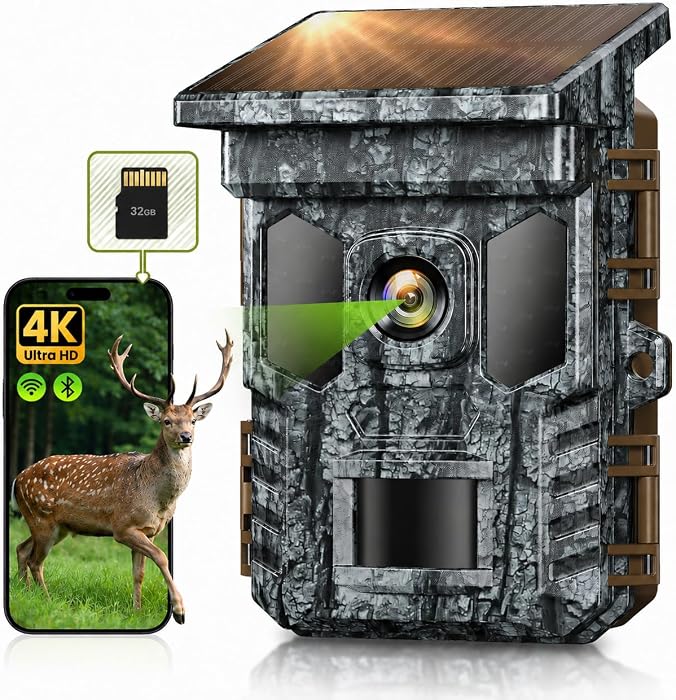
The solar panel sits on top of the CEYOMUR rather than hanging off a cable, and that is the detail that makes it our top pick. There is no second panel to aim, no extra wire to lose, and the 5,200mAh battery is built into the housing. Add the included 32GB card, 68MP stills, and 4K video, and the kit is ready for the woods without a trip to the store.

We also like the detection package: three PIR sensors cover a 120-degree arc, the trigger is rated at 0.1 second, and the low-glow infrared reaches about 20 meters. That is the kind of coverage that catches an animal crossing a lane rather than posing in front of the lens. The IP66 housing means rain and dust are part of the plan, not a reason to bring it inside.

The ordinary job is where this one earns its place: a gate, a feeder, or a trail through the back forty. The 32GB card is already inside, so there is no last-minute stop for storage. We recommend it first for a camera you can walk up to and check.

Worth Noting

  • Local WiFi only; no remote cellular access
Our Verdict

The CEYOMUR CY95 is our default solar trail camera: integrated charging, 68MP stills, 4K video, and a 32GB card without a cellular plan.

Check Latest Price
2

MAXDONE PH970S Best Two-Camera Value

MAXDONE Solar Trail Camera 2 Pack

Two-camera coverage

Field Score 85/100
Power
Integrated solar; 6,000mAh battery
Storage
32GB card included
Resolution
64MP photos; 4K at 30fps
Connectivity
WiFi 6 and Bluetooth
View on Amazon

Two cameras change the math. The MAXDONE kit puts a 6,000mAh battery and an integrated solar panel on each unit, so a gate and a back fence can both keep watch without a second shopping trip. The 64MP stills and 4K video match the top pick on paper, and each camera comes with a 32GB card.

Where we are more careful is the connection. The app uses WiFi 6 and Bluetooth to make its own local signal, which is great when you are standing at the tree and less useful when you are across the property. We prefer this kit for places we can reach rather than a distant lease, and we like the 100-degree lens for a feeder or a gate.

The reason to choose this over the CEYOMUR is simple: two cameras for a broader perimeter, with the same easy solar charging. We also appreciate the 65-foot low-glow night range and the 0.1-second trigger, which are practical rather than headline numbers.

Worth Noting

  • Two-camera kit may be more than a single spot needs
Our Verdict

The MAXDONE two-pack is the better buy for covering two spots: each camera has integrated solar, a 6,000mAh battery, 4K video, and a 32GB card.

Check Latest Price
3

SEHMUA TC18 Best Cellular for Wide Coverage

SEHMUA 4G LTE Cellular Trail Camera

Cellular wide views

Field Score 84/100
View
355° horizontal, 100° vertical
Power
Two 6W solar panels; two cameras
Resolution
2K video; 100 ft night vision
Connectivity
4G LTE; pre-installed SIM
View on Amazon

A fixed camera sees one slice of a field. The SEHMUA's head rotates 355 degrees horizontally and tilts 100 degrees, and you control it from the app, so one tree can cover a barn door, a gate, and the lane between them. The kit includes two cameras and two 6W solar panels, which is a lot of coverage for a cellular setup.

It runs on 4G LTE with a pre-installed SIM and no WiFi, which is the right design for a lease or a back pasture. The 2K live feed and 100-foot low-glow night vision are clear enough to identify animals and vehicles, and the 0.2-second trigger is quick for a panning camera. We like that the solar panel is separate from the camera head, so you can aim the panel at the sun while the camera looks where you need it.

Compared with the Moultrie two-pack, the SEHMUA gives you a moving view rather than a fixed one. That is the reason it earns a runner-up spot: one camera can sweep a wide area instead of watching a single lane. For a barnyard or a gate where you want to look around remotely, the rotating head is the feature that decides it.

Worth Noting

  • Cellular signal at the camera decides performance
Our Verdict

The SEHMUA TC18 is the cellular pick for a wide view: 355-degree remote pan, 2K live feed, and a solar panel on each of two cameras.

Check Latest Price
4

Misstech SV-TCK Best Budget

Misstech Solar Trail Camera

Budget backyard watch

Field Score 83/100
Power
Built-in solar; rechargeable battery
Storage
8GB card included; 128GB max
Resolution
64MP photos; 4K video
Connectivity
Bluetooth app; 30-50 m range
View on Amazon

The Misstech keeps the cost low without stripping out the parts that matter. You get a built-in solar panel and rechargeable battery, 64MP stills, 4K video, a 0.1-second trigger, and an 8GB card in the box. For a backyard, a gate, or a small property, that is enough camera to learn what is moving after dark.

We like the on-camera screen and the Trailcam Go app for checking footage without pulling the card. The app works over Bluetooth within roughly 30 to 50 meters in open ground. The 8GB card is a starter; the slot takes up to 128GB if you plan to record a lot of video.

The IP66 housing and 0.1-second trigger are the practical bits we care about at this price. We came away thinking it is a strong first camera or a second one for the barn. The local storage also means there is no monthly fee to factor in.

Worth Noting

  • Local Bluetooth app only; no cellular access
Our Verdict

The Misstech SV-TCK is the budget solar camera we recommend first: 64MP stills, 4K video, an 8GB card, and no monthly fee.

Check Latest Price
5

SPYPOINT Flex-M Best Budget Cellular

SPYPOINT Flex-M Solar Bundle

Budget cellular stills

Field Score 82/100
Plan
Free 100-photo monthly plan
Power
Bundled solar panel; battery powered
Resolution
28MP photos; 720p video
Connectivity
Dual-SIM LTE cellular
View on Amazon

Cellular trail cameras usually come with a bill. The SPYPOINT Flex-M bundle includes a solar panel and a free photo plan for up to 100 images a month, which makes it the easiest way to try remote scouting without committing to a subscription. The camera itself is 28MP with 720p video, low-glow night vision, and a dual-SIM LTE design.

We like the plan structure because it matches how a lot of people use a camera: a handful of deer or trespasser photos a day, not a live feed. The app delivers stills to your phone, and the solar panel keeps the battery topped up when it gets sun. Time-lapse and time-lapse-plus modes are there for fields and food plots.

The panel is a separate piece, so plan on aiming it at the sun rather than clipping it to the camera. The camera's job is stills, and the free plan is the reason it earns a spot. If you want video, the 720p output is the first thing to check against your expectations.

Worth Noting

  • 720p video is lower resolution than 4K picks
Our Verdict

The SPYPOINT Flex-M bundle is the budget cellular camera to beat: a free 100-photo monthly plan, a solar panel, and 28MP stills in one kit.

Check Latest Price
6

Moultrie Edge Solar Best Premium Two-Pack

Moultrie Edge Solar Cellular Trail Camera

Premium cellular pair

Field Score 81/100
Pack
Two cameras
Power
Integrated solar; removable Li-ion
Resolution
40MP photos; 1080p video
Connectivity
Multi-carrier 4G LTE
View on Amazon

The Moultrie Edge Solar is built around the idea that a cellular camera should not need a solar accessory. The panel is integrated into the housing, the battery pack is removable and rechargeable, and each of the two cameras connects over multi-carrier LTE. That is a cleaner install than a separate panel and a bag of AAs.

We like the 40MP stills and 1080p video for a cellular camera; they are not the highest numbers here, but they are balanced against file size and transmission time. The app supports remote settings and on-demand photos, and the 100-foot low-glow flash reaches farther than most of the fixed-lens picks. The included onX Hunt membership is a useful extra if you already map stands.

For open fields and food plots where two cameras need to report back, the cleaner install is the reason to pay for this kit. The integrated panel also means there is no second bracket to lose. We think that is the right trade if your camera locations get good sky.

Worth Noting

  • Needs direct sun to keep the battery up
  • Premium price for a two-camera kit
Our Verdict

The Moultrie Edge Solar two-pack is the premium cellular kit for set-and-forget scouting: integrated solar, removable Li-ion batteries, and multi-carrier LTE.

Check Latest Price
7

TACTACAM Reveal X 3.0 Best for Built-In Storage

TACTACAM Reveal X Gen 3.0 Cellular Trail Camera

No-SD cellular

Field Score 80/100
Power
Bundled solar panel; battery powered
Storage
Built-in storage; no SD required
Resolution
1080p video
Connectivity
Multi-carrier cellular
View on Amazon

The Reveal X 3.0's built-in storage is the detail that separates it from every other cellular camera here. There is no SD card to lose, swap, or forget, and the camera can hold footage until you pull it or request it through the app. That is a small convenience that becomes a real one when a camera is mounted high or a long walk from the truck.

The rest of the kit is aimed at remote scouting: multi-carrier cellular, a pre-installed antenna, 1080p video, low-glow infrared, GPS, and a three-shot burst. We like the three-shot burst for deer because it gives you a sequence instead of one frame, and the app is straightforward to set up. The camera also has a built-in GPS tag, which helps when you run several sets.

For a cellular camera you want to run without cards, the storage design is the reason to choose it. The app is straightforward, and the three-shot burst gives you a sequence instead of a single frame. The built-in storage is the feature you are paying for.

Worth Noting

  • 1080p video trails 4K picks
  • Separate solar panel must be aimed
Our Verdict

The TACTACAM Reveal X 3.0 kit is the premium cellular pick for built-in storage: no SD card, a bundled solar panel, and easy app setup.

Check Latest Price
8

Assark PH960S

Assark Trail Camera 64MP 4K with Fixed Solar Panel

Ready-to-hang budget

Field Score 79/100
Power
Fixed solar; 6,000mAh battery
Storage
32GB card included; 128GB max
Resolution
64MP photos; 4K video
Connectivity
WiFi and Bluetooth app
View on Amazon

The Assark leads with battery capacity: a 6,000mAh pack and a fixed solar panel, plus a 32GB card in the box. The 64MP stills and 4K video look familiar at this level, and the 0.1-second trigger is quick enough for deer and smaller game. If you want a camera that arrives ready to hang, this one does.

We appreciate the adjustable PIR sensitivity and the 100-degree lens, which make it easier to tune for a narrow trail instead of a whole field. The TrailCam Go app connects over the camera's own WiFi and Bluetooth, so you can preview and download without pulling the card. That local link is the main thing to understand: it is not a cellular camera, and the app is only useful when you are near it.

The 65-foot night range and IP66 housing suit a feeder or a fence line. We rank it as an also-consider rather than a runner-up because the CEYOMUR brings a wider 120-degree detection arc and the MAXDONE brings two cameras. The Assark's appeal is simpler: a big battery and a ready-to-use card at a lower price.

Worth Noting

  • Fixed panel needs careful aiming at the sun
Our Verdict

The Assark PH960S is a strong budget alternative if you want a bigger 6,000mAh battery and a 32GB card, with the same local WiFi approach.

Check Latest Price
9

VIDVIS TCQSW

VIDVIS TCQSW – 4K 64MP Trail Camera for Wildlife Scouting

Local WiFi value

Field Score 78/100
Power
Built-in solar; rechargeable battery
Storage
32GB card included; 256GB max
Resolution
64MP photos; 4K video
Connectivity
Local WiFi/Bluetooth; 50 ft range
View on Amazon

The VIDVIS reads like a value alternative to the top pick: 64MP stills, 4K video, an included 32GB card, and a solar panel built into the body. The 0.2-second trigger and 70-foot detection are a touch slower and shorter than the fastest cameras here, but they are workable for deer and backyard critters.

We like the 90-degree view for a defined trail; it keeps branches and sky out of the frame better than a very wide lens. The WiFi and Bluetooth app lets you preview and download on your phone, and the night vision reaches 65 feet with 850nm low-glow LEDs. That is fine for a feeder or a gate.

The seal is the part to watch: check it after a storm, keep the latch clean, and make sure the housing closes evenly. Those are the reasons it sits in also-consider rather than the top tier, but the core kit is still useful for a backyard or gate.

Worth Noting

  • Local WiFi only; no cellular monitoring
  • App pairing can take a few tries
Our Verdict

The VIDVIS TCQSW is a solid also-consider for local WiFi scouting, with 64MP stills, 4K video, a 32GB card, and a 50-foot app range.

Check Latest Price

How We Tested 12 Solar Trail Cameras Over Seven Months

We started from about 40 solar trail cameras and cut the list by spec and price: no discontinued models, nothing without a real solar panel and some form of remote access, nothing so new it had no track record. That left 12 we mounted and left out in the weather for seven months — early spring through late fall — on backyard treelines, a fence line on a cattle pasture, and a deer trail on a friend's property.

Every camera got the same first afternoon. I set each one up alone, phone in one hand and manual in the other, timing the run from unboxing to first saved photo and noting whether pairing held on the first try, whether the app demanded an account, and whether the solar cable still reached when the camera was strapped to a thick trunk. Then we aimed all of them at the same stump and compared day and night images at 20 and 60 feet: whether detail held, whether the infrared washed out the near ground, and how much of the frame a deer-sized target filled when it crossed at an angle.

Once they were up, we opened the app weekly to log battery percentage, and the shaded mounts told the story — some slid backward through a gray week while others held. We timed how long a live view took to open, whether WiFi held at the far end of a yard, and whether a night's photos arrived in a trickle or a burst the next morning. After thunderstorms, sprinklers, and the first hard freeze, we opened every housing to check for fogging and water in the battery bay, and we noted what came in the box and whether the camera was usable without a paid plan.

How to Choose a Solar Trail Camera

Choose Local WiFi or Cellular Before Anything Else

A local WiFi camera creates its own hotspot, so you connect within a short range and pull footage without a data plan. That suits a backyard, barn, or stand you pass regularly; it is a poor fit for a lease hours away. The camera's WiFi is not your house network, so do not expect it to reach the kitchen from the back fence. Cellular models send photos over LTE, so a game camera can live in the backcountry, but they need coverage and usually a data plan. We start here because it changes the rest of the shopping list.

Look at How the Solar Panel Lives With the Camera

An integrated top-mounted panel is one less thing to mount, aim, and lose. A separate panel can be angled toward the sun while the camera points at a trail, which is more flexible in shade. Neither helps if the panel sits under heavy cover. We check battery capacity and panel placement before trusting the solar claim, and we prefer a removable or rechargeable battery pack because it gives you a fallback during a cloudy stretch. In winter, assume you need more sun than in summer.

Resolution Is Less Important Than Detection

A 64MP still is not much use if the camera fires late or misses the animal at the edge of the frame. We look for a fast trigger, a wide PIR arc, and a night-vision range that matches the distance you expect. The CEYOMUR's three-sensor 120-degree detection is a good example of coverage doing more than a headline megapixel count. Set the camera at the height of the animal's body, clear branches from the PIR window, and aim it slightly downward on a trail.

Budget for Storage and the Data Plan

The sticker on the camera is not the whole cost. Local models need an SD card, and the slot may take more than the included card; cellular cameras need a plan, and free tiers are usually limited to a set number of photos each month. We like bundles that include a 32GB card or built-in storage because they remove a small but annoying extra purchase. If you plan to run video often, price a larger card and a plan that can handle the uploads before you commit.

Check the Seal and Mount It for the Long Haul

The housing is the part that decides whether a camera survives a season. IP66 is a sensible minimum for rain and dust, but the seal, latch, and strap matter just as much. We mount cameras with a clear view of the approach, trim branches that will trigger the PIR, and check the seal after the first big storm. A cheap camera with a clean, well-aimed mount often beats a better one that is pointed at waving grass.

Frequently Asked Questions

Final Verdict

The CEYOMUR CY95 is the solar trail camera we recommend first because it handles the ordinary job cleanly: integrated solar charging, 68MP stills, 4K video, a 32GB card, and wide three-sensor detection without a subscription. If you need two cameras, the MAXDONE kit covers more ground for the money.

For a remote lease, step up to a cellular model: the SEHMUA TC18 gives you a rotating 360-degree view, while the SPYPOINT Flex-M is the lower-cost way to start.