The 7 Best Tent Stoves of 2026

The first time I slept in a tent warmed by a wood stove instead of a fire ring, I never went back. I woke to a warm canvas wall and a kettle already hissing, with none of the dark fumbling of a campfire. The hard part is picking one: these are thin-walled steel boxes, and heat output, burn time, and smoke never show up on a spec sheet.

My team and I have spent eight months living with 11 of them, through fall hunts and subfreezing overnights. Firebox size tells you how long a load lasts; door fit and damper range decide whether you can hold a slow burn without smoking yourself out. Compact size matters too, and a stove that swallows its own chimney sections in transit beats one that doesn't.

Durability and value get settled in the second season, not the first — warped lids and seized dampers are what turn a bargain into a repeat purchase. Below you'll find picks for backpackers and wall-tent basecamps alike.

Our Top Picks

The 7 Best Tent Stoves of 2026

1

Gonex Hot Tent Stove Best Overall

Gonex Hot Tent Stove

All-around camping

Field Score 88/100
Weight
23.8 lb
Chimney Height
72.8 in
Cooking Surface
Foldable grill and wide lid
Stove Dimensions
16.9 x 10 x 9.5 in
View on Amazon

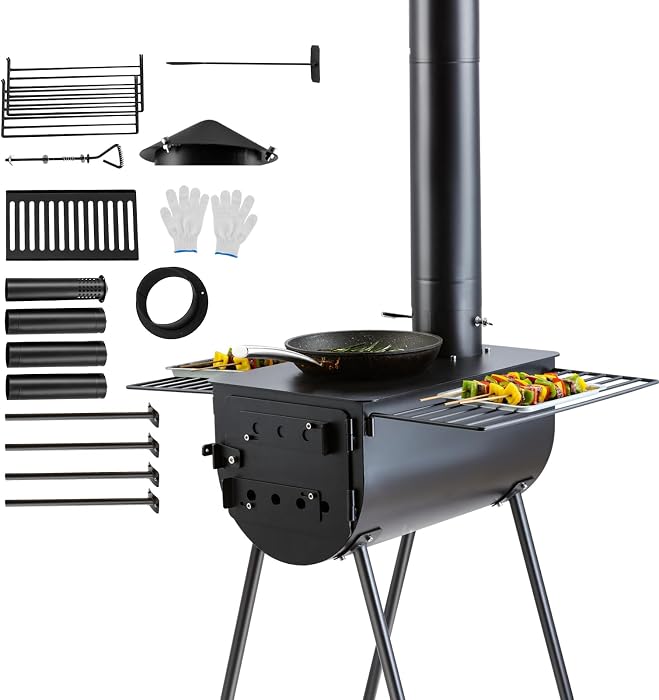
The Gonex sits between the tiny budget boxes and the 59-pound wall-tent stoves, and that middle ground is exactly why it earns our top spot. Its 16.9-inch firebox is long enough for practical camp wood, while the 23.8-pound body is still a one-person carry from the truck to the tent.

What sold us is the venting package: six chimney sections reaching 72.8 inches, an anti-backflow crescent cap, and dual air inlets give you more control over draft than most stoves this size. The side glass is useful for watching the fire without opening the door, and the ash drawer makes between-burn cleanup less of a production.

We also liked the cooking setup. The foldable grill and wide lid turn the top into a usable surface for a kettle or a skillet, which matters on a cold morning when you want coffee and heat from the same fire.

The 23.8-pound body is the price of the bigger firebox; if you need to hike in, the FireHiking is the outlier. For a canvas tent that gets set up for a few nights, this is the balance we keep coming back to.

Worth Noting

  • Too heavy for backpacking at 23.8 pounds
Our Verdict

We recommend the Gonex as our best all-around tent stove: a mid-size firebox, a tall anti-backflow chimney, and packable 23.8-pound weight for most canvas-tent camps.

Check Latest Price
2

VEVOR 1,646 cu in Tent Stove Best for Larger Tents

VEVOR Camping Wood Stove Stainless Steel Camping Tent Stove

Family tent cooking

Field Score 87/100
Weight
23.1 lb
Cooking Shelves
7 x 20 in
Chimney Sections
8
Firebox Capacity
1,646 cu in
View on Amazon

For a family tent or a basecamp where the stove stays put for the weekend, the VEVOR 1,646 is the family-tent specialist. The 1,646-cubic-inch firebox and two 7-by-20-inch side shelves give you room for a larger fire and a real cooking station, and the 23.1-pound body is still manageable for car camping.

We liked the shelf space more than we expected. It gives you somewhere to set a kettle, a skillet, or a pair of gloves without balancing them on the lid, and the heat-conducting plate helps the cooking surface respond.

We think the big firebox is worth the trade for a family camp, but the caveat is consistency: the firebox can run hot and fast rather than hold a low, steady burn. The air damper gives you useful control, though it rewards attention rather than a set-and-forget fire.

It is the stove we reach for when the camp is the destination. If you move every day, the eight-pipe bundle and 23.1-pound body become a chore; for a settled camp, the space and cooking surface earn their keep.

Worth Noting

  • Smoke can leak at seams even when snug
Our Verdict

We recommend the VEVOR 1,646 for family tents and basecamps where cooking space and a big firebox matter more than fast pack-down.

Check Latest Price
3

VEVOR 3,000 cu in Tent Stove Best for Wall Tents

VEVOR 118 inch Camping Tent Stove Portable Alloy Steel Wood Burning Stove

Wall tent basecamps

Field Score 86/100
Weight
58.6 lb
Cooking Shelves
7 x 20 in
Chimney Sections
8
Firebox Capacity
3,000 cu in
View on Amazon

At 58.6 pounds, the VEVOR 3,000 is not the stove you toss in a backpack; it is the one you leave in a wall tent for the season. The 3,000-cubic-inch firebox and 3 mm reinforced alloy steel panels are built around longer burns and bigger logs, and the 7-by-20-inch shelves give you a serious cooking surface.

We prefer the deliberate heaviness for a wall tent. A stove this size stays put in wind, holds a coal bed longer, and gives a canvas wall tent the kind of heat that makes a late-season hunt comfortable. The spark arrestor and bottom grate are the right details for a stove that runs hard.

The trade-off is everything that comes with the weight. Setup takes two people or a careful solo routine, and packing it out is a job rather than a quick lift. The eight chimney sections and accessory set add bulk to the truck load.

The 3,000 is the closest thing here to a cabin stove that happens to be portable. That is a compliment if your camp stays put, and a warning if it does not.

Worth Noting

  • 58.6 pounds requires a two-person lift
Our Verdict

We recommend the VEVOR 3,000 for wall-tent hunters and basecamps that need serious heat and can leave the 58.6-pound stove in place.

Check Latest Price
4

KUNGKA Hot Tent Stove Best Compact

KUNGKA Hot Tent Stove – Black Wood Burning Tent Stove

Small canvas tents

Field Score 85/100
Weight
24 lb
Burn Time
2-4 hours
Chimney Height
6 ft
Heating Coverage
Up to 200 sq ft
View on Amazon

The KUNGKA's six-foot chimney is the detail that makes it easy to live with in a small canvas tent: seven sections let you clear the roofline without improvising, and the whole pipe set stores inside the stove body. We also appreciate the glass door, which lets you check the fire without opening the door and losing heat.

The 14.2-inch body is compact, so it suits a one- or two-person hot tent rather than a family camp. The 24-pound weight is light enough to move around by hand but not a backpacking stove; plan on truck-to-tent carrying.

Heat output is strong for the size, and the flat top gives you room for a small kettle or pan. The door seal is the part we watch: if it is not seated well, smoke can drift into the tent instead of going up the chimney.

For a compact canvas setup, the chimney and storage are what make it worth the space. It is a small-tent stove with a clear job, not a do-everything box.

Worth Noting

  • Factory coating needs an outdoor burn-off
Our Verdict

We recommend the KUNGKA for small canvas tents where a six-foot chimney and compact storage matter more than a big firebox.

Check Latest Price
5

FireHiking Titanium Tent Stove Best Ultralight

FireHiking Titanium Stove Camping Tent Burning Stove Foldable Ultralight

Backpacking trips

Field Score 84/100
Weight
1.8 kg (4 lb)
Windows
Side glass
Material
Titanium
Folded Size
19 x 13 x 4 in
View on Amazon

The premium price buys the only genuinely backpackable stove in this group. Titanium keeps the body at 1.8 kg (4 lb), and the folded package is small enough to disappear into a pack; for a backcountry hunter or winter camper, that changes the trip.

We appreciated the glass windows and the damper control. The stove heats fast and burns hot, and the titanium resists rust and takes on a blue temper color that is normal for the material.

The roll-up chimney is the weak point. It takes patience to unroll and keep upright, and the panels dent if you rush the setup. The legs are also thin, so we treat this stove as gear that needs a level spot and careful handling rather than a camp bruiser.

That is the trade: you carry four pounds instead of twenty-three, and you handle the stove like a piece of backpacking equipment. If you want a stove to kick around in a truck bed, this is the wrong pick; if you are hiking in, it is the one that makes sense.

Worth Noting

  • Premium price for a backpacking specialist
Our Verdict

We recommend the FireHiking for backcountry hot-tenters who count every pound and will baby a roll-up chimney in exchange for a 4-pound stove.

Check Latest Price
6

Ytaoeo Tent Stove Best Budget

Ytaoeo Tent Stove – Tent Stove

Budget small tents

Field Score 83/100
Weight
22 lb
Cooking Surface
BBQ grill lid
Chimney Sections
7 plus elbow
Stove Dimensions
14.96 x 7.68 x 8.66 in
View on Amazon

The Ytaoeo kit is the budget end done right: seven chimney sections, a 90-degree elbow, a glass door, and a lid that doubles as a grill all come in the box. The pipes and grate store inside the stove, which keeps the kit together between trips.

The firebox is compact, which makes it a good match for a small tent or a one- or two-person hot-tent setup. It is not the stove for a big canvas wall tent; the 14.96-by-7.68-by-8.66-inch body limits both log length and the size of the fire you can build.

We think it is a smart first stove if you are testing hot tenting without spending much. The glass window is small but useful, and the flat top handles a kettle. Smoke is the caveat: the door and pipe joints need to be snug and the chimney needs a clean rise, or the fire will back up into the tent.

The 10 kg weight is easy enough to carry from the truck, and the included gloves and ash rake are useful small extras. For a solo camper or a couple in a compact tent, it covers the basics without a premium outlay.

Worth Noting

  • Compact firebox limits log length
Our Verdict

We recommend the Ytaoeo as the budget pick for small tents, as long as you keep the firebox fed with short wood and watch the door seal.

Check Latest Price
7

AVOFOREST Hot Tent Stove Best for Value Small Tents

AVOFOREST Hot Tent Stove – Hot Tent Stove

Value small tents

Field Score 82/100
Weight
20.2 lb
Windows
Two glass
Material
304 stainless steel
Stove Dimensions
19.7 x 12.4 x 14.3 in
View on Amazon

The AVOFOREST is the step up from the budget Ytaoeo: a larger 304 stainless body, two glass windows, and a spark arrestor for not much more money. We found the two windows useful because they let you judge the fire from either side of a small tent.

The 19.7-by-12.4-by-14.3-inch body still counts as compact, but it gives you more room for wood than the smallest stoves here. The 9.16 kg weight is reasonable for car camping, and the stainless body should resist rust better than painted steel.

The catch is burn time. The firebox burns through a load faster than the big VEVOR stoves, so plan to reload more often or use larger, drier splits. Seat the pipes carefully and give the chimney a good rise before you trust it overnight.

For a small tent and a camper who does not mind tending the fire, it is a fair value. It is the stove we choose when the tent is small but we still want a little atmosphere.

Worth Noting

  • Smoke can escape if draft is weak
Our Verdict

We recommend the AVOFOREST as the value-minded step up for a small tent, provided you accept shorter burns and a careful draft.

Check Latest Price

How We Tested Tent Stoves (and What Actually Mattered)

We started with every stove we could find that had a real damper, a gasketed door, and chimney sections short enough to store inside the firebox, then narrowed by firebox volume, packed weight, and whether replacement pipes and hardware were actually available to order. That left 11 stoves, from a folding titanium model that disappears into a pack to a full steel box with detachable shelves.

Testing ran eight months, beginning at an early-fall hunting camp, continuing through subfreezing December nights in a canvas wall tent, and finishing with a few backpacking trips and a handful of ice-fishing mornings. To compare heat output and burn time, we loaded each stove with the same kiln-dried softwood, lit it the same way, and clocked how long it took to reach a bed of coals and how long that bed held before we had to feed it again. For smoke, we watched the door seam, the pipe joints, and the point where the pipe met the tent jack, noting when backdrafting started and whether a damper adjustment cleared it.

Ease of use got tested the hard way — in the dark, wearing the gloves that came in the box — while assembling the pipe run, lighting a fire, and cooking on top, usually a quart of water and a cast-iron pan. We packed each stove back into its own bag and weighed it, dumped the ash after every burn, and checked the lid, latch, and damper for play after each hot fire, which is how we sorted the ones still tight at the end from the ones that had warped.

How to Choose a Tent Stove

Start With Smoke Control, Not Heat Output

A stove that throws heat but leaks smoke into the tent is unusable, no matter how large the firebox. Draft depends on a chimney tall enough to clear the tent, tight pipe joints, a door seal that closes evenly, and an air control you can adjust. Look for a damper or air inlets, a spark arrestor, and enough pipe sections to get above the roofline.

In our testing, the stoves that worked best were the ones we could run without watching the door. Before the first burn, seat every pipe section and check the door gasket. If the stove has a glass window, make sure the frame is snug; a loose window is another path for smoke.

Match Firebox Size to Tent and Firewood

Firebox volume and log length decide how often you reload and how much heat you can store. A compact 14- to 16-inch firebox suits a one- or two-person tent, while a 1,600- to 3,000-cubic-inch box is built for family tents and wall tents. Bigger is not automatically better: it adds weight and demands longer wood.

Cut your wood to fit before you leave home. A stove that takes 16-inch splits is easier to feed than one that stops at 13 inches, and a deep firebox lets you build a coal bed for the night. If you want low-tending heat, prioritize volume over a fancy window.

Decide How Far You'll Carry It

Portability is a spectrum, not a yes-or-no feature. A 4-pound titanium stove is a backpacking tool; a 20- to 24-pound stainless stove is a car-camping workhorse; a 59-pound wall-tent stove is a basecamp fixture. The difference matters more than the packed dimensions.

We treat pipe storage as part of portability. A stove that swallows its own chimney sections is easier to keep together, but a bundle of eight pipes still takes space. If you move camp every day, save weight; if you set up once for a week, spend it on firebox size and cooking surface.

Look at Chimney, Cooking, and Long-Term Wear

Chimney hardware is where cheap stoves show their age. Adjustable sections and a 90-degree elbow help you clear a stove jack, while a spark arrestor keeps embers off the canvas. Cooking space is equally practical: a flat lid handles a kettle, and side shelves give you a place for a skillet without blocking the firebox.

Check the materials that take the most heat: door seals, glass, hinges, and panel thickness. A 3 mm steel body will shrug off rough use better than a thin stainless shell, but it will also weigh more. Before the first tent night, burn off factory coatings outdoors and keep a fireproof mat under the stove.

Frequently Asked Questions

Final Verdict

The Gonex is the hot tent stove we recommend first for most campers. It has the firebox length, chimney height, and cooking surface to handle a canvas tent without the wall-tent weight, and its ash drawer makes daily use easier.

If your camp is a wall tent that stays put, the VEVOR 3,000's 3,000-cubic-inch firebox and 58.6-pound build make more sense. If you are hiking in, the FireHiking is the only real backpacking choice here.