The 7 Best Thermal Monoculars Under $1,000 of 2026

A thermal monocular is one of those purchases where the wrong first impression costs you twice: once at checkout, and again every cold night you spend squinting at a smeared, laggy screen. I want enough resolution to tell a coyote from a calf at distance, a refresh rate that doesn’t make panning feel like a flipbook, and controls I can work with gloves on. After eight months with seven models under $1,000, that’s the bar I kept returning to.

This price range has gotten genuinely useful. Sensor resolution, lens size, and refresh rate matter more than the loudest claim on the box: a 256x192 sensor can be plenty for scanning open ground, while a 384x288 sensor gives you more room to identify what you’re looking at. Wi-Fi and weather sealing are conveniences until the night you need them, and battery life separates a tool you trust from one you babysit. Value for money isn’t the cheapest number—it’s a clear image when you zoom, a screen bright enough to read without washing out, and controls that make sense in the dark; the picks below are the ones that cleared it.

Our Top Picks

The 7 Best Thermal Monoculars Under $1,000 of 2026

1

RIX Pocket K3 Best Overall

RIX Pocket K3 Thermal Monocular for Hunting

Distance identification

Field Score 87/100
Lens
15mm
Weight
7.52 oz
Refresh Rate
50Hz
Thermal Resolution
384 x 288
View on Amazon

384 x 288 is why this one is here. That's the highest resolution in this guide, and paired with a 15mm lens and 2x base magnification it's the difference between seeing a warm body and seeing an animal: at a couple of hundred yards the Pocket K3 gives you a shape you can name, where the 256-resolution units here hand you a dot that could be a raccoon, a possum, or the neighbor's cat.

Electronic image stabilization is the feature we ended up valuing most. At 2x base magnification every tremor in your hands is doubled, and stabilization is what lets you scan standing in a field instead of bracing the unit against a fence post. The 17.5-degree field of view helps too, wide enough to sweep a treeline in a few passes rather than hunting back and forth over the same patch.

The hardware is sorted for real nights out. There's a standard 1/4-inch thread underneath for a tripod, the cell is a removable 18650 so a spare in a pocket buys a few more hours, and at 7.52 ounces it disappears into a jacket. IP67 sealing covers rain, and the five-year manufacturer warranty is the longest of the seven picks by several years, which on a premium optic is worth real money.

What all of that costs you is the top price in this group, and the optical advantage shows up mostly past 150 yards. Hunt tight timber and never glass across open ground, and a 256-resolution pick below does the same job for a lot less.

Worth Noting

  • Premium price against the rest of this group
  • 2x base magnification is tight in close cover
Our Verdict

We recommend the Pocket K3 to any hunter who needs to know what the heat signature is, because this is the only unit here that reliably answers that question.

Check Latest Price
2

TOPDON TS004 Best Battery Life

TOPDON TS004 Thermal Imaging Monocular

All-night scanning

Field Score 86/100
Lens
13mm
Battery Life
Up to 11 hrs
Weather Rating
IP67
Thermal Resolution
256 x 192
View on Amazon

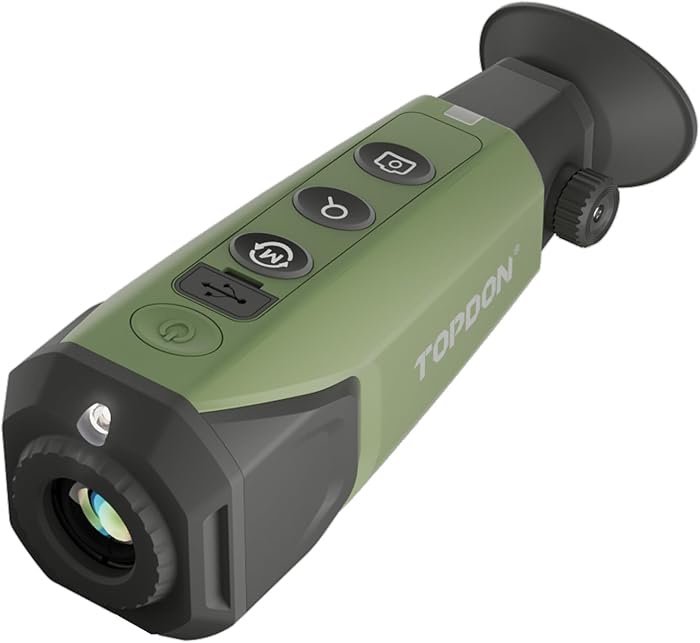
Eleven hours is the longest runtime anyone quotes in this group, and it changes the shape of an evening. Instead of rationing scans and nursing a battery toward midnight, you leave the TS004 switched on and use it, which is the entire point of carrying one. Add IP67 sealing and a body rated for two-meter drops and it's the unit we hand someone heading out into cold rain.

The optical recipe is the standard one here: 256 x 192 at 50Hz behind a 13mm lens. TOPDON's figures are 410 meters for detection and clear detail inside 100 yards, which is the honest split for this sensor — spotting across a field, reading shapes up close. Grain creeps into the image at longer range, and that's the sensor talking rather than the build.

The extras are unusually complete: five palettes, Wi-Fi to the TopInfrared app with photo, video, and audio capture, and a 5,000mAh cell that charges over USB. The app is the better trick of the two, because it turns the unit into something two people can watch and lets you grab a still or start recording from the phone instead of hunting for a button in the dark.

The one structural compromise is power. The 5,000mAh pack is sealed inside, so a multi-day trip means carrying a power bank rather than a spare cell, and the runtime advantage only holds if you can recharge. For a single overnight, or a truck with a USB port, that's a non-issue.

Worth Noting

  • Digital zoom past 2x mostly enlarges pixels
Our Verdict

We point anyone facing long, wet nights at the TS004, because eleven hours of runtime and IP67 sealing mean you stop managing the battery and start using the thing.

Check Latest Price
3

RIX Pocket K2 Best for Tight Budgets

RIX Pocket K2 Portable Thermal Monocular for Hunting

Budget pocket carry

Field Score 85/100
Lens
9mm
Weight
7.05 oz
Display
800 x 600 OLED
Thermal Resolution
256 x 192
View on Amazon

Nine millimeters of lens sets the K2's ceiling, and it's worth being blunt about it: this is a 100-to-150-yard unit. Inside that range it's the best value in the guide. Its 19.4-degree field of view is second only to the ATN OTS XLT here, and a wide view is what lets you pick up movement in cover quickly instead of sweeping the same bush three times.

The number that makes it work is a NETD under 25mK, the best thermal sensitivity of any pick here. That's the figure deciding whether an animal separates from the ground behind it on a mild, humid evening when everything in the field is nearly the same temperature. Sensitive units hold that contrast; cheaper ones wash the whole scene into gray soup.

The small decisions are good too. The lens cover is built in and slides open with a thumb, so there's no cap to lose in the dark, and the 800 x 600 OLED display is sharper than the sensor feeding it. At 200 grams it's a jacket-pocket object rather than a piece of kit you plan around, and the five-year warranty matches the top pick's.

Zoom is where it runs out. Pushing a 256-resolution image onto an animal at 250 yards gives you a heat signature without a species. On timber and creek bottoms you'll never notice the ceiling; glassing bean fields at last light, you will.

Worth Noting

  • Useful identification stops around 150 yards
Our Verdict

We send budget buyers to the K2, since it is the least expensive way here to get 50Hz and genuinely good thermal contrast, as long as your work stays inside 150 yards.

Check Latest Price
4

GOYOJO G215 Best for Spotting at Distance

GOYOJO G215 Thermal Imaging Monocular for Hunting

Fixed-post spotting

Field Score 84/100
Lens
15mm
Battery
6+ hrs, replaceable batteries
Storage
16GB internal
Thermal Resolution
256 x 192
View on Amazon

Close to five times the weight of the RIX pockets, the G215 is a two-hand instrument. At around a kilogram it's the one you set on a fence rail or screw to a tripod, and it's happiest living in a truck or a blind rather than hanging from a neck strap for six hours.

What the bulk buys is reach. A 15mm lens with an 11.7-degree field of view is the second-longest in this group, and GOYOJO's own numbers tell the real story: detection of a human at 1,417 meters, recognition at 254. That gap is the honest difference between knowing something is out there and knowing what it is, and it's the most useful pair of figures in this guide. We treat the G215 as a scanner that reaches across a valley, not a tool for counting antler points.

Power is the reason to choose it over the cheaper pockets. It runs on replaceable batteries, so a couple of spares cover a full night and the six-hour rating stops being a deadline. There's also 16GB of internal storage with no card slot, which is generous until it fills, at which point you offload over Wi-Fi rather than swapping media.

Worth Noting

  • About 2.2 pounds, so plan on a rest
  • IP65 only, and a one-year warranty
Our Verdict

We like the G215 as a fixed-post scanner, where its 15mm lens reaches and its swappable batteries keep it running all night.

Check Latest Price
5

Teslong TTS260 Best for Recording

Teslong TTS260 Thermal Monocular 256 x 192

Saving your scans

Field Score 81/100
Lens
12mm
Storage
32GB built-in
Refresh Rate
25Hz
Thermal Resolution
256 x 192 (512 x 384 enhanced)
View on Amazon

The eyepiece is what separates the TTS260 from the rest of the budget tier. It's a 0.32-inch 800 x 600 OLED panel, and the rectangular view it throws is bigger and cleaner than the small round windows on most of the cheaper units here.

That matters more than the size of the number suggests, because a thermal is something you hold against your eye for an hour at a time, and a dim, cramped window is what makes people leave the unit in the truck. Behind it sits a 12mm lens and a 256 x 192 sensor with super-resolution processing to 512 x 384, giving a usable picture out to roughly 200 yards. Teslong's detection figure is 218 yards, and for once the claim and the useful range sit close together.

Recording is the other half of the pitch: 32GB onboard, a mini HDMI output that plays footage on a real screen, eight palettes, and hotspot tracking that flags the warmest thing in the frame. That combination is unusual in this group, and it's why this is the pick for a landowner, a hunt club, or anyone who needs a record of what came through the back pasture at 2 a.m.

The compromise is refresh rate. At 25Hz the image steps when you pan quickly, so swinging onto a moving animal is less smooth than on the 50Hz units, though slow deliberate scanning hides it almost entirely. If you track running hogs, pay the difference for the TOPDON.

Worth Noting

  • 25Hz refresh looks steppy when panning
Our Verdict

We recommend the TTS260 to anyone who wants to keep what they see, because the big OLED view, 32GB of storage, and HDMI out are worth more than a faster refresh rate here.

Check Latest Price
6

ATN BlazeSeeker 207 Best for Close-Range Scanning

ATN BlazeSeeker 207 Thermal 256x192 1-8.8X 12μm 35mK 50Hz Hunting

Close-range treelines

Field Score 80/100
Lens
7mm and 10mm
Zoom
1-8.8x
Weight
9.6 oz
Thermal Resolution
256 x 192
View on Amazon

8.8x is the biggest number on this spec sheet and the one to ignore. On a 256 x 192 sensor, magnification past roughly 4x enlarges pixels instead of revealing detail, so the zoom runs out of image long before it runs out of travel. Set it near the bottom and the picture is honest.

Close work is where it earns its place. The 7mm and 10mm lens options give a wide field, so sweeping a treeline at 60 or 80 yards is quick and the image stays bright. Past about 100 yards detail stops resolving, which is what a lens that short dictates; this is a companion for the last hundred yards, not a ridge-to-ridge glass.

The app is where it earns its keep. Mirroring the screen to a phone makes it a two-person tool, one set of eyes on the field and one on the screen in a warm truck, and it records stills and video to a MicroSD card of up to 256GB that you supply. A three-year warranty, the second-longest here, backs it up.

At 9.6 ounces with five palettes and a 12-micron sensor rated under 35mK, it's a serious little unit that is simply limited by its glass. For someone who already owns a thermal scope and wants a pocket scanner for the walk in, that's a fair trade.

Worth Noting

  • Detail fades past about 100 yards
Our Verdict

We see the BlazeSeeker 207 as a second thermal for close work, where its wide short lens and phone mirroring do more than its headline zoom.

Check Latest Price
7

ATN OTS XLT Best for Rangefinder Work

ATN OTS XLT Thermal Monocular w/ 50Hz Thermal Sensor

Rangefinder work

Field Score 77/100
Zoom
2-8x
Battery Life
10+ hrs
Field Of View
22.5 degrees
Objective Lens
25mm
View on Amazon

A built-in rangefinder is the one thing nothing else in this guide offers. Press the button and you get a distance to the heat signature you're looking at, which for anyone working a property line or setting up on a field edge is useful math already done.

The 25mm objective is also the longest lens here, and with 2-8x magnification it puts more pixels on a distant animal than the short-lens units can manage. A 22.5-degree field of view keeps the bottom of the range wide enough to actually find things, which is the trade long lenses usually lose.

ATN sells this one on the lens and the rangefinder rather than on a sensor resolution, and resolution is the number that decides what you can identify at distance. Ask for it before you commit.

Power is where we hesitate. Some units have arrived that won't switch on or that drain within minutes, which points at a battery or contact problem rather than the sensor; charge it and run it for an hour before the season starts, while a return is still easy. Ten-plus hours of rated runtime and a two-year warranty are the right numbers on paper, and the thermal performance itself, with deer and rabbits picked out at a few hundred yards, is what keeps this here as a rangefinder-first option.

Worth Noting

  • Sensor resolution is not published
Our Verdict

We keep the OTS XLT on the list for the hunter who wants a rangefinder built into a thermal, with the caveat that it needs a shakedown before opening day.

Check Latest Price

How We Tested Thermal Monoculars Under $1,000

I built the shortlist by reading listings and owner reviews, then filtering for models that hit the under-$1,000 brief without obvious corner-cutting: a real thermal sensor, a lens size that matched the intended magnification, a refresh rate that wouldn’t turn panning into a slideshow, and battery life for a full night rather than a quick look. That left seven units, which we used for eight months.

Most of that time was after sunset and before sunrise: scanning a hayfield from a fence line, following a wooded trail, checking a backyard for raccoons, and sitting in a cold truck while the screen fogged and cleared. We also packed two units for camping weekends and took them on predawn wildlife walks, where range and ease of use matter more than they do on a bench.

At each session I compared how quickly a warm body separated from cool ground, whether I could keep a deer or coyote in frame while panning, and how much detail survived when I zoomed. I noted when the image went grainy in low contrast, when brightness washed out highlights, and whether the controls were reachable with gloves. Battery runs started at full charge and continued until shutdown; weather sealing got checked in drizzle and after a drop in wet grass. We tried Wi-Fi pairing in the field, not just at home, and tracked whether the app added delay.

At the end, I weighed each unit’s image, build, and battery life against what it cost, because value here isn’t the lowest sticker—it’s the model that keeps working when the night gets cold and the animal won’t hold still.

How to Choose a Thermal Monocular under $1,000

Resolution Is the Real Buying Decision

Almost every sensor in this group is 256 x 192, with one 384 x 288 option. Detection is easy for all of them: a warm body against cold ground shows up at 200 yards on a 256 sensor, no argument. Identification is harder, because telling a coyote from the neighbor's dog, or a deer from a hog, needs enough pixels on the animal itself.

Digital zoom doesn't fix that. Pushing a 256 image to 8x spreads the same pixels across a bigger screen. If you only need to know something is out there, save the money; if you need to name it before you commit to a stalk, resolution is where the extra spend goes.

Match the Lens to How You Actually Hunt

Focal length sets the trade between reach and field of view. A 9mm or 10mm lens gives a wide, bright picture that suits timber, brush, and the last hundred yards. A 15mm or 25mm lens reaches farther but narrows what you can take in at once, which is the trade most hunters underestimate.

Manufacturers quote detection from a standard calculation, so treat a four-figure meter rating as the distance at which a human-sized heat source becomes a few pixels. The GOYOJO G215's own numbers make the point: 1,417 meters for detection, 254 for recognition. Shop for recognition distance and expect it to be a fraction of what's printed.

Refresh Rate and Steady Scanning

25Hz and 50Hz describe how often the sensor redraws. A 50Hz unit pans smoothly and holds a walking animal steady; a 25Hz unit looks steppier when you sweep quickly, and you stop noticing when you scan slowly and deliberately. Electronic stabilization is the other half of the same problem, especially at 2x base magnification, where every tremor in your hands doubles.

If you glass from a truck window or a tripod, refresh rate matters less than optics. If you scan standing in open country for an hour, both the refresh rate and the stabilization are worth paying for.

Batteries, Sealing, and Warranty Length

Runtime figures are quoted generously and cold nights shorten them. What matters more is whether the cell comes out. A unit that takes a swappable 18650 buys you another night for the cost of a spare, while a sealed pack that runs eleven hours is fine as long as you can recharge it. Think about which failure you'd rather have at 2 a.m.

On sealing, IP67 survives rain and a dunking; IP65 handles spray but not immersion. Warranty length across this group runs from one year to five, and on a premium optic that coverage is worth more than another color palette you'll never switch to.

Look Through It Before You Commit

Every unit here has a small display inside a rubber eyecup, and comfort varies more than the specifications suggest: some windows are round and cramped, some rectangular and open, and how they sit with glasses or a brimmed hat is personal. Brightness settings matter too, because in full dark a screen with no dim step can be glaring.

If you can look through a thermal scanner before buying, do it at night rather than under store lights. If you can't, buy somewhere with a return window and try it in the dark within the first week.

Frequently Asked Questions

Final Verdict

For most hunters, the RIX Pocket K3 is the one to buy. The 384 x 288 sensor is the difference between a hot dot and an animal you can name, and the stabilization, swappable cell, and five-year warranty make the premium easier to justify than the price tag suggests.

If you want to spend less, the TOPDON TS004 is the better all-nighter with eleven hours of runtime, IP67 sealing, and a recording app, and the RIX Pocket K2 is the lightest route into real thermal for work inside 150 yards.