The 7 Best Thumb Button Releases for Compound Bows of 2026

Archery releases are small, expensive pieces of gear that can quietly wreck a shot—or teach you to trust your form. A thumb-button release gives you more control than a wrist strap, but only if the trigger breaks cleanly, the head sits where your hand expects it, and the release doesn't develop creep halfway through the season. I've spent enough evenings chasing a clean release to know that the wrong one shows up as a flinch, not a spec sheet.

We tested 14 thumb-button releases over eight months, shooting them on compound bows at an indoor range and in my backyard. We compared machining quality, what each one delivered for the money, and how consistently it performed once trigger travel, tension, and finger position were dialed in. The details that separate a great release from a frustrating one are small: a smooth break, no creep, and hardware that still feels tight after months in a bow case. The list below is what survived that scrutiny.

Our Top Picks

The 7 Best Thumb Button Releases for Compound Bows of 2026

1

Spot Hogg Whipper Snapper CJ Best Overall

Spot Hogg Whipper Snapper CJ

All-around compound shooting

Field Score 88/100
Weight
2.4 oz
Jaw Type
Closed jaw
Finger Count
3 finger
Hand Orientation
Ambidextrous
View on Amazon

The closed jaw and 2.4-ounce aluminum body are the first things we noticed, and they explain why the Whipper Snapper CJ stays on our short list. The jaw wraps the D-loop with very little side-to-side play, which gives you a cleaner feeling at full draw than a loose hook. The three-finger handle is compact without feeling cramped, and the release balances close to the hand instead of hanging off the string. We also like that the settings stay put: the single screw controls both trigger tension and travel, so you can tune the break once and stop thinking about it.

That adjustability is the real reason we recommend it as the default. It is not the most modular release here, but it covers the range most compound shooters actually use, and the ambidextrous build means left-handed archers are not pushed into a different model. At 2.4 ounces it disappears on a hunt, and the closed jaw gives you a positive connection when you are loading in low light. We spent a range session switching between it and the four-finger T-Rex, and the difference was mostly in how much hand we wanted wrapped around the handle. For everyone else, this is the release we reach for first.

Worth Noting

  • Three-finger grip only
  • Pricier than budget imports
Our Verdict

We recommend the Whipper Snapper to most compound shooters because it is light, ambidextrous, and adjustable enough to settle in without constant fiddling.

Check Latest Price
2

T.R.U. Ball Bone Collector T-Rex Best Four-Finger Hunting Release

T.R.U. BALL Bone Collector T-Rex Archery Thumb Release

Four-finger hunting

Field Score 87/100
Weight
4 oz
Material
Metal
Finger Count
4 finger
Hand Orientation
Right hand
View on Amazon

The trigger break is what sold us on the T-Rex. It is crisp and sensitive, with a thumb knob that lets you move the contact point without rebuilding the whole shot. We found it easy to get a surprise break instead of punching the trigger, which is the whole point of a thumb release. The four-ounce metal body has enough mass to feel steady in the hand, and the four-finger handle distributes the load comfortably even on a 70-pound draw. It is the release we hand to a four-finger shooter who wants a hunting trigger that feels more expensive than it is.

The T-Rex is a dedicated four-finger hunting release, and the comfortable grip is the reason to choose it over the Spot Hogg. What you get is a very comfortable handle and a trigger that is easy to tune to a clean break. We liked the thumb knob adjustment because it changes the reach without changing your anchor. If you shoot 3D and hunt with the same bow, this is a release that does not ask you to choose between the two. It is a premium pick, but the trigger and hand fit are where the money goes.

Worth Noting

  • Right-hand only
  • Premium price
Our Verdict

We recommend the T-Rex for four-finger shooters who want a comfortable hunting handle and a crisp, sensitive trigger that breaks cleanly.

Check Latest Price
3

Stan OnneX Thumb Best Premium Target Release

Stan OnneX Thumb Archery Release

Premium target tuning

Field Score 86/100
Weight
8.48 oz
Trigger
Zero travel
Hook Type
Open hook
Finger Options
3 or 4 finger
View on Amazon

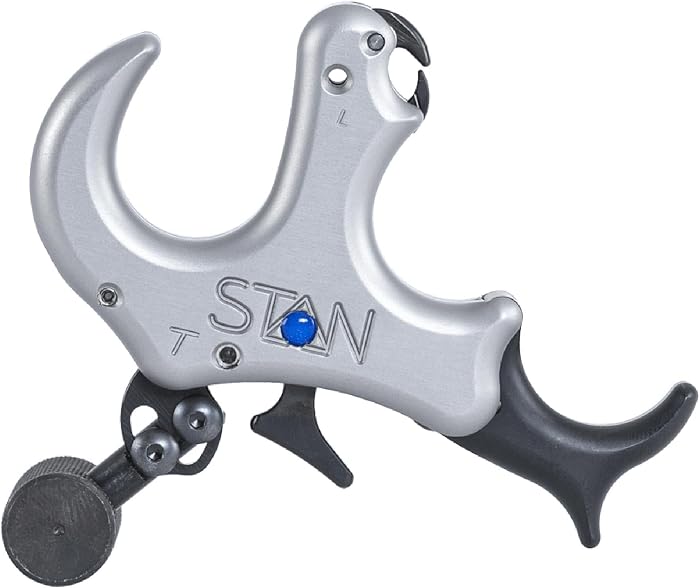
The box contains more setup pieces than most thumb releases: interchangeable three- and four-finger extensions, two thumb barrel sizes, and two barrel post lengths. That sounds fussy, but the point is reach and angle. We spent time swapping the pieces until the barrel sat where our thumb wanted it, and the release started to feel less like a generic handle and more like a fitted one.

The trigger is the other half of the story. It has zero travel and a broad tension range, so you can set it feather-light or give it a little more resistance. We liked that the break is clean without feeling fragile. The open hook keeps lateral nock travel consistent, and the loop retention system holds the D-loop while you set your hand. If you have ever fumbled a closed jaw in the dark, the open hook is a real advantage.

The trainer lock is the feature we did not expect to use as much as we did. It lets you work the trigger and build a surprise break without launching an arrow, which is useful for practice and for learning the release. The stainless steel build feels solid, and the release is clearly built for target work.

We think the OnneX is the release for the archer who treats setup as part of the sport. It rewards you for spending an evening getting the barrel and trigger right, and it gives you a level of modularity the other picks here do not match. If you want a hunting release that disappears in your hand, the Spot Hogg is the easier choice. If you want to tune every contact point and practice without shooting, the OnneX earns its premium price.

Worth Noting

  • Premium price
  • Heavy at 8.48 ounces
Our Verdict

We recommend the OnneX for target archers who want to tune the handle, trigger reach, and break point to their hand and practice without launching an arrow.

Check Latest Price
4

LWANO 3-4 Finger Thumb Release Best Midrange Adjustability

LWANO 3-4 Finger Thumb Release – 3-4 Finger Thumb Trigger Release Aid for Compound Bow

Midrange adjustability

Field Score 83/100
Weight
10.2 oz
Trigger
Adjustable travel and tension
Material
6061-T6 aluminum
Finger Options
3 or 4 finger
View on Amazon

The travel-lock screw is the detail that makes the LWANO feel more expensive than it is. It lets you lock out trigger travel after you set it, so the break stays where you put it instead of drifting over a season. The thumb button is multi-position, the trigger tension and travel are adjustable, and the pinky angle can be micro-adjusted. We spent a while moving the barrel around, and the release never felt like it was fighting the adjustment.

We think this is the sweet spot in the middle of the market. The 6061-T6 aluminum frame and stainless steel internals feel solid, and the click into engagement is definite enough that you know the jaw is closed. It is not as modular as the Stan, but the adjustments it does have are the ones that matter for a hunting shot. What you get for the money is a tunable, solidly built hunting release that does not ask for flagship pricing. For a shooter who wants premium adjustment without the premium tier, this is the one.

Worth Noting

  • No rotating head
  • Heavier than the Spot Hogg
Our Verdict

We recommend the LWANO for shooters who want a tunable midrange release with a travel lock, a multi-position thumb button, and solid internals.

Check Latest Price
5

TruFire Rivet Best for One-Handed Loading

TruFire Rivet Handheld Archery Release Aid

One-handed loading

Field Score 81/100
Trigger
Link-style
Material
Aluminum
Operation
One-hand cocking and opening
Finger Options
3 or 4 finger
View on Amazon

The Rivet's party trick is that you can cock and open it with one hand. The link-style trigger and full D-loop encapsulation let you load the loop without taking your eyes off the target, which is the kind of convenience that matters when you are in a stand or trying to stay quiet. We liked the slim thumb button because it stays out of the way during the draw instead of catching on your release hand.

The adjustable pinky groove switches the handle between three- and four-finger configurations, and the matte gray anodized aluminum body has a comfortable, neutral feel. The trigger is crisp and predictable once tuned. The Rivet is not the most heavily built release here, but the loading routine is the reason to choose it.

We think the Rivet makes the most sense for the hunter who values the loading routine more than a match-grade trigger. It is easy to operate with one hand, the D-loop stays captured, and the grip is comfortable for a long sit. If you want a trigger with more adjustment and a more solid feel, the LWANO is the better step up. If you want a simple release that loads quickly, the Rivet is the one we reach for.

Worth Noting

  • ⚠️ Pin can work loose
  • Trigger can be set very light
Our Verdict

We recommend the Rivet for hunters who want one-handed cocking and opening, full D-loop capture, and a comfortable three- or four-finger handle.

Check Latest Price
6

AMEYXGS 3-Finger Thumb Release Best Budget

AMEYXGS 3-Finger Thumb Release – Archery Bow Release for Compound Bows

Budget three-finger

Field Score 80/100
Jaw
360-degree rotating
Color
Black
Material
Aluminum alloy
Finger Count
3 finger
View on Amazon

The first thing we noticed about the AMEYXGS is how much release you get for the least money here. The 360-degree rotating jaw takes torque off the string, and the three-finger aluminum handle is simple and comfortable. The trigger is crisp enough for practice, and the rotating jaw makes it easy to set your hand at longer distances. We think it is the budget pick to beat for a first thumb release or a backup that lives in your pack.

It is a simpler release overall: you get the rotating jaw and a decent trigger, but not the travel lock or stainless internals of the midrange picks. For a new archer who wants to try a thumb button without spending much, that trade-off makes sense. It is the one we keep as a loaner or a second release.

Worth Noting

  • Three-finger grip only
Our Verdict

We recommend the AMEYXGS as a low-cost three-finger release for a first thumb button, a backup, or a loaner that still gives you a rotating jaw.

Check Latest Price
7

sntxmy 4-Finger Thumb Release

sntxmy 4-Finger Thumb Release – Bow Release for Compound Bow 360° Rotatable Thumb Release for Compound Bow

Budget four-finger

Field Score 78/100
Jaw
360-degree rotating
Color
Camo
Finger Count
4 finger
Rated Tension
80-100 pounds
View on Amazon

The camo finish and four-finger grip are what separate this sntxmy from the three-finger budget picks. The 360-degree rotating head moves smoothly, and the aluminum body is light enough to hang on the string without pulling your hand out of position. The four-finger handle gives you more surface area than the cheap three-finger models, which we liked for longer practice sessions. The 80-100 pound rating covers the compound bows most hunters shoot.

The release is where it gets more complicated. The jaw can feel sticky out of the box, and the trigger is not as refined as the LWANO's. We worked the jaw and backed off the tension before shooting, and it settled into a predictable release. The rotating head is the best part: it lets you set your hand where it wants to sit instead of forcing a fixed angle. The camo finish is a nice change from black, though it may not match the photos exactly.

We think this is the budget four-finger release for someone who wants to try the grip without committing to a flagship. It is not the release we choose for a high-volume target season, and the sticky jaw is worth checking before you hunt. But as a backup, a loaner, or a first four-finger release, it earns its place. The camo finish and light body make it easy to keep in a pack, and the rotating head is the feature that keeps it from feeling like a disposable.

Worth Noting

  • Four-finger grip only
Our Verdict

We recommend this sntxmy as a budget four-finger release for someone who wants a rotating jaw and a camo finish without spending much.

Check Latest Price

How We Tested Thumb Button Releases

I started by pulling every current thumb-button release I could find from major archery brands, then narrowed the field to 14 that represented the formats shoppers actually compare: three-finger and four-finger bodies, open-hook and closed-jaw designs, caliper heads, and rotating heads. I ruled out duplicates and models whose adjustments seemed too limited to matter on a compound bow, then ordered the rest in for hands-on testing over eight months.

Each release was set up on my compound bows and used for at least several dozen arrows per session at an indoor range and in the backyard. I adjusted trigger travel, tension, and finger spacing where the design allowed, then paid attention to whether the thumb button fell under my thumb without shifting my grip. For every shot, I noted whether the release broke cleanly or felt gritty, whether it reset without hanging up, and whether the head rotated smoothly when I changed anchor or shooting position.

To judge durability and quality, I carried the releases in a bow case between sessions, looked for slop in the head and wear on the jaws or hooks, and checked screws and adjustment collars after repeated use. Value came down to what each release included and how much adjustment it offered for the money, not just the logo on the body; performance was tracked by shooting groups at 20 and 40 yards and comparing how repeatable each release felt over multiple sessions.

How to Choose a Thumb Button Release

Start With the Handle, Not the Trigger

A thumb release is a handle first. A three-finger grip feels quicker and more compact, while a four-finger handle spreads the load across more of your hand and suits heavier draws. If you are left-handed, start with an ambidextrous model rather than assuming you can swap the wrist strap; the Spot Hogg is the release here that covers both hands without a different model. Shooters who want one release for everything should try both finger counts before buying. The wrong handle will make a good trigger feel worse than it is.

Know What Trigger Travel and Tension Do

Trigger tension controls how hard you press; travel controls how far the thumb moves before the shot breaks. A zero-travel trigger can feel like a glass rod, while a little travel gives you more feedback through a hunting glove. A travel lock is useful if you find a setting you like and want it to stay there. We care more about a repeatable break than an ultra-light one. If you shoot with gloves or in cold weather, leave enough tension that you can feel the trigger through the fabric.

Match the Jaw and Loading Style to the Hunt

Closed jaws capture the D-loop and feel secure when you are loading in the dark; open hooks are faster to attach and can keep lateral nock travel consistent, but they rely on loop retention to stay put. One-hand cocking is the other field feature worth paying for: it lets you load without taking your eyes off the animal. If you mostly shoot targets, a closed jaw or an open hook with retention both work. If you hunt from a stand, practice loading with the release you plan to carry.

Weight and Build Quality Show Up Later

A light release disappears on the string and is easier to carry all day; a heavier stainless or aluminum body can steady a target shot but will remind you it is there on a long hike. Weight is not a quality score. What matters is whether the jaw closes positively, the trigger resets cleanly, and the screws stay put. Budget aluminum can develop a sticky jaw or loose fittings, so check the jaw and thumb button before each season. A midrange release with stainless internals is usually the better long-term buy than the cheapest one.

Spend Where the Adjustment Is

The jump from budget to midrange buys you adjustable trigger travel and tension, better materials, and a more consistent break. The jump to premium buys modular handles, zero-travel triggers, and features like a trainer lock. Most compound shooters do not need the top tier, but they do benefit from a trigger they can tune to their hand. If you shoot every week, put your money into adjustment and a solid jaw rather than a fancy finish. If you shoot occasionally, a simple release with a clean break is enough.

Frequently Asked Questions

Final Verdict

For most compound shooters, we recommend the Spot Hogg Whipper Snapper CJ first. It is light, ambidextrous, and the single-screw trigger adjustment covers the tuning most of us actually use. If you shoot four fingers, the T.R.U. Ball Bone Collector T-Rex is the better fit. If you want a modular target release, the Stan OnneX earns its premium price, and budget shoppers can start with the AMEYXGS without giving up a rotating jaw.