The 3 Best Wall Mounted Electric Pressure Washers of 2026

For years my pressure washer lived under a tarp in the garage, and every wash began with twenty minutes of untangling hose. Mounting it on the wall ended that: the unit stays plumbed, the hose retracts into its own reel, and washing the car becomes a five-minute job. The catch is that a wall-mounted unit is only as good as the parts you stop seeing once it's up — the connectors, the reel, the bracket holding it to your siding.

We spent the past eight months mounting and running 10 of these machines against real mess — oil stains on the driveway, a fence gone green, mud-caked tires. Peak PSI is the number printed biggest on the box, but hose management and connector quality change your day more than a couple hundred extra pounds of pressure. A dripping quick-connect bleeds pressure and patience in equal measure.

The picks below are the ones that earned a permanent spot on the wall. Each installs without drama, stays leak-free through a season of use, and feels worth the money.

Our Top Picks

The 3 Best Wall Mounted Electric Pressure Washers of 2026

1

Giraffe Tools Essential 100FT Best Overall

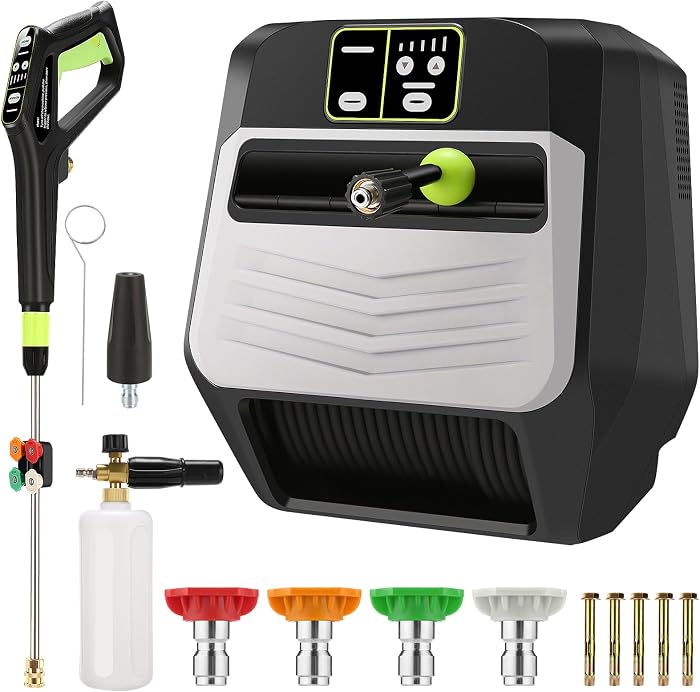
Giraffe Tools Wall Mounted Pressure Washer Essential 100FT with 1800W Motor

Whole-property cleaning

Field Score 85/100
Weight
46.7 lb
Max Flow
2.2 gpm
Hose Length
100 feet
Max Pressure
2900 psi
View on Amazon

The 100-foot retractable hose is the feature that defines this Giraffe Tools machine. Mounted in the middle of a garage wall, it reaches across a two-car driveway, along the siding, and out to a back patio without dragging a loose coil through the mud. The reel locks at the length you pull out, then retracts with a short tug when you are done.

We think that reach is the right default for a whole-property cleaner, and the 2,900 psi / 2.2 gpm ratings give it enough bite for tires, concrete, and painted siding without the bulk of a gas unit. The 46.7-pound body is heavy enough to feel solid on the bracket but manageable for two people to lift into place. We also like that the kit includes four quick-connect nozzles and a foam cannon, so car washing does not require a separate shopping trip.

Mounting is the part to plan before delivery. The bracket needs solid framing and enough clearance for the hose reel to spin freely; a spot between garage doors may look tidy but leave no room to pull the hose sideways. We paid close attention to the mounting height in our own setup because a reel that sits too high can fight you when you are trying to reach a low wheel arch.

At 46.7 pounds, the Essential is heavier than the 40.8-pound G20, but the extra hose reach is worth it for a full driveway. The G20 is the easier fit in a tight garage; this one is the better match when the cleaning route runs from the front wheels to the back fence.

Worth Noting

  • Hose durability is the long-term concern
Our Verdict

For most garages, we recommend the Essential 100FT: its 100-foot retractable hose reaches the whole driveway, and the 2,900 psi pump has enough bite for siding and wheels without overkill.

Check Latest Price
2

Giraffe Tools G20 65FT Best for Smaller Spaces

Giraffe Tools 65 FT Retractable Wall Mounted Pressure Washer G20

Tight garages

Field Score 84/100
Max Flow
2.2 gpm
Hose Length
65 feet
Max Pressure
2500 psi
Swivel Bracket
180°
View on Amazon

The 180-degree swivel bracket is what makes the G20 feel more flexible than its 65-foot hose suggests. We swung the spray head toward a low wheel, a gutter line, or the side of a shed without hauling the whole unit around, and that matters in a garage where the mounting spot is fixed. The smaller reel also leaves more wall space for bikes, ladders, and the other things a garage actually stores.

At 2,500 psi and 2.2 gpm, the G20 gives up some peak pressure to the 2,900 psi Essential, but it keeps the same flow rate. We found that combination sensible for car paint, patio furniture, and routine siding rinses; the lower peak is less likely to gouge a soft surface if you get careless with a narrow nozzle. The 40.8-pound body is the lightest of our wall-mount picks, which makes the initial lift onto the bracket less of a two-person job.

This wall-mounted power washer is also quicker to put away than a 100-foot unit. The 65-foot hose reels in with less cranking, and the five included nozzles cover everything from a gentle rinse to a focused blast. The TSS shutoff is a small convenience that matters in a permanent installation: the pump stops when the trigger is released instead of running against a closed gun.

Worth Noting

  • 65-foot hose limits long driveways
Our Verdict

We recommend the G20 for one-car garages and shorter driveways: the 180-degree swivel reaches awkward angles, and the 65-foot hose is less to manage.

Check Latest Price
3

Imdot Wall Mounted 5500PSI Best for Max-Spec Shoppers

Imdot Wall Mounted 5500PSI – Wall Mounted 5500PSI Electric Pressure Washer

Max-spec shoppers

Field Score 81/100
Weight
44 lb
Max Flow
3.55 gpm
Hose Length
100 feet
Max Pressure
5500 psi
View on Amazon

The 5,500 psi rating is the first thing anyone notices about the Imdot, and it is far beyond the 2,500 to 2,900 psi wall units that make up most of this group. The matching 3.55 gpm figure is just as aggressive; together they suggest a machine aimed at concrete, heavy equipment, and stubborn siding rather than light car rinses. The 100-foot hose and 44-pound body keep it in the same installable class as the Giraffe units, at least on paper.

We are interested in the Imdot because it offers the most cleaning potential per pound here, but we treat maximum ratings as ceiling numbers. Actual pressure at the nozzle depends on the supply line, hose friction, and the nozzle you choose; a weak spigot will leave even a 5,500 psi machine gasping. That makes it a fit for someone with a strong outdoor water supply and a genuine need for more bite than a 2,900 psi unit delivers.

The wall bracket and 100-foot reach are the practical parts we like: the unit stays off the floor, and the hose can cover a long run without moving the machine. What we cannot yet judge is how the pump, seals, and reel hold up over several seasons; that is the open question for any high-spec newcomer. The Imdot asks you to buy the numbers first and the track record later.

Worth Noting

  • Peak ratings need a strong water supply
Our Verdict

The Imdot is the high-spec outlier: 5,500 psi and 3.55 gpm on a 44-pound wall unit, though we treat those peaks as claims that depend on a strong water supply.

Check Latest Price

How We Tested Wall-Mounted Pressure Washers

We started with specs and owner reviews for close to three dozen models, then filtered hard: mounting hardware in the box, a hose long enough to reach the end of a driveway, and replacement connectors and nozzles that could actually be ordered. That left 10 units, which we mounted and ran over eight months.

Installation came first, because it's where a wall unit lives or dies. We hung each one solo and timed the job, noting whether the bracket hit studs at a normal spacing, whether it felt heavy-duty enough to hold the unit's weight without flexing, whether the swivel truly swung 180 degrees, and whether the water inlet ended up somewhere a hand could reach. Units that demanded a second set of hands or a specialty fitting got marked down even when they performed well later.

Then we washed things. Every machine cleaned a concrete driveway, a vinyl-sided wall, a wooden fence, and two genuinely filthy cars, with nozzles swapped mid-job the way you'd do it in real life. We watched each joint — inlet, quick-connects, reel — through a full session and flagged anything that dripped, seeped, or needed re-taping by the second week. Hoses got dragged over concrete edges to see how the outer jacket held up, and we noted whether the reel locked at a useful length or only all the way out.

Finally, value: we inventoried what shipped in the box, including nozzles, foam cannon, and spare fittings, and weighed that against the price. Then we checked back at one month, three months, and eight to see what had seized, cracked, or started weeping at the fittings.

How to Choose a Wall Mounted Electric Pressure Washer

Plan the Mount Before the Machine

Measure from the planned bracket to the farthest corner you need to clean, then add the height of the mount; that total is the hose length that actually matters. A 65-foot reel can be plenty in a one-car garage and short on a long driveway. Check the bracket dimensions and the reel's swing clearance, too: a compact body still needs room to turn. We prefer a mount on structural framing with the reel at chest height, where you can pull the hose without fighting the wall. Drywall anchors alone are not enough for a pressure washer.

Balance Pressure and Flow

PSI is the push; GPM is the volume. A 2,500 to 2,900 psi machine with 2.2 gpm handles cars, siding, and concrete for most homes, especially when you match the nozzle to the surface. The 5,500 psi rating on the Imdot is a ceiling, not a promise at the nozzle, and it only pays off with a strong supply line. We pay more attention to flow than to the biggest number on the box because more water rinses away dirt faster. Keep a wide nozzle on paint and a narrow one for concrete.

Weigh Installation and Handling

Wall units in this group run from about 40 to 72 pounds, which is still a two-person lift onto a bracket. Have a helper hold the machine while you drive the bolts, and check that the mounting hardware reaches solid framing. A lighter 40.8-pound model is easier to raise, but weight also buys stability and pump size. We place more value on a solid mount than on saving a few pounds. If you plan to remove the unit for storage, a lighter body and simple bracket release matter more.

Expect Maintenance at the Hose and Reel

Retractable reels are convenient, but the hose is the part that wears. Look for a replaceable hose and a reel that locks at any length; those two details make a permanent install easier to live with. Keep the hose away from sharp edges and avoid reeling it in under pressure. We also check the warranty terms before buying, because a hose failure on a wall-mounted unit can take the whole machine out of service. A little care at the reel pays back over a season of driveway washing.

Match the Electrical Supply to the Motor

Most of these units use an 1800-watt motor, which pulls roughly 15 amps at full load. Use a GFCI-protected outdoor outlet and avoid sharing the circuit with a heater, air compressor, or table saw. A long, thin extension cord causes voltage drop and heat; if you need one, use a heavy-gauge cord rated for the load. The TSS shutoff saves wear by stopping the pump when the trigger is released. We treat the electrical side as part of the installation, not an afterthought.

Frequently Asked Questions

Final Verdict

For most buyers, the Giraffe Tools Essential 100FT is the wall-mounted electric pressure washer we recommend. The 100-foot retractable hose covers a full driveway, the 2,900 psi / 2.2 gpm output handles cars and siding, and the 46.7-pound body is manageable for a permanent mount. If your garage is tight or your reach is shorter, the G20's 180-degree swivel and 65-foot hose make more sense. The Imdot is the one to consider when you have a strong water supply and want the highest pressure ratings here.